In the swirling mists of the Kamakura period, when demons still prowled Japan's mountain passes and supernatural forces shaped the fate of mortals, an old woman bent over her washing by the riverbank made a discovery that would echo through centuries of Japanese storytelling. What she pulled from those dark waters wasn't driftwood or debris—it was a peach so enormous it defied nature itself, floating downstream like a gift from the gods.
This wasn't just any folktale destined to entertain children around hearth fires. The legend of Momotarō—literally "Peach Boy"—became Japan's most enduring heroic epic, a story so deeply embedded in the national consciousness that even today, his image adorns everything from candy wrappers to political campaigns. But behind the simple tale lies a complex mythology that reveals profound truths about Japanese values, spirituality, and the eternal struggle between civilization and chaos.
The Miraculous Birth That Defied Heaven
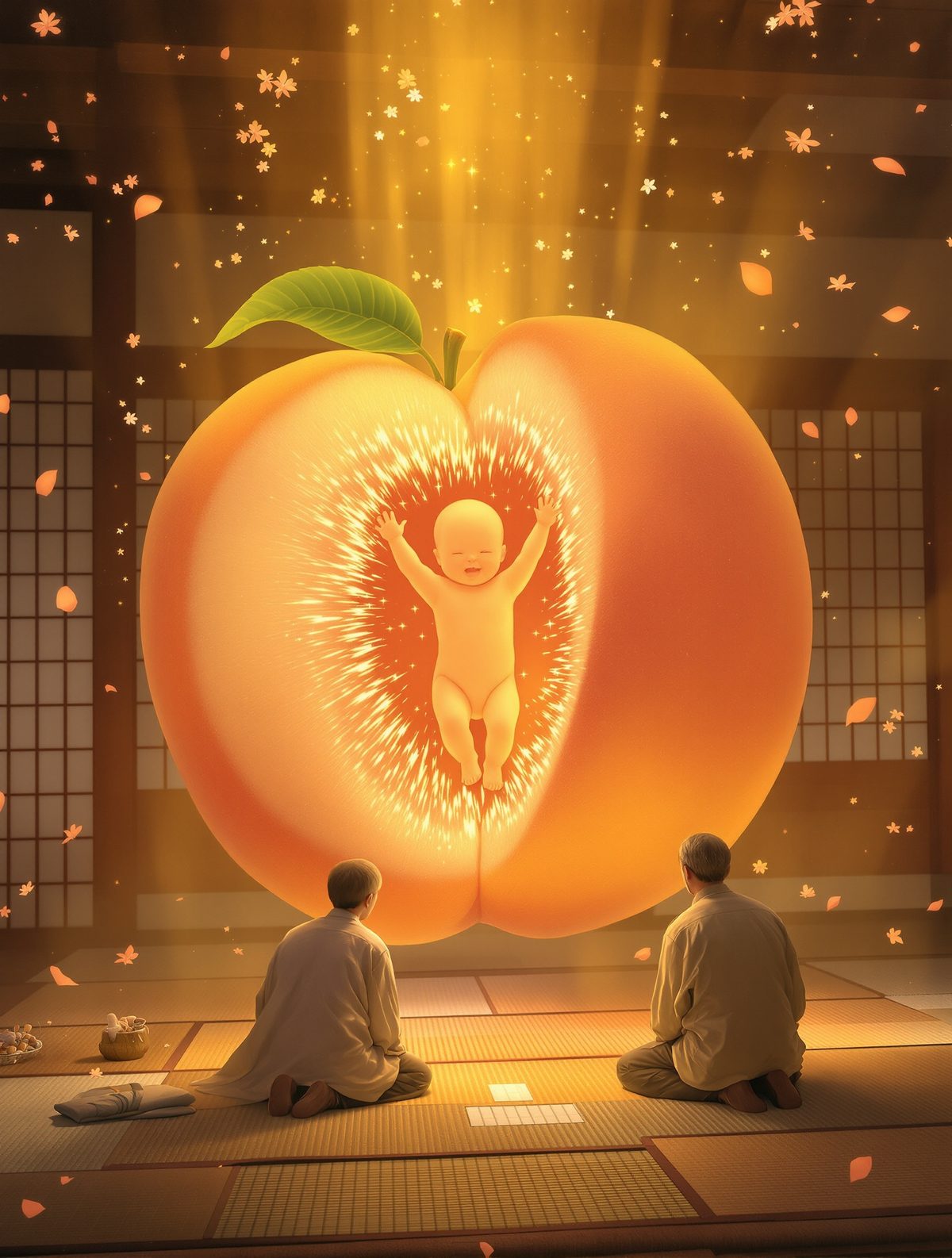
The elderly woman who discovered the supernatural peach lived in what is now Okayama Prefecture, in a humble village where the Asahi River winds through fertile valleys. She and her woodcutter husband had spent decades longing for a child, their prayers echoing unanswered in local shrines. When she spotted the massive fruit bobbing in the current—some versions describe it as large as a sake barrel—she knew immediately this was no ordinary peach.
The couple's anticipation of sharing this magnificent fruit turned to wonder when their knife first pierced its skin. Instead of juice flowing forth, a radiant light filled their simple home. From within the peach emerged not pit and flesh, but a perfectly formed infant boy, glowing with divine energy. The child spoke his first words immediately: "I have been sent from heaven to be your son."
This miraculous birth carries profound significance in Shinto belief, where divine spirits regularly interact with the mortal world through natural phenomena. Peaches themselves held special meaning in Japanese spirituality—they were considered powerful talismans against evil, their wood used to craft demon-repelling arrows and their blossoms celebrated as symbols of immortality and divine favor.
Growing into Legend: The Making of a Hero
Momotarō grew with supernatural speed, displaying strength and wisdom that amazed his elderly parents. By some accounts, he reached full maturity in mere months, though he retained the innocent heart that would define his heroic nature. The boy's divine origins became evident through small miracles—he could communicate with animals, his presence caused crops to flourish, and wild beasts grew tame in his company.
But it was Momotarō's sense of justice that truly set him apart. As reports filtered in of the oni demons terrorizing nearby villages—kidnapping maidens, stealing treasures, and spreading fear throughout the land—the young hero felt an irresistible calling. These weren't mere bandits or wild animals, but supernatural beings of immense power who had established their stronghold on the remote Onigashima (Demon Island), from where they launched their reign of terror.
What makes Momotarō's story particularly fascinating is how it reflects real historical anxieties. During the Heian and Kamakura periods, when this legend took root, Japan faced constant threats from pirates, bandits, and foreign invaders. The oni of the story likely represented these very real dangers, transformed through folklore into supernatural antagonists that required a divine champion to defeat.
The Power of Kibi Dango: Ancient Magic in Dumpling Form
Before departing on his quest, Momotarō's adoptive mother prepared him a supply of kibi dango—special dumplings made from millet flour that possessed magical properties. These weren't merely provisions for a long journey; they were weapons of spiritual warfare, imbued with the power to transform enemies into allies.
The recipe for these legendary dumplings reveals deep connections to ancient Japanese agricultural traditions. Millet was considered a sacred grain, one of the five cereals blessed by the gods. Archaeological evidence suggests that ritualistic preparation of millet-based foods played crucial roles in seasonal festivals and protective ceremonies throughout Japan's early history.
As Momotarō journeyed toward Onigashima, he encountered three creatures who would become his legendary companions: a dog, a monkey, and a pheasant. Each initially challenged him, but when offered a kibi dango, they immediately recognized his divine mission and pledged their loyalty. This wasn't mere animal training—it was spiritual transformation, the dumplings serving as conduits for Momotarō's celestial power.
Modern scholars have noted the symbolic significance of these particular animals. Dogs represented loyalty and protection, monkeys embodied cleverness and adaptability, while pheasants symbolized courage and nobility. Together, they formed a perfect complement to Momotarō's divine strength, each contributing essential qualities to the coming battle.
The Siege of Onigashima: When Gods War Against Demons
Onigashima—Demon Island—was no mythical realm but likely based on real locations that struck terror into ancient Japanese hearts. Some historians identify it with islands off the coast of Okayama where pirates once established strongholds, while others point to volcanic islands whose smoking peaks and treacherous shores seemed perfect homes for supernatural evil.
The battle itself reads like an ancient military campaign. Momotarō and his animal allies didn't simply storm the demon fortress; they employed sophisticated tactics that would make Sun Tzu proud. The pheasant conducted aerial reconnaissance, the monkey infiltrated the fortress walls, and the dog led frontal assaults while Momotarō coordinated the overall strategy.
The demons themselves were described as fearsome giants with wild hair, horns, and tiger-skin loincloths—a combination of native Japanese spiritual beliefs and influences from Chinese and Korean demon lore. Their leader, the Oni King, possessed strength that could shatter mountains and breath that could wither crops across entire provinces. Yet for all their power, they proved no match for divine righteousness combined with clever strategy.
The victory wasn't achieved through violence alone. Many versions of the legend emphasize Momotarō's mercy toward defeated enemies, his willingness to accept surrender, and his focus on recovering stolen treasures rather than wreaking vengeance. This reflects core Buddhist and Confucian values about the proper conduct of rulers and heroes.
The Treasure Ship Returns: Wealth Beyond Gold
Momotarō's triumphant return brought more than military victory. The treasure ship he sailed home carried not just gold, silver, and precious jewels stolen by the demons, but something far more valuable—the restoration of peace and order to the land. Villages that had lived in fear could again send their children to play by riverbanks. Merchants could travel roads without supernatural terror.
The specific treasures mentioned in various versions of the legend offer intriguing glimpses into what medieval Japanese society valued most. Beyond obvious wealth, the lists include magical items: clothing that never wore out, rice that never spoiled, and sake that never ran dry. These reflected the deepest wishes of people who lived constantly on the edge of famine and hardship.
But perhaps the most significant treasure was Momotarō himself—proof that heaven had not abandoned humanity, that divine intervention was possible, and that righteousness would ultimately triumph over chaos. His elderly parents lived to see their supernatural son become the greatest hero in the land, their decades of childless sorrow transformed into generational pride.
The Eternal Return: Why Momotarō Still Matters
In our modern world of technological marvels and scientific understanding, what relevance does a story about a boy born from a peach hold? The answer lies not in its supernatural elements but in its enduring themes that speak to fundamental human experiences.
Momotarō represents the hope that exists in every society for leaders who combine strength with righteousness, who fight not for personal gain but for the protection of the innocent. His story reminds us that true power comes not from divine birth alone but from the choices we make—to help rather than harm, to build rather than destroy, to unite rather than divide.
The legend's emphasis on unlikely alliances—a divine boy working with talking animals, elderly parents nurturing a supernatural child, former enemies becoming loyal friends—speaks to our modern need for collaboration across differences. In an era of increasing polarization, Momotarō's kibi dango offer a metaphor for the small acts of kindness and recognition that can transform opponents into allies.
Most profoundly, the story suggests that within ordinary moments—an old woman doing laundry by a river—extraordinary possibilities await. The next time you see something unusual floating downstream in your own life, perhaps it's worth investigating. You never know what miracles might emerge when you're brave enough to crack them open.