Picture this: you're lying beside someone you've never seen, married to a voice in the darkness who comes to you only when the sun has set. Your sisters whisper that he must be hideous—why else would he hide? Your trembling hand reaches for the oil lamp. Just one look. What could go wrong?
This is the moment that changed everything for Psyche, a mortal woman whose beauty rivaled that of Venus herself. In the flickering light of that fateful lamp, she was about to discover that some truths are too dangerous to illuminate—and that breaking the ultimate taboo would cost her everything she thought she knew about love.
The Beauty That Started a War
Psyche's story begins not with love, but with jealousy so fierce it shook Olympus itself. According to Apuleius's Metamorphoses, written in the 2nd century CE, Psyche was the youngest daughter of an unnamed king, blessed with beauty so extraordinary that people began worshipping her instead of Venus. Temples to the goddess stood empty while crowds gathered just to glimpse the mortal girl who seemed to glow with divine light.
Venus, never one to tolerate competition, flew into a rage that would make a hurricane seem like a gentle breeze. But here's what most people don't know: in Roman mythology, Venus wasn't just vain—she was the divine embodiment of love's creative power. When people stopped worshipping her, they weren't just hurting her ego; they were disrupting the cosmic order itself. Love was literally leaving the world.
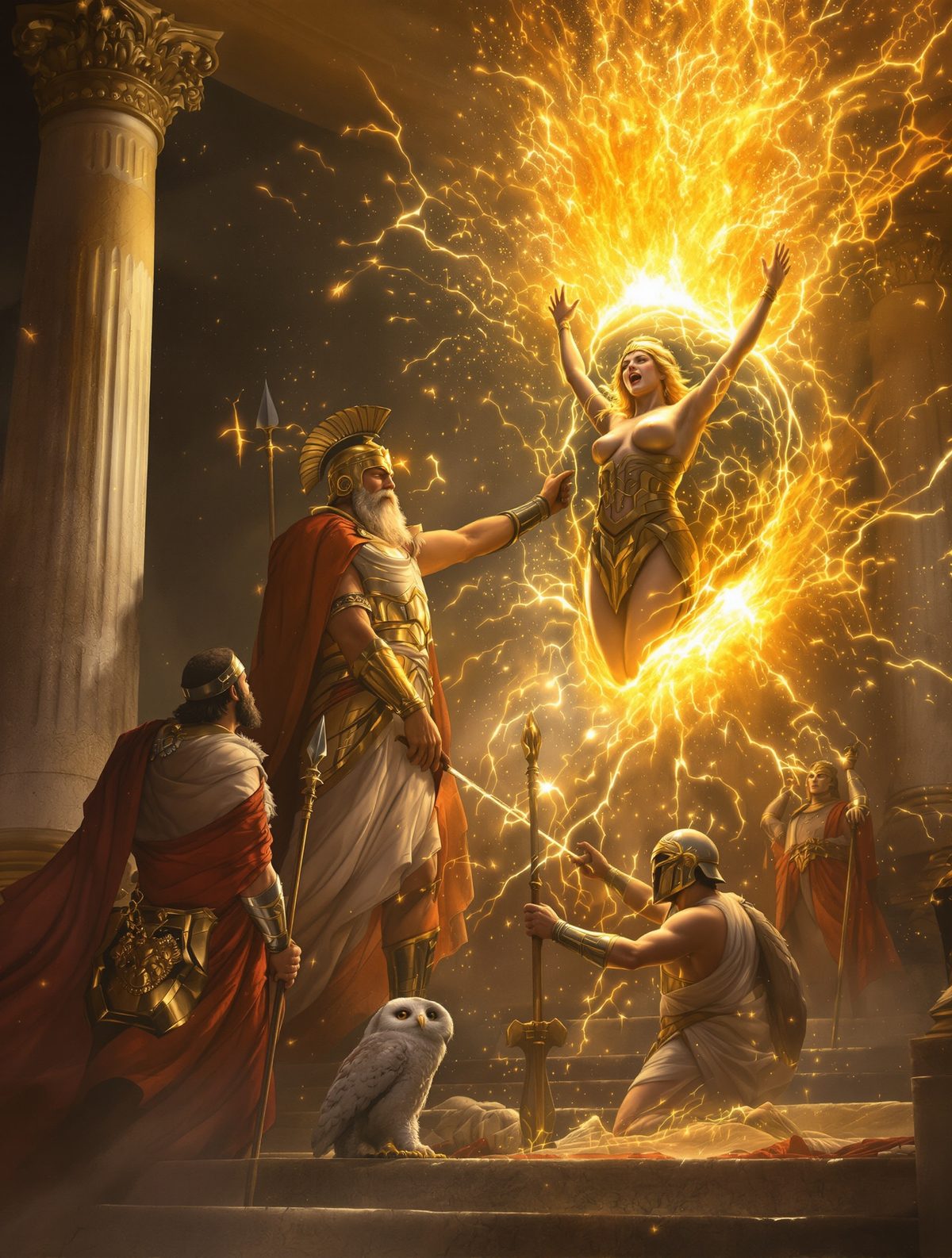
The goddess summoned her son Cupid, whose arrows had toppled empires and humbled gods. Her command was simple: make Psyche fall in love with the most despicable creature on Earth. But fate, it seems, has a wicked sense of humor. The moment Cupid saw Psyche, he accidentally pricked himself with his own arrow. The god of love had fallen in love—and with his mother's greatest enemy.
A Wedding Dressed as a Funeral
While Venus plotted and Cupid burned with secret passion, Psyche faced a different torment. Despite her divine beauty, no man dared court her. They worshipped her from afar but never approached—how do you propose to someone you think is a goddess? Her two sisters married kings and lived in splendor, while Psyche remained alone in her father's palace, beautiful and untouchable as a marble statue.
Desperate, her father consulted the Oracle at Miletus (not Delphi, as many assume—a detail that shows how far this crisis had spread beyond Greece's borders). The prophecy was terrifying: dress Psyche as a bride and leave her on a mountaintop, where a winged serpent would claim her as his wife. This creature, the Oracle declared, was so fearsome that even Jupiter trembled before it.
What followed was perhaps history's strangest wedding procession. Psyche was dressed in bridal finery but carried to her doom like a sacrifice. Torches flickered like funeral pyres. Her parents wept as if burying their daughter. The entire kingdom mourned as they abandoned their princess on a windswept crag, leaving her to face whatever monster would claim her.
But here's where the story takes its first supernatural turn: as Psyche stood alone on that desolate peak, Zephyrus, the West Wind, gently lifted her and carried her to a hidden valley where a palace more magnificent than any earthly dwelling awaited her—invisible servants, rooms that glowed with their own light, and a husband who came to her only in darkness.
The Palace of Impossible Wonders
Psyche's new home defied every law of physics and architecture. The palace had walls of precious stones that seemed to generate their own light, eliminating any need for lamps or torches. Invisible servants attended her every need—baths drawn by unseen hands, meals that appeared as if by magic, music that played from empty air. It was luxury beyond imagination, but it came with one absolute rule: she must never try to see her husband's face.
This wasn't just an arbitrary command. In Roman religious practice, many mystery cults required initiates to undergo periods of blindness or darkness before revelation. The most sacred truths, they believed, could only be approached gradually. Psyche's invisible marriage was a kind of spiritual initiation—she was learning to love without the superficial judgment that physical appearance brings.
Her husband would arrive each night, speaking to her in a voice like honey and silk. He was gentle, passionate, intelligent—everything she had dreamed of in a companion. He told her stories of the gods, shared the secrets of the universe, and loved her with a tenderness that made her forget the strange circumstances of their union. For a time, Psyche was genuinely happy. But happiness, as any student of mythology knows, is usually just the calm before the storm.
The trouble began when her husband—still unknown to her as Cupid—agreed to let Zephyrus bring her sisters for a visit. He warned her they would be jealous and try to poison her contentment, but Psyche, lonely for her family, insisted. It was a decision that would nearly destroy them both.
Sisters of Poison and Doubt
When Psyche's sisters arrived at the impossible palace, their reaction was immediate and predictable: seething jealousy masked as concern. Here was their baby sister, the one who couldn't find a husband, now living in luxury that made their royal marriages look like poverty. They had to destroy it.
Their psychological warfare was masterful and cruel. Why, they asked with false sweetness, did her husband hide his appearance? What kind of loving spouse demanded such secrecy? They reminded her of the Oracle's prophecy—hadn't she been promised to a winged serpent? Perhaps he was indeed a monster, fattening her up for eventual consumption, waiting until she bore his children to devour them all.
These weren't random accusations. In Roman culture, a marriage without the visual confirmation of the husband's identity would have been deeply troubling. Roman wives were expected to know their husbands' families, social status, and physical condition. A relationship conducted entirely in darkness violated every social norm—it was, by definition, monstrous.
The sisters' final masterstroke was providing the tools of betrayal: a sharp knife and a small oil lamp. "Hide these beside your bed," they instructed. "When he's deep in sleep, light the lamp and look upon his true form. If he's the monster we suspect, cut off his head immediately. If not... well, at least you'll finally know the truth."
That word—truth—was the hook that caught Psyche. Because despite all her happiness, part of her had always wondered. In the deepest hours of night, when her husband slept beside her, she had fought the urge to reach out and trace his features with her fingers. Now her sisters had given that curiosity a name: it wasn't betrayal, it was the pursuit of truth.
The Lamp That Shattered Paradise
The night of the great revelation arrived with ominous stillness. Psyche lay beside her sleeping husband, the hidden lamp and knife within reach, her heart hammering so loudly she feared it would wake him. Hours passed as she wrestled with her conscience. Finally, as the night reached its deepest point, she could bear the uncertainty no longer.
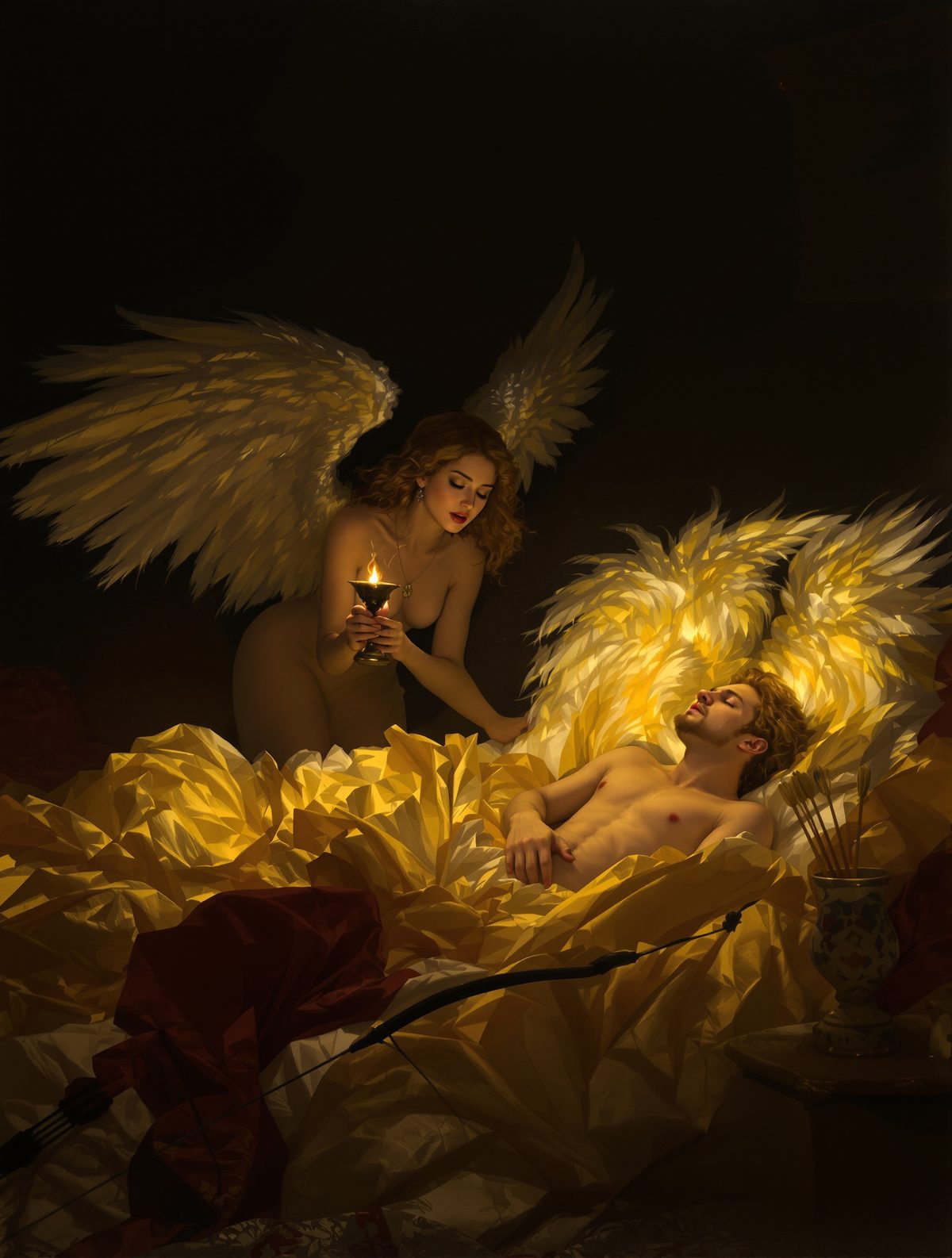
With trembling hands, she lit the small oil lamp. The flame flickered to life, casting dancing shadows on the palace walls—and then everything changed.
There was no monster. No serpent. No demon.
Instead, bathed in the lamp's golden glow, lay the most beautiful being she had ever seen. Cupid himself—young, perfect, with skin like polished marble and hair that caught the light like spun gold. His great white wings were folded against his back, and beside him lay his famous bow and the arrows that had toppled gods and mortals alike. This was her mysterious husband: not a monster, but Love incarnate.
Psyche stood transfixed, the knife forgotten in her other hand. She leaned closer to marvel at his impossible beauty, to drink in every detail of the face she had never seen. And in that moment of wonder and relief, catastrophe struck with the inevitability of Greek tragedy.
A single drop of burning oil fell from the lamp onto Cupid's bare shoulder.
The god's eyes flew open—not with the drowsy confusion of normal awakening, but with the immediate, terrible awareness of betrayal. In that instant, Psyche saw not just his physical beauty, but the depth of his pain. She had broken the one rule, violated the one trust that their entire relationship depended upon.
Without a word, Cupid rose and flew from the window into the night sky, leaving Psyche alone with the dying flame of her lamp and the dawning realization of what she had lost.
When Love Abandons the World
What happened next reveals the true cosmic significance of this intimate betrayal. With Cupid wounded and hiding in his mother's palace, love began disappearing from the world. Marriages grew cold. Flowers stopped blooming. Even the animals ceased their mating rituals. Venus, pleased at her son's return but furious at Psyche's effrontery, set the mortal woman seemingly impossible tasks: sorting mountains of mixed grains, gathering wool from murderous sheep, collecting water from the River Styx itself.
But here's the twist that gives this ancient story its enduring power: Psyche didn't give up. Aided by sympathetic ants, helpful reeds, and even an eagle of Jupiter, she completed each impossible task. Her final challenge took her to the Underworld itself, where she had to request a box of beauty from Proserpina. Even there, even in the realm of the dead, her determination never wavered.
The story's resolution—Psyche's transformation into a goddess and her reunion with Cupid—might seem like a fairy tale ending, but it represents something far more profound. Psyche, whose name means "soul" in Greek, had to prove that true love could survive knowledge, that genuine intimacy required both physical and spiritual sight.
Why does this 2,000-year-old story still matter? Because it captures a truth about relationships that modern psychology is only beginning to understand: the tension between mystery and knowledge in love. Psyche's lamp represents our endless desire to know our partners completely, to illuminate every corner of their being. But the burning oil that woke Cupid reminds us that some truths come with a cost, that the act of examination can sometimes damage what we're trying to understand.
In our age of social media transparency and digital surveillance, where privacy is nearly extinct and every secret can be exposed with a few keystrokes, Psyche's story asks us: What do we lose when nothing remains hidden? Can love survive in the harsh light of complete knowledge, or does it need shadows to flourish? The lamp still flickers, the oil still burns, and we're still learning whether some taboos exist not to torment us, but to protect the very things we cherish most.