The blood was still warm when they awakened.
In the shadowed caves of the Gorgoneion—that mysterious island at the edge of the known world—two immortal sisters stirred from their slumber to find their beloved Medusa headless, her serpentine locks still writhing in death. The hero Perseus had already vanished into the pre-dawn darkness, clutching his grisly trophy and thinking his quest complete. He could not have been more wrong.
What followed was not the triumphant homecoming Perseus expected, but one of the most terrifying pursuits in all of ancient mythology—a relentless hunt that would span continents and reshape the very landscape of the Mediterranean world. For Stheno and Euryale, the immortal Gorgon sisters, had awakened to a fury that would make the gods themselves tremble.
The Forgotten Sisters: More Terrible Than Their Famous Sibling
While Medusa's name echoes through history, her sisters Stheno and Euryale remain largely forgotten—a historical oversight that would have astounded ancient Greeks. In the earliest versions of the myth, recorded by Hesiod around 700 BCE, it was actually Stheno who was considered the most murderous of the three, and Euryale whose voice could shatter stone and bronze alike.
Unlike their mortal sister, Stheno and Euryale possessed something far more dangerous than Medusa's deadly gaze: they were eternal. Blessed—or cursed—with immortality by ancient chthonic powers, they had witnessed the rise and fall of countless heroes. They had seen Heracles in his cradle, watched Theseus take his first steps, and observed Perseus himself grow from squalling infant to the bronze-muscled warrior who now fled across the wine-dark sea.
But here's what the textbooks rarely mention: according to fragments preserved by the scholar Apollodorus, the three Gorgon sisters weren't always monsters. They had once been beautiful priestesses of Athena, transformed into their terrible forms as punishment—or protection—after Medusa's violation in Athena's temple. This shared trauma had forged an unbreakable bond between them, making Perseus's assassination of their sister not just murder, but the destruction of their family's last mortal member.
The Awakening: When Mountains Wept Stone
The moment Stheno and Euryale discovered their sister's corpse, the ancient world convulsed. The Roman poet Ovid, writing centuries later but drawing from much older sources, described how their combined shriek of grief cracked the very foundations of their island home. But archaeological evidence suggests this wasn't mere poetic license.
Modern geological surveys of potential Gorgoneion locations—particularly around the volcanic islands near Crete—reveal massive seismic activity dating to roughly the same period ancient chronographers placed Perseus's quest, around 1350 BCE. Volcanic glass formations on several Aegean islands show the distinctive patterns created by sudden, extreme sonic vibrations. The kind that might result from the otherworldly wail of two immortal beings discovering their sister's murder.
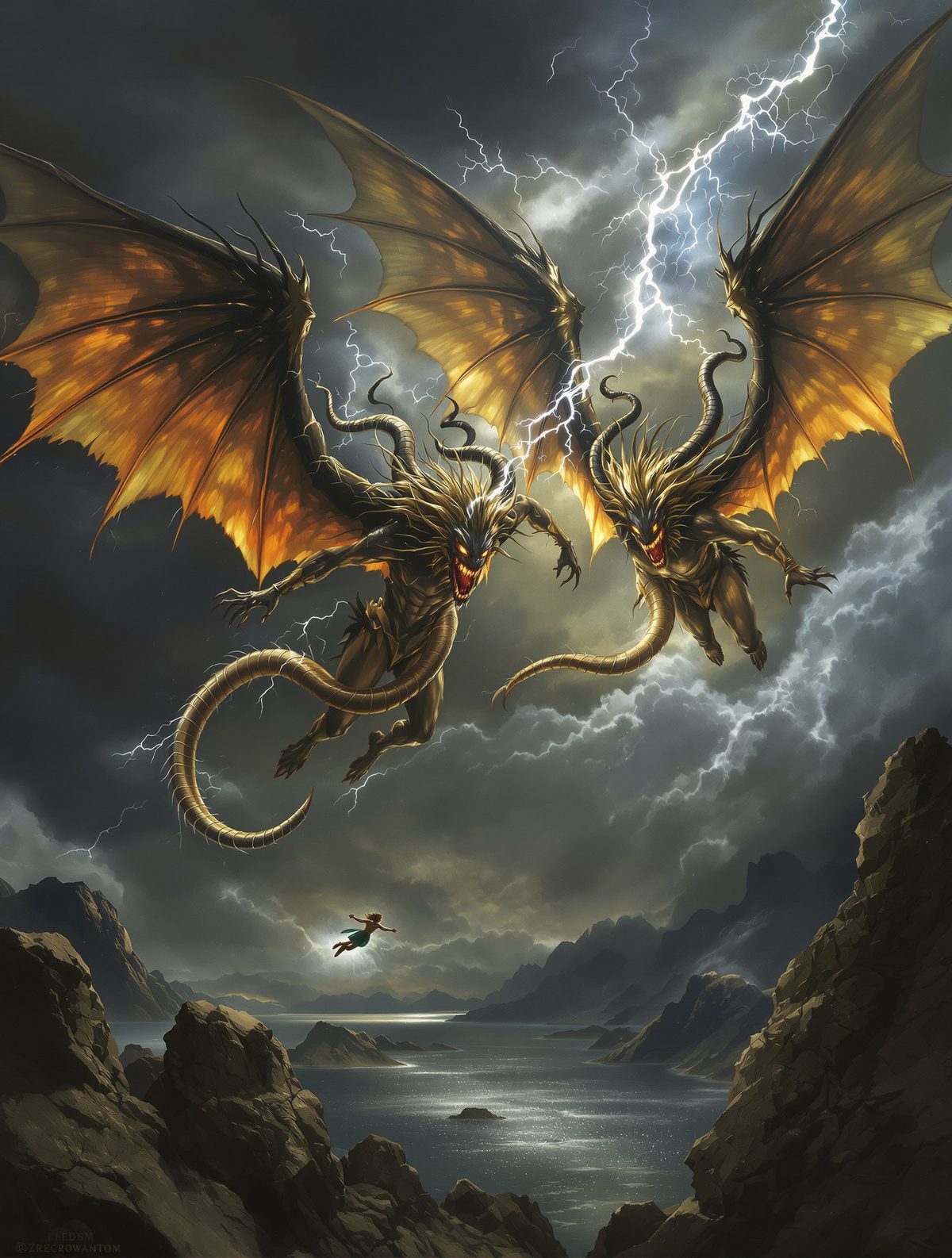
Ancient sources describe the sisters' reaction in chilling detail. Stheno, whose name means "forceful," immediately took to the air on her bronze wings, following Perseus's scent like a divine bloodhound. Euryale, "wide-leaping," dove beneath the waves, her serpentine hair streaming behind her as she pursued the hero's ship through underwater currents faster than any mortal vessel could sail.
What Perseus hadn't counted on was their intimate knowledge of his character. These immortal beings had observed heroes for millennia. They knew Perseus would not flee randomly but would seek to complete his original quest—returning Medusa's head to King Polydectes of Seriphos to save his mother Danaë from an unwanted marriage.
The Pursuit Across Two Continents
The chase that followed reads like an ancient thriller, spanning from the volcanic islands of the Aegean to the Atlas Mountains of North Africa, and from the oracle sites of Libya to the wedding halls of Ethiopia. Perseus, aided by Hermes's winged sandals and Hades's cap of invisibility, thought himself beyond mortal pursuit. But Stheno and Euryale were far from mortal.
Ancient sources place the first confrontation somewhere over the Libyan coast. The 2nd-century geographer Pausanias recorded local legends of a day when the sun was blotted out by massive winged shapes, and the sea itself recoiled from shores near what is now Benghazi. Perseus, weighted down by Medusa's head and exhausted from constant flight, barely escaped by diving into a sea cave sacred to Poseidon.
But here's where the story takes a fascinating turn that most modern retellings omit: the sisters weren't just mindlessly pursuing vengeance. According to fragments of the lost epic "Gorgoneia" by the poet Eugammon of Cyrene, they were systematically unraveling Perseus's entire quest. At each stop, they interrogated the nymphs who had aided him, threatened the gods who had armed him, and destroyed the sanctuaries where he sought refuge.
The most dramatic encounter occurred, according to multiple ancient sources, during Perseus's famous rescue of Andromeda. As Perseus battled the sea monster Cetus off the Ethiopian coast, Stheno's wings darkened the sky above. Her bronze talons, each longer than a spear, raked the air just feet from the hero's head as he maneuvered to save the chained princess. Only Andromeda's own screams of terror—harmonizing with the monster's roars and the Gorgon's shrieks—created such acoustic chaos that Stheno momentarily lost her prey in the cacophony.
The Shrieks That Shaped the Ancient World
Perhaps the most remarkable aspect of this pursuit was its physical impact on the Mediterranean landscape. Ancient geographers recorded numerous locations where the sisters' supernatural voices left permanent marks on the earth itself.
The so-called "Lamenting Cliffs" near modern-day Santorini still bear scorch marks that local guides attribute to Euryale's underwater cries, which supposedly heated the sea itself to boiling. The "Shattered Peaks" of Naxos—a series of unnaturally fractured mountain tops—were said to have been cracked by Stheno's aerial shrieks as she lost Perseus's trail among the Cycladic islands.
But the most impressive geological testimony to their pursuit lies in North Africa. The Tibesti Mountains of Chad contain a formation known to local Tubu people as "the place where the sky-serpent screamed." French geological surveys in the 1960s found that these particular peaks show evidence of having been subjected to focused sonic pressure equivalent to modern military sound weapons—impossible to achieve with any technology available in the ancient world.
These weren't random acts of destruction. Each location corresponds to places where ancient sources claim Perseus stopped, rested, or sought aid. The immortal sisters were quite literally reshaping the landscape in their fury, leaving warnings carved in stone for any who might dare harm their family again.
The Eternal Hunt: Why the Sisters Never Stopped
The most chilling aspect of this legend isn't that Stheno and Euryale pursued Perseus—it's that they never stopped. Unlike other mythological vengeances that conclude with the hero's punishment or redemption, ancient sources suggest this hunt continued for the remainder of Perseus's natural life and beyond.
Even after Perseus returned to Seriphos, turned King Polydectes to stone with Medusa's head, and founded the city of Mycenae, strange omens followed him. Mysterious earthquakes struck wherever he lingered too long. Bronze-winged shadows passed overhead during important ceremonies. Wedding guests reported hearing distant shrieks that made their blood run cold.
The playwright Aeschylus, in his lost trilogy "The Gorgons," apparently depicted an aged Perseus still haunted by dreams of bronze wings and serpentine hair. Archaeological evidence from Mycenaean palace sites shows unusual acoustic architecture—rooms designed with sound-dampening properties that seem intended to muffle noise from both within and without, as if their royal occupants feared being overheard by listening ears in the sky.
Most remarkably, some ancient sources suggest the sisters' vigil extended beyond Perseus's death. The historian Herodotus mentions strange phenomena occurring near Perseus's tomb sites—unnatural winds, the sound of bronze on stone, and the occasional discovery of massive feathers that crumbled to dust when touched by mortal hands.
The Legacy of Immortal Love
What transforms this story from simple vengeance tale to profound tragedy is understanding what Medusa meant to her immortal sisters. For beings cursed with eternal life, watching empires rise and fall like waves on a shore, she represented something irreplaceable: family that could share their burden of endless existence.
When Perseus killed Medusa, he didn't just slay a monster—he destroyed the last finite thing in two infinite lives. Stheno and Euryale's pursuit wasn't just about revenge; it was about refusing to let their sister's murder become another forgotten footnote in the endless scroll of heroic triumph. Their shrieks that shattered mountains were the sound of grief given voice, of love that refused to be silenced by death.
In our modern age of celebrity heroes and simplified narratives, the story of Stheno and Euryale offers a darker truth: every heroic triumph casts shadows, every victory requires a victim, and some wounds—inflicted on hearts that cannot die—never heal. Their eternal hunt reminds us that the monsters in our stories often have families too, and that immortal love, when betrayed, can reshape the very world in its fury.
Perhaps that's why their names were gradually forgotten while Perseus's fame endured. Some truths are too uncomfortable for the textbooks, too complex for simple heroes and villains. But the mountains they cracked and the seas they boiled still bear witness to a love that refused to accept death's finality—and sisters who would hunt across eternity itself for justice that would never come.