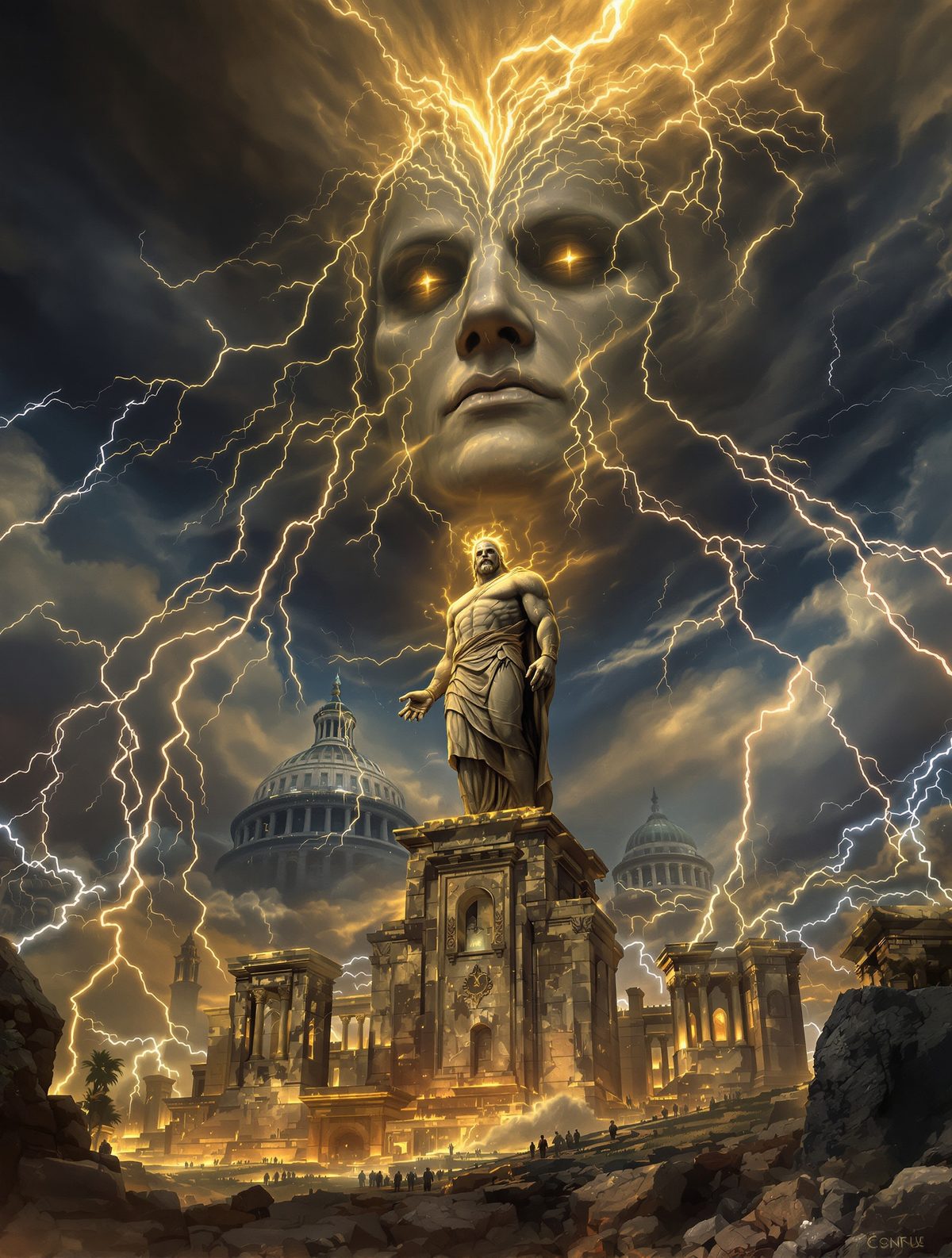
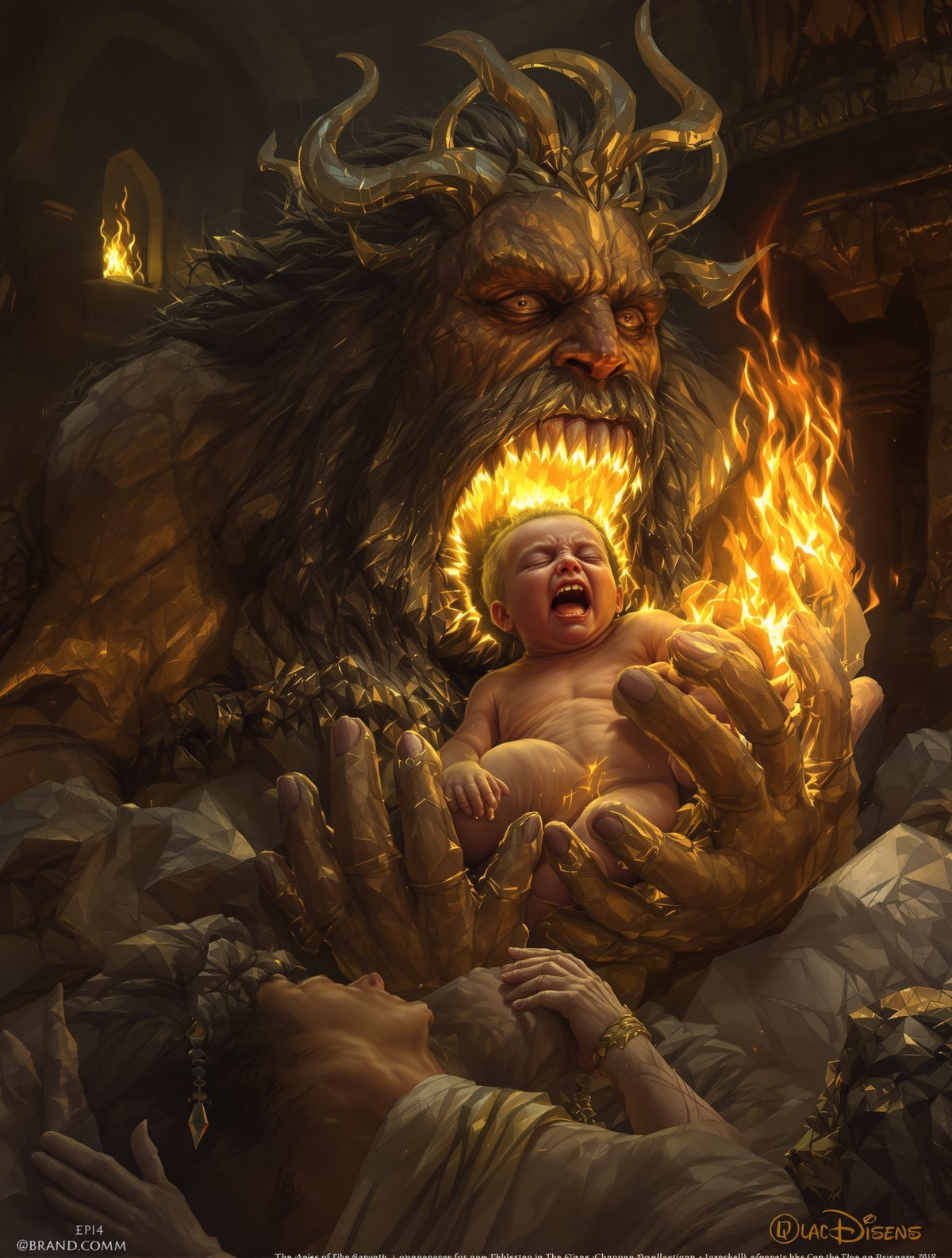
The birth cries echoing through the marble halls of Mount Othrys weren't tears of joy—they were screams of terror. As each newborn drew their first breath, their father Cronus would snatch them from their mother's arms and, without hesitation, swallow them whole. The most powerful being in the universe had become a monster, devouring his own children to cheat fate itself. This is the story they sanitized in your mythology textbooks—the tale of divine paranoia so extreme it would make modern tyrants blush.
The Weight of Prophecy: When Gods Fear Their Own Blood
To understand why Cronus became history's most horrific father, we must journey back to the moment his world shattered. Fresh from his own bloody coup against his father Uranus, Cronus sat upon the throne of the cosmos, wielding the adamantine scythe that had castrated the previous ruler. He thought himself invincible—until Gaia, the Earth Mother herself, delivered a prophecy that would haunt his every waking moment.
The oracle was devastatingly simple: "As you overthrew your father, so shall one of your children overthrow you." In the ancient Greek mindset, prophecies weren't possibilities—they were inevitabilities written into the fabric of reality itself. The Fates had spoken, and not even the king of the Titans could argue with destiny.
What most people don't realize is that Cronus had witnessed firsthand the power of filial rebellion. He had felt his father's blood on his hands, heard Uranus's death rattle as the sky god fell. The trauma of patricide, combined with the intoxicating fear of losing absolute power, twisted something fundamental in Cronus's divine psyche. Here was a being who controlled time itself, yet found himself trapped by the inexorable march of fate.
The Devouring Begins: A Marriage Destroyed by Madness
Rhea, Cronus's wife and sister (divine family trees were notoriously complicated), initially had no idea what awaited their first child. Picture the scene: the Titaness of motherhood and fertility, glowing with the joy of impending birth, cradling her newborn daughter Hestia. The baby's eyes had barely opened when Cronus burst into the chamber, his face a mask of terrible resolve.
Ancient sources describe the moment with chilling detail. Hesiod's Theogony, our primary source for these events, tells us that Cronus "would swallow down each child as it came from the womb to his wife's knees." The phrase "to his wife's knees" wasn't just poetic license—it referred to the ancient birthing position where women would squat or kneel during labor, making the father's interception of the newborn all the more immediate and brutal.
What happened to the swallowed children is one of mythology's most disturbing mysteries. They didn't die—gods cannot truly die—but existed in a strange limbo within their father's stomach. Imagine the psychological horror: conscious beings trapped in darkness, able to think and feel but unable to act, while their father continued his reign above. Some later sources suggest they could hear the outside world, forced to listen as each new sibling joined them in their living tomb.
The pattern repeated with methodical cruelty. After Hestia came Demeter, then Hera, then Hades, then Poseidon. Five children, five acts of cannibalistic infanticide. Each birth must have filled Rhea with fresh hope, only to have it crushed moments later as Cronus's massive form darkened the doorway.
Rhea's Breaking Point: A Mother's Desperate Gambit
By the time Rhea was pregnant with her sixth child, something had fundamentally shifted. The sources describe her as being "grieved in her heart" and plotting vengeance. This wasn't just maternal instinct—this was divine fury channeled through desperate love. She had watched her husband devour five of her children, and she refused to let it happen again.
What many don't know is that Rhea didn't act alone. She sought counsel from her parents, Gaia and Uranus—the same Uranus whom Cronus had mutilated years earlier. The irony was palpable: the dethroned sky god helping to orchestrate his usurper's downfall through the very prophecy Cronus sought to avoid. Gaia, the primordial Earth Mother, had particular motivation—she had grown disgusted with Cronus's tyranny and yearned for a new order.
The plan they hatched was brilliantly simple. When Rhea went into labor with Zeus, she did so in secret on the island of Crete, in a cave on Mount Ida. The location wasn't chosen randomly—Crete was far from Cronus's seat of power, hidden by distance and deception. Here, surrounded by loyal allies including the goat Amalthea who would nurse the infant, Rhea gave birth to the child who would change everything.
But the truly audacious part came next. Returning to Mount Othrys, Rhea presented Cronus with a stone wrapped in swaddling clothes. Ancient sources tell us it was specifically an omphalos stone—a sacred boulder believed to mark the center of the world. The fact that Cronus, in his paranoid haste, swallowed a rock without question reveals just how far his madness had progressed.
The Titan's Feast: Divine Cannibalism and Ancient Anxieties
The image of Cronus devouring his children became one of the most powerful and recurring motifs in Western art, but why did this particular story resonate so deeply with ancient audiences? The answer lies in understanding the very real fears that plagued early Greek society.
Archaeological evidence suggests that ritual child sacrifice, while not common, did occur in certain circumstances during Bronze Age Greece. The myth of Cronus gave people a way to process and condemn such practices by projecting them onto a divine tyrant who was ultimately punished for his actions. It's no coincidence that Cronus's story was told alongside tales of the Golden Age—a time when, supposedly, he ruled justly before paranoia corrupted him.
The cannibalistic aspect also tapped into deeper anxieties about paternal authority. In ancient Greek society, fathers held absolute power over their children's lives and deaths. The patria potestas (though Roman in name, the concept existed throughout the ancient Mediterranean) gave fathers the legal right to expose unwanted infants, sell children into slavery, or even execute them for disobedience. Cronus represented this patriarchal power taken to its logical, horrifying extreme.
Francisco Goya's famous painting "Saturn Devouring His Son" (painted between 1819-1823) captures the primal horror of the myth perfectly—a wild-eyed giant tearing into the flesh of his own child, blood streaming down his hands. While painted millennia after the original myth, Goya understood that the story's power lay not in its divine setting but in its fundamentally human fears about power, succession, and the corruption of familial love.
Zeus's Revenge: The Prophecy Fulfilled Through Its Own Prevention
The bitter irony of Cronus's story is that his very attempts to prevent the prophecy guaranteed its fulfillment. By the time Zeus reached adulthood, hidden and protected on Crete, he possessed something his father had lost: the moral authority that comes from righteous anger.
When Zeus finally returned to challenge Cronus, he didn't come alone. The story tells us that his first act was to force his father to regurgitate his swallowed siblings. The mechanism varies depending on the source—some say Zeus used an emetic potion prepared by the wise Titaness Metis, others suggest it was accomplished through divine force. What's consistent is the order of emergence: Poseidon came up first, then Hades, then Hera, Demeter, and finally Hestia. The stone Rhea had substituted emerged as well and was later placed at Delphi as a monument to deception's power over tyranny.
The freed siblings weren't infants anymore—they had somehow matured during their imprisonment, emerging as fully-grown gods burning with desire for vengeance. The subsequent Titanomachy (War of the Titans) lasted ten years and reshaped the cosmic order, but its outcome was never really in doubt. Cronus had created his own destroyers through his monstrous actions.
Legacy of the Child-Eater: Why This Ancient Horror Still Matters
The myth of Cronus devouring his children isn't just an ancient curiosity—it's a timeless exploration of how fear corrupts power and how attempts to control fate often guarantee the very outcomes we seek to avoid. In our modern world, we see echoes of Cronus's paranoia in authoritarian leaders who destroy their own successors, corporations that consume their most innovative divisions, and parents who smother their children's potential out of fear of being surpassed.
Perhaps most relevant today is the myth's examination of generational conflict. Cronus represents the ultimate "boomer" archetype—a ruler so terrified of being replaced that he literally consumes the future. His story warns us about the dangers of leaders who view progress as a personal threat rather than a natural evolution.
The ancient Greeks understood something we sometimes forget: the most dangerous tyrants aren't those who seize power through violence, but those who maintain it through the systematic destruction of anything that might challenge their supremacy. Cronus's tragedy wasn't just that he ate his children—it was that his fear transformed him from a potentially great ruler into a monster who deserved exactly the fate he fought so hard to avoid.
In the end, the child-eater's tale reminds us that prophecies have a way of fulfilling themselves, not despite our efforts to prevent them, but precisely because of them. Sometimes the wisest response to an inevitable future isn't resistance—it's the courage to face change with grace instead of letting fear devour everything we claim to protect.