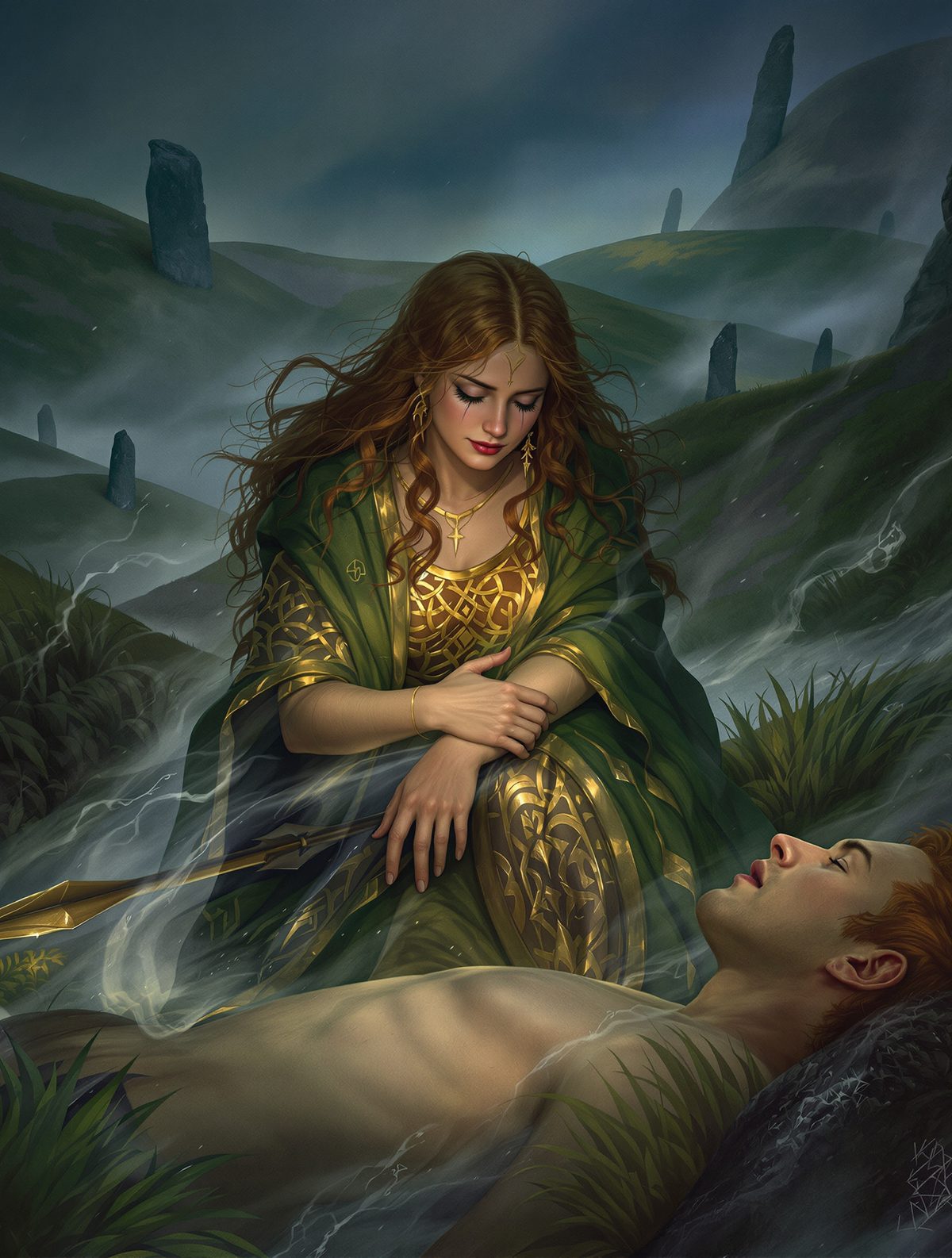
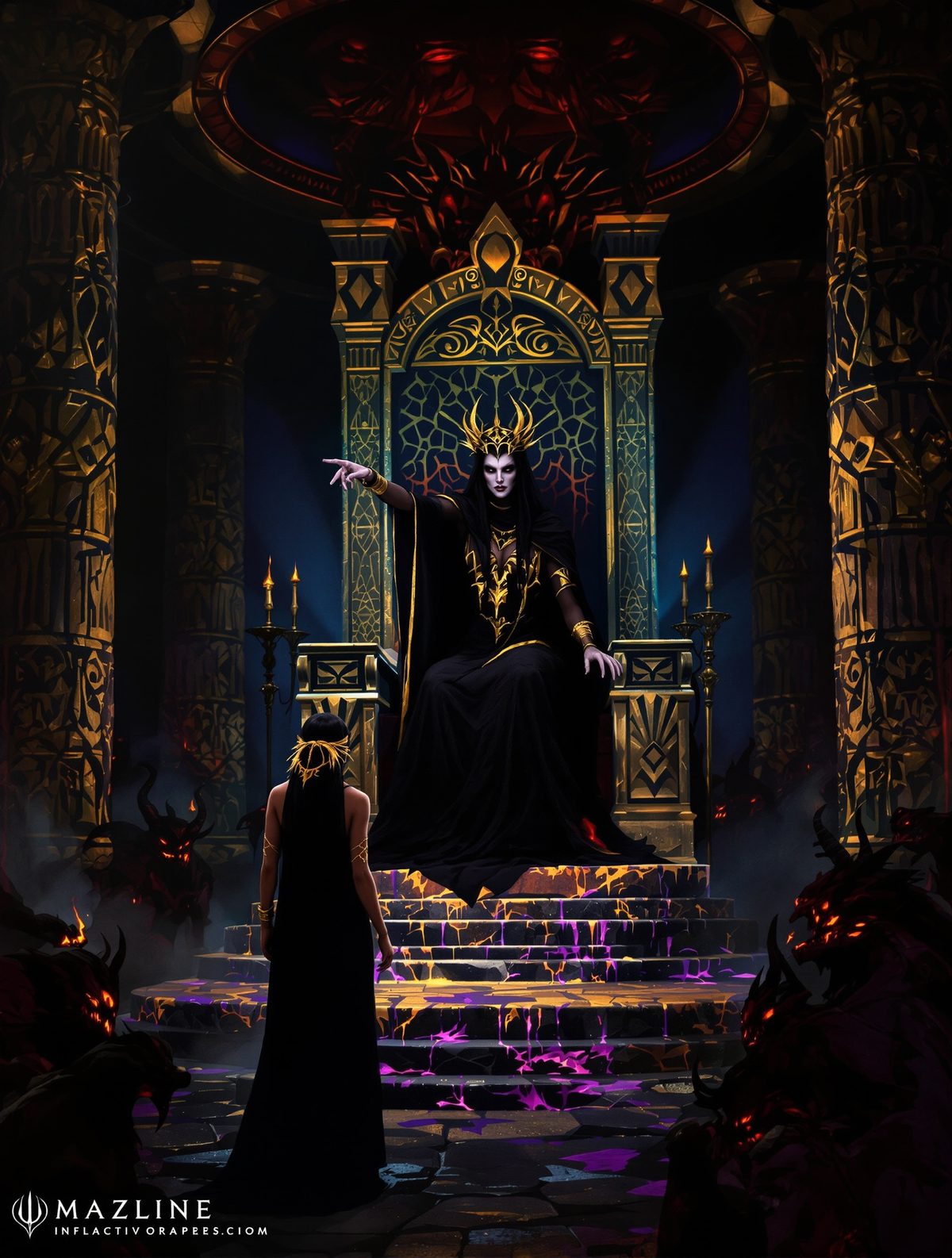
Picture this: the most powerful goddess in all of Mesopotamia, draped in divine regalia and radiating celestial authority, stands naked and trembling before a throne carved from the bones of the damned. Her crown has been stripped away. Her royal garments lie in tatters at seven different gates behind her. And sitting before her, eyes blazing with the cold fire of death itself, is her own sister—who is about to pass the most brutal sentence imaginable.
This isn't some medieval fairy tale or Hollywood fantasy. This is the story recorded in cuneiform tablets over 4,000 years ago, when scribes in ancient Sumer put stylus to clay to preserve one of humanity's most chilling family dramas. The tale of Inanna's descent into the underworld reveals a world where even gods could die, where family bonds meant nothing in the face of cosmic law, and where the price of hubris was measured in divine blood.
The Queen of Heaven's Fatal Gambit
Inanna wasn't just any goddess—she was the goddess of ancient Mesopotamia. Known to the Akkadians as Ishtar, she commanded dominion over love, beauty, sex, and warfare. Her temples in Uruk, dating back to 4000 BCE, were among the most magnificent structures in the ancient world. Priests and priestesses performed sacred rituals in her honor, and kings claimed legitimacy through her divine blessing.
But Inanna had a problem that wealth and worship couldn't solve: her sister Ereshkigal ruled the underworld, and their relationship was... complicated. While Inanna basked in the adoration of mortals above, Ereshkigal governed the shadowy realm of the dead below. The cuneiform tablets suggest that Inanna's descent wasn't born of family affection or diplomatic necessity—it was pure ambition. She wanted to expand her dominion into death's realm itself.
The Sumerian poem "Inanna's Descent to the Underworld," preserved on tablets from around 1900 BCE, tells us that Inanna prepared for her journey with meticulous care. She donned seven divine garments: her crown, beads around her neck, twin egg-shaped stones on her shoulders, a golden ring, a breastplate, a golden rod and measuring line, and a royal robe. Each piece wasn't just jewelry—it was a source of divine power, carefully accumulated over millennia of rule.
Seven Gates, Seven Humiliations
What happened next reveals just how seriously the ancient Mesopotamians took the concept of cosmic law. Even gods, apparently, couldn't simply waltz into the underworld without consequences. The gatekeeper, Neti, demanded that Inanna surrender one divine garment at each of the seven gates leading to Ereshkigal's throne room.
Imagine the psychological torture: at the first gate, her crown—symbol of her royal authority—was torn away. At the second, her protective beads. At the third, fourth, and fifth gates, more symbols of power vanished. By the sixth gate, even her breastplate was gone. At the seventh and final gate, Inanna surrendered her royal robe and entered her sister's presence completely naked and powerless.
This stripping away wasn't arbitrary humiliation—it represented a fundamental truth about death that resonated deeply with ancient peoples. No earthly power, no divine authority, no accumulated wealth could protect anyone from death's judgment. Even gods had to face the underworld's laws as equals.
The tablets preserve Ereshkigal's reaction with chilling clarity: she didn't greet her sister with joy or even diplomatic courtesy. Instead, her eyes became "eyes of death," her words became "words of wrath," and her utterance became "the wailing cry of guilt."
The Annunaki's Deadly Verdict
Here's where the story takes a turn that would make even modern legal dramas seem tame. Ereshkigal didn't simply execute her sister in a fit of rage—she convened a proper court. The seven judges of the underworld, known as the Annunaki, were summoned to render verdict on the goddess who had dared to invade their realm.
These weren't ordinary judges. The Annunaki were ancient deities themselves, beings so old and powerful that they predated the current generation of gods. In Mesopotamian cosmology, they represented the inexorable forces of fate and cosmic justice. When they fixed their "look of death" upon Inanna, they weren't just passing sentence on a trespasser—they were upholding the fundamental order of the universe.
The verdict was swift and absolute: death. But not just any death—a death designed to send a message that would echo through both divine and mortal realms. Inanna's corpse was hung on a hook for three days and three nights, displayed like a common criminal's body as a warning to any other gods who might harbor similar ambitions.
The specific detail of three days wasn't coincidental. Throughout ancient Near Eastern cultures, three days represented a complete cycle—the time needed for a soul to fully separate from its body and for death to become irreversible. By the third day, even divine intervention would be too late.
When Gods Die, Worlds Tremble
What the ancient tablets describe next reveals just how interconnected the divine and mortal realms were in Mesopotamian thinking. With Inanna dead, the entire world above began to die as well. Animals stopped mating. Plants ceased growing. Humans lost all interest in love and procreation. The goddess of fertility's death had literally sterilized the world.
This wasn't mere poetic metaphor—it reflected a sophisticated understanding of ecological balance that modern environmentalists would recognize. Remove one crucial element from a complex system, and the entire network collapses. The ancient Sumerians understood this principle and encoded it into their most sacred stories.
Enki, the god of wisdom and fresh water, finally intervened—but not through force or trickery. Instead, he created two beings called the gala-tura and kur-jara, beings that existed outside the normal categories of male and female, living and dead. These creatures could enter the underworld without triggering its laws because they occupied liminal space—they were neither fully one thing nor another.
The Price of Resurrection
Even divine mercy came with a price that reveals the ancient world's sophisticated understanding of cosmic balance. Ereshkigal agreed to release Inanna's corpse, but resurrection required a substitute. Someone else would have to take Inanna's place in the underworld—permanently.
The choice Inanna made when she returned to life tells us everything about both divine nature and human psychology. When she discovered that her beloved consort Dumuzi hadn't mourned her death but had instead continued ruling in her absence, she condemned him to take her place below. Love, apparently, was conditional even among gods.
The final twist—that Dumuzi's sister Geshtinanna would share his fate, spending half the year in the underworld so her brother could return to life for the other half—became the mythological explanation for the changing seasons. When Dumuzi was below, the world grew cold and barren. When he returned, spring bloomed again.
Echoes Across Eternity
This 4,000-year-old story of sisterly betrayal and divine justice resonates today precisely because it grapples with truths that transcend culture and era. The tale of Inanna and Ereshkigal asks uncomfortable questions: What happens when ambition meets absolute power? Can family bonds survive the ultimate test? And perhaps most unsettling of all: what does it mean that even gods can die?
Modern readers might see parallels everywhere—from corporate boardrooms where siblings destroy each other over inheritance, to international conflicts where shared history means nothing in the face of competing interests. But the story's enduring power lies not in its political metaphors but in its unflinching examination of death as the great equalizer.
In our age of technological hubris and dreams of conquered mortality, Inanna's naked march through those seven gates reminds us that some boundaries remain absolute. No crown, no wealth, no accumulated power can ultimately protect us from the final judgment that awaits every mortal—and according to the ancient Sumerians, every god as well. The only question is whether we'll face it with Inanna's arrogant ambition or learn the humility that might have saved her from that terrible hook in her sister's dark domain.