
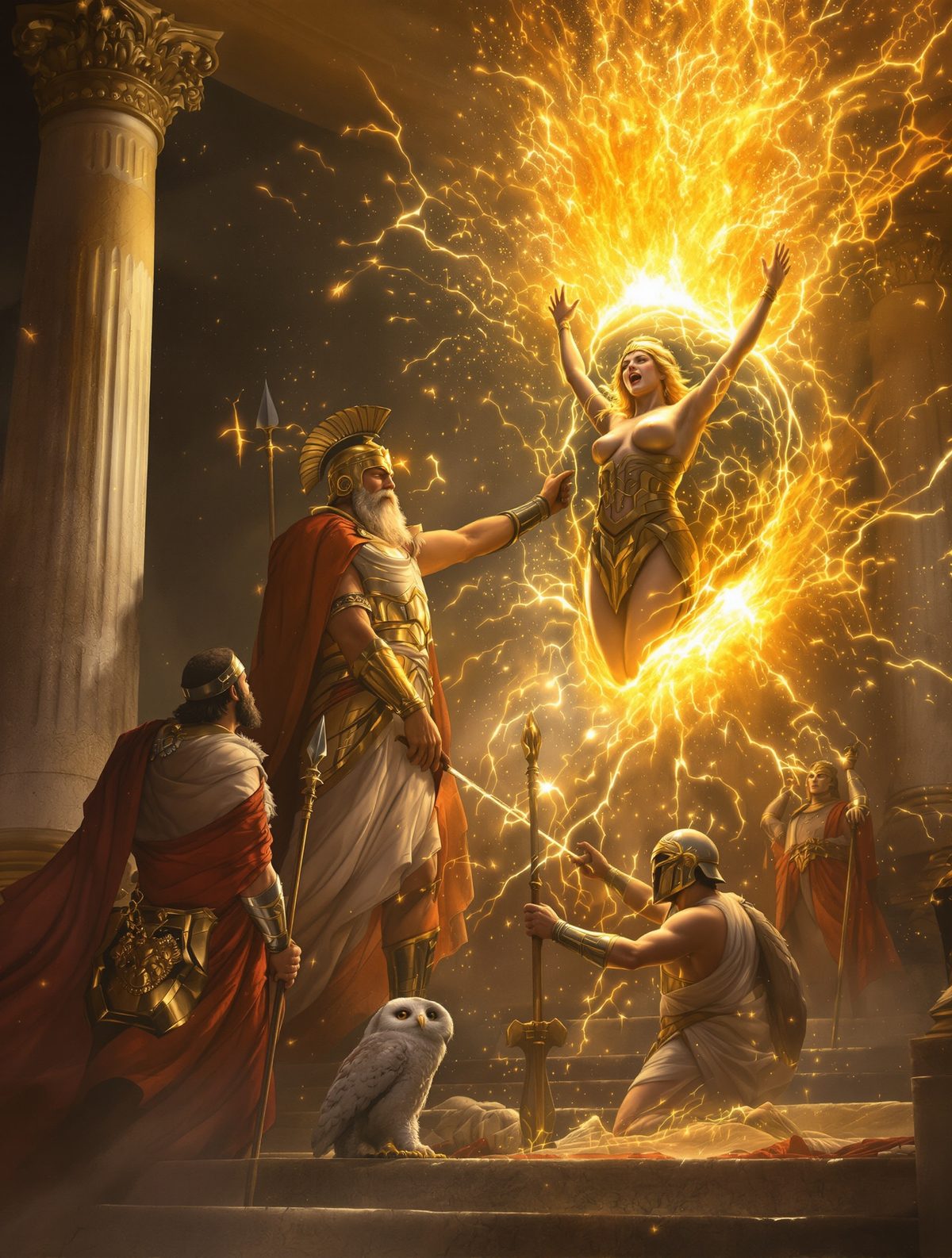
The throne room of Olympus echoed with an unearthly roar that made the very foundations of heaven tremble. Jupiter, king of all gods, master of thunder and lightning, writhed in agony as something clawed at the inside of his skull like a caged beast desperate for freedom. His divine head felt ready to explode, and for the first time in eternity, the most powerful being in the Roman pantheon knew true helplessness.
What happened next would become one of the most extraordinary birth stories ever told — a tale so bizarre that it makes modern superhero origins seem mundane by comparison. But this wasn't fiction. To the Romans, this was sacred truth, recorded by poets like Ovid and carved into temple walls across the empire. The birth of Minerva from Jupiter's skull wasn't just mythology; it was the divine explanation for wisdom itself entering the world.
When Gods Seek Medical Advice
Picture, if you will, the most powerful deity in Roman mythology reduced to clutching his head in desperation. Jupiter's migraines weren't your typical headaches — they were cosmic in scale, threatening to tear apart the very fabric of divine reality. According to Ovid's Metamorphoses, written around 8 CE, these weren't sudden pains but had been building for what felt like eons.
The cause? Jupiter had made a catastrophic error in judgment. Earlier, he had swallowed his first wife, the Titaness Metis, whole. Why? A prophecy had warned that any child born to Metis would be more powerful than its father — and Jupiter wasn't about to be overthrown as he had overthrown his own father, Saturn. But divine pregnancies don't simply disappear, even when the mother is digested. Inside Jupiter's belly, then migrating to his head, the child continued to grow.
Here's what most people don't realize: the Romans believed this gestation period lasted for months, during which Jupiter consulted every healer, sage, and divine physician available. Nothing worked. Divine herbs, celestial meditation, even the legendary healing springs of Aesculapius — the god of medicine himself was baffled. The pain only intensified, as if something inside Jupiter's skull was literally forging weapons.
The Divine Blacksmith's Radical Solution
Enter Vulcan, the divine blacksmith whose forge burned beneath Mount Etna in Sicily. Romans knew Vulcan as a master craftsman, the god who forged Jupiter's thunderbolts and created the most intricate divine artifacts. But what's lesser known is that Vulcan also served as the gods' emergency surgeon — a detail preserved in fragments of ancient Roman religious texts discovered in Pompeii's ruins.
When Jupiter's condition reached its crisis point, Vulcan arrived carrying not his usual hammer, but a specialized axe — what Roman sources call a securis caelestis, or heavenly axe. This wasn't a crude tool but a precision instrument, described in the Fasti by Ovid as being forged from meteoric iron and inscribed with protective runes.
The scene that followed would have been worthy of any modern medical drama, except the patient was the ruler of the universe. Jupiter, normally depicted sitting regally on his throne, was forced to kneel before Vulcan. The other gods formed a circle around them — not out of curiosity, but because divine protocol demanded witnesses for such an unprecedented procedure. Mars held his father steady, while Mercury prepared to catch whatever emerged.
With one perfectly aimed strike, Vulcan split Jupiter's skull along what anatomists today would recognize as the sagittal suture — the natural division line running from front to back across the top of the head. The sound, according to Virgil's account in the Aeneid, was like thunder splitting the sky, heard across all three realms: heaven, earth, and the underworld.
The Goddess Who Needed No Childhood
What emerged from Jupiter's opened skull defied every natural law — divine or otherwise. Minerva sprang forth not as an infant requiring care and nurturing, but as a fully mature goddess, complete with armor, spear, and shield. Her first cry wasn't the wail of a newborn but a war shout that shook the pillars of Olympus.
But here's the detail that often gets overlooked: Minerva's armor wasn't just decorative. Archaeological evidence from Roman temples dedicated to Minerva shows that her breastplate bore the image of Medusa — a trophy she wouldn't acquire until much later in mythological chronology. This suggests that the Romans believed Minerva emerged already knowing her entire future, already prepared for battles she hadn't yet fought.
The Greeks had their own version of this story with Athena, but the Roman interpretation carried unique elements. Roman Minerva was born not just with wisdom and warfare skills, but with complete knowledge of every craft and art form. She understood architecture, weaving, poetry, and strategy from the moment of her birth. Temple inscriptions from the 2nd century BCE describe her as "nata perfecta" — born perfect.
Perhaps most remarkably, Roman sources suggest Minerva's birth caused an immediate transformation in Jupiter himself. The terrible headaches vanished instantly, but more than that — the king of gods reportedly felt a sense of completion, as if a missing part of himself had finally been externalized and given form.
The Practical Magic of Divine Surgery
Modern readers might dismiss this as pure fantasy, but the Romans saw profound symbolism in every detail. The location of Minerva's emergence — the head rather than the womb — represented the supremacy of intellectual creation over physical reproduction. This was wisdom literally being born from thought itself.
Roman physicians actually studied this myth for medical insights. The physician Soranus of Ephesus, writing in the 2nd century CE, referenced Minerva's birth in his treatises on difficult deliveries, arguing that sometimes radical intervention was necessary to save both mother and child — even if the "mother" was the head of Jupiter.
The timing of Vulcan's axe strike was also considered significant. Roman astronomers calculated that Minerva's birth occurred during a rare celestial alignment when Mars, Venus, and Mercury formed a perfect triangle in the sky — an event they claimed happened only once every 847 years. Whether this calculation was accurate matters less than the fact that Romans believed cosmic forces had to align for such divine surgery to succeed.
Ripples Across the Roman World
News of Minerva's unusual birth didn't stay confined to Mount Olympus. According to Roman tradition, the moment she emerged from Jupiter's skull, every owl in the world simultaneously hooted — establishing these birds as her eternal companions and symbols of wisdom. More practically, Roman generals began consulting Minerva before major military campaigns, believing that a goddess literally born ready for war understood strategy better than any other deity.
The city of Rome itself claimed special connection to this birth story. The Capitoline Hill housed not just Jupiter's greatest temple, but also a shrine to Minerva that supposedly contained a relic of Vulcan's axe. Roman soldiers would touch this artifact before departing for distant campaigns, believing it would grant them some of Minerva's instant readiness for battle.
Even Roman education was influenced by this myth. Teachers argued that just as Minerva emerged fully formed with complete knowledge, truly gifted students could achieve sudden, complete understanding of complex subjects through intensive study — what they called "per capita eruditio" or "learning through the head."
When Ancient Wisdom Meets Modern Questions
In our age of gradual learning, lengthy education, and step-by-step skill development, Minerva's instant emergence from Jupiter's skull seems impossibly foreign. Yet this ancient Roman story touches on questions that remain remarkably relevant today. In a world where artificial intelligence can seemingly acquire vast knowledge instantaneously, where we debate whether wisdom can be programmed or must be earned through experience, Minerva's birth offers a fascinating counterpoint to our assumptions about how understanding develops.
The Romans believed that true wisdom — represented by Minerva — couldn't emerge through normal processes. It required divine intervention, radical action, and the willingness to literally split open conventional thinking. Perhaps that's why this story has survived for over two millennia: not because we believe gods literally give birth through their skulls, but because we recognize that breakthrough insights often arrive suddenly, fully formed, and ready for action — like a goddess of wisdom springing forth from the mind of creation itself.
The next time you experience that sudden moment of clarity when a complex problem suddenly makes perfect sense, you might be witnessing your own small version of Minerva's miraculous birth — wisdom emerging fully grown from the depths of thought, armed and ready to change the world.