The acacia trees stood like skeletal fingers against the merciless sky, their bark splitting under the relentless African sun. For seven long years, the clouds had abandoned the verdant hills of Kikuyuland, leaving behind a landscape of death that stretched from the sacred Mount Kirinyaga to the furthest reaches of tribal territory. Children with distended bellies wandered listlessly between huts, their mothers long since having stopped singing the ancient lullabies. The elders gathered in hushed circles, whispering words that chilled the soul more than any drought: the earth spirits demanded blood.
In this crucible of desperation, one young woman would make a choice that would echo through generations of Kikuyu oral tradition, becoming perhaps the most haunting sacrifice story in all of African mythology.
When the Heavens Closed Their Eyes
The great drought began during what the colonial records would later mark as the 1890s, though the Kikuyu measured time not by European calendars but by the rhythm of rains and harvests that had sustained them for countless generations. The initial failure of the rains was not unprecedented—the people of the central highlands had weathered dry seasons before. But as one year stretched into two, then three, then an unthinkable seven, even the most weathered medicine men began to speak in whispers.
The Kikuyu understood drought not merely as meteorological misfortune, but as a profound spiritual crisis. Their cosmology held that Ngai, the supreme deity who dwelt atop Mount Kirinyaga (now known as Mount Kenya), controlled the rains through a complex network of ancestral spirits and earth deities. When the rains failed catastrophically, it meant the spiritual contract between the living and the dead had been broken.
Archaeological evidence from the region suggests this period coincided with one of East Africa's most severe climatic disasters of the 19th century. Tree ring data and geological samples indicate rainfall dropped to less than 30% of normal levels across the Ethiopian Highlands and the East African Plateau—a drought so severe it would have made the American Dust Bowl seem modest by comparison.
The Council of Desperation
As the seventh year of drought wore on, the kiama—the council of elders—convened what oral histories describe as the most solemn gathering in living memory. These men, whose collective wisdom spanned generations, had exhausted every traditional remedy. They had sacrificed goats and sheep, poured libations of honey beer at sacred groves, and performed elaborate purification ceremonies. The medicine men had consulted the mathagumo (divining gourds) countless times, always receiving the same terrifying message: the earth spirits demanded the ultimate sacrifice.
What makes this story particularly remarkable is how it reflects the sophisticated spiritual hydraulics of Kikuyu cosmology. The tribe believed in Mumbi and her nine daughters, the founding mothers of the Kikuyu clans, who had become earth spirits upon their deaths. These spirits controlled the underground waters and the fertility of the soil. But they were not benevolent forces to be casually appeased—they were ancient powers who demanded respect, and when that respect was not given, they could withdraw their life-giving gifts entirely.
The elders determined that only the sacrifice of a virgin—a young woman who embodied the same purity as the founding mothers—could restore the cosmic balance. It was not a decision made lightly. Among the Kikuyu, women held profound spiritual significance as life-givers and the bridges between the world of the living and the ancestors.
Wanjiru Steps Forward
From among the eligible young women, Wanjiru emerged as the chosen one—though oral traditions differ on whether she volunteered or was selected. Some versions describe her as the most beautiful maiden in the region, with skin like polished copper and eyes that reflected the wisdom of her ancestors. Others emphasize her spiritual gifts, claiming she could communicate with the ancestors through dreams and had prophetic abilities that manifested during the sacred ngoma dances.
What remains consistent across all versions is Wanjiru's extraordinary composure in the face of her fate. Unlike the tragic heroines of Greek mythology who often met their doom through divine caprice or mortal folly, Wanjiru's sacrifice was portrayed as a conscious, noble choice—a supreme act of ubuntu, the African philosophy that emphasizes our interconnectedness and collective responsibility.
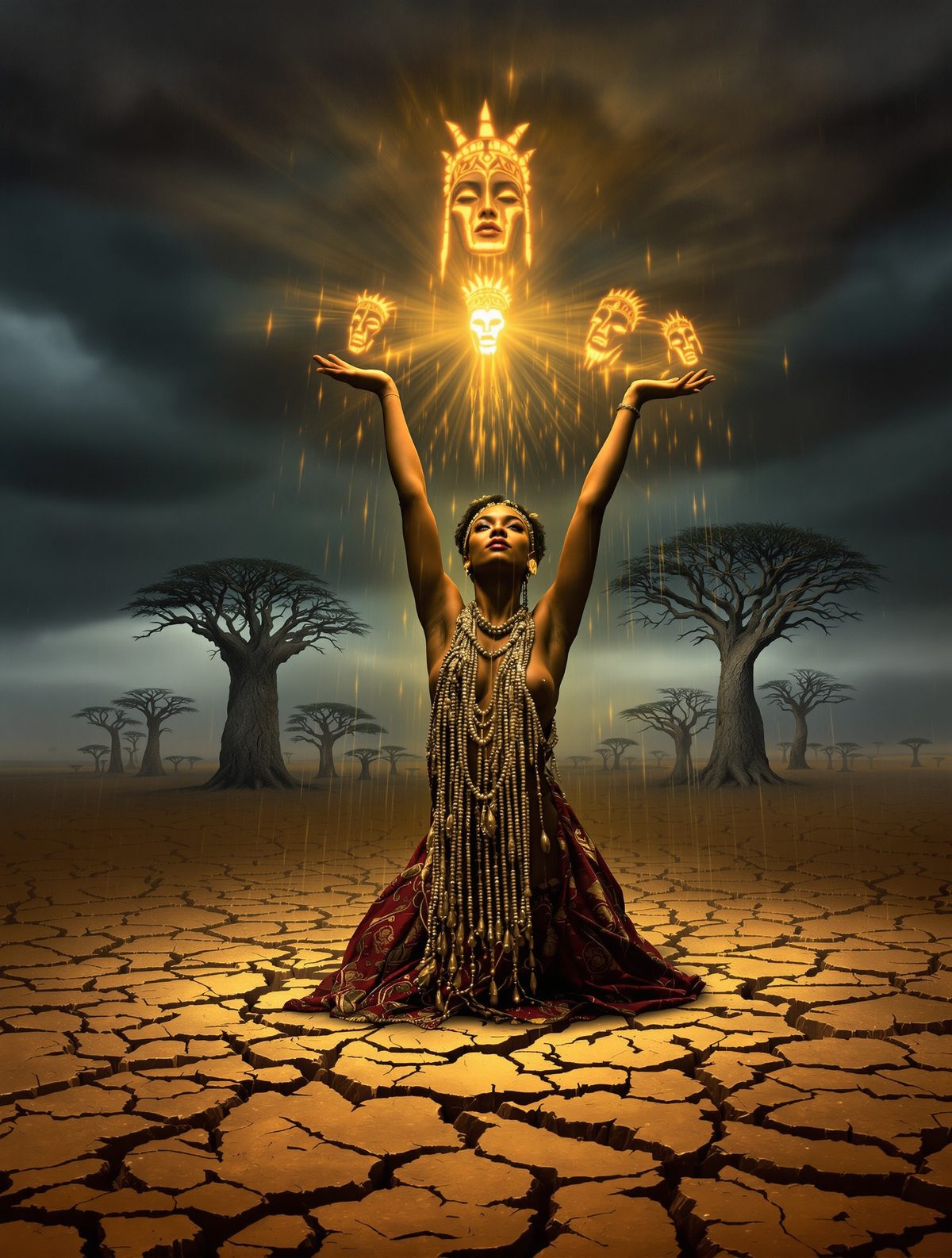
The preparations for her sacrifice involved elaborate rituals that lasted for days. Wanjiru was adorned with the finest beadwork, her body painted with sacred ochre and chalk designs that told the story of her people's covenant with the earth. She was fed the finest foods still available—perhaps the last goat's milk, the final stores of millet flour—as the community literally gave their last sustenance to honor their savior.
The Earth Opens Its Mouth
The actual sacrifice took place at a location that oral histories consistently identify as a sacred grove near a natural spring—one of the few water sources that hadn't completely dried up during the seven-year drought. The entire community gathered, creating a human circle around the ceremonial ground. The atmosphere was described in the oral traditions as one of profound solemnity mixed with desperate hope.
Here's where the story takes on elements that seem to transcend normal reality—a characteristic common to many of the world's most powerful mythological narratives. As Wanjiru stood at the center of the circle, the earth itself began to respond to her presence. Witnesses described the ground beneath her feet becoming soft, almost liquid, as if the very soil recognized her as an offering.
What followed was neither violent nor sudden. Instead, Wanjiru began to sink slowly into the earth, as if the ground were gently embracing her. Some versions describe her singing the traditional songs of her people as she descended, her voice growing softer but never fearful. Others tell of her speaking words of comfort to her grieving community, promising that her sacrifice would not be in vain.
The most remarkable detail, consistent across all versions of the legend, is what happened as Wanjiru disappeared completely into the earth: the first drops of rain began to fall. Not a sudden downpour, but gentle, life-giving drops that seemed to emerge from nowhere in the cloudless sky.
When the Heavens Wept
Within hours of Wanjiru's disappearance into the earth, the rains began in earnest. The oral traditions describe a deluge that lasted for days, filling the dried riverbeds, reviving the withered crops, and washing the accumulated dust and death from the landscape. It was as if the earth spirits, finally appeased by Wanjiru's ultimate gift, released seven years of hoarded moisture all at once.
But the story doesn't end with the return of the rains. The Kikuyu believe that Wanjiru became one with the earth spirits, joining the pantheon of ancestral mothers who watch over the fertility of the land. In some versions, she became the spirit of the underground waters themselves, forever ensuring that such a devastating drought would never again afflict her people.
The location where Wanjiru sacrificed herself became a sacred site, visited by generations of Kikuyu women seeking blessings for fertility and successful harvests. Even today, some elderly Kikuyu claim they can identify the spot, marked by a spring that never runs dry and vegetation that remains mysteriously green even during dry seasons.
The Rains Remember
In our age of climate science and meteorological satellites, it's tempting to dismiss Wanjiru's story as mere superstition—a primitive attempt to explain natural phenomena through supernatural means. But such a dismissal misses the profound truth embedded in this ancient narrative: the recognition that human communities sometimes face crises so severe that they demand ultimate sacrifice, and that the survival of the collective sometimes requires individuals to give everything they have.
Today, as we face our own environmental crisis—one that, like the great Kikuyu drought, threatens the very foundations of human civilization—Wanjiru's story resonates with uncomfortable relevance. Her tale asks us difficult questions: What are we willing to sacrifice to ensure the survival of future generations? How do we honor those who give everything so that their communities might live?
Perhaps most importantly, Wanjiru's legend reminds us that the relationship between humans and the natural world is not merely transactional but profoundly spiritual. The earth spirits that demanded her sacrifice were not cruel gods but guardians of an ancient contract—one that acknowledged humanity's role as stewards rather than masters of the natural world. In forgetting that contract, we may have sown the seeds of our own seven-year drought.