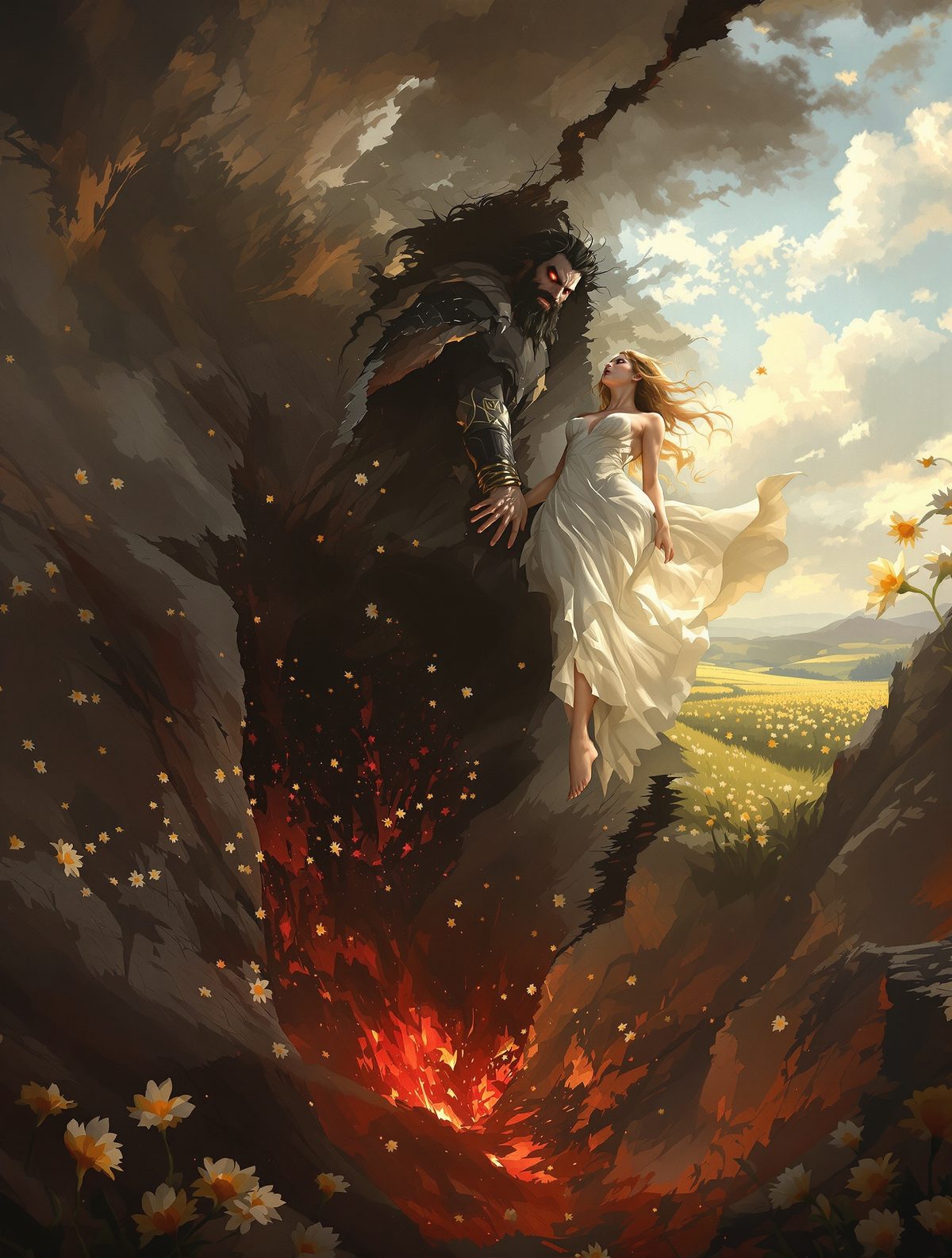
The morning sun cast long shadows across the Nysian meadow as a young woman bent to examine a flower unlike any she had ever seen. Its petals shimmered with an otherworldly beauty, its fragrance hypnotic. Persephone reached out her slender fingers toward the narcissus bloom, unaware that this single gesture would split the world in two—literally and figuratively. In the space of a heartbeat, paradise became hell, freedom became captivity, and the eternal cycle of seasons was born from one girl's scream that echoed across both heaven and earth.
The Trap Beneath Paradise
The meadow where Persephone wandered that fateful day wasn't just any field of flowers. Ancient sources place this legendary abduction in the plains of Nysa, though even the Greeks couldn't agree on its exact location—some claimed it was in Sicily, others in Attica, and still others insisted it was in Asia Minor. What they all agreed upon was its supernatural beauty: a place where flowers bloomed eternal, where the grass never withered, and where the boundary between the mortal world and the divine grew thin as morning mist.
But here's what the sanitized versions rarely mention: that magnificent narcissus flower wasn't growing there by accident. According to Hesiod's Theogony, written around 700 BCE, the bloom was deliberately planted by Gaia, the Earth herself, as part of an elaborate conspiracy. Zeus, king of the gods and Persephone's own father, had orchestrated the entire scene. The flower was bait in a trap that would solve his brother Hades' loneliness problem—regardless of what his daughter might want.
The narcissus itself carries darker symbolism than most realize. Named after the youth who fell in love with his own reflection, it represented death and rebirth in ancient Greek culture. Its bulbs were toxic, its beauty deadly—a perfect metaphor for what was about to unfold. When Persephone's fingers closed around its stem, she unknowingly triggered the most dramatic kidnapping in mythological history.
When the Earth Cracked Like Thunder
The moment Persephone plucked the narcissus, the earth didn't simply open—it exploded. The Homeric Hymn to Demeter, composed sometime between 700-500 BCE, describes a cataclysm that would make modern disaster movies seem tame. The ground "roared" and "gaped wide," creating a chasm so deep that mortals claimed they could see the fires of Tartarus burning far below.
From this supernatural earthquake emerged Hades himself, lord of the underworld, driving a chariot pulled by immortal horses described as being blacker than midnight. But here's a detail that might surprise you: Hades wasn't some grotesque monster. Ancient depictions show him as darkly handsome, bearded and regal, carrying a golden scepter and wearing a crown that sparkled with the gems of the earth's depths. His helmet of invisibility—the kynee—could render him unseen by gods and mortals alike, though he had cast it aside for this moment of ultimate visibility.
The horses pulling his chariot had names that revealed their terrifying nature: Orphnaeus ("the dark one"), Aethon ("the blazing one"), and according to some accounts, Nycteus ("the night-black"). These weren't ordinary steeds but creatures born from the blood of Medusa, capable of galloping through solid rock as easily as air. Their hooves struck sparks from the stones as they thundered upward from the depths, their breath forming clouds of sulfurous steam.
The Screams That Shook Two Worlds
What happened next challenges our modern understanding of consent and agency in ways that made even ancient Greeks uncomfortable. Hades seized Persephone—the texts use the word harpazo, meaning "to snatch away by force"—and hauled her into his golden chariot despite her desperate resistance. Her screams, according to the Homeric Hymn, were so piercing they reached both the peaks of Olympus and the depths of the sea.
But here's where the story takes an unexpected turn that reveals the complex nature of ancient Greek society: nobody helped her. Not the other nymphs in the meadow, not the shepherds in distant fields, not even the gods who surely heard her cries. Only Helios, the all-seeing sun god, and Hecate, goddess of crossroads and dark magic, witnessed what truly happened—and both remained silent until much later.
This wasn't mere coincidence or cowardice. In ancient Greek culture, marriage by capture had deep historical roots, and divine marriages followed similar patterns. The Greeks understood this story as a cosmic necessity disguised as violence—though that interpretation doesn't make Persephone's terror any less real or justified. Her screams represented not just personal anguish but the sound of innocence dying, of childhood ending, of the natural order being forever altered.
The Geography of Divine Violence
The route Hades took to his underground kingdom wasn't a simple straight-line descent. Ancient geographers and mythologists mapped out an elaborate journey that spanned the Mediterranean world. Starting from the meadow, his chariot allegedly thundered across the plains of Attica, then dove into the earth near Lake Cyane in Sicily—a real location where ancient pilgrims would come to mourn Persephone's fate.
Archaeological evidence suggests the Greeks took this geography seriously. At Cyane, now called Fonte Ciane near Syracuse, ancient visitors left votive offerings well into the Roman period. The spring's blue-green waters were said to be the tears of the nymph Cyane, who tried to prevent Hades from passing and was dissolved into water for her interference. Modern chemical analysis shows the spring's unusual color comes from dissolved limestone—but the ancient Greeks preferred their more poetic explanation.
The journey to Hades' palace took the divine couple through the river Styx, past the three-headed guardian Cerberus, and into a realm that was far more complex than our modern "hell" concept suggests. The underworld had multiple regions: the Elysian Fields for heroes, Tartarus for the wicked, and the vast Asphodel Meadows where ordinary souls spent eternity. Hades ruled them all from a palace made of precious metals and lit by gems that glowed with their own inner fire.
The Pomegranate Seeds That Changed Everything
The most crucial detail of Persephone's captivity involves six tiny seeds—though some versions say it was four, or seven, or even twelve. These pomegranate seeds represent one of mythology's most psychologically complex moments. Did Hades force them down her throat? Did she eat them deliberately as a form of agency within powerlessness? Or did she consume them unconsciously, not understanding their binding power?
The pomegranate itself was loaded with meaning in ancient Greek culture. Its blood-red seeds symbolized fertility, death, and rebirth—the same cycle Persephone would come to embody. In ancient Mediterranean societies, pomegranates were associated with marriage ceremonies, making Hades' choice of fruit grimly appropriate. The number of seeds varied in different tellings, but their effect remained constant: anyone who ate food in the underworld became bound to it forever.
Modern scholars debate whether this detail represents ancient understanding of trauma bonding, or simply a narrative device to explain the seasonal cycle. But there's a lesser-known twist: some versions suggest that Persephone chose to eat the seeds after discovering her mother Demeter's devastating response to her disappearance. Perhaps she realized that her return to the upper world would mean eternal winter, and she made a conscious sacrifice to save humanity.
When Myths Speak to Modern Souls
The story of Persephone's abduction resonates today because it captures truths about trauma, resilience, and transformation that transcend any single culture or era. In our modern world, where discussions of consent and agency dominate headlines, this ancient tale offers both disturbing parallels and surprising wisdom. Persephone's journey from innocent maiden to queen of the underworld mirrors the psychological passage many survivors of trauma experience—forced into knowledge they never wanted, yet ultimately finding power in the darkness.
The seasonal cycle born from her story—six months above ground, six below—speaks to the rhythms of healing and growth that still govern human experience. We all have our winters of the soul, our descents into darkness, our gradual returns to light. The ancient Greeks understood that some transformations can only happen in the depths, that some wisdom can only be gained through passages we would never choose willingly.
Perhaps most importantly, Persephone's tale reminds us that even the most powerless can find agency within constraint, can transform from victim to queen, can make meaning from the meaningless. In a world where innocence is still stolen and darkness still claims the unwilling, her story offers not easy comfort but complex hope: that we can survive our underworlds, that we can rule our own depths, and that even in the realm of death, life finds a way to bloom again.