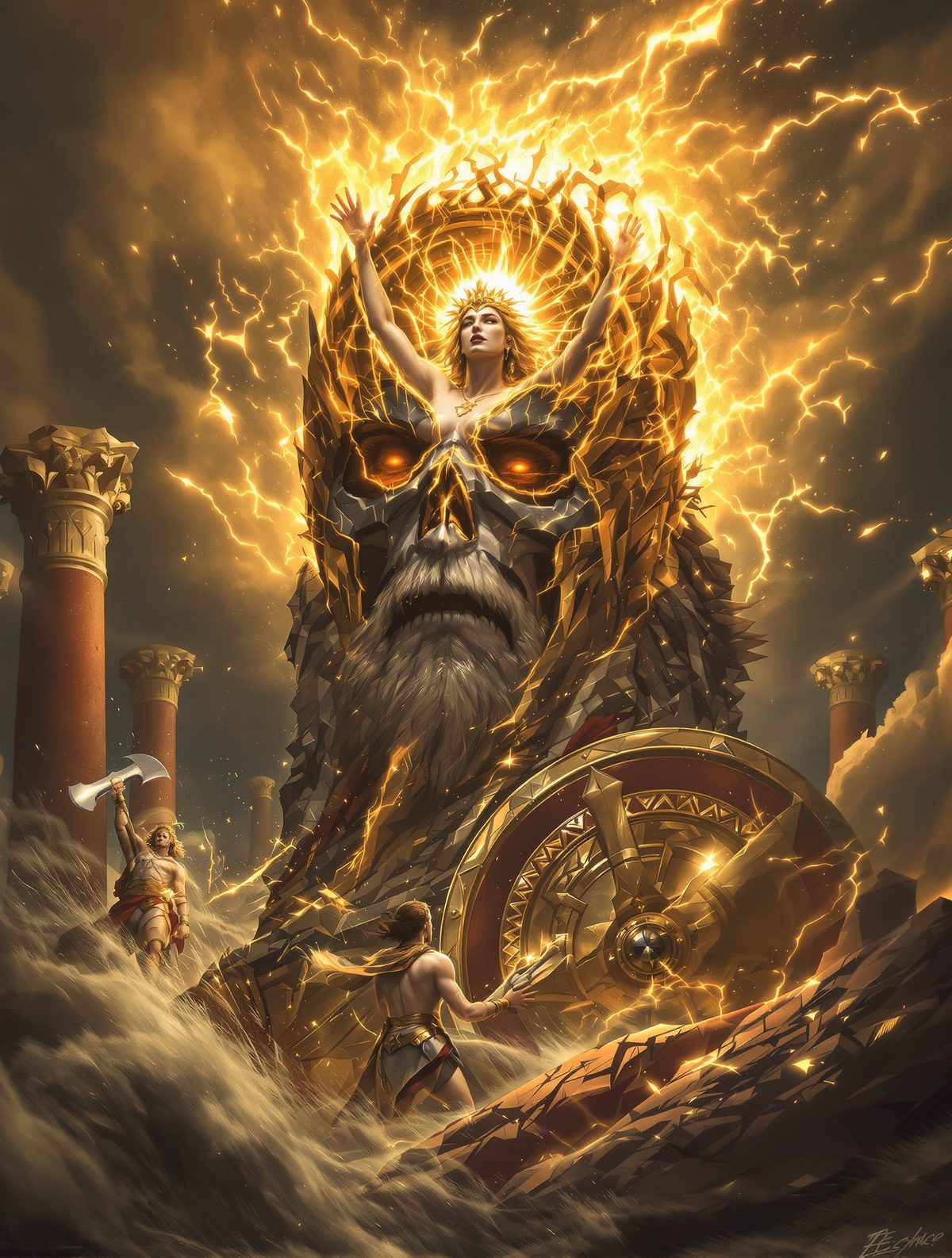
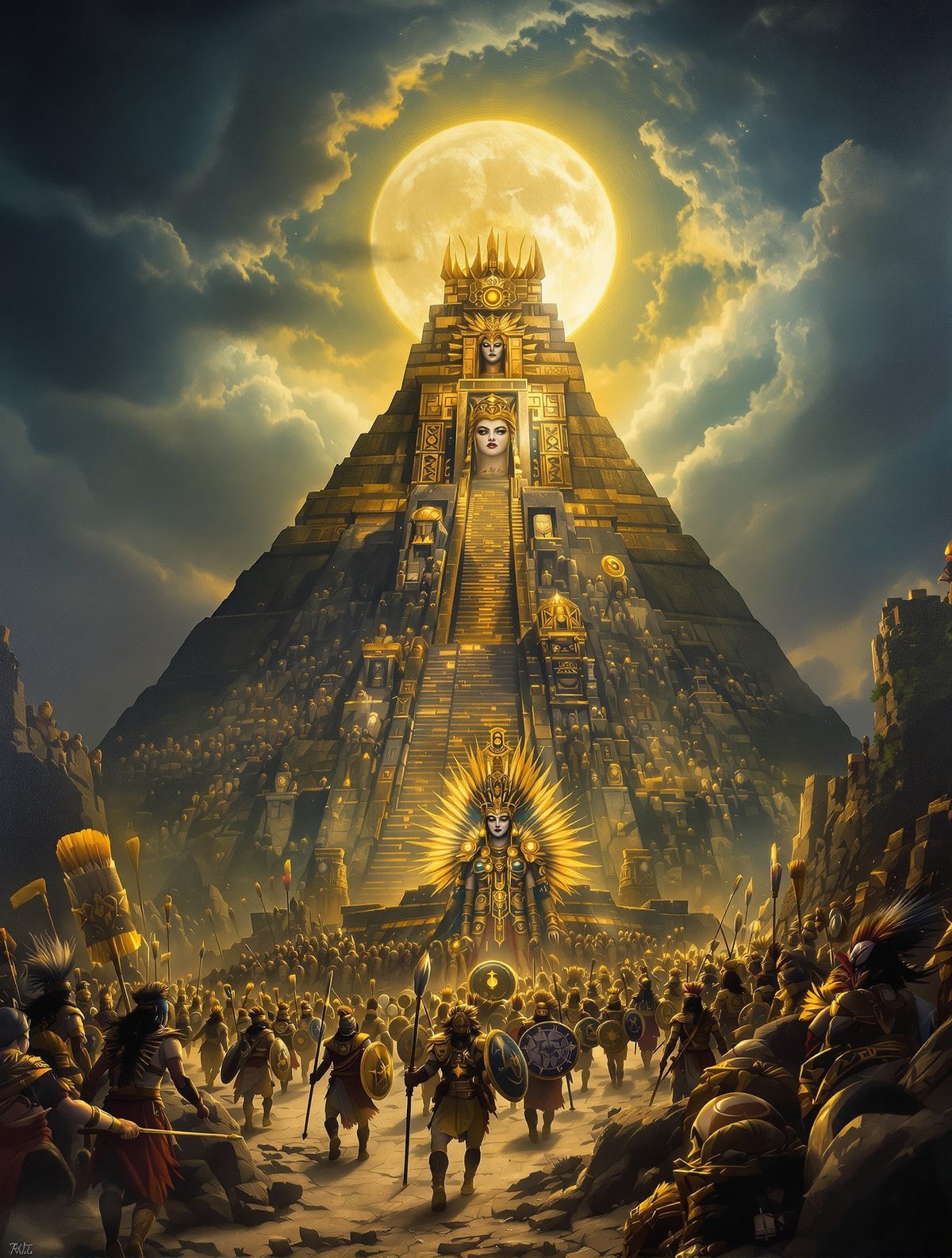
In the pre-dawn darkness of Coatepec, the sacred Serpent Mountain, four hundred warriors crept through the shadows with murder on their minds. Their target wasn't an enemy kingdom or rival tribe—it was their own mother. Leading this unprecedented act of matricide was Coyolxauhqui, the moon goddess whose face would one day be carved into massive stone discs weighing fifteen tons. But on this night, before she became one of Mesoamerica's most recognizable deities, she was simply a daughter consumed by rage, convinced that her mother's mysterious pregnancy would bring eternal shame upon their divine bloodline.
What happened next would become one of the most violent and psychologically complex myths in the Aztec pantheon—a story so disturbing that Spanish conquistadors would later use it as evidence of indigenous "barbarism," never recognizing the profound theological questions it explored about birth, death, and cosmic balance.
The Feather That Changed Everything
Coatlicue, the earth goddess whose name literally means "She of the Serpent Skirt," had already given birth to the moon, the stars, and countless other deities. Her children numbered in the hundreds, with Coyolxauhqui—the moon—serving as their unofficial leader and her four hundred sons, known collectively as the Centzon Huitznahua, representing the southern stars.
The family dynamics were relatively stable until the day Coatlicue encountered a small bundle of hummingbird feathers while sweeping the temple atop Coatepec. According to the Florentine Codex, compiled by Franciscan friar Bernardino de Sahagún in the 16th century from indigenous sources, she tucked the feathers into her bosom for safekeeping. The moment she did, the feathers vanished, and she found herself mysteriously pregnant.
This wasn't just any pregnancy—this was a divine conception that would produce Huitzilopochtli, destined to become the Aztecs' primary god of war and the sun itself. But Coyolxauhqui didn't know that. All she saw was her elderly mother, suddenly with child under circumstances that seemed shameful and inexplicable.
The moon goddess's reaction reveals a fascinating aspect of Aztec theology often overlooked in basic mythology texts: even gods were bound by social conventions and concepts of honor. Coyolxauhqui wasn't evil in the modern sense—she was a daughter trying to preserve her family's reputation according to the moral standards of her time.
Conspiracy in the Celestial Court
Coyolxauhqui's outrage quickly transformed into action. She began secretly meeting with her four hundred brothers, the star gods, convincing them that their mother's pregnancy was an unacceptable disgrace. The Aztec sources describe her as a skilled orator who gradually built consensus among her siblings that matricide was not only justified but necessary.
The conspiracy she orchestrated was remarkably sophisticated. The four hundred brothers would approach Coatepec in full war regalia, surrounding the mountain to ensure Coatlicue couldn't escape. They would strike at dawn, killing their mother quickly before the shameful child could be born. Coyolxauhqui herself would deliver the killing blow—a detail that underscores how personal this vendetta had become.
But the myths reveal an fascinating psychological dimension: some of the brothers had doubts. Two of them, whose names sadly haven't survived in the historical record, secretly warned Coatlicue about the plot. This detail suggests that even among the star gods, Coyolxauhqui's interpretation of justice wasn't universal—a nuance that adds moral complexity to what might otherwise be a simple story of good versus evil.
What makes this conspiracy truly chilling is its calculated nature. This wasn't a crime of passion but a carefully planned execution, complete with military tactics and coordinated timing. The star gods were essentially planning the divine equivalent of an honor killing.
The Child Who Heard Everything
Here's where the story takes a supernatural turn that even by mythological standards is extraordinary: the unborn child in Coatlicue's womb was fully conscious and aware of everything happening around him. Huitzilopochtli could hear his siblings plotting their mother's death, could sense their approach, and was already formulating his response.
The Florentine Codex records that Huitzilopochtli spoke to his terrified mother from within her womb, telling her not to be afraid and that he would protect her. Imagine the psychological horror of this situation: a pregnant woman, warned that her own children are coming to kill her, being comforted by her unborn baby who promises to fight for her life.
This prenatal consciousness wasn't unique to Huitzilopochtli in Mesoamerican mythology, but it was particularly significant. It established him as a fully formed deity before birth, complete with moral reasoning, tactical intelligence, and the power to act. Some scholars interpret this as an Aztec exploration of the question: at what point does life begin? Their answer, embedded in this myth, was definitively at conception.
The unborn god's awareness also raises questions about predestination versus free will. Did Huitzilopochtli choose to protect his mother, or was he cosmically destined to do so? The Aztec sources don't provide clear answers, but the ambiguity itself may be the point.
Dawn of Destruction
As the first light crept over the peaks of central Mexico, four hundred star gods began their assault on Coatepec. They came in full war paint and battle dress, carrying obsidian-bladed weapons and cotton armor, their faces decorated with the fierce designs reserved for sacred warfare. Coyolxauhqui led the charge, her own face painted with the sacred blue and white that would later become her signature colors in Aztec art.
But as the attacking force reached the summit where Coatlicue waited, something unprecedented occurred: Huitzilopochtli burst forth from his mother's womb fully grown, fully armed, and furious. He emerged carrying a xiuhcoatl—a turquoise fire serpent that served as both weapon and symbol of his solar power. His birth cry was the roar of a jaguar mixed with the shriek of an eagle, so loud it could be heard across all of Mesoamerica.
What followed was less a battle than a massacre. Huitzilopochtli immediately attacked Coyolxauhqui, beheading and dismembering her with such violence that her body parts scattered across the mountain. He then turned on the four hundred star gods, routing them completely and chasing them across the sky.
The descriptions in the codices are remarkably graphic, detailing how Huitzilopochtli cut off his sister's limbs one by one, then hurled her head high into the sky where it became the moon. Her dismembered body tumbled down the mountainside, breaking apart with each impact against the rocky slopes.
The Stone That Remembers
This myth wasn't just told—it was carved in stone with breathtaking artistry. The famous Coyolxauhqui Stone, discovered in 1978 by electrical workers digging near Mexico City's main cathedral, depicts the dismembered moon goddess in incredible detail. The eight-foot-diameter monolith shows her severed head, arms, and legs arranged in a composition that somehow manages to be both beautiful and horrifying.
Archaeologists believe this stone disc was placed at the base of the Templo Mayor in Tenochtitlan, positioned so that when sacrificial victims were thrown down the pyramid's steps, they would land on Coyolxauhqui's image—symbolically reenacting her defeat. The Aztecs weren't just telling this story; they were using architecture and ritual to make it perpetually real.
But here's a detail that makes this even more fascinating: recent analysis of the carving reveals that Coyolxauhqui's expression isn't one of pain or defeat. Her face appears serene, almost peaceful, as if death had brought her release rather than punishment. Some scholars now interpret this as evidence that the Aztecs viewed her not as a villain but as a tragic figure—someone whose sense of justice led her down a destructive path.
Echoes in a Modern World
This ancient story of family violence, honor, and revenge might seem like a relic of a distant past, but its themes remain disturbingly contemporary. Every year, thousands of people worldwide—predominantly women—are killed by family members who believe they've brought "shame" to their household. The same moral reasoning that drove Coyolxauhqui drives modern honor killings, domestic violence, and family-based persecution.
But the myth also offers something else: a condemnation of such violence through the figure of Huitzilopochtli. Yes, he responds with violence himself, but his violence is protective rather than punitive—he defends the vulnerable rather than preserving social conventions. The Aztecs, through this story, seem to be arguing that protecting life takes precedence over protecting honor.
Perhaps most remarkably, this myth continues to influence Mexican culture today. Coyolxauhqui has been reclaimed by feminist scholars and artists as a symbol of female power and resistance. Her dismemberment is reinterpreted not as defeat but as transformation—her scattered pieces becoming the very forces of nature. The moon still rises every night, after all, no matter how many times it's destroyed.
In our own era of family conflicts, cultural honor codes, and the protection of the vulnerable, the story of Coyolxauhqui and Huitzilopochtli remains as relevant as ever. It reminds us that the most dangerous enemies are sometimes those closest to us, and that the courage to protect the innocent—even when it means defying family—might be the most divine quality of all.