The King of the Gods clutched his skull in agony, divine ichor streaming between his fingers as hammering sounds echoed from within his own head. For months, Zeus had endured the unbearable pain of what felt like a cosmic blacksmith working overtime inside his cranium. Little did he know that his own daughter was literally forging her destiny—and her armor—in the most unusual nursery in all of creation: the mind of the most powerful deity in the Greek pantheon.
What happened next would become one of the most spectacular and bizarre birth stories in all of mythology, involving cannibalism, cranial surgery, and the emergence of wisdom itself in the form of a fully-armed goddess ready for battle.
The Prophecy That Started It All
To understand how Zeus ended up with a weaponized daughter hammering inside his head, we need to go back to his greatest fear: losing power. The ruler of Olympus had a complicated relationship with prophecies, particularly those involving his own downfall. His grandfather Uranus had been castrated by his son Cronus, who in turn had been overthrown by Zeus himself. The pattern was clear, and Zeus was determined to break it.
Enter Metis, the Titaness of wisdom and cunning intelligence. Her name literally meant "wisdom" or "craft," and she was Zeus's first wife—though this detail often gets overshadowed by his more famous marriage to Hera. Metis had actually helped Zeus defeat the Titans by providing him with the potion that forced Cronus to regurgitate Zeus's siblings. She was, by all accounts, the perfect partner for a newly crowned king of the gods.
But then came the prophecy that would change everything. The Fates, those ancient arbiters of destiny, revealed that Metis would bear two children: first a daughter equal to Zeus in wisdom, and then a son who would surpass his father in strength and become king of gods and mortals. For Zeus, this wasn't just a prediction—it was a death sentence for his reign.
A Divine Case of Extreme Measures
Zeus's solution was as brutal as it was direct: he would swallow his pregnant wife whole. The ancient sources differ on exactly how he accomplished this feat of divine cannibalism. Some accounts suggest he tricked Metis by challenging her to a shape-shifting contest, then swallowed her when she transformed into a water droplet. Others claim he simply overpowered her and consumed her by force.
Hesiod's Theogony, our earliest written source for this tale from around 700 BCE, describes Zeus as "putting her in his belly" to ensure that she could never give him counsel that might threaten his rule. It was the ultimate act of patriarchal control—not just silencing his wife, but literally internalizing her wisdom while preventing her from bearing the son who would overthrow him.
But Zeus had underestimated both the resilience of Metis and the determination of their unborn daughter. Inside the cosmic darkness of Zeus's interior, Metis continued her pregnancy and began preparing her daughter for the world outside. What's particularly fascinating is that she didn't just nurture the child—she equipped her with the tools she would need to thrive in a world ruled by her father.
The Divine Forge Inside a God's Head
Here's where the story takes a turn that even the most creative mythologist might find hard to believe: Metis began forging armor and weapons for her unborn daughter inside Zeus's head. Ancient sources describe the sound of divine metalwork echoing through the king of the gods' skull—hammer strikes that grew stronger and more painful with each passing day.
The specific details of this internal armory are remarkable. Metis crafted a helmet that would make Athena invisible to her enemies, a spear that never missed its target, and the famous aegis—a shield or breastplate that would become one of the most recognizable symbols in Greek mythology. Some versions describe the shield as bearing the head of the Gorgon Medusa, though that addition would come later in Athena's story.
What makes this tale even more intriguing is the implication that wisdom itself was being forged through this process. Unlike other Olympic births, Athena wasn't just growing physically—she was being educated, trained, and equipped with both martial skills and intellectual prowess. The hammering in Zeus's head wasn't just the sound of metalwork; it was the sound of a mind being sharpened to perfection.
Ancient Greek physicians actually used this myth to explain severe headaches and what we might now recognize as migraines. The idea of thoughts and wisdom literally taking physical form inside the head aligned with early Greek theories about how the mind worked.
The Most Dramatic Medical Intervention in History
By the time Zeus could no longer bear the pain, he was desperate for relief. The mighty ruler who had defeated the Titans and established order in the cosmos was brought low by what amounted to divine pregnancy pains in his cranium. He called upon Hephaestus, the god of fire and forge, to perform what might be history's most dramatic cesarean section.
Some versions of the myth suggest it was actually Hermes or even Prometheus who wielded the axe, but Hephaestus is the most commonly cited divine surgeon. The choice makes symbolic sense—who better to deliver a goddess forged in wisdom than the master craftsman of the gods himself?
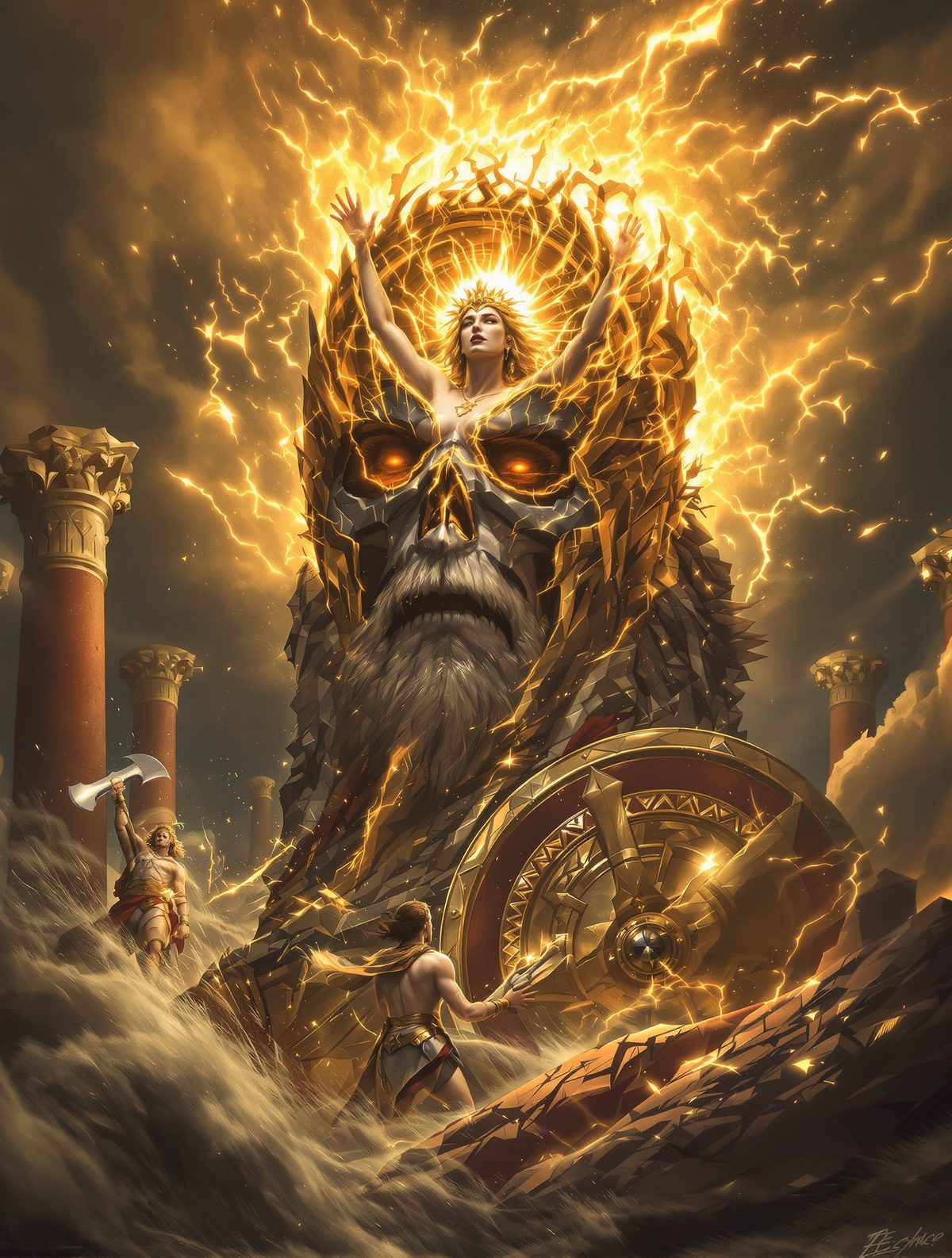
The moment of Athena's birth was nothing short of spectacular. Ancient sources describe Zeus's skull splitting open with a sound like thunder, and from the crack emerged not a crying infant but a fully grown woman in gleaming armor, letting out a war cry that shook Mount Olympus itself. The other gods reportedly fled in terror at the sight, except for Hephaestus, who stood transfixed by his handiwork.
Athena sprang forth brandishing her spear and shield, her grey eyes blazing with inherited wisdom and her own fierce intelligence. She was, in that moment, everything her parents had been and more—combining Zeus's authority with Metis's wisdom, but adding her own unique domain over strategic warfare and craftsmanship.
The Birth of Wisdom Itself
What's particularly fascinating about Athena's birth is how it reflects ancient Greek attitudes toward knowledge, wisdom, and gender. By being born from Zeus's head rather than from a woman's womb, Athena became associated with intellectual rather than biological creation. She was wisdom made manifest, thought given physical form.
This origin story also explains many of Athena's unique characteristics among the Olympic gods. Unlike Aphrodite, who was born from sea foam, or Apollo and Artemis, who were born on the island of Delos, Athena's birth was thoroughly masculine in its conception—literally. This made her acceptable as a powerful goddess in a patriarchal pantheon while also explaining her eternal virginity and her role as a protector of heroes rather than a lover of mortals.
The irony, of course, is that Zeus's attempt to prevent his own overthrow by consuming Metis actually created one of the most powerful and influential deities in the Greek pantheon. Athena became the patron goddess of Athens, the most intellectually advanced city-state in ancient Greece, and her influence on Greek culture was immeasurable.
Why This Ancient Story Still Matters
The tale of Athena's birth from Zeus's split skull isn't just a colorful myth—it's a story about the power of wisdom to literally reshape the world around it. In an age where we're constantly bombarded with information but often struggle to find genuine insight, the image of wisdom being carefully forged and then emerging fully formed has particular resonance.
The story also speaks to the lengths people will go to maintain power, and how attempts to suppress wisdom and counsel often backfire spectacularly. Zeus tried to internalize and control Metis's wisdom, but instead created something even more powerful: a goddess who embodied strategic thinking, just warfare, and the practical application of knowledge.
Perhaps most importantly, Athena's birth story reminds us that the most transformative ideas often emerge from periods of intense pressure and apparent constraint. Like the goddess herself, breakthrough insights are forged in difficult circumstances and emerge fully formed, ready to change the world around them. In our own era of rapid change and intellectual challenges, we might do well to remember that wisdom, once born, cannot be put back into the box—or in this case, the skull—that tried to contain it.