Picture this: the ancient Egyptian sky goddess Nut, her star-spangled body stretched across the heavens, writhing in labor pains that have lasted for eternity. Inside her divine womb, five children wait to be born—gods who will reshape the world. But there's a catch that would make even a Vegas high-roller sweat: she's been cursed never to give birth on any day of the year. Every sunrise, every sunset, every moment that exists within the 360-day Egyptian calendar is forbidden to her.
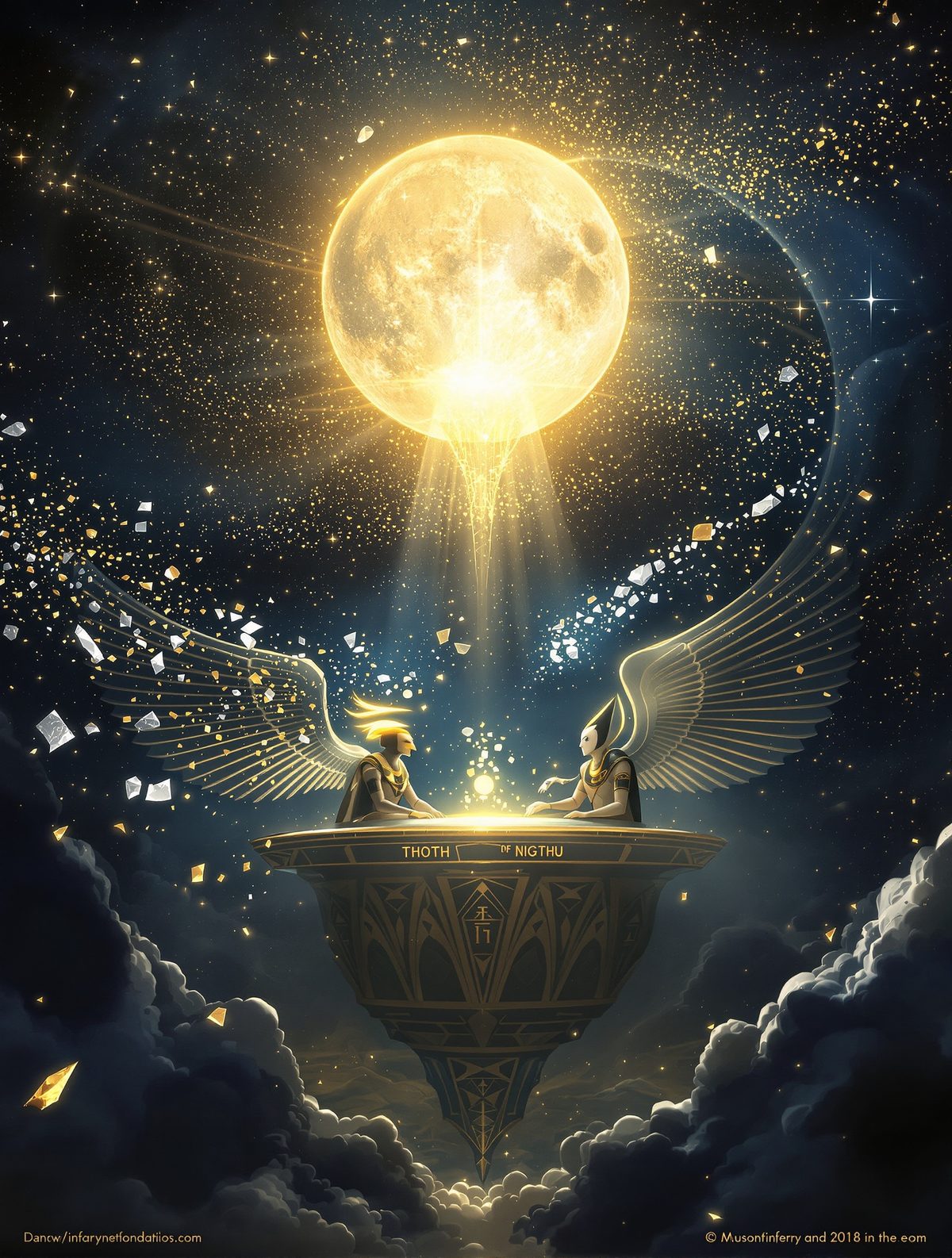
This is when Khonsu, the silver-crowned moon god, decided to sit down at the most consequential gambling table in cosmic history. What he wagered wasn't gold or jewels—it was pieces of his own luminous essence, fragments of moonlight itself. The stakes? Creating five days that belonged to no year, no calendar, no cosmic order. Five impossible days when the impossible could happen.
The Curse That Shook the Heavens
To understand why Khonsu would risk his very essence, we need to grasp just how vindictive the gods could be when their authority was challenged. Ra, the sun god and supreme ruler of the Egyptian pantheon, had received a prophecy that chilled his solar heart: one of Nut's children would eventually overthrow him. In typical divine fashion, Ra's solution was swift and merciless.
The curse he placed on Nut was elegantly cruel. The Egyptian calendar contained exactly 360 days, divided into twelve months of thirty days each—a perfect celestial prison. "You shall not give birth on any day of any year," Ra declared, his words becoming cosmic law. Nut, the sky goddess whose body formed the very dome of heaven, was trapped in eternal pregnancy.
But here's what most people don't realize: this wasn't just about preventing births. In ancient Egyptian cosmology, Nut's daily cycle was essential to life itself. Each evening, she swallowed the sun (Ra), and each morning, she gave birth to it anew. She was literally the mechanism by which day and night functioned. Ra's curse threatened to disrupt this fundamental process, creating a cosmic crisis that could unravel reality itself.
The Moon God's Desperate Gambit
Enter Khonsu, whose name means "traveler"—and boy, was he about to take the journey of a lifetime. Depicted with the sidelock of youth and bearing the crescent moon as his crown, Khonsu was more than just a lunar deity. He was the divine gambler, the god of time and fate, and crucially, he had something that existed outside Ra's perfectly ordered calendar: his own lunar light.
The ancient texts, particularly those found in Edfu Temple, describe Khonsu's moonlight as iah—a substance that was both physical and spiritual, measurable yet magical. Unlike solar light, which belonged entirely to Ra, lunar light was Khonsu's own creation, reflected and transformed by his divine essence. This gave him a loophole that even Ra's curse couldn't close.
But Khonsu couldn't simply create new days from nothing—that would be direct defiance of Ra's cosmic order. Instead, he needed to win them, to earn them through a game that even the gods respected. So he sought out Thoth, the ibis-headed god of wisdom and divine scribe, who was known throughout the pantheon as an unbeatable strategist at senet, the ancient Egyptian board game.
The Game That Changed Time Itself
The gambling match between Khonsu and Thoth wasn't your typical board game night. Ancient sources suggest they played senet, a game so sacred that it was believed to mirror the soul's journey through the afterlife. The board had thirty squares, representing the thirty days of each month—a cosmic irony that couldn't have been lost on either player.
Here's the fascinating part that archaeologists have pieced together from various temple inscriptions: Khonsu didn't bet conventional treasures. Instead, he wagered portions of his lunar light—specifically, 1/72nd of his illumination for each game he lost. This wasn't random; 72 was a deeply significant number in Egyptian mathematics, representing the number of years it took for the calendar to shift by one day due to the difference between the 365-day solar year and the 360-day civil calendar.
The games stretched across what felt like eons. Thoth, despite his reputation for invincibility, found himself outmatched by Khonsu's desperate determination. With each victory, Khonsu claimed another fragment of time, another sliver of possibility. The moon god's light grew dimmer and dimmer, but his resolve only strengthened.
When the cosmic dice finally stopped rolling, Khonsu had won enough light to create exactly five additional days—days that existed outside Ra's 360-day year, beyond the reach of his curse. These would become known as the epagomenal days, from the Greek word meaning "brought in besides."
The Birth of Gods and the Birth of Time
What happened next reads like the most dramatic birth announcement in history. On these five stolen days, Nut finally gave birth to her divine children, each one destined to reshape Egyptian mythology forever:
Day One: Osiris emerged, the god who would rule the underworld and judge the dead. Day Two: Horus the Elder, the falcon-headed sky god. Day Three: Set, the chaotic god of storms and the desert. Day Four: Isis, the great mother goddess and master of magic. Day Five: Nephthys, the protector of the dead and sister to Isis.
But here's the detail that will blow your mind: Egyptian astronomers had actually observed that the solar year was about five days longer than their civil calendar. Khonsu's gambling story wasn't just mythology—it was their ancestors' brilliant way of explaining a real astronomical phenomenon. They had essentially created a mythological framework for the leap days needed to keep their calendar in sync with the seasons.
The cost to Khonsu was permanent. Having lost 1/72nd of his light, the moon would never again shine as brightly as it once had. This is why, the Egyptians explained, the moon waxes and wanes—it's still trying to recover the light that Khonsu sacrificed in his cosmic gamble.
The Ripple Effects of Divine Dice
Khonsu's victory created more than just five extra days—it fundamentally altered the relationship between fate and free will in Egyptian cosmology. Prior to this cosmic gamble, Ra's word had been absolute law. But Khonsu proved that even divine decrees could be circumvented through cleverness, sacrifice, and a willingness to risk everything.
The five epagomenal days became some of the most important in the Egyptian religious calendar. They were considered outside normal time, making them perfect for magical workings and divine interventions. Ordinary laws—both physical and spiritual—were suspended. It was during these days that the veil between worlds was thinnest, when gods walked more freely among mortals.
Interestingly, different regions of Egypt celebrated these days in varying ways. In Memphis, they were days of great festival and celebration. In Thebes, they were more somber, focused on the dangerous unpredictability of time outside normal cosmic order. In the Fayyum region, people would actually gamble during these days, believing that Khonsu's spirit would guide their dice and bring them luck.
Why Ancient Gambling Still Matters Today
At first glance, this might seem like just another colorful myth from humanity's more superstitious past. But look deeper, and you'll find themes that resonate powerfully in our modern world. Khonsu's story is fundamentally about a parent figure willing to sacrifice everything for the next generation—in this case, sacrificing his own light so that Nut's children could be born.
It's also about finding loopholes in seemingly impossible systems, about the power of creative thinking to overcome institutional barriers. In an age where we're constantly told that certain problems are "just how things are," the moon god's cosmic gamble reminds us that sometimes the most rigid systems have unexpected vulnerabilities.
Perhaps most importantly, it's about the price of change. Khonsu didn't win those five days without permanent cost—his diminished light serves as an eternal reminder that progress often requires sacrifice from those who dare to challenge the status quo. Every time we look up at the waxing and waning moon, we're seeing the result of the most consequential bet ever made: a god who literally gambled away pieces of himself to give the future a chance to be born.
In our own era of calculated risks and cosmic uncertainties, maybe we could all learn something from a moon god who knew when the stakes were high enough to bet everything on tomorrow.