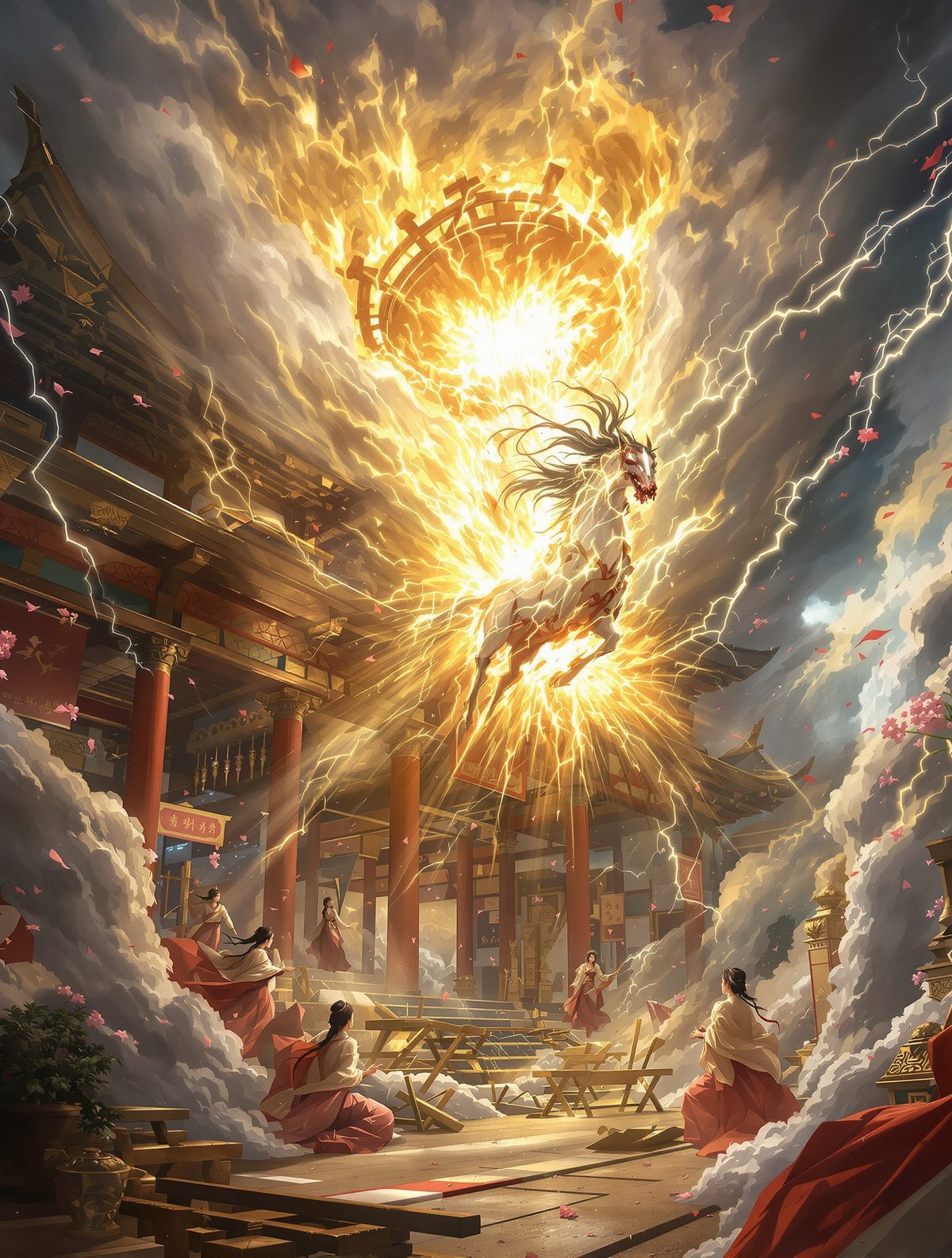

The storm had claimed everything—the fishing nets, the boat's mast, and now, it seemed, his daughter's life. As Lin Yuanji stumbled along the rocky shoreline of Meizhou Island in the pre-dawn darkness of 987 CE, his weathered hands trembling as they held a flickering oil lamp, he never expected to witness the birth of a goddess. But there, among the twisted kelp and shattered driftwood left by the typhoon's fury, lay the body of his twenty-eight-year-old daughter, Lin Mo Niang—and she was glowing like a fallen star.
The Daughter Who Spoke to Storms
Lin Mo Niang had always been different. Born during the Song Dynasty in 960 CE in what is now Fujian Province, she emerged into the world without crying—a silence so profound that her parents named her "Mo Niang," meaning "silent girl." But this silence masked extraordinary abilities that would become the stuff of legend.
From childhood, Mo Niang displayed an uncanny connection to the sea that surrounded Meizhou Island. Fishermen's wives would later whisper that she could predict storms three days before they arrived, simply by watching the way seabirds flew or how the waves lapped against the harbor stones. By age sixteen, she had reportedly saved over a dozen fishing boats by appearing to their crews in dreams, guiding them away from hidden reefs and treacherous currents.
What made her truly remarkable, however, was her ability to enter trance-like states during which her spirit could supposedly travel across vast distances of ocean. Neighbors claimed to have seen her sitting motionless in her father's house while simultaneously witnessing her walking on water miles away, leading lost sailors to safety. In an age when women rarely ventured beyond their family compounds, Mo Niang's soul soared across the South China Sea like an albatross.
The Night the Sea Turned Angry
The typhoon that struck on September 4th, 987 CE, was unlike any the fishermen of Meizhou had ever witnessed. Modern meteorologists would classify it as a Category 5 super typhoon, with winds exceeding 180 miles per hour. The storm surge reached heights of thirty feet, transforming familiar fishing grounds into a liquid hell of churning mountains and valleys.
As the typhoon approached, Mo Niang entered one of her deepest trances yet. According to the earliest written accounts, compiled by the scholar Liao Pengfei in 1150, her family found her in their small wooden home, seated in lotus position, her breathing so shallow they feared she had died. But her lips moved constantly, as if speaking to invisible companions, and her eyes—though closed—seemed to track movement across vast distances.
For three days and nights, as the storm raged, Mo Niang remained in this supernatural state. Villagers reported seeing a luminous female figure walking on the storm-tossed waves, her red robes somehow remaining dry despite the hurricane winds. This ghostly guardian appeared to seventeen different fishing boats that had been caught far from shore, leading each one through a maze of deadly rocks and surging waters to safety.
But divine intervention comes at a cost. On the morning of September 7th, as the typhoon finally moved inland, Mo Niang's physical form was found floating face-down in the harbor, her body battered by the very waves she had mastered in life.
The Light That Changed Everything
Lin Yuanji had weathered forty-three years of coastal storms, but nothing had prepared him for what he witnessed when he discovered his daughter's body. As his lamp light fell across Mo Niang's still form, her skin began to emit what witnesses later described as "tianshi guangmang"—celestial divine radiance.
The glow started as a faint shimmer, like moonlight on calm water, but quickly intensified until Mo Niang's entire body pulsed with golden-white light. The radiance was so intense that Lin Yuanji could see clearly for a hundred yards in every direction, turning the storm-darkened beach into what resembled midday. More remarkably, the light seemed to extend beyond the visible spectrum—fishermen reported feeling an overwhelming sense of peace and protection that penetrated to their very souls.
According to the "Tianfei Xiansheng Lu" (Record of the Celestial Consort's Sacred Life), written in 1196, the divine light continued for seven days and seven nights. During this period, Mo Niang's body showed no signs of decomposition, and her face maintained what observers called an expression of "infinite compassion mixed with fierce determination." Local Buddhist monks declared it a manifestation of "jieshi chengfo"—instant buddhahood—while Taoist priests recognized the signs of immortal transformation.
When Gods Are Born from Grief
The transformation of Lin Mo Niang into Mazu—literally "Mother Ancestor"—represents one of the most remarkable cases of deification in Chinese history. Unlike many mythological figures whose origins are lost in prehistory, Mazu's ascension from mortal woman to supreme sea goddess is unusually well-documented, with over 1,000 years of continuous historical records.
Within a decade of her death, sailors throughout the South China Sea were reporting miraculous rescues by a figure matching Mo Niang's description. She appeared during storms as a woman in flowing red robes, sometimes walking on water, sometimes manifesting as a divine light that guided ships to safety. By 1123 CE, the phenomenon had become so widespread that Emperor Huizong of Song officially recognized her as a protective deity, granting her the title "Lady who Protects the Country and Shelters the People."
What's particularly fascinating is how Mazu's worship spread beyond China's borders through maritime trade networks. Portuguese sailors in Macau adopted her as "A-Ma" (from which the territory gets its name), while her temples spread throughout Southeast Asia wherever Chinese merchants established trading posts. Today, over 200 million people worldwide venerate Mazu, making her one of the most widely worshipped Chinese deities.
The Science Behind the Sacred
Modern researchers have proposed several intriguing explanations for the mysterious luminescence witnesses attributed to Mo Niang's body. Marine biologist Dr. Chen Wei-Ming from Taiwan's National Ocean University suggests that prolonged exposure to certain bioluminescent organisms common during typhoons could create a persistent glow on human skin that might last for days.
More controversially, physicist Dr. Sarah Liu from UC Berkeley has theorized that the extreme electromagnetic activity generated by super typhoons might, under very specific conditions, create sustained electrical charges in objects with high water content—including human bodies. While this remains scientifically unproven, it's worth noting that similar luminous phenomena have been reported following other extreme weather events throughout history.
However, attempts to explain away Mazu's transformation miss the deeper historical significance. Whether divine intervention or natural phenomenon, the glowing body on Meizhou's shore became the catalyst for a religious movement that would shape maritime culture across East and Southeast Asia for over a millennium.
The Goddess Who Never Left the Water
Today, as climate change intensifies storm systems and rising seas threaten coastal communities from Hong Kong to the Philippines, Mazu's legend resonates with renewed urgency. Her temples—there are over 5,000 worldwide—continue to serve as community centers where fishermen's families gather to pray for safe voyages and favorable weather.
Perhaps most remarkably, modern satellite technology has confirmed what Mazu's devotees have long believed: the traditional shipping routes where her miraculous rescues were most frequently reported correspond precisely with the safest passages through the South China Sea's treacherous reef systems. Whether through divine guidance or accumulated maritime wisdom, the "paths of Mazu" remain the preferred routes for everything from fishing boats to massive container ships.
In our age of GPS navigation and weather satellites, it's tempting to dismiss such legends as primitive superstition. But Lin Yuanji's daughter understood something we're only rediscovering: that the sea demands not just technical skill, but spiritual preparation for the moments when all human knowledge proves insufficient. In the glow of her transformed body, ancient Chinese sailors found not just hope, but the profound reassurance that someone was watching over them in the vast darkness of the deep—someone who had sacrificed everything to light their way home.