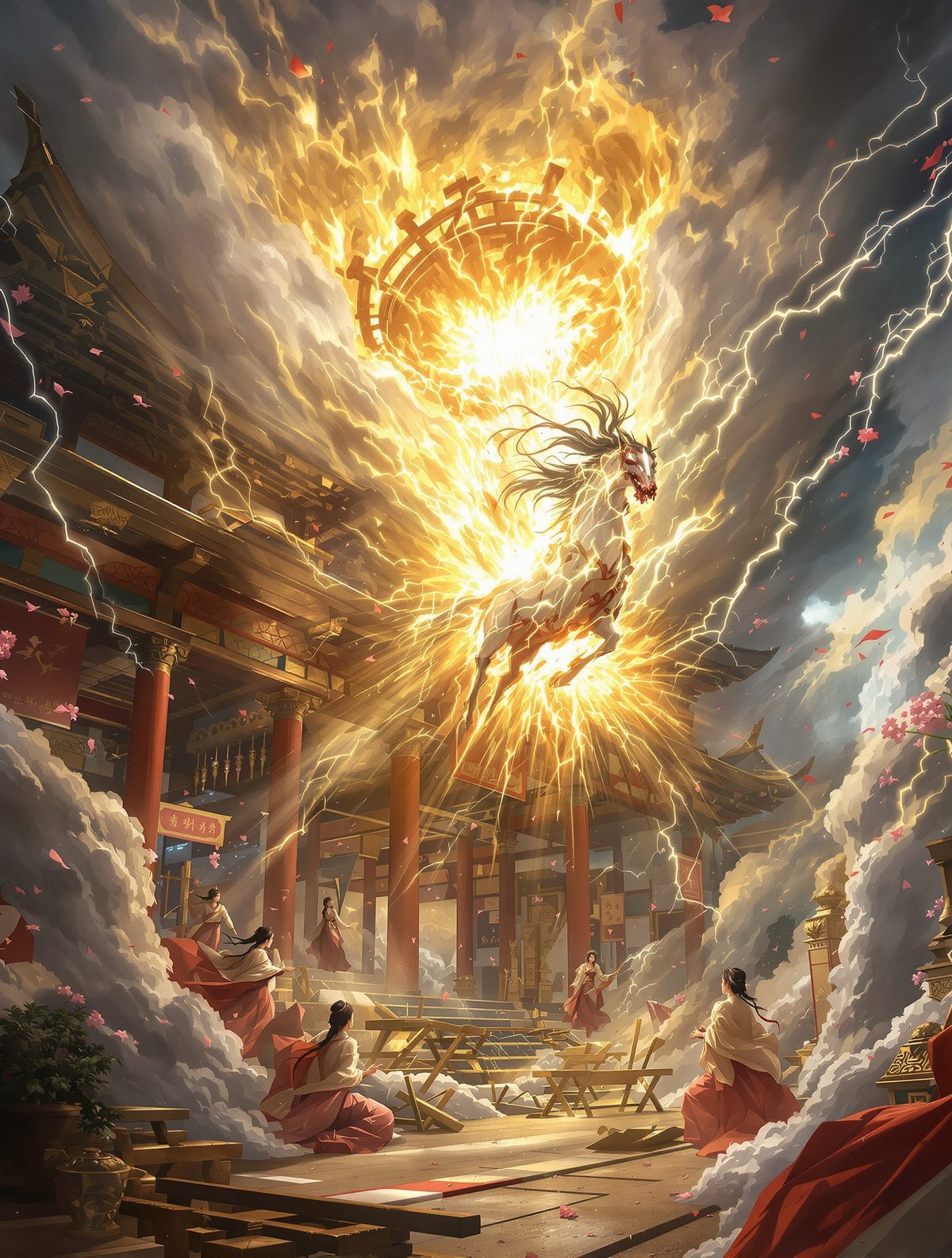
Picture this: the most sacred weaving hall in all existence, where divine maidens create the very fabric of reality under the gentle supervision of the sun goddess herself. Suddenly, the ceiling explodes inward in a shower of splintered wood and divine blood as a flayed horse crashes through the roof. The screams that follow aren't just of terror—they're the sound of cosmic order itself beginning to unravel.
This isn't a scene from a horror movie. It's one of the most shocking episodes in Japanese mythology, recorded in the Kojiki (712 CE) and Nihon Shoki (720 CE), Japan's oldest surviving chronicles. The perpetrator? Susanoo-no-Mikoto, the storm god whose jealous rage would literally plunge the world into darkness and nearly destroy the heavenly realm itself.
The Divine Dysfunction of Heaven's Royal Family
To understand the magnitude of Susanoo's rampage, you need to know that this wasn't just sibling rivalry—this was a conflict between fundamental forces of nature with the power to reshape reality itself. Born from the purification ritual of their father Izanagi after his traumatic return from the underworld, the three most powerful deities in the Shinto pantheon were essentially cosmic embodiments given divine form.
Amaterasu Omikami ruled the High Celestial Plain (Takamagahara) as the sun goddess, bringing light and order to the world. Her brother Tsukuyomi governed the night and moon. And then there was Susanoo—assigned dominion over the seas and storms, but consumed by a rage so profound that the very mountains trembled when he wept.
What many don't realize is that Susanoo's fury stemmed from a deep existential crisis. Unlike his siblings who embraced their cosmic roles, the storm god yearned to visit his mother Izanami in the underworld realm of Yomi. This wasn't mere homesickness—it was a fundamental rejection of the natural order that would have catastrophic consequences.
The Escalating Divine Conflict
The trouble began when Susanoo appeared at the gates of heaven, ostensibly to bid farewell to Amaterasu before departing for the underworld. But his sister, wise to his volatile nature, greeted him in full battle regalia. The earth shook, mountains crumbled, and the sea boiled from the sheer force of their divine energies clashing.
What happened next reveals a fascinating aspect of Shinto mythology often overlooked in popular retellings: the gods resolved their standoff through a contest of creation rather than destruction. Each deity would create new beings, with the "winner" determined by the gender and nobility of their offspring. Susanoo created five male deities from Amaterasu's jewelry, while she created three female deities from his sword.
By the contest's original terms, Amaterasu should have won—after all, the male deities came from her possessions. But Susanoo, displaying the kind of logical gymnastics that would make any frustrated sibling proud, declared himself the victor because he had "created" the male gods. Incredibly, Amaterasu accepted this reasoning and allowed him to remain in heaven.
This decision would prove to be catastrophic.
When Storm Gods Go Wild
What followed was essentially the mythological equivalent of the worst houseguest in history. Susanoo's "celebration" of his victory involved a systematic destruction of everything sacred in the heavenly realm. He filled in the irrigation channels of Amaterasu's divine rice fields—rice being not just sustenance but the very foundation of Japanese civilization and spiritual practice. He defecated in her sacred halls during the harvest festival, turning spaces of divine communion into scenes of unspeakable defilement.
But the storm god was just getting started. In a detail that reveals the sophisticated agricultural knowledge of ancient Japan, the myths describe how Susanoo destroyed the ridges between rice paddies—a seemingly small act that would actually cause flooding and ruin entire harvests. The ancient chroniclers understood that divine agriculture required the same careful water management that earthly farming demanded.
Each transgression was worse than the last, building to a crescendo of violence that would shock even modern audiences. And through it all, Amaterasu displayed a patience that speaks to the Japanese cultural values embedded in these tales—she made excuses for her brother, interpreting his actions in the most charitable light possible. Perhaps he was drunk, she reasoned. Perhaps his methods were crude but his intentions good.
This divine forbearance makes what happened next even more shocking.
The Flayed Horse and the Shattering of Order
The final act took place in the sacred weaving hall, where Amaterasu and her divine attendants worked at their looms creating the garments of the gods. This wasn't mere craft work—in Shinto belief, weaving was a sacred act that literally helped maintain the fabric of reality itself. The rhythmic working of the looms kept the cosmic order intact.
Into this scene of divine tranquility, Susanoo introduced absolute chaos. He flayed a "heavenly piebald horse"—not just any horse, but a sacred animal associated with divine messengers and seasonal festivals. The act of flaying was particularly horrific in Japanese culture, where the integrity of the body was considered essential to spiritual purity.
Then came the moment that would change everything: Susanoo hurled the bloody carcass through the roof of the weaving hall.
The psychological impact was immediate and devastating. One of the divine weaving maidens was so shocked that she injured herself fatally with her shuttle—a detail that underscores how even minor disruptions in the divine realm could have lethal consequences. The other maidens fled in terror, their cosmic work abandoned.
But most catastrophically of all, Amaterasu herself—the embodiment of light, order, and divine patience—finally reached her breaking point.
When the Sun Goddess Hides: The World's First Eclipse
Amaterasu's response to her brother's ultimate transgression was as dramatic as it was devastating: she retreated into the Heavenly Rock Cave (Ame-no-Iwato) and sealed herself inside with a massive boulder. In an instant, the world was plunged into eternal darkness.
This wasn't merely the absence of sunlight—this was the withdrawal of divine order itself. Crops failed, evil spirits roamed freely, and chaos reigned over both heaven and earth. The very concept of time became meaningless without the sun's cycle. What the ancient chroniclers were describing was essentially the end of the world as a functioning, ordered system.
The crisis required nothing less than the combined effort of eight million deities (yaoyorozu no kami) to resolve. Their solution reveals the sophisticated understanding of human psychology embedded in these ancient tales: they couldn't force Amaterasu out, but they could make her curious enough to emerge voluntarily.
The rescue plan involved the goddess Ame-no-Uzume performing what was essentially the world's first striptease outside the cave, causing such raucous laughter among the assembled deities that Amaterasu couldn't resist peeking out to see what was happening. When she did, her own reflection in a strategically placed mirror convinced her that another sun goddess had taken her place, prompting her to emerge fully—at which point the other gods quickly sealed the cave to prevent her return.
The Enduring Power of Divine Dysfunction
Susanoo's rampage and its aftermath reveal something profound about how ancient Japanese culture understood the relationship between order and chaos, family and society, individual desire and collective good. The storm god's punishment—banishment from heaven and the cutting of his divine beard and fingernails (symbols of his power)—wasn't just justice but a necessary restoration of cosmic balance.
Yet perhaps most remarkably, this wasn't the end of Susanoo's story. In his earthly exile, he would go on to become a hero, slaying the eight-headed, eight-tailed dragon Yamata-no-Orochi and founding important lineages. The mythology suggests that even destructive forces, properly channeled and humbled, can become sources of protection and renewal.
In our modern world of family dysfunction and social media outrage, there's something oddly contemporary about a story where unchecked anger destroys sacred spaces and forces positive forces into hiding. Susanoo's rampage reminds us that words and actions have consequences that ripple far beyond their immediate targets—and that sometimes, restoring light to the world requires the combined effort of an entire community working together with creativity, patience, and just a little bit of divine trickery.