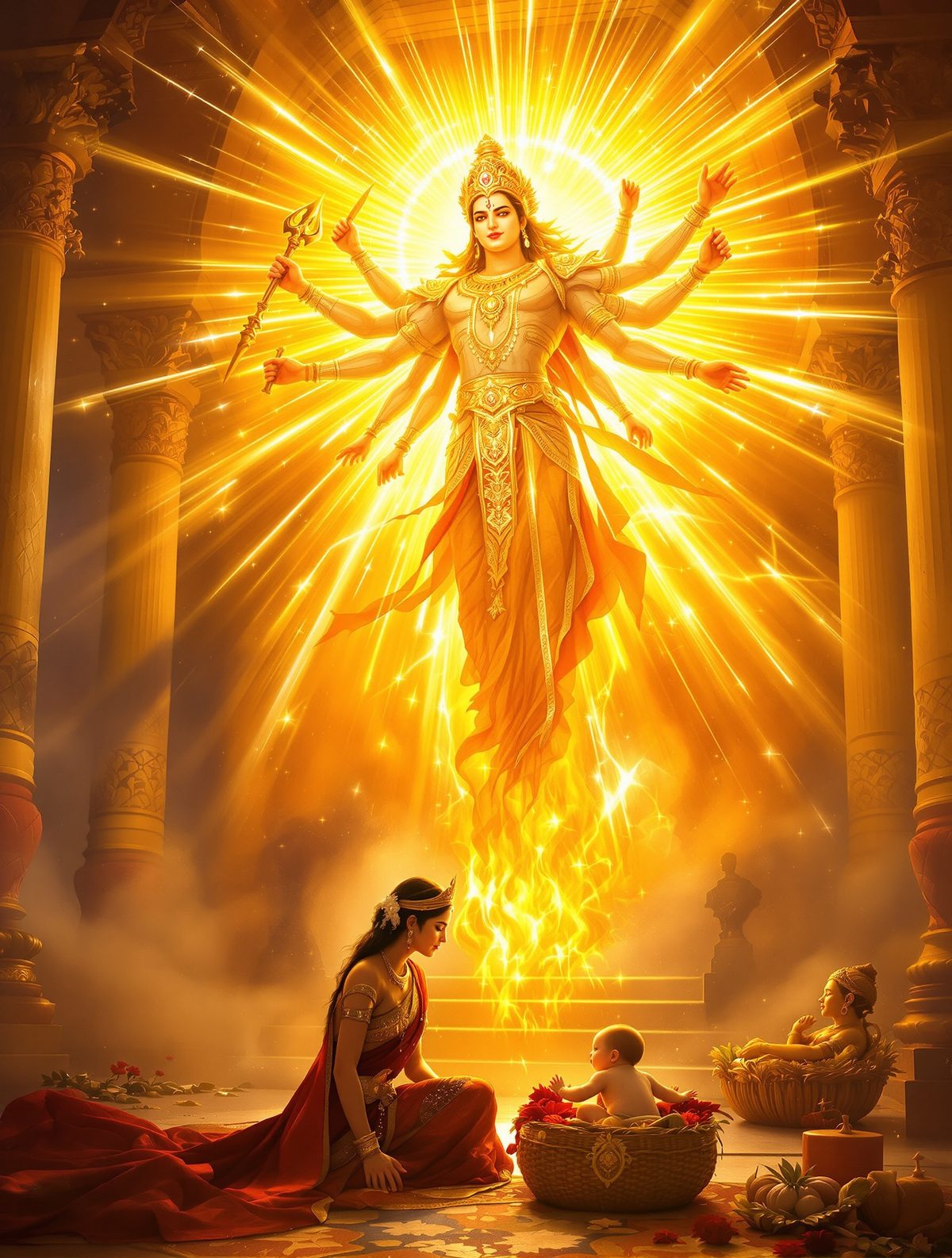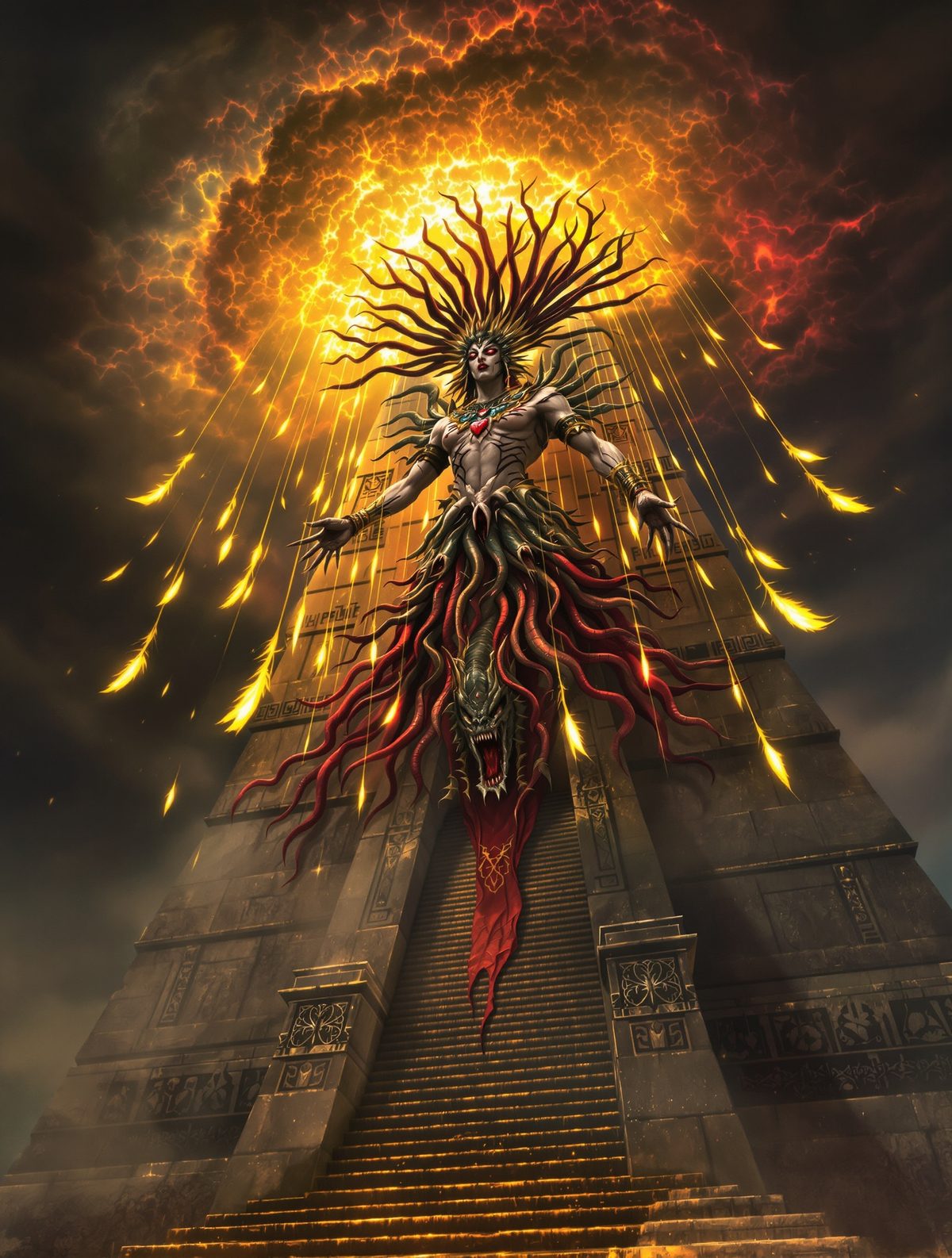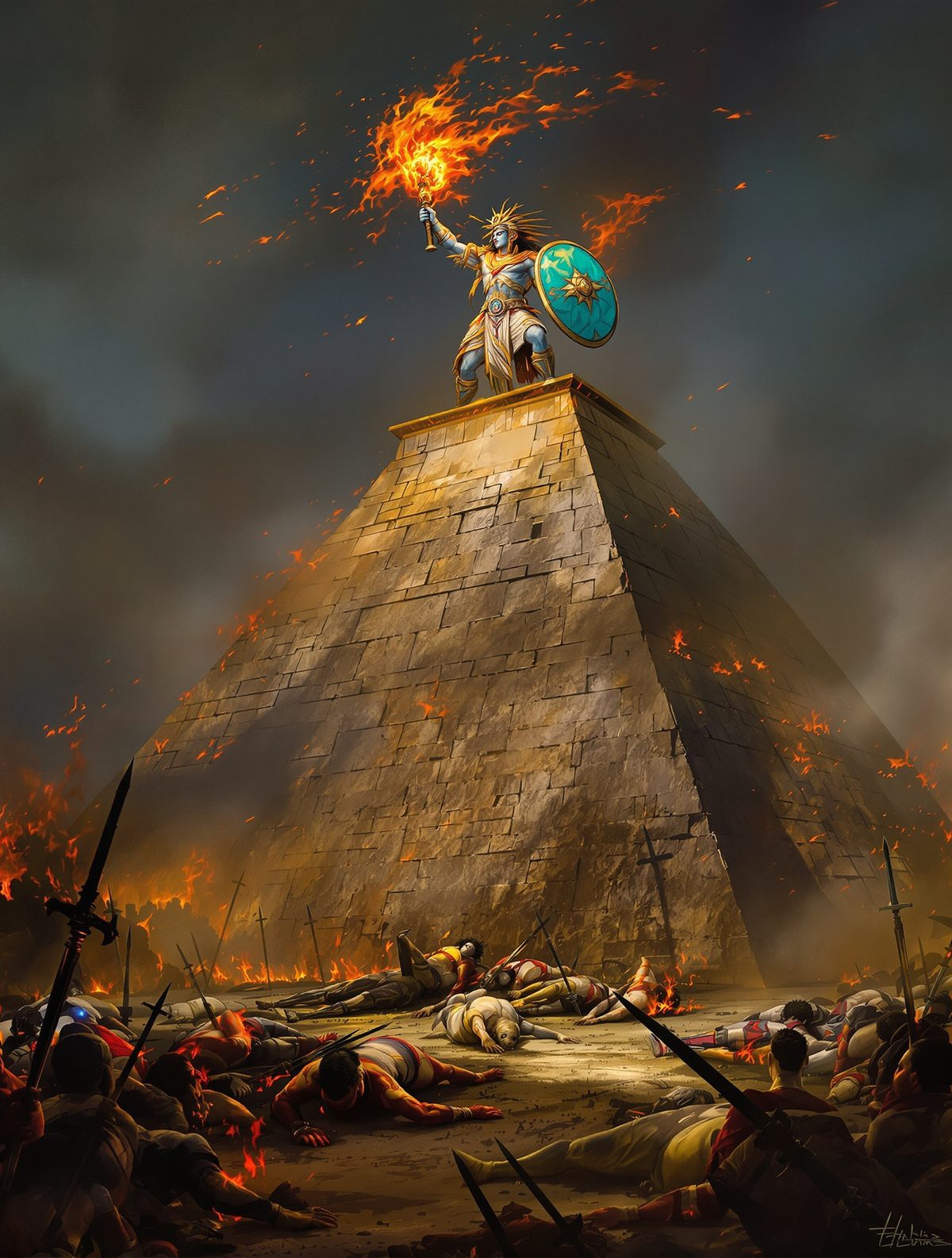
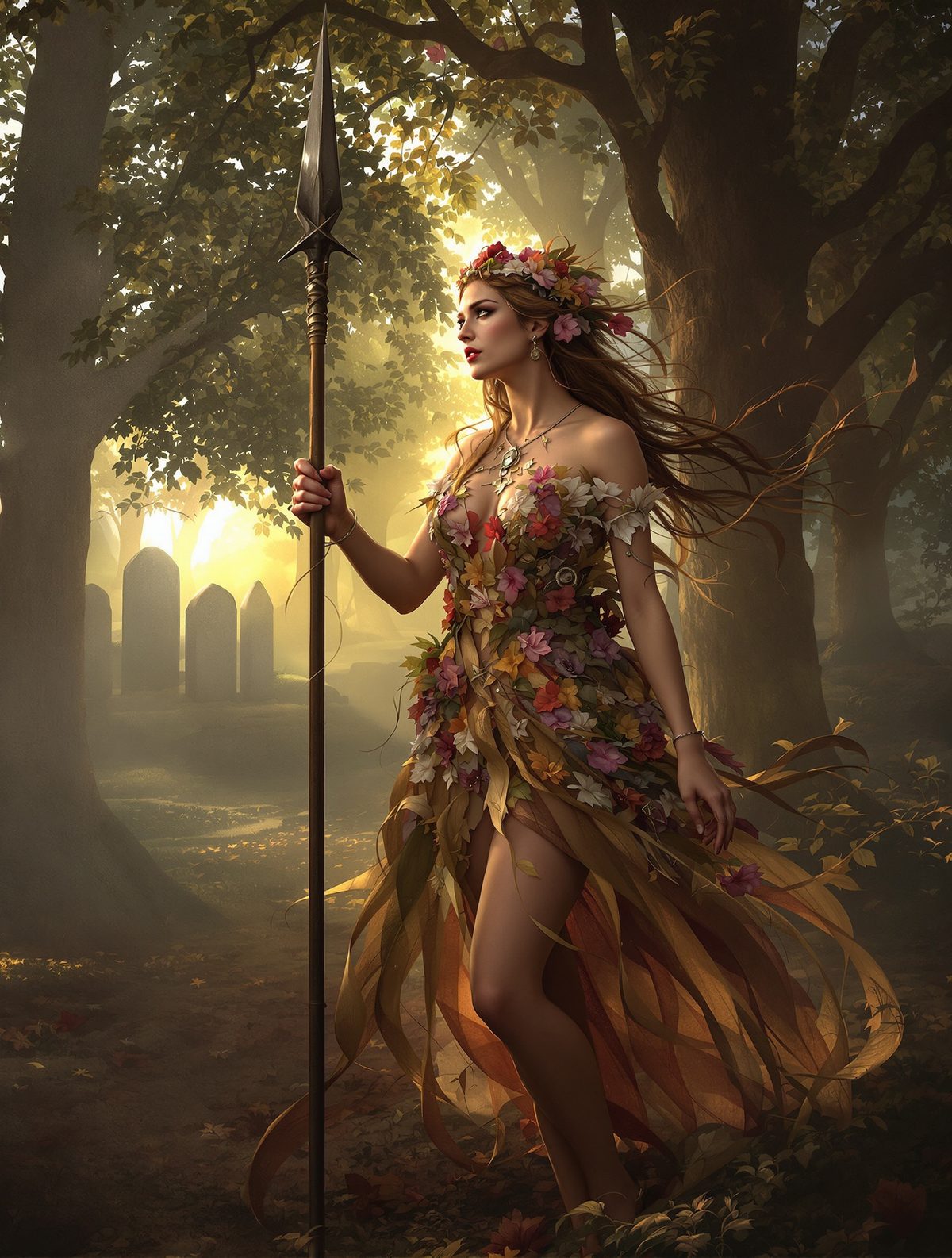
In the mist-shrouded hills of medieval Wales, where ancient oak groves whispered secrets older than memory, two master magicians committed an act that would reshape the very nature of love and betrayal. With hands that could bend reality itself, Math fab Mathonwy and his nephew Gwydion gathered oak blossoms, golden broom flowers, and sweet meadowsweet petals. What they created from these innocent blooms would become one of Celtic mythology's most haunting figures—a woman whose very existence was a contradiction, whose beauty masked a heart capable of orchestrating the perfect murder.
Her name was Blodeuwedd, meaning "flower face," and she was never meant to love anyone but the man for whom she was created. Yet in choosing her own heart over her magical bonds, she would set in motion a tale of passion, deception, and supernatural revenge that still echoes through Welsh folklore today.
The Curse That Demanded a Solution
To understand Blodeuwedd's story, we must first grasp the impossible situation that led to her creation. Lleu Llaw Gyffes, whose name means "Bright One of the Skillful Hand," was no ordinary prince. Born through magical deception when his uncle Gwydion tricked the virgin goddess Arianrhod into giving birth, Lleu faced a trilogy of devastating curses from his furious mother.
Arianrhod's three-fold doom was precise and cruel: Lleu would receive no name except from her lips, bear no arms unless she gave them, and—most devastating of all—never take a wife "of the race that is now upon this earth." The first two curses Gwydion had cleverly circumvented through shapeshifting trickery, but the third seemed insurmountable. How do you find a wife for a man when no mortal woman may wed him?
The answer lay in creation itself. Math and Gwydion, two of the most powerful magicians in the Mabinogion—the collection of Welsh tales that preserves these ancient stories—decided to craft a bride from the very essence of the earth. They chose their materials with symbolic precision: oak for strength and endurance, broom for humility and cleanliness, and meadowsweet for love and happiness. What emerged from their botanical alchemy was a woman of such breathtaking beauty that even the birds fell silent when she passed.
The Perfect Wife's Imperfect Heart
Blodeuwedd appeared to be everything a magical bride should be. Tall and graceful, with skin like petals and hair that caught sunlight like spun gold, she seemed the very embodiment of springtime itself. Math and Gwydion presented her to Lleu with great ceremony, and the young lord was instantly smitten. They wed in a grand celebration, and Lleu granted her dominion over his lands in Ardudwy, in what is now northwestern Wales, while he traveled on royal business.
But here lies one of the tale's most psychologically fascinating elements: Blodeuwedd possessed free will. Despite being magically crafted for one purpose, she retained the fundamental human capacity for choice—a detail that distinguishes Welsh mythology from many other traditions where created beings remain enslaved to their makers' intentions. This freedom, however, would prove to be both her greatest gift and her most dangerous quality.
For while Lleu saw in Blodeuwedd the perfect wife, she experienced their marriage as a beautiful prison. Created specifically to love one man, she found herself yearning for something—or someone—else entirely. The flowers from which she was made may have given her beauty, but they could not dictate her heart's desires.
When Gronw Pebr Came Hunting
Destiny arrived in Blodeuwedd's life in the form of Gronw Pebr, Lord of Penllyn, who came hunting near her castle while Lleu was away. The moment their eyes met, both were lost. Medieval Welsh poetry describes such instant, overwhelming love as serch—a passion so intense it was considered almost supernatural in itself.
What followed was no mere affair but a complete abandonment of the magical bonds that had shaped Blodeuwedd's existence. For three nights, she and Gronw were lovers, and in those nights, she made a choice that would doom them all. She would help Gronw kill her husband.
But Lleu Llaw Gyffes was no ordinary man to be dispatched with sword or poison. His very nature was bound up with light and divinity—his name connects him to the Celtic god Lugus, associated with skill, craft, and solar power. Killing such a being required more than mortal weapons; it demanded the unraveling of cosmic protections that had been woven around him since birth.
The Impossible Murder Plot
What Blodeuwedd accomplished next reveals her as one of mythology's most cunning conspirators. With the skill of a master spy, she began to extract from her trusting husband the exact conditions under which he could be killed—information so specific and seemingly impossible that Lleu revealed it without suspicion.
The conditions were elaborate to the point of absurdity: Lleu could only be slain at twilight, neither day nor night. He must be neither inside nor outside a building, neither on foot nor on horseback. The weapon could only be a spear that had been forged for exactly one year, worked on only during sacred hours when people attended mass. Most incredibly, he had to be in a specific position—standing with one foot on the edge of a bath and the other on the back of a goat, with a curved roof of thatch over the bath.
These weren't random conditions but precise magical safeguards, each element designed to make his death virtually impossible. The liminal timing (twilight), the threshold positioning (neither in nor out, neither walking nor riding), and the sacred manufacture of the weapon all reflect deep Celtic beliefs about the nature of magical protection.
Blodeuwedd listened to each impossible condition and filed it away. Then, with breathtaking audacity, she convinced Lleu to demonstrate this "impossible" position, claiming she was worried about his safety and wanted to understand the danger. Like Eve offering the apple, she made betrayal seem like loving concern.
The Moment of Perfect Murder
For an entire year, Gronw Pebr secretly forged the required spear, working on it only during mass times when the community gathered in prayer. When the weapon was complete and the moment ripe, Blodeuwedd set her trap with flawless precision.
As Lleu balanced in the exact position his magical protections required—one foot on the bath's edge, one on the goat's back, the thatched roof curving overhead—Gronw emerged from hiding. The spear flew true, striking Lleu in the side. But rather than dying like a mortal man, the wounded lord transformed into an eagle and soared away, disappearing into the Welsh mountains with a cry of anguish that supposedly echoed across all of Gwynedd.
For Blodeuwedd and Gronw, the plan had worked perfectly. They claimed Lleu's lands and ruled together as lovers, believing themselves free at last. But they had underestimated the vengeance of a master magician who had just lost his carefully crafted nephew.
The Price of Betrayal
Gwydion's fury was terrible to behold. Using his powers of tracking and transformation, he followed the eagle-Lleu through the mountains until he found him, wounded and wasting away at the top of an ancient oak tree. Through magical healing and careful nurturing, Gwydion restored his nephew to human form and health.
The revenge that followed was swift and symbolic. Gronw Pebr, faced with Lleu's demand for satisfaction, begged to place a stone between himself and the vengeful lord's spear. Lleu agreed—then threw his weapon with such force that it pierced both stone and man. The perforated stone, known as Llech Ronw, supposedly still stands in Wales as testament to this supernatural revenge.
But it was Blodeuwedd's punishment that reveals the true genius of Celtic storytelling. Rather than simply destroying his creation, Gwydion chose a fate that was both poetic and eternal. He transformed her into an owl—a creature forever associated with darkness, solitude, and betrayal. "You shall not dare show your face ever again in the light of day," he declared, "for fear of all the other birds. And there shall be enmity between you and all other birds, and it shall be their nature to mob and molest you wherever they find you."
Why Blodeuwedd Still Matters
In our modern world of dating apps and divorce courts, Blodeuwedd's story might seem like ancient history. Yet her tale speaks to timeless questions that remain painfully relevant: Can love be manufactured or must it arise naturally? What happens when duty conflicts with desire? Is it possible to betray someone you were literally created to love?
Blodeuwedd represents something rarely seen in ancient literature—a female character who chooses her own path, even when that choice leads to destruction. She wasn't seduced or corrupted; she made a calculated decision to pursue love on her own terms, regardless of the magical bonds that tied her to another fate. In a world where women were often treated as property to be exchanged between men, she claimed agency over her own heart and body.
Her transformation into an owl—forever separated from the daylight world, eternally hunted by other birds—serves as both punishment and a strange kind of liberation. She became something wild and untamed, no longer bound by human expectations or magical compulsions. Perhaps Gwydion's curse was also, in its way, the gift of absolute freedom.
Today, when we struggle with questions of authentic love versus arranged relationships, of individual choice versus social obligation, Blodeuwedd's flower face still haunts us from the shadows. Her story reminds us that even the most perfect creation may harbor an imperfect heart—and that sometimes, the most beautiful betrayals are also the most human.