In the pre-dawn darkness of ancient Hastinapura, a teenage princess made a decision that would echo through millennia. Princess Kunti, daughter of the Yadava king Shurasena, held in her trembling hands the most dangerous gift imaginable: the power to summon any deity at will. What happened next would create the greatest warrior the world had ever seen—and tear a mother's heart in two.
The sacred mantra had been gifted to her by the irascible sage Durvasa, pleased by her devoted service during his stay at her father's palace. But mantras of such power were not meant to be tested lightly. They were cosmic keys that could unlock forces beyond mortal comprehension. Yet Kunti, barely sixteen and burning with curiosity, could not resist the temptation to see if the ancient words truly held divine power.
The Sage's Dangerous Gift
Sage Durvasa was notorious throughout the ancient world for his volcanic temper and swift curses. Kings trembled at his approach, knowing that the slightest discourtesy could bring destruction upon their kingdoms. Yet when he arrived at King Shurasena's court, young Princess Kunti served him with such grace, patience, and devotion that even this famously wrathful sage was moved to gratitude.
The mantra he granted her was no ordinary blessing. Known in Sanskrit as the "Akshaya Mantra," it possessed the terrifying power to compel any deity—from the mightiest of the Trimurti to the humblest celestial being—to appear before the summoner and grant them a child. In the cosmic hierarchy of ancient India, this was tantamount to holding the reins of creation itself.
But Durvasa's gift came with an unspoken weight of responsibility. Such power was traditionally reserved for married queens seeking heirs for their kingdoms, not unmarried princesses driven by adolescent curiosity. The sage departed without explaining the full implications of his boon, leaving Kunti with a weapon she didn't fully understand.
When the Sun God Blazed Forth
On that fateful morning, as the first hint of dawn touched the eastern sky, Kunti stood alone on her palace balcony. The irony of her choice was exquisite—summoning Surya, the sun god, at the very moment when his golden chariot was beginning its daily journey across the heavens. Perhaps she thought the proximity of sunrise would make his appearance less dramatic, more natural. She was catastrophically wrong.
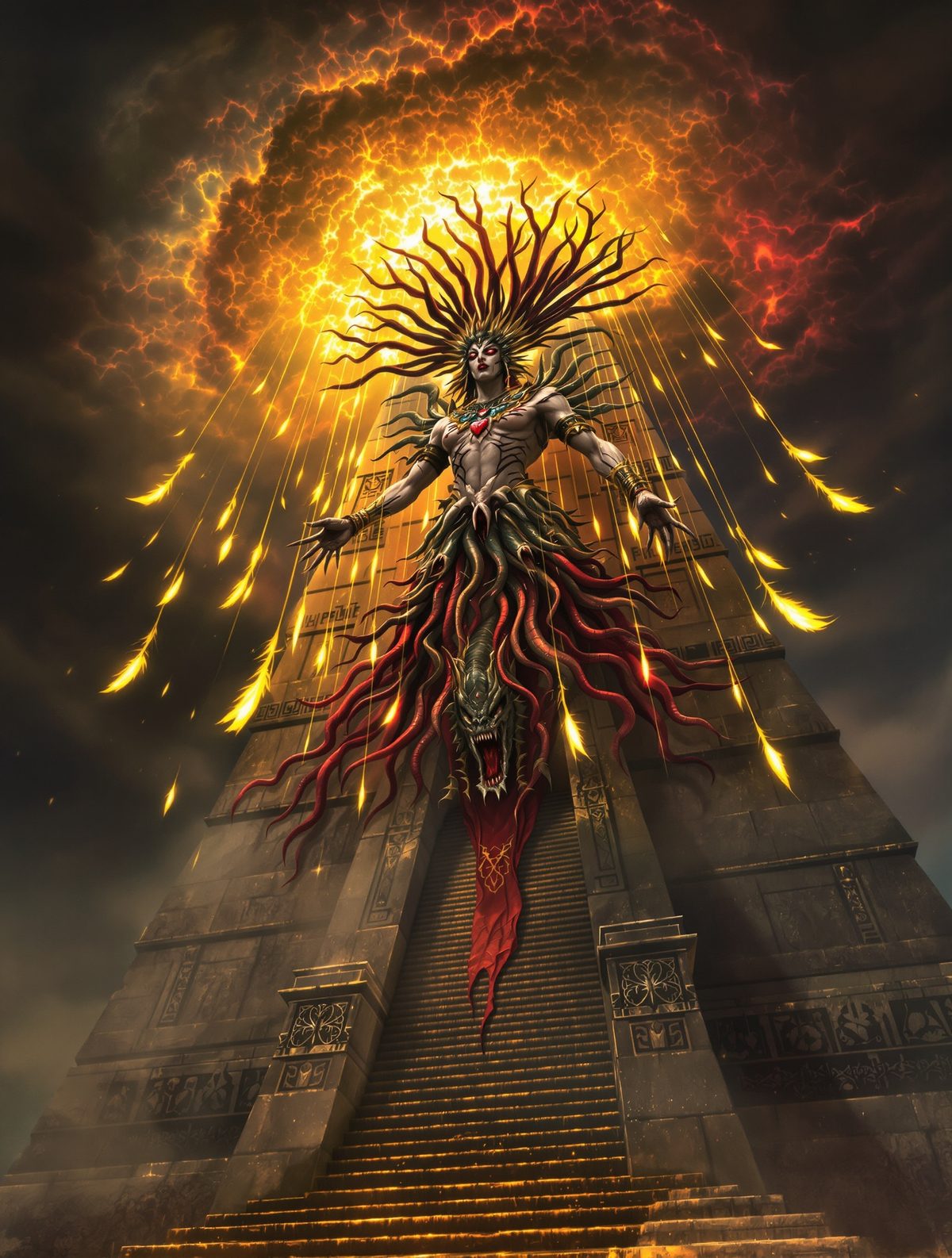
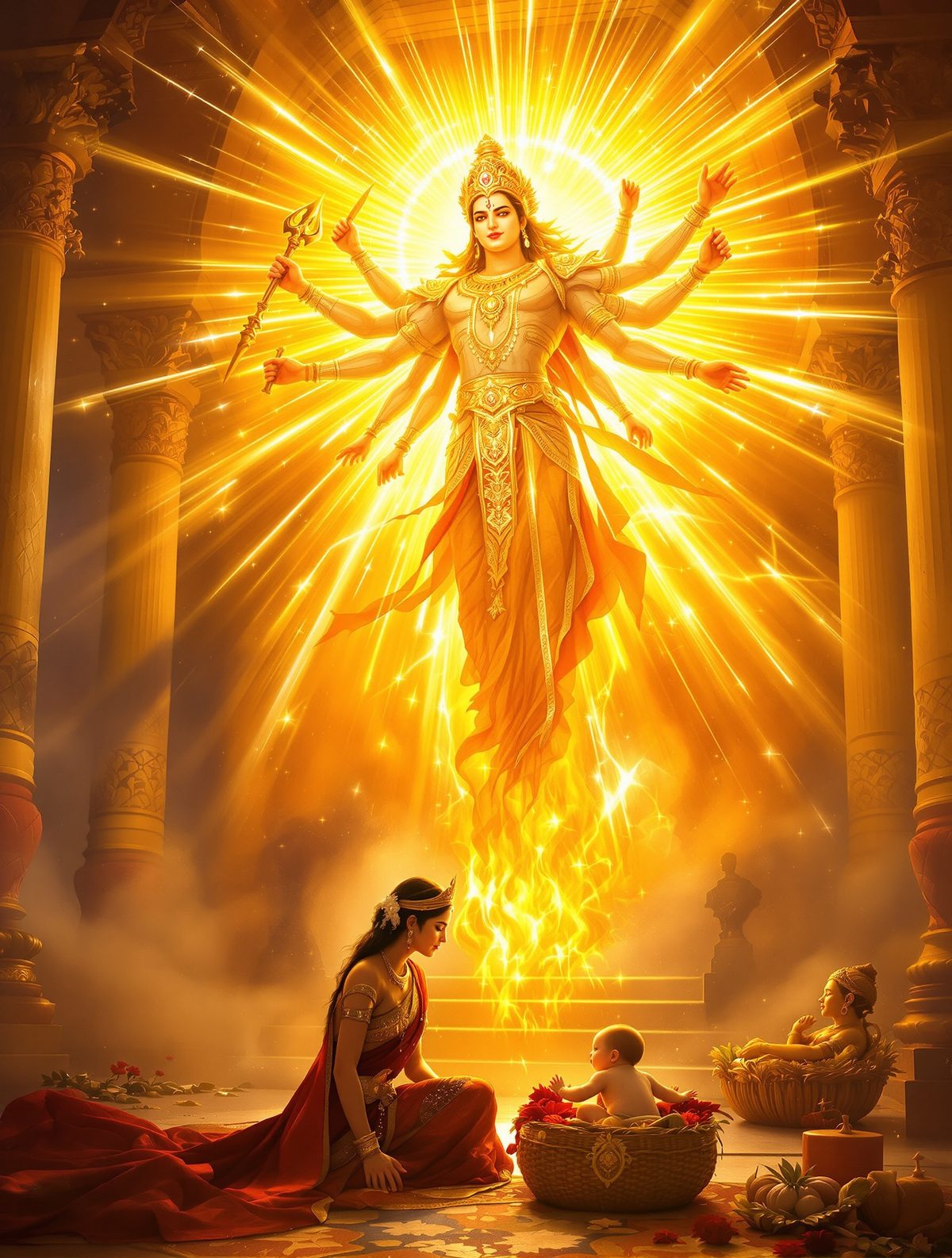
The moment the ancient syllables left her lips, reality itself seemed to convulse. The gentle pre-dawn light exploded into a blazing inferno that made the midday sun seem dim by comparison. Surya manifested not as a gentle morning deity, but in his full cosmic glory—a being of such radiant power that his very presence threatened to incinerate everything within miles.
Ancient texts describe Surya's divine form in breathtaking detail: crowned with flames that danced like living gold, his body radiating light from seven different cosmic fires, riding his chariot drawn by seven horses each representing a different ray of the sun. His appearance was so overwhelming that even the gods themselves were said to avert their eyes when beholding his true form.
Kunti fell to her knees, instantly realizing the magnitude of her mistake. This was no gentle garden spirit or playful celestial messenger—this was one of the fundamental forces of the universe, compelled by cosmic law to grant her request.
The Birth of a Legend
What followed defied every natural law. Surya, bound by the irrevocable power of the mantra, blessed Kunti with immediate conception and birth. In a matter of moments that stretched like hours, she felt the divine child growing within her, born not of human gestation but of pure solar energy and divine will.
The child emerged into the world already bearing the gifts of his divine father. Most remarkably, he was born wearing Kavacha and Kundala—divine golden armor and earrings that were not mere ornaments but integral parts of his very being. This armor, forged from crystallized sunlight itself, would make him virtually invulnerable to any earthly weapon. The earrings glowed with inner fire, marking him as a son of Surya for any who had the wisdom to recognize the signs.
But perhaps most striking of all was the child's radiance. Like his divine father, he seemed to emit his own light, his skin glowing with a golden luminescence that marked him as no ordinary mortal. Ancient chroniclers would later describe how his very presence could illuminate a dark room, and how his golden armor blazed like a second sun on the battlefield.
The infant was perfect in every way—beautiful beyond description, already showing signs of the incredible strength and nobility that would define his life. Yet to Kunti, gazing upon this divine child, he represented not joy but terror.
A Mother's Impossible Choice
In the rigid social structure of ancient India, an unmarried princess bearing a child faced a fate arguably worse than death. The scandal would not only destroy her own life but bring dishonor upon her entire lineage. Her future marriage prospects would evaporate, her father's kingdom could face diplomatic catastrophe, and the child himself would be branded as illegitimate, forever barred from his rightful place in society.
For three agonizing days, Kunti held her divine son, torn between maternal love and social reality. She studied every feature of his perfect face, memorizing the way the light played across his golden skin, listening to his strong heartbeat that seemed to drum with the rhythm of the cosmos itself. The child showed no signs of ordinary infant helplessness—his eyes held an ancient wisdom, and his tiny hands grasped with surprising strength.
But courage in the face of divine power is different from courage in the face of social destruction. The same princess who had dared to summon a god now found herself paralyzed by the thought of her father's disappointment and society's judgment.
In the end, maternal love took the cruelest form imaginable. Believing she was saving her son from a life of illegitimate shame, Kunti made the heartbreaking decision to abandon him, trusting that his divine nature would protect him where her mortal love could not.
The River's Mercy
The Ashwanadi River, a tributary of the mighty Ganga, had witnessed countless offerings over the millennia—flowers, prayers, and sacred objects cast upon its waters by devoted pilgrims. But never had it received so precious a cargo as the basket that floated gently downstream on that morning of profound sorrow.
Kunti had crafted the basket herself from the finest materials she could gather without arousing suspicion—silk cloth blessed by temple priests, cushions stuffed with the softest cotton, and waterproofed with sacred oils. She had placed within it what little she could give her son: a small amount of gold, a piece of cloth bearing the royal insignia that might someday reveal his true parentage, and a letter she could never send, explaining the choice that was breaking her heart.
The child—who would grow up to be known as Karna, meaning "the one who peeled away" his mother's heart—did not cry as his basket drifted from shore. Ancient texts suggest that even as an infant, he possessed an otherworldly understanding of his fate. His golden armor caught the morning sunlight, creating ripples of light across the water that seemed almost like a divine blessing upon his journey.
The river, as if understanding the sacred nature of its charge, carried the basket gently downstream toward a destiny none could have imagined. The child who had been abandoned by royalty was floating toward adoption by a humble charioteer named Adhiratha and his wife Radha, who would raise him with more love and devotion than many princes ever received.
The Legacy of a Secret That Changed History
The child in the basket would grow up to become Karna, the greatest archer of his age and one of the most complex figures in all of world literature. Despite being raised by adoptive parents of humble station, his divine heritage could not be suppressed. He became a warrior of such skill that he could split arrows in mid-flight and shoot down celestial weapons with mortal ones.
Yet the cruel irony of his story was only beginning. Years later, during the great Kurukshetra War, Karna would find himself fighting against his own half-brothers—the Pandavas, who were also sons of Kunti, born through her later use of the same divine mantra after her marriage. Neither side knew the truth: that the greatest enemy of the Pandavas was their own elder brother, and that Kunti was forced to watch in agonized silence as her children prepared to kill each other.
The secret she had kept to protect her reputation ultimately led to the most tragic fratricide in mythological history. Only in the final moments of Karna's life would the truth emerge, too late to change anything but not too late to reveal the devastating cost of shame and social expectation.
Today, in an age when we speak of reproductive rights, single parenthood, and the courage to make impossible choices, Kunti's story resonates with startling contemporary relevance. Her tale reminds us that the intersection of divine power and human weakness creates not just heroes and legends, but real people facing impossible decisions with consequences that echo through generations. The princess who summoned a god but couldn't face society's judgment embodied a very human truth: that sometimes our greatest failures of courage create the very legends that outlast our fears.