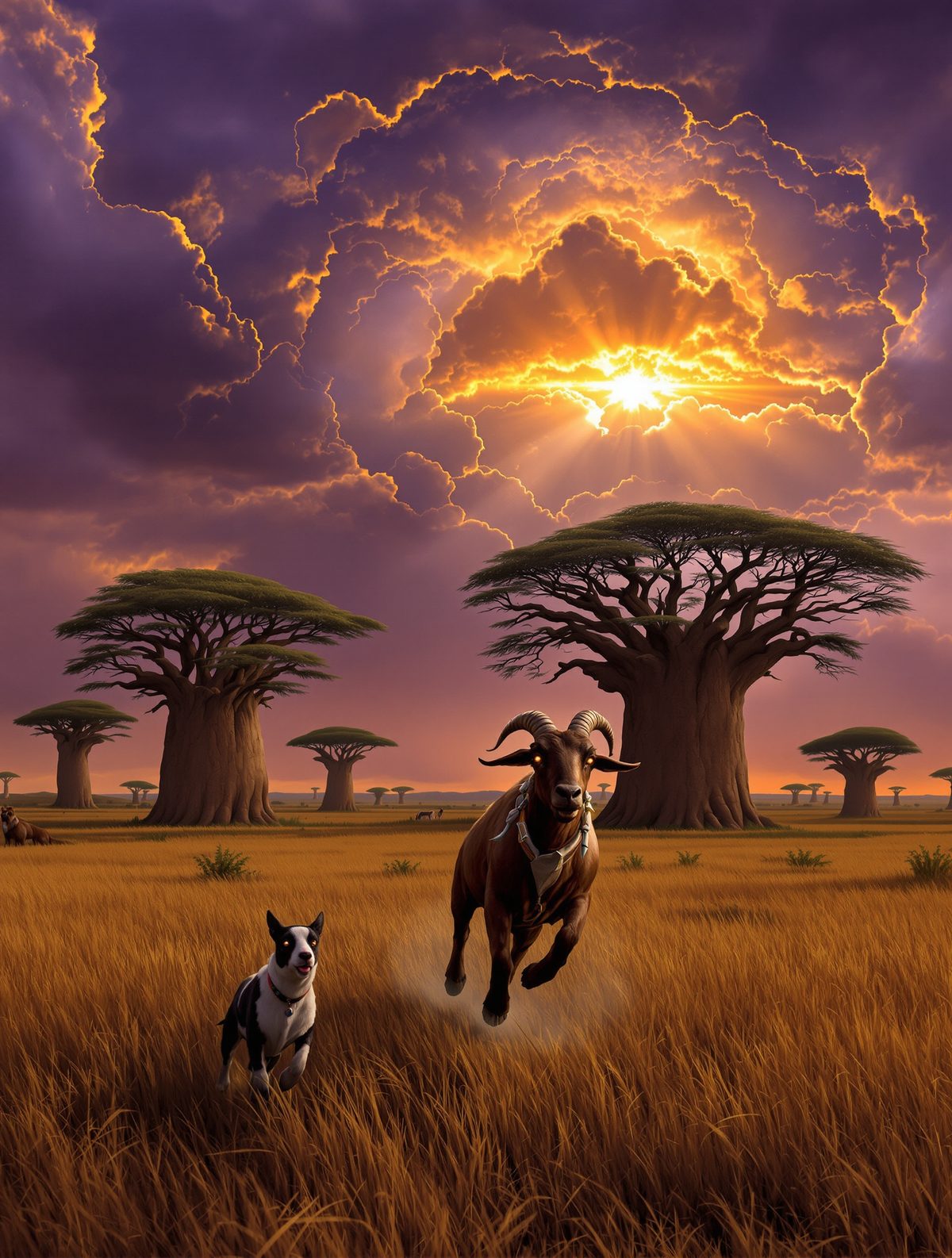
Picture this: the fate of all humanity hanging in the balance between a lazy dog with good intentions and an ambitious goat carrying terrible news. In the sprawling oral traditions of West Africa's Akan people, stretching across modern-day Ghana and Côte d'Ivoire, this isn't just another animal fable—it's the cosmic explanation for why humans must face death, told around countless fires for over a millennium.
Long before European missionaries arrived with their own creation stories in the 15th century, the Akan had already woven intricate mythologies explaining life's greatest mysteries. At the center of their spiritual universe sat Nyame, the supreme sky god whose name literally means "he who knows and sees all." And according to the griots and storytellers who preserved these tales across generations, Nyame once held the power to grant humanity something we've dreamed of ever since: eternal life.
The Sky God's Generous Heart
In the beginning, when the world was still young and malleable, Nyame looked down from his celestial throne with compassion for the humans he had helped create. These early people—emerging from the rich red earth that still characterizes much of Ghana today—lived simple lives in harmony with nature, but they carried a heavy burden: the knowledge that their time was limited.
The Akan storytellers describe Nyame as a deity of infinite wisdom, governing not just the sky but the very fabric of existence. Unlike the distant, unknowable gods of some mythologies, Nyame was intimately concerned with human welfare. Archaeological evidence from sites like Begho and Bono Manso suggests that by 1000 CE, the Akan had already developed sophisticated religious practices centered around this sky deity, with elaborate festivals and rituals marking the agricultural calendar.
Moved by humanity's plight, Nyame made a momentous decision. He would send a message to Earth—not just any message, but a divine decree that would fundamentally alter the human condition. The chosen messenger was Dog, an animal the Akan revered for its loyalty and connection to the spiritual realm. In Akan cosmology, dogs weren't merely pets or hunting companions; they were psychopomps, creatures capable of moving between the world of the living and the realm of the ancestors.
The message Dog carried was breathtakingly simple yet profound: "You shall not die. You shall live forever." Seven words that would transform humanity's destiny, eliminating the specter of mortality that had haunted every generation since the beginning of time.
An Eavesdropper's Fatal Ambition
But Nyame's court was not a place of privacy. In the vibrant mythology of the Akan, the sky realm bustled with activity—spirits, ancestors, and animals all played their roles in the cosmic drama. Among these celestial beings was Goat, and Goat had been listening.
What motivated Goat's fateful decision varies across different versions of the story, collected by ethnographers like R.S. Rattray in the early 20th century. Some traditions paint Goat as jealous of Dog's trusted position as Nyame's messenger. Others suggest a deeper, more troubling motivation: Goat had its own message to deliver, one that would establish a very different kind of cosmic order.
As Dog prepared for the journey to Earth—a spiritual odyssey that would take him through multiple realms of existence—Goat made its move. Without Nyame's knowledge or blessing, this uninvited messenger bounded ahead, determined to reach humanity first. The race that followed would determine the fate of every human being who would ever live.
Here's where the story reveals its sophisticated understanding of character and consequence. Goat wasn't simply fast; it was driven. While Dog traveled at a steady pace, secure in the importance of its mission, Goat sprinted ahead with single-minded determination. The Akan storytellers understood something profound about the nature of good and evil: sometimes darkness prevails not through superior strength, but through superior urgency.
The Fateful Pause That Changed Everything
Dog's downfall came from a very human weakness: the inability to resist immediate gratification. Partway through the journey to Earth, Dog encountered something irresistible—food. The specific nature of this temptation varies by region and storyteller. Some versions describe a feast left by generous villagers, others a cache of bones too delicious to ignore. But the result was always the same: Dog stopped to eat.
This moment of weakness speaks to the Akan understanding of how destiny unfolds. It's not through grand gestures or cosmic battles that fate is decided, but through small choices, momentary lapses in judgment, the accumulated weight of tiny decisions. Dog's pause to satisfy its hunger would echo through all of human history.
Meanwhile, Goat pressed on, covering the vast spiritual distance between Nyame's realm and the human world below. The geography of this journey, as described in Akan oral tradition, mirrors the actual landscape of ancient Ghana—dense forests giving way to savanna, rivers to be crossed, mountains to be climbed. These weren't just mythological spaces but recognizable landmarks that gave the story tangible reality for its listeners.
When Goat finally arrived among the early humans, it delivered its own version of Nyame's message. But this version carried a cruel twist: "You shall die. Death has come to stay among you." The words fell like stones into still water, sending ripples of mortality spreading outward to touch every human life that would follow.
The Message That Sealed Humanity's Fate
By the time Dog arrived, belly full and spirit satisfied, the damage was irreversible. The humans had already received Goat's message, and in the logic of Akan mythology, the first divine decree carried permanent weight. Dog delivered Nyame's original message of eternal life, but it was too late—death had already taken root in the human experience.
The aftermath reveals the sophisticated moral universe of Akan storytelling. This wasn't a simple tale of good versus evil, but a complex meditation on responsibility, timing, and the irreversible nature of certain choices. Nyame, despite his divine power, didn't simply reverse Goat's message. The sky god's respect for the cosmic order meant that even he was bound by certain rules—once spoken, divine words carried permanent weight.
Some versions of the story describe Dog's anguish upon discovering what had happened. The loyal messenger, who had carried hope for all humanity, now bore the weight of having failed in the most important mission ever entrusted to any creature. This emotional dimension adds layers of tragedy to what might otherwise be a simple cautionary tale about gluttony or laziness.
The Akan understanding of this mythological moment was nuanced. Death wasn't presented as purely evil—it was simply different from what Nyame had originally intended. In many West African cosmologies, death serves important functions: it creates urgency, drives achievement, and maintains the balance between the world of the living and the realm of the ancestors.
Echoes Across Cultures and Centuries
What makes this Akan myth particularly fascinating is how it resonates with similar stories across Africa and beyond. The Zulu have their own version involving a chameleon and a lizard. Among the Shona people of Zimbabwe, it's a hare and a frog who race with messages of life and death. These parallel narratives suggest either ancient cultural exchange or universal human concerns about mortality and divine justice.
European ethnographers, encountering these stories during the colonial period, often dismissed them as primitive folklore. But modern anthropologists recognize their sophisticated exploration of philosophical questions that continue to challenge human thinking. How do individual choices affect collective destiny? What role does timing play in shaping outcomes? Can good intentions excuse harmful results?
The story also reflects the Akan understanding of divine-human relationships. Unlike mythologies where gods are distant and unknowable, Nyame is presented as genuinely concerned with human welfare. The tragedy isn't that the sky god is cruel or indifferent, but that even divine benevolence can be thwarted by the actions of secondary characters—a surprisingly modern view of how complex systems can produce unintended outcomes.
Why Ancient Wisdom Still Matters
In our age of instant communication and global connectivity, the tale of Dog and Goat carries unexpected relevance. Every day, we witness how misinformation can outrun truth, how the loudest voice often drowns out the most accurate one, how a moment's distraction can have cascading consequences.
The Akan storytellers who preserved this myth understood something we're still learning: that the most important messages don't always arrive first, and that the responsibility for delivering truth requires not just good intentions but unwavering focus. In a world where false information spreads faster than factual reporting, where social media algorithms reward engagement over accuracy, Nyame's test feels less like ancient mythology and more like prophetic warning.
Perhaps most importantly, this story reminds us that our individual choices—Dog's decision to stop and eat, Goat's decision to race ahead with a darker message—ripple outward in ways we can barely comprehend. The next time we're faced with the choice between doing something right and doing something fast, we might remember two animals racing toward humanity with the power to determine our ultimate destiny, and ask ourselves: which messenger are we?