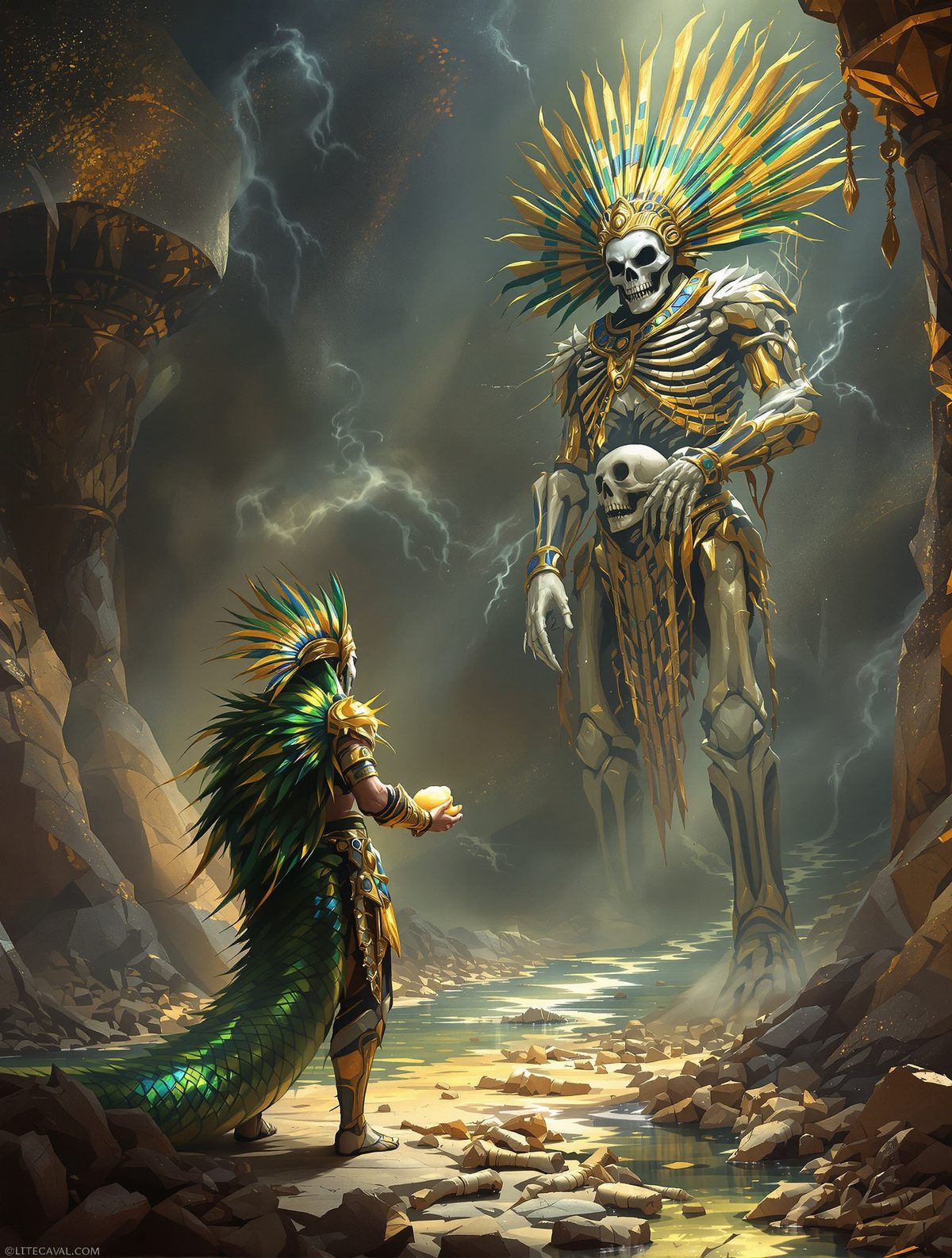
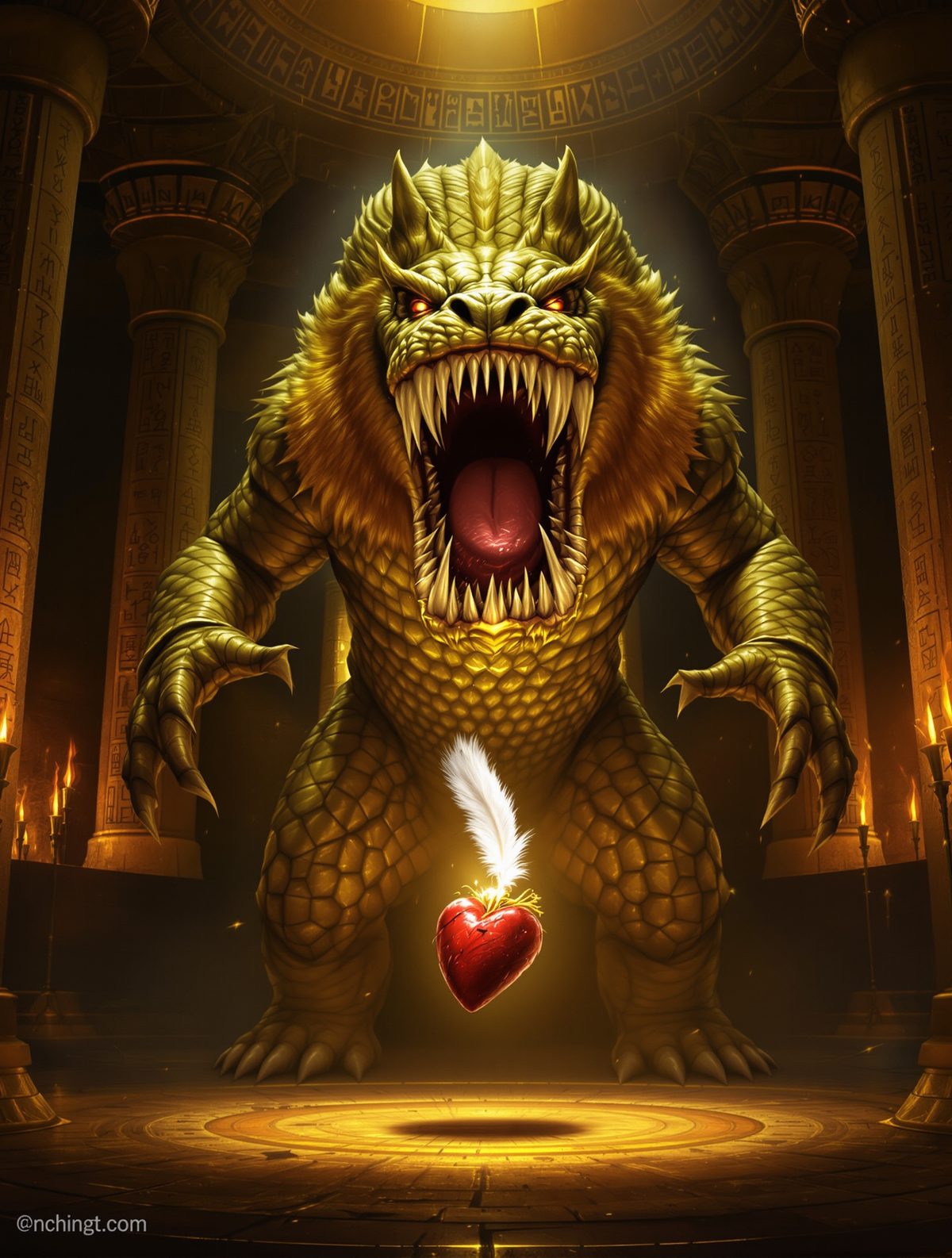
Picture this: You've lived a full life in ancient Egypt, died, and now stand in a vast hall gleaming with gold and lapis lazuli. Your mummified body lies far behind you—this is your soul's final test. The jackal-headed god Anubis approaches, holding your still-beating heart in one hand. On golden scales, he places it opposite a single white feather. You pray to every god you know that your heart doesn't tip the balance, because lurking in the shadows is a creature so terrifying that even the gods fear her hunger. Meet Ammit—part crocodile, part lion, part hippopotamus—and if those scales tip the wrong way, she will devour not just your heart, but your very existence for all eternity.
This isn't just death. This is something far worse than anything your worst nightmares could conjure. This is complete and utter annihilation of the soul.
The Hall Where Eternity Hangs in the Balance
The ancient Egyptians called it the Hall of Two Truths, though most souls who entered probably wished they'd never heard of it. Located in the Duat—the Egyptian underworld—this cosmic courtroom served as the ultimate testing ground for every person who had ever lived. Archaeological evidence from tombs dating back to 2055 BCE shows elaborate paintings of this hall adorning burial chambers, suggesting that even pharaohs trembled at the thought of facing judgment here.
The hall stretched impossibly wide, its ceiling supported by columns carved to resemble papyrus plants that seemed to sway in an otherworldly breeze. Forty-two divine judges sat in attendance, each representing a different sin or moral failing. These weren't minor infractions either—we're talking about lies, theft, adultery, murder, and dozens of other transgressions that could damn a soul. The deceased had to recite the "Negative Confession," a list of 42 declarations beginning with "I have not..." covering everything from "I have not stolen" to the oddly specific "I have not fouled the water."
But here's the fascinating part: even if you recited every line perfectly, your heart still had to prove your innocence. Ancient Egyptians believed the heart was the seat of intelligence, emotion, and moral character—not the brain, which they unceremoniously removed during mummification and threw away. Your heart literally carried the weight of every sin, every cruel word, every selfish act. And Ammit could smell deception from across the cosmic courtroom.
When Gods Created the Perfect Destroyer
Ammit wasn't born—she was designed. The ancient texts describe her as having the head of a Nile crocodile, the torso and front legs of a lion, and the hindquarters of a hippopotamus. This wasn't random monster-making; the Egyptians chose the three most feared animals in their world, creatures responsible for more deaths along the Nile than any other beasts. Crocodiles could snatch a person in seconds, lions were apex predators of the desert, and hippos—despite their seemingly docile appearance—killed more humans than any other large animal in Africa.
But here's what most people don't realize: Ammit wasn't evil. In Egyptian theology, she served a crucial cosmic function. She was Ma'at's enforcer—the goddess of truth, justice, and cosmic order. Without Ammit, the universe would become polluted with corrupt souls, throwing the entire cosmic balance into chaos. She was terrifying, yes, but she was also necessary. The Egyptians understood that some form of ultimate justice had to exist, even if it came with crocodile teeth.
Ancient papyri from Thebes, dating to around 1550 BCE, reveal that Ammit had epithets that would make your blood run cold: "Devourer of the Dead," "Soul-Crusher," and most chilling of all, "She Who Feeds on Hearts." Unlike other Egyptian deities who had temples and worshippers, Ammit received no prayers, no offerings, no festivals. She simply waited, patient as death itself, for the scales to tip in her favor.
The Weighing: When Your Heart Betrays You
The actual moment of judgment was called the "Weighing of the Heart," and surviving papyri give us incredibly detailed accounts of how this cosmic trial unfolded. The deceased would watch as Anubis, with surgical precision, extracted their heart—somehow still intact and beating despite their death. The heart would be placed on one side of golden scales so sensitive they could detect the weight of a single lie.
On the other side sat the feather of Ma'at—not just any feather, but the feather that represented absolute truth and moral purity. Ancient texts suggest this feather was so light it seemed to float rather than rest on the scale, white as fresh snow and perfectly straight. Modern scholars have calculated that this feather would weigh approximately 0.6 grams—meaning your heart had to be virtually weightless with sin to pass the test.
Thoth, the ibis-headed god of wisdom and writing, served as the cosmic stenographer, recording the results with a reed pen on papyrus that would preserve the verdict for eternity. If your heart balanced perfectly with the feather—a moment depicted in tomb paintings as bathed in golden light—you would proceed to the Field of Reeds, the Egyptian version of paradise.
But if your heart sank even slightly... that's when Ammit stirred from her patient vigil.
The Devouring: A Fate Worse Than Hell
What happened next was so terrifying that Egyptian mortuary texts devoted entire chapters to avoiding it. Ammit would approach with movements described as both graceful and utterly menacing—the fluid gait of a lion combined with the unstoppable advance of a hippo and the lightning-quick reflexes of a crocodile. Her jaws, lined with razor-sharp teeth, would open wide enough to swallow a human heart in a single bite.
Here's the truly horrifying part: this wasn't just physical destruction. When Ammit devoured a heart, she consumed the person's ba and ka—the essential spiritual components that made up their eternal soul. The victim didn't go to hell or purgatory; they simply ceased to exist. No afterlife, no reincarnation, no spiritual continuation of any kind. They were erased from existence so completely that it was as if they had never been born.
Ancient Egyptians called this fate "the second death," and they feared it more than any torture the imagination could devise. To die was natural; to be unmade was cosmic horror. Surviving family members couldn't even pray for the devoured soul because there was literally nothing left to pray for. The person's name would be struck from family records, their mummy destroyed, and their memory actively erased from history.
Archaeological evidence from the Valley of the Kings shows that even pharaohs invested fortunes in magical protections against Ammit. Tutankhamun's tomb, discovered by Howard Carter in 1922, contained multiple amulets specifically designed to keep the heart light during judgment—including scarab beetles inscribed with spells commanding the heart not to testify against its owner.
The Soul Eater's Hunger Never Ends
What made Ammit particularly terrifying was her patience. Unlike gods who might show mercy or demons who could be bargained with, Ammit was incorruptible. She felt no satisfaction from devouring souls, no pleasure from their terror, no anger at their sins. She was cosmic justice personified—as inevitable as gravity and as impartial as mathematics.
Ancient texts describe her as being perpetually hungry, not from gluttony, but because human corruption provided an endless feast. The "Book of the Dead," compiled around 1550 BCE, contains over 200 spells designed to help souls pass the weighing of the heart, suggesting that most ancient Egyptians fully expected to fail the test. They lived their entire lives knowing that a crocodile-headed monster waited to judge their every action.
But here's a fascinating detail that historians often overlook: Ammit's presence actually encouraged moral behavior. Knowing that every lie made your heart heavier, every act of kindness made it lighter, the ancient Egyptians developed one of history's most sophisticated ethical systems. They weren't just afraid of Ammit—they were motivated by her to become better people.
When Legends Refuse to Die
Today, more than 3,000 years after the last pharaoh ruled Egypt, Ammit's legend continues to captivate us. She appears in modern movies, video games, and novels—always as a creature of ultimate judgment and inescapable justice. But perhaps what makes her story so enduring isn't the monster herself, but what she represents: the deeply human fear that our actions matter, that justice exists beyond human law, and that some sins are too great for forgiveness.
In our modern world, where accountability often seems negotiable and consequences can be avoided with enough money or influence, Ammit represents something both terrifying and strangely comforting. She embodies the idea that ultimate justice exists—that somewhere, somehow, the scales will balance, and no amount of power or privilege can save a truly corrupt heart from being weighed and found wanting.
The ancient Egyptians understood something we sometimes forget: that the possibility of irreversible consequences makes our choices meaningful. Without Ammit waiting in the shadows, would the weighing of the heart have any weight at all?