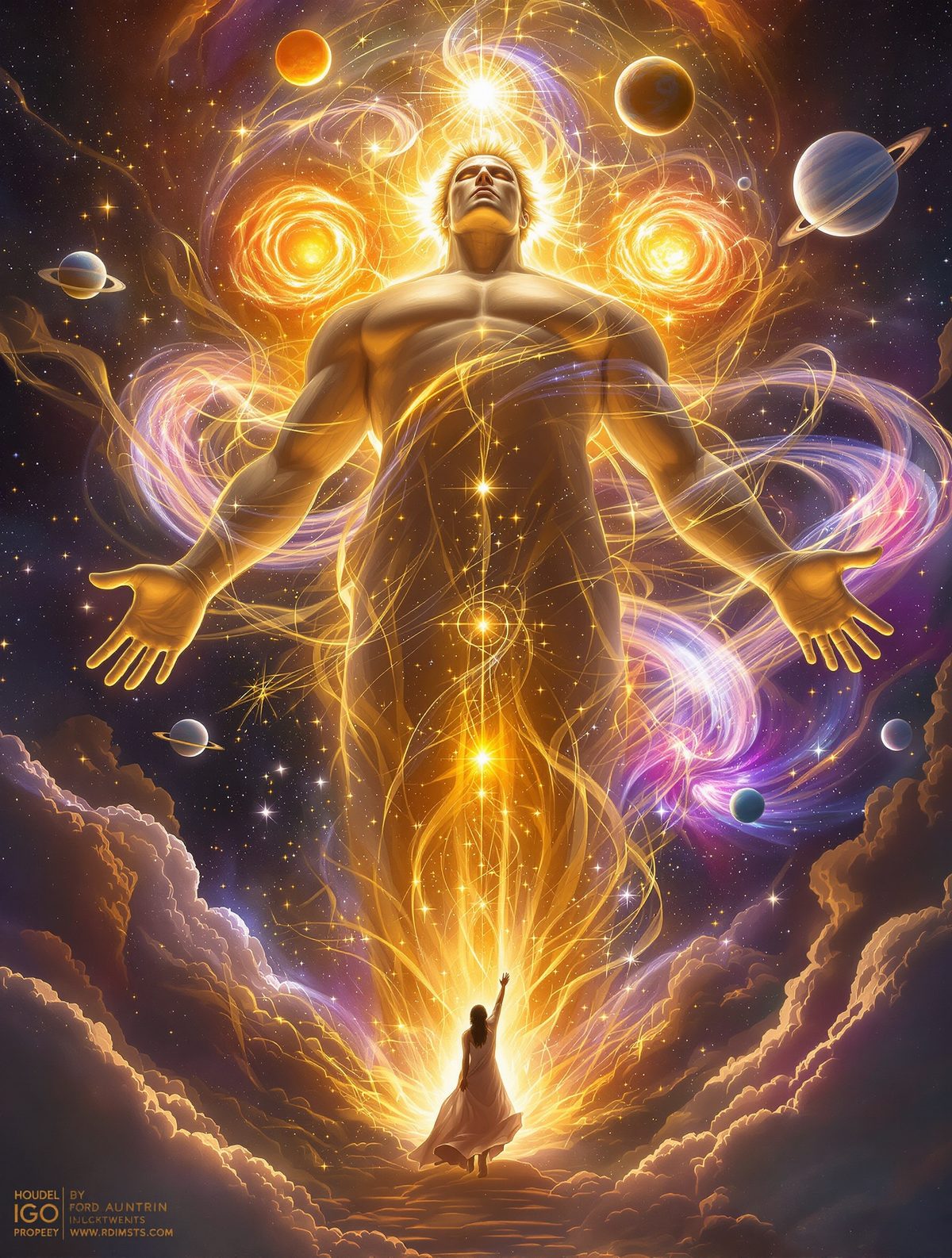
Picture this: before the first star ignited, before matter and energy danced their cosmic ballet, there existed only one being—a giant so vast that his body contained every possibility that would ever unfold. This was Purusha, whose very name means "cosmic person," and whose willing sacrifice would birth everything you see, feel, and breathe. But here's what your mythology textbooks never told you: this wasn't just another creation story. It was humanity's first attempt to explain quantum physics, consciousness, and the fundamental interconnectedness of all existence—written down over 3,000 years ago.
The Purusha Sukta, found in the tenth mandala of the Rig Veda (composed around 1500-1200 BCE), tells perhaps the most psychologically sophisticated creation myth ever conceived. While other cultures imagined gods molding clay or speaking words into existence, ancient Vedic seers envisioned something far more profound: a universe born from the ultimate act of self-sacrifice, where divinity literally becomes reality.
The Cosmic Giant Who Contained Everything
Imagine a being so immense that he possessed not just a thousand heads, but a thousand eyes and a thousand feet. The Rig Veda tells us Purusha was sahasrashirsha purusho sahasrakshah sahasrapat—and yet, even with this infinite multiplicity, he still exceeded the earth by ten fingers' breadth. This wasn't mere poetic exaggeration; it was a sophisticated metaphor for consciousness itself.
Here's what's truly mind-bending: according to the hymn, only one-quarter of Purusha became the manifest universe. Three-quarters of his being remained transcendent, existing beyond space and time. Ancient Vedic thinkers had essentially described what modern physics calls the observable universe—that tiny fraction of reality we can actually perceive and measure, floating in an ocean of dark matter and dark energy we can barely comprehend.
But Purusha wasn't just big—he was everything. Every potential mountain, every future ocean, every star that would someday burn, every thought that would ever be conceived—all of it existed within his cosmic form as pure possibility. The Vedic seers understood something remarkable: that consciousness and cosmos were not separate phenomena, but two aspects of a single, underlying reality.
The Gods' Ultimate Dilemma
Now comes the twist that makes this myth psychologically brilliant: the gods themselves were somehow born from Purusha, yet they needed to sacrifice him to create the universe. This paradox—that the gods exist within the very being they must dismember—points to one of the deepest insights in Vedic philosophy.
The devas (gods) who performed the sacrifice weren't external entities with their own agenda. They represented the organizing principles of consciousness itself—the cosmic intelligence that transforms pure potential into manifest reality. When the Vedic rishis spoke of Indra wielding his thunderbolt or Agni consuming offerings, they were describing psychological and cosmic processes, not literal divine beings sitting on golden thrones.
The sacrifice took place at the cosmic level, but also within the depths of consciousness itself. This wasn't a one-time historical event—it was the eternal process by which undifferentiated awareness becomes the multiplicity of experience. Every moment, consciousness "sacrifices" its unity to become the diversity of thoughts, sensations, and perceptions.
The Dismemberment That Created Everything
What happened next reads like the universe's most sacred anatomy lesson. When the gods dismembered Purusha's willing form, each part became a fundamental aspect of reality with stunning precision:
His mind became the moon—not just the celestial body, but the principle of reflection, memory, and cyclic time. Ancient Indians understood that consciousness wasn't produced by the brain, but channeled through it, like moonlight reflecting the sun's brilliance.
His eyes transformed into the sun, becoming not merely the source of light, but the cosmic principle of illumination, knowledge, and spiritual insight. The Sanskrit word for sun, surya, shares roots with words meaning "to shine" and "to see"—connecting physical light with the light of awareness itself.
From his breath came vayu, the wind, but also the vital force that animates all living beings. This wasn't just meteorology; it was recognition that the same energy that moves atmospheric currents also powers the rhythm of your heartbeat and the firing of your neurons.
His mouth became Indra and Agni—the gods of storms and fire respectively—representing the power of speech, the consuming nature of hunger and desire, and the transformative energy that breaks down the old to birth the new.
Perhaps most remarkably, his navel became the atmosphere, that delicate layer between earth and sky where life can exist. The Vedic rishis understood that consciousness, like biological life, requires a precise balance of conditions to flourish.
The Social Order Emerges
Here's where the myth takes a controversial turn that has shaped Indian society for millennia. According to the Purusha Sukta, the four varnas (social classes) emerged from different parts of Purusha's body: Brahmins (priests) from his mouth, Kshatriyas (warriors) from his arms, Vaishyas (merchants) from his thighs, and Shudras (laborers) from his feet.
This passage has been used to justify rigid caste hierarchies for over two thousand years, but the original vision was far more nuanced. The hymn wasn't prescribing social inequality—it was describing the organic specialization necessary for any complex society to function. Just as a body needs different organs working in harmony, society requires different groups contributing their unique talents.
What's often overlooked is that all four varnas came from the same divine source. The Brahmin's mouth and the Shudra's feet were equally sacred parts of Purusha's cosmic form. The tragedy is how this organic vision of social cooperation became corrupted into systems of oppression and exclusion—a perversion of the original teaching that all existence shares the same divine essence.
Sacrifice as Cosmic Principle
The most profound aspect of Purusha's myth isn't the creation itself, but what it reveals about the fundamental nature of existence: everything that lives participates in an ongoing cosmic sacrifice. The sun sacrifices hydrogen to create light. Plants sacrifice sunlight to grow. Animals sacrifice plants to survive. Humans sacrifice time and energy to create meaning.
This wasn't the morbid obsession with death that some scholars suggest, but a radical insight into interconnectedness. The Sanskrit word yajna (sacrifice) doesn't just mean giving something up—it means participating consciously in the cosmic circulation of energy and intelligence that sustains all life.
Every breath you take participates in Purusha's eternal sacrifice. Oxygen atoms that once flowed through dinosaur lungs now power your cells. Carbon from ancient supernovas forms the proteins in your muscles. You are literally made from the dismembered body of a cosmic giant, and someday your atoms will contribute to future beings in ways you can't imagine.
The Eternal Return
Perhaps most remarkably, the Purusha Sukta suggests that this cosmic sacrifice isn't a one-time event, but an eternal process. Purusha continuously offers himself so that existence can unfold, moment by moment. Creation isn't something that happened in the distant past—it's happening right now, in the space between your thoughts, in the pause between heartbeats.
Modern physics has arrived at a similar conclusion through different means. Quantum field theory tells us that what we call "empty space" is actually alive with virtual particles constantly popping into and out of existence. The vacuum itself sacrifices its apparent nothingness to birth the dance of matter and energy we call reality.
The Vedic rishis intuited what we're only now beginning to understand scientifically: consciousness and cosmos are not separate phenomena, but aspects of a single, self-organizing intelligence that manifests as the multiplicity of experience while remaining fundamentally unified.
When you truly grasp the implications of Purusha's sacrifice, everything changes. You're not a separate individual struggling for survival in a hostile universe—you're a unique expression of the same cosmic intelligence that births stars and guides the migration of butterflies. Your consciousness isn't produced by your brain—it's the eternal awareness of Purusha himself, experiencing reality through the temporary lens of your particular nervous system.
This ancient myth offers something our fragmented modern world desperately needs: a vision of existence that is simultaneously scientific and sacred, recognizing that the universe isn't a collection of separate objects, but a single, magnificent being continuously offering itself so that the dance of life can continue. In remembering Purusha's sacrifice, we remember who we truly are.