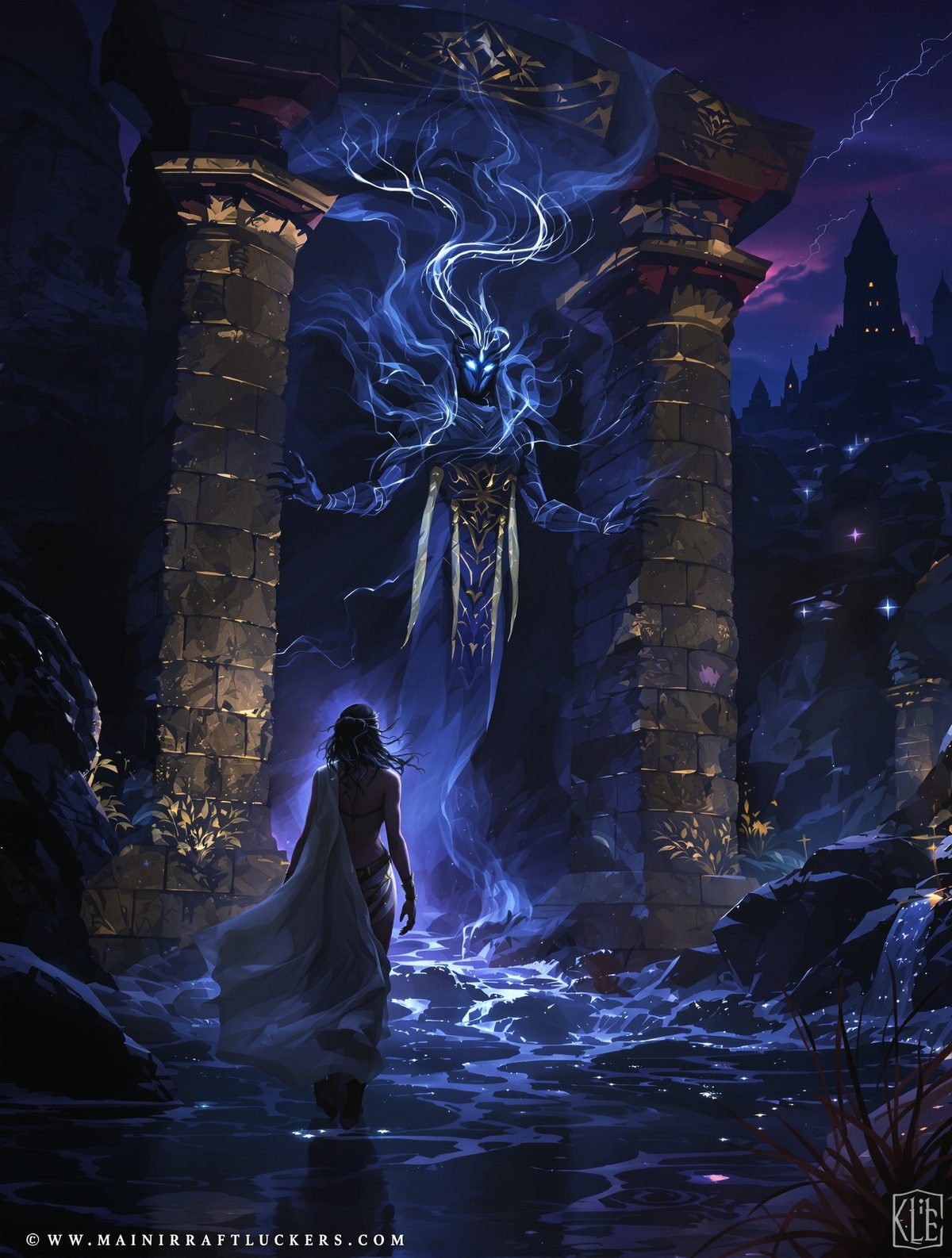
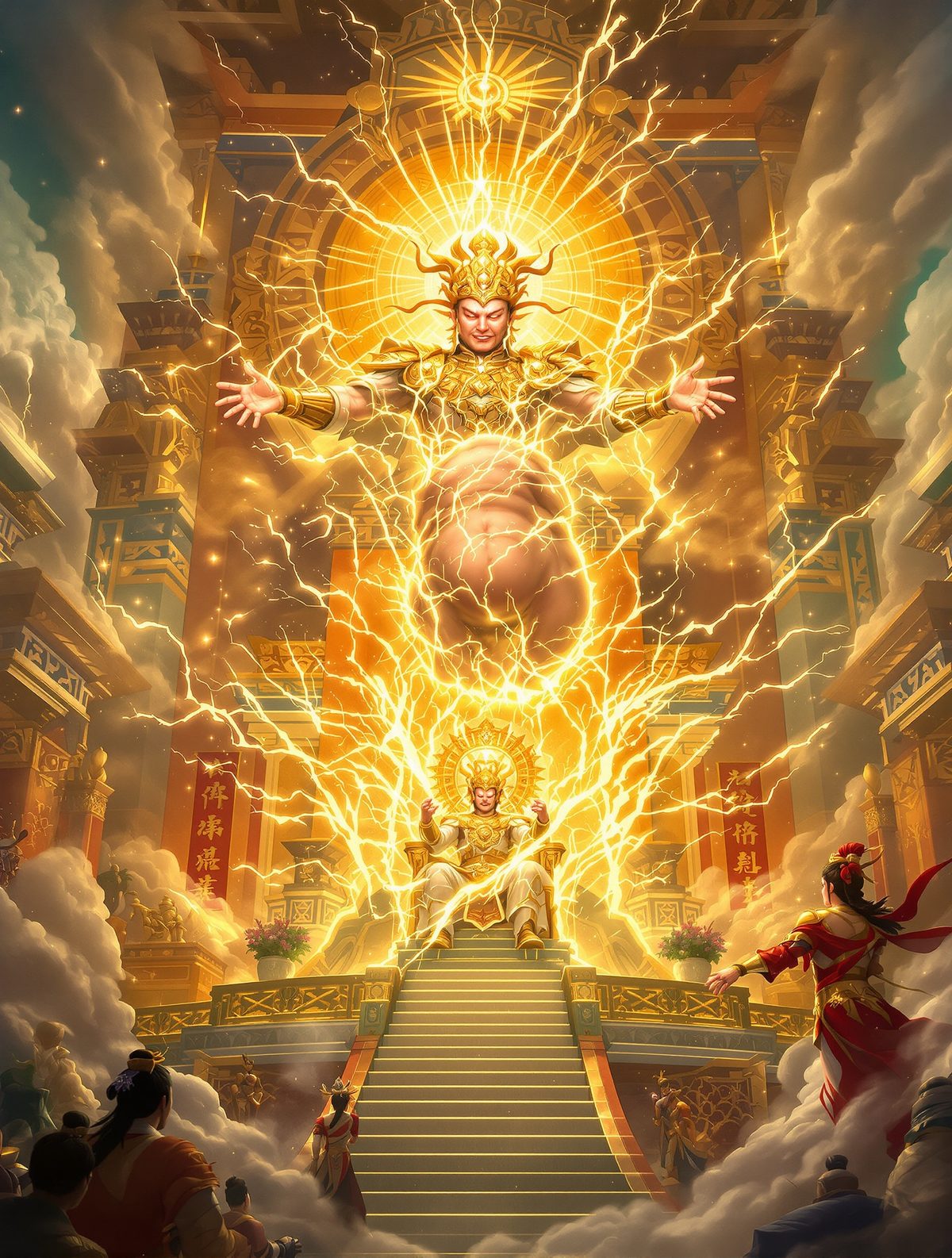
The crystalline halls of the Celestial Palace echoed with the thunderous crash of ten thousand wine cups hitting marble floors. In the flickering light of dragon-flame torches, a figure stumbled through the sacred corridors—not just any figure, but Marshal Tianpeng, commander of Heaven's mighty naval forces. His ornate armor clinked with each unsteady step, the golden insignia of his rank catching the ethereal light. Behind him lay a banquet hall in chaos. Ahead of him walked the most beautiful woman in all creation, her silk robes shimmering like moonbeams on water. In his wine-addled mind, desire overcame divine protocol. He reached out his hand toward Chang'e, the Moon Goddess herself—and with that single gesture, sealed his fate for eternity.
The Marshal Who Ruled Heaven's Waters
Before his spectacular fall from grace, Marshal Tianpeng stood as one of the most powerful beings in the Celestial Realm. His official title, Tianpeng Yuanshuai, carried weight that made even veteran immortals bow in respect. Under his command sailed 100,000 celestial sailors across the vast cosmic waters that surrounded the heavenly domains—an armada so magnificent that their war junks could blot out entire constellations when they passed overhead.
Unlike the earthbound generals who commanded foot soldiers, Tianpeng's domain was the limitless expanse of the celestial seas. His flagship, the Cloud-Splitting Dragon, measured three li from bow to stern—roughly a mile of pure divine craftsmanship, its hull carved from thousand-year celestial pearwood and its sails woven from phoenix feathers. From its command deck, Tianpeng could survey battles that raged across multiple heavenly realms simultaneously.
What many don't realize is that Tianpeng wasn't just a military commander—he was essentially Heaven's first line of defense against the chaos that lurked beyond the ordered cosmos. The celestial waters teemed with primordial monsters, rogue dragons who refused to acknowledge the Jade Emperor's authority, and worse things that had existed since before the world took shape. His victories against the Demon King of the Northern Abyss alone earned him a place at the Jade Emperor's right hand during the great celestial councils.
The Festival That Changed Everything
The Peach Festival of Immortality occurred once every 3,000 years, when the Queen Mother of the West's magical peach trees bore their divine fruit. This wasn't just any celebration—it was the social event of the celestial calendar, where the hierarchies of Heaven were both reinforced and occasionally reshuffled based on political maneuvering and divine favor.
On this particular night, the year equivalent to roughly 645 CE in mortal terms according to celestial records, the festivities had reached unprecedented heights. The Jade Emperor himself had declared the celebration would last for seven full days and nights, with entertainment provided by the finest celestial performers. Wine flowed from the Dragon King's personal reserves—nectar so potent that a single cup could intoxicate a mountain god for a century.
Marshal Tianpeng, flush with his recent victory over a rebellion of sea demons in the Eastern Quarter, had been seated at the high table, just three places from the Jade Emperor's throne. Contemporary celestial chronicles describe him as "magnificent in bearing, with eyes that held the depth of cosmic oceans and a voice that could command the tides themselves." But they also note something else: his well-documented weakness for celestial wine and his growing reputation for what polite society called "romantic pursuits."
Chang'e: The Untouchable Beauty
To understand the magnitude of Tianpeng's transgression, one must appreciate who Chang'e truly was in the celestial hierarchy. She wasn't merely beautiful—beauty was common enough in Heaven. Chang'e was the Moon Goddess, keeper of the lunar palaces, and most importantly, she was under the direct protection of the Queen Mother of the West herself. Her story was already tragic: having stolen the elixir of immortality to save it from her husband Hou Yi, she had fled to the moon where she lived in splendid isolation, accompanied only by the Jade Rabbit.
What made her absolutely forbidden wasn't just her exalted status—it was her role as a symbol of unattainable purity. The Moon Palace was considered a sanctuary where no male deity, regardless of rank, could enter without explicit imperial permission. Chang'e's appearance at the festival was itself a rare honor, marking only the third time in celestial history that she had descended from her lunar domain to attend a court celebration.
Witnesses described her that night as wearing robes that seemed to contain actual moonlight, her every movement causing silver radiance to ripple through the air around her. Her beauty was so otherworldly that even the most sophisticated courtiers found themselves speechless in her presence. The Celestial Court Records note that "her grace was such that lotus flowers bloomed spontaneously in her footsteps, and the very air seemed to sing with silver bells when she spoke."
The Moment That Shattered Heaven
By the third watch of the night—roughly midnight in mortal terms—Marshal Tianpeng had consumed what court records conservatively estimate as "seventeen cups of Dragon King wine, four goblets of Immortal Dew, and at least three servings of the Monkey King's personal peach wine reserves." For context, a single cup of Dragon King wine was sufficient to lay low most earthly immortals for days.
The exact sequence of events became the subject of intense celestial investigation. According to the sworn testimony of the Star God of Literature, who was seated nearby, Tianpeng had been regaling the table with increasingly boastful stories of his naval conquests when Chang'e passed behind his chair en route to pay respects to the Queen Mother. The alcohol, combined with what witnesses described as an already inflated ego from his recent military successes, proved a catastrophic combination.
In a moment that seemed to freeze the entire celestial court in horror, Tianpeng reached out and grabbed Chang'e by the wrist, pulling her toward him with the words: "Why should the moon be so far away when the ocean is right here?" Some accounts suggest he attempted to embrace her; others claim he tried to kiss her. What every witness agreed upon was Chang'e's immediate cry of outrage—a sound so pure and piercing that it shattered every piece of jade in the banquet hall and caused several minor deities to faint from the psychic shock.
The silence that followed lasted exactly thirteen heartbeats, according to the God of Time's official testimony. Then the Jade Emperor's voice cut through the air like a blade forged from starlight itself: "GUARDS."
Divine Justice Swift and Merciless
The trial of Marshal Tianpeng became the most talked-about celestial court proceeding in over a millennium. Unlike earthly justice, divine law operated on principles of cosmic balance and symbolic punishment. The Jade Emperor, serving as supreme judge, presided over a tribunal that included the Queen Mother of the West (still furious about the insult to her protégé), the Dragon Kings of the Four Seas (reluctantly turning against their former ally), and the Buddha himself, specially summoned to ensure the proceedings met the highest moral standards.
Tianpeng's defense, such as it was, relied heavily on his previous service record and claims of diminished capacity due to the extraordinary potency of the celestial wine. His advocate, the God of Military Honors, argued that stripping him of rank and a temporary banishment to earth would suffice. The prosecution, led by the fearsome Goddess of Divine Justice, painted a picture of systematic arrogance and entitlement that had finally culminated in an unforgivable assault on celestial order itself.
The turning point came when Chang'e herself testified. Her words were brief but devastating: "I have endured isolation on the moon for millennia, accepting loneliness as the price of my immortality. Yet I felt safer in that empty palace than I did in this hall surrounded by Heaven's greatest protectors. If this is how Heaven's marshal treats those under divine protection, what hope exists for justice in the three realms?"
The Jade Emperor's judgment was swift and, by celestial standards, surprisingly creative in its cruelty. Tianpeng would be stripped of his rank, expelled from Heaven, and condemned to reincarnation on Earth. But not as a human—that would be too merciful. Instead, he would be born as a pig, the animal considered most base and earthly, furthest from the ethereal nature of celestial beings. Moreover, due to a "clerical error" by the reincarnation officials (widely believed to be intentional), he retained his human consciousness and speech, ensuring he would forever remember what he had lost.
The Pig Who Remembered Being a God
The cosmic irony of Tianpeng's punishment extended far beyond mere physical transformation. As Zhu Bajie—"Pig of Eight Prohibitions"—he retained all his memories of commanding vast fleets and being revered by thousands. Yet he found himself trapped in a body that represented everything he had once considered beneath his notice: earthly, crude, driven by appetites rather than noble purpose.
His subsequent adventures as part of Xuanzang's pilgrimage to retrieve the Buddhist scriptures became legendary in their own right, but they were essentially a extended penance for that one moment of drunken entitlement. Every day brought reminders of his fall: his clumsy pig's body struggling to perform the graceful movements he once executed effortlessly, his fellow pilgrims treating him as comic relief rather than a decorated military commander, and his constant hunger for earthly food replacing his former satisfaction with celestial nectar.
Perhaps most cruelly, he occasionally encountered former subordinates during the journey—minor water spirits or river dragons who had once saluted him as their supreme commander. Their shock and barely concealed disgust at his transformation served as constant reminders that his punishment was not merely physical but profoundly social and psychological.
The Eternal Price of Entitled Power
The legend of Marshal Tianpeng's transformation into Zhu Bajie resonates across centuries not merely as a cautionary tale about excessive drinking, but as a profound meditation on how power, privilege, and entitlement can corrupt even the most accomplished individuals. Here was a being who had literally commanded the forces that kept cosmic chaos at bay, whose strategic brilliance had saved Heaven itself on multiple occasions—yet none of that mattered the moment he decided his desires superseded another being's autonomy.
In our contemporary world, where conversations about consent, power dynamics, and accountability continue to evolve, Tianpeng's story offers startling relevance. His punishment wasn't just about divine justice—it was about the recognition that no achievement, no matter how great, grants license to treat others as objects for personal gratification. The Jade Emperor's verdict implicitly acknowledged that Chang'e's dignity and safety mattered more than preserving the reputation of Heaven's most successful military commander.
The "clerical error" that left Tianpeng with his memories serves as perhaps the most psychologically sophisticated element of his punishment. He was forced to live with the full knowledge of what he had been and what he had thrown away—not for some grand principle or noble sacrifice, but for a moment of base impulse that revealed the ugliness lurking beneath his polished exterior. In transforming him into a pig while leaving his consciousness intact, the celestial court ensured that Tianpeng's punishment would be not just physical discomfort, but eternal self-awareness of the precise moment when he chose poorly.
The story suggests that true justice sometimes requires more than simple retribution—it demands transformation, understanding, and the opportunity for redemption through service to others. Zhu Bajie's journey toward enlightenment alongside Xuanzang represents the possibility that even those who have fallen furthest can find their way back to grace, though the path may be longer and more difficult than they ever imagined when they held power without wisdom.