Picture this: the universe holds its breath as all knowledge—every prayer, every ritual, every sacred word that gives meaning to existence—simply vanishes. The cosmic libraries are empty. The priests stammer, their mantras forgotten. Even the gods themselves seem confused, as if someone has stolen the very DNA of reality. This isn't science fiction—it's one of Hinduism's most dramatic tales, where a sleeping god must awaken to hunt down the ultimate thief.
While Lord Vishnu dozed peacefully on his eternal serpent bed, floating through the cosmic ocean between the cycles of creation and destruction, an audacious demon named Hayagriva executed what might be called the greatest heist in mythological history. He didn't steal gold or jewels—he stole the Vedas themselves, the sacred texts that contained all knowledge, from right under the nose of Brahma, the creator god.
The Cosmic Crime Scene
To understand the magnitude of this theft, imagine if someone could steal the concept of mathematics itself—not just the textbooks, but the very idea that 2+2=4. That's essentially what Hayagriva accomplished. The Vedas weren't merely books; they were the fundamental operating system of the universe, containing the sacred formulas that kept reality running smoothly.
The timing couldn't have been more perfect for this cosmic criminal. Hindu cosmology describes time in vast cycles called kalpas—each lasting 4.32 billion years. At the end of each kalpa, Brahma goes to sleep, and with him, the universe dissolves into the cosmic ocean. During this period, called pralaya, Vishnu enters his famous yogic sleep, known as Yoga Nidra, resting on the thousand-headed serpent Shesha as he floats through the primordial waters.
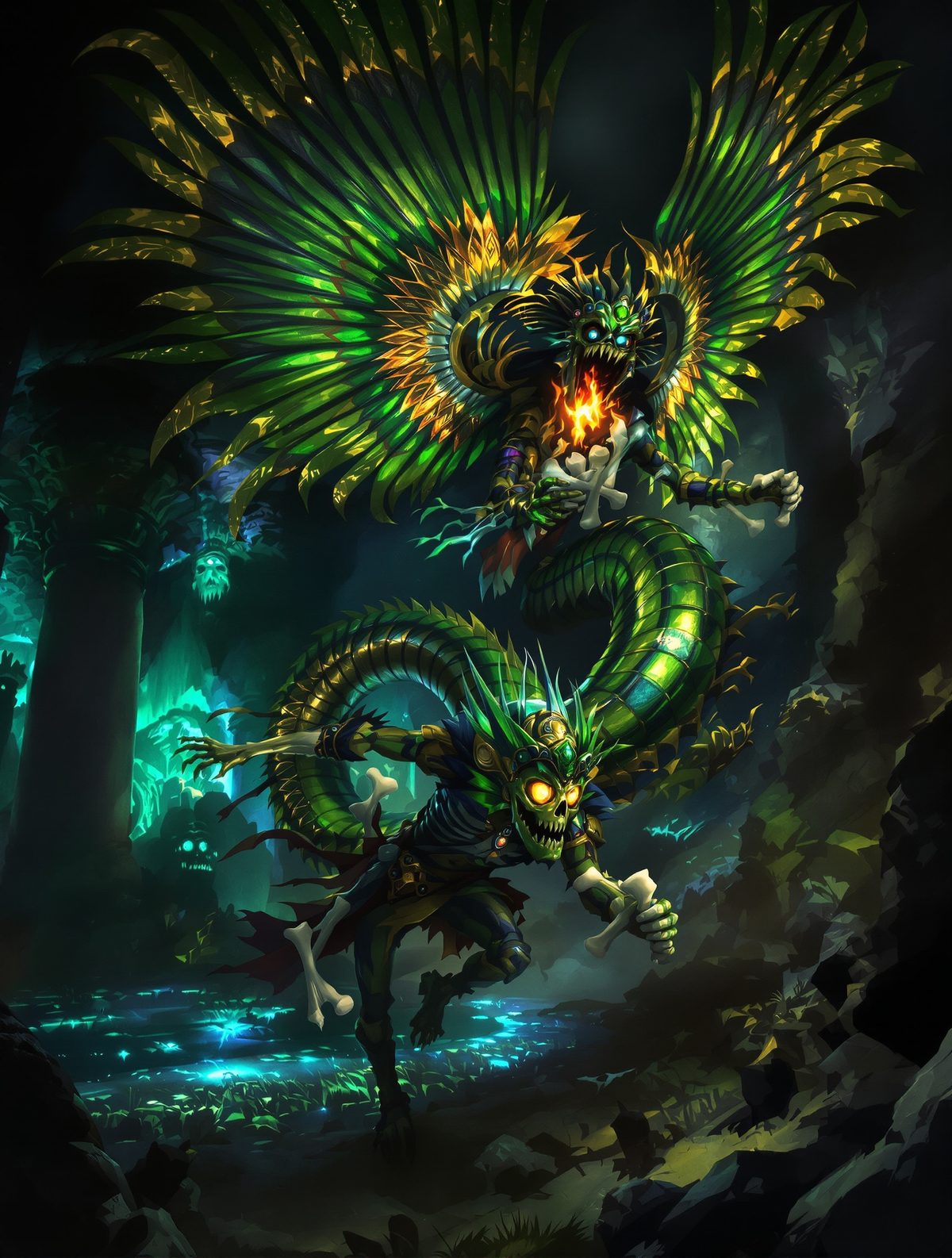
It was during one of these cosmic intermissions that Hayagriva struck. The demon, whose name ironically means "horse-necked," had been waiting eons for this opportunity. As Brahma settled into his own slumber, the Vedas—represented as physical manuscripts in some versions, or as pure knowledge in others—became vulnerable. Some texts suggest the Vedas actually emerged from Brahma's mouth as he yawned, making them easy pickings for the alert demon.
When Knowledge Dies
The immediate aftermath of the theft reads like a cosmic horror story. Without the Vedas, the universe began to unravel at its intellectual and spiritual foundations. The Rig Veda, with its 1,028 hymns containing the secrets of fire and sacrifice—gone. The Sama Veda, whose melodic chants could influence the very fabric of reality—silent. The Yajur Veda, containing the practical formulas for maintaining cosmic order—vanished. The Atharva Veda, with its knowledge of healing and daily life—erased.
What makes this story particularly fascinating is its recognition of knowledge as something almost physical—something that can be stolen, hidden, or lost. Ancient Hindu philosophers understood what modern information theorists are just beginning to grasp: information isn't just data, it's the foundation of reality itself. Without the Vedas, even the gods were reduced to confused amnesiacs.
The demon Hayagriva didn't just hide his prize in some earthly cave. According to the Devi Bhagavata Purana, he retreated to the deepest depths of the cosmic ocean—the very same waters where Vishnu lay sleeping. The audacity is breathtaking: hiding your stolen goods literally under the bed of the cosmic policeman.
The Awakening of the Preserver
But the universe has a way of calling for help, and Vishnu's sleep wasn't destined to last forever. Different versions of the myth describe his awakening differently—some say it was the collective prayers of suffering beings, others suggest it was the natural end of the cosmic night. The Bhagavata Purana describes how Vishnu became aware of the crisis through his omniscience, even while in his cosmic slumber.
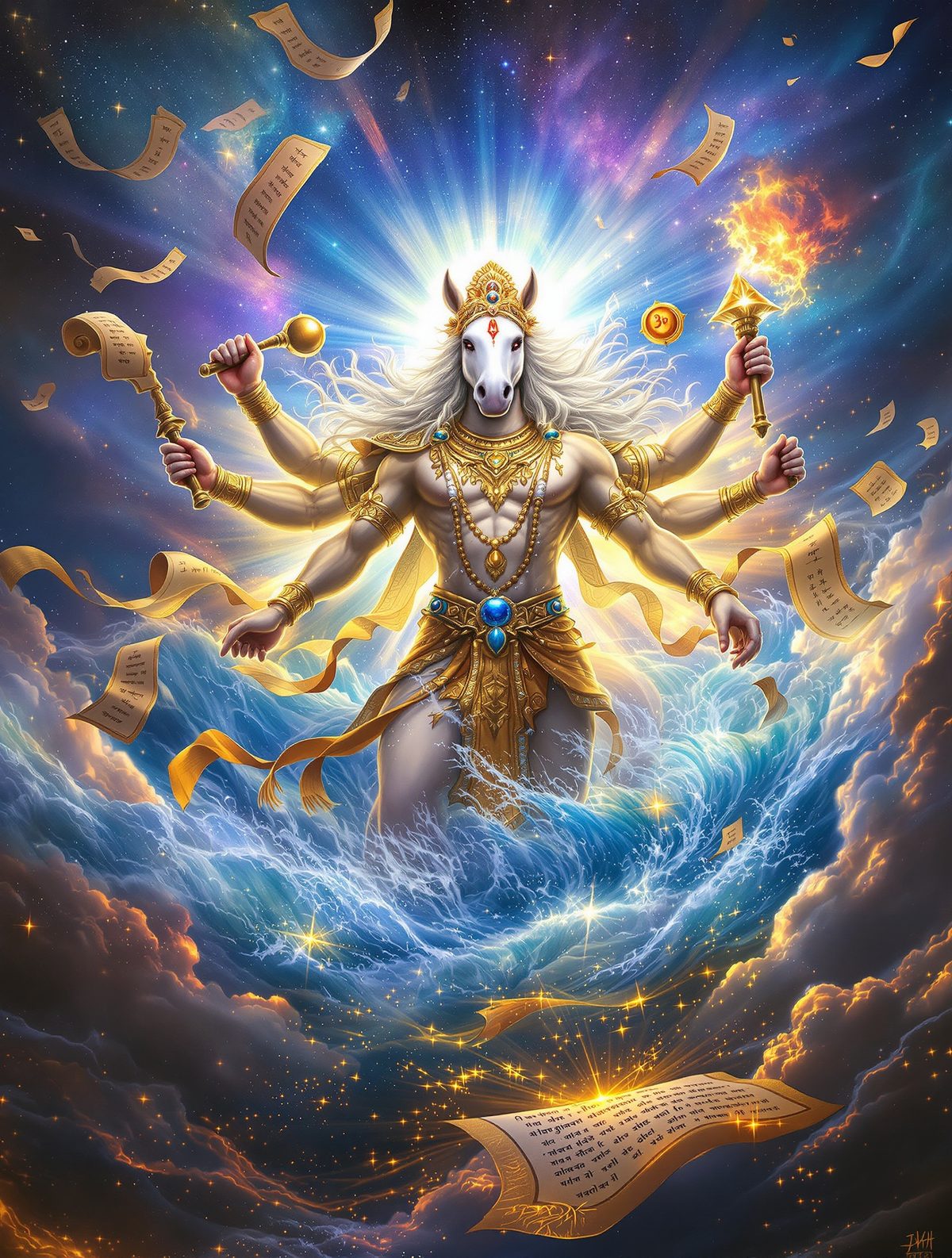
Here's where the story takes a delicious twist that many people don't know: Vishnu chose to fight fire with fire, or rather, horse with horse. To defeat the horse-headed demon Hayagriva, Vishnu took on his own equine form, becoming the avatar known as Hayagriva—yes, the same name as the demon. This wasn't coincidence but cosmic irony of the highest order.
The transformation scene, as described in various Puranas, is spectacular. Vishnu's human head was replaced by that of a magnificent white horse, complete with flowing mane and eyes that blazed with divine knowledge. His horse head wasn't merely symbolic—in Vedic tradition, the horse represented vitality, knowledge, and the power to traverse different realms of existence. The Ashvamedha (horse sacrifice) was considered the most powerful of all Vedic rituals precisely because of the horse's cosmic significance.
The Hunt Across the Cosmic Waters
What followed was perhaps the most unusual chase scene in all of mythology: a horse-headed god pursuing a horse-headed demon through the infinite waters of cosmic space. But this wasn't just a physical pursuit—it was a battle of knowledge against ignorance, order against chaos.
The Devi Bhagavata Purana describes how Vishnu-Hayagriva possessed something the demon lacked: legitimate authority over knowledge. While the demon had stolen the Vedas, he couldn't truly comprehend or use them. It's like stealing a supercomputer without knowing the password—you have the hardware, but you're locked out of the software.
The battle itself was less about physical force and more about intellectual and spiritual superiority. Some versions describe Vishnu-Hayagriva literally out-knowing his opponent, reciting Vedic verses that the demon had stolen but never understood. Each correctly pronounced syllable weakened Hayagriva's hold on the sacred knowledge.
In a climactic moment that would make any action movie proud, Vishnu-Hayagriva didn't just defeat the demon—he absorbed him, transforming the agent of ignorance into a part of divine knowledge itself. The demon's power wasn't destroyed but converted, like spiritual recycling on a cosmic scale.
The Restoration of Everything
With the Vedas recovered, Vishnu carefully returned them to Brahma, who was just beginning to stir from his cosmic sleep to start the next cycle of creation. But here's a detail that often gets overlooked: the knowledge that returned wasn't exactly the same as what was stolen. Having passed through the crucible of loss and recovery, of theft and restoration, the Vedas were somehow enriched by the experience.
This plot point reveals something profound about how ancient Hindu thinkers viewed knowledge—not as static information but as something alive, something that could grow through challenge and adversity. The recovered Vedas contained not just the original wisdom but also the story of their own theft and recovery, making them more complete than before.
The myth also establishes Hayagriva (the divine version) as a special deity of learning and knowledge. Even today, students and scholars across India invoke Hayagriva before beginning their studies. The horse-headed avatar became the patron of libraries, universities, and anyone seeking to master complex knowledge—a cosmic reminder that sometimes you need to become like your enemy to defeat them.
Why This Ancient Heist Still Matters
In our age of information warfare, data breaches, and concerns about artificial intelligence, this ancient story feels remarkably contemporary. We're living through our own version of knowledge theft—from academic research locked behind paywalls to social media algorithms that manipulate information flow to foreign powers stealing technological secrets.
The myth of Hayagriva offers a surprisingly modern insight: knowledge isn't truly possessed until it's understood, and it isn't truly secure until it's widely shared. The demon could steal the Vedas but couldn't use them effectively because he lacked the wisdom to comprehend them. Similarly, stolen data or hacked information is often less useful to thieves than they imagine, because context and understanding can't be stolen—only earned.
Perhaps most importantly, the story suggests that knowledge has its own intelligence, its own desire to be free and properly used. Like Vishnu awakening from cosmic sleep, sometimes the universe itself responds to protect what's truly valuable. In a world where we're drowning in information but starving for wisdom, the tale of the horse-headed god reminds us that real knowledge—the kind worth stealing, worth fighting for, worth awakening for—is always about more than just data. It's about understanding our place in the cosmic order and having the wisdom to act accordingly.