In the bone-white silence of Mictlan, the Aztec underworld, something unprecedented was about to unfold. The year was unknown—for time flows differently in the realm of the dead—but the consequences would echo through every human heartbeat for millennia to come. Quetzalcoatl, the Feathered Serpent god, was about to attempt the most audacious heist in mythological history: stealing the very bones that would give birth to a new race of humans.
What happened next in those shadowy depths would explain why some people tower over others, why humanity comes in such wonderfully varied sizes, and why the Aztecs believed that our very existence hung by the thinnest of threads—one stumble away from never having existed at all.
The World Before the Theft
To understand the magnitude of Quetzalcoatl's mission, we must first grasp what the Aztecs believed about creation itself. According to the Popol Vuh and other Mesoamerican texts, the world had already ended four times. Four previous races of humans had been created and destroyed by the gods, each iteration an improvement on the last—yet each ultimately found wanting.
The first humans were made of mud and dissolved in the rain. The second, carved from wood, had no souls and were destroyed by a great flood. The third race met their doom when the sky fell and jaguars devoured them. The fourth perished when the world was consumed by wind and they transformed into monkeys. Now, in the Fifth Sun, the gods faced their greatest challenge yet: creating humans who could not only survive but truly honor their creators.
Here's what most textbooks won't tell you: the Aztecs believed that bone was the most precious substance in creation. Unlike flesh, which decays, or blood, which dries, bone endures. It was the eternal framework upon which all life hung. The bones of the previous human races lay scattered in Mictlan, guarded jealously by Mictlantecuhtli, the Lord of the Dead, whose very name meant "Lord of the Place of the Fleshless."
Descent into the Realm of Eternal Night
Mictlan wasn't simply a place where the dead went—it was a nine-level labyrinth of trials that souls had to navigate for four years before reaching their final rest. Imagine descending through layers of increasing darkness, each more treacherous than the last. Rivers of scorpions. Mountains that crashed together. Obsidian winds that could slice flesh from bone.
Quetzalcoatl's journey to the deepest level was no casual divine stroll. Even for a god, entering Mictlan meant confronting the fundamental forces of decay and dissolution. Ancient Aztec priests who recounted this tale would often emphasize that Quetzalcoatl had to die symbolically just to reach Mictlantecuhtli's throne room—a detail that adds profound weight to his sacrifice for humanity's sake.
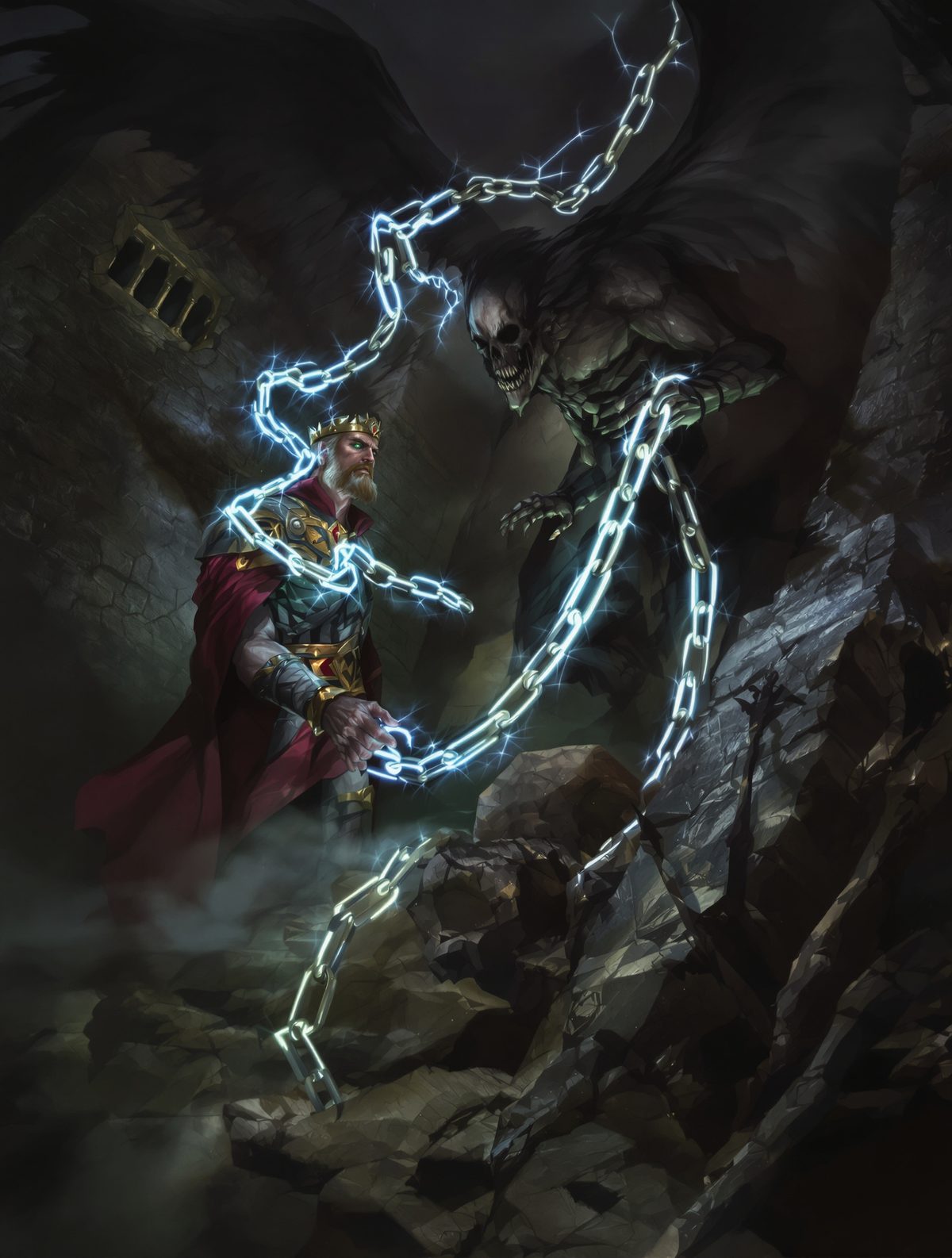
When the Feathered Serpent finally stood before Mictlantecuhtli, the scene would have been breathtaking in its cosmic horror. Picture the Lord of the Dead: a skeletal figure adorned with owl feathers, his eye sockets blazing with the cold light of dying stars, seated upon a throne made from the compressed bones of eons. Around him, the precious remains of humanity's previous incarnations lay in carefully organized piles—femurs here, skulls there, ribs stacked like ancient libraries of genetic possibility.
The Devil's Bargain
What happened next reveals something fascinating about Aztec psychology. Mictlantecuhtli didn't immediately refuse Quetzalcoatl's request for the bones. Instead, he agreed—but with conditions that seemed designed to humiliate the Feathered Serpent god. "Very well," the Death Lord reportedly said, "but first you must circle my realm four times while blowing this conch shell."
Here's the twist that most people miss: Mictlantecuhtli handed Quetzalcoatl a solid conch shell with no holes. It was impossible to make sound with it. This wasn't just a test—it was a cosmic joke, the kind of bureaucratic nightmare that suggests even Aztec gods dealt with divine red tape.
But Quetzalcoatl was cleverer than the Lord of the Dead anticipated. He summoned worms to bore holes through the shell and bees to fly inside it, creating a haunting, otherworldly music that echoed through all nine levels of Mictlan. The sound was so beautiful, so alive, that it temporarily transformed the realm of death into something resembling the world above.
Mictlantecuhtli had no choice but to honor his bargain—or so it seemed. "Take the bones," he said, but privately, he seethed with rage. No one had ever outwitted him in his own domain. The Lord of the Dead began plotting his revenge even as Quetzalcoatl gathered the precious remains.
The Chase That Shaped Humanity
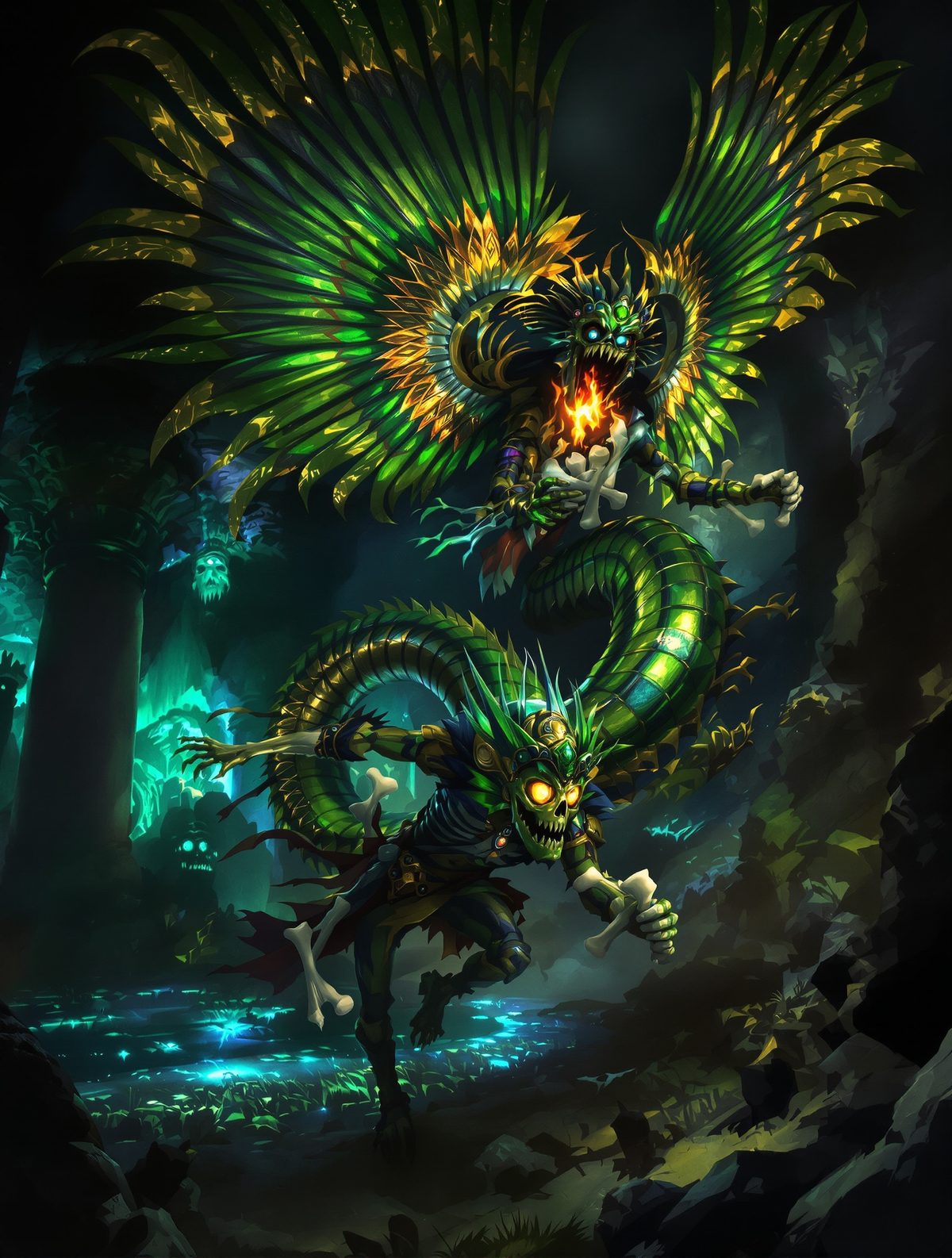
What followed was perhaps the most consequential chase scene in all of mythology. As Quetzalcoatl began his ascent through the nine levels of Mictlan, carefully cradling the bones that would become humanity's foundation, Mictlantecuhtli had second thoughts. The Death Lord commanded his servants—beings called the tzitzimimeh, skeletal star demons—to pursue the Feathered Serpent and stop him at all costs.
Picture this scene: Quetzalcoatl, in his aspect as the wind god, rushing upward through the darkening levels of the underworld while behind him, the very forces of entropy and dissolution gave chase. The bones of future humanity clutched against his chest, the Feathered Serpent navigated obstacles that would have destroyed lesser beings—rivers of blood, forests of thorns, caverns where the walls themselves were alive and hungry.
But here's the detail that changes everything: as Quetzalcoatl neared the surface world, a quail suddenly burst from the underworld's shadows and flew directly into his path. Some versions say Mictlantecuhtli sent the bird. Others suggest it was simply fate. But the result was the same—startled, the Feathered Serpent stumbled.
The bones scattered across the threshold between death and life, some breaking into large pieces, others shattering into fragments, still others turning to dust. In that single moment of divine clumsiness, the future of human diversity was written. This is why, the Aztecs believed, some humans grow tall and others remain short, why we come in such magnificent variety instead of being identical divine copies.
The Blood Price of Creation
But Mictlantecuhtli wasn't finished. Even as Quetzalcoatl gathered up the scattered bone fragments—every piece precious, even the smallest chips—the Death Lord appeared and demanded the ultimate price. "You have taken from my realm," he declared, "now you must give something in return. I demand your blood to awaken these bones."
This moment reveals something profound about Aztec theology that often gets lost in simplified retellings. Creation, in their worldview, always required sacrifice. Nothing came without cost. Even the gods had to give of themselves—literally—to bring about new life.
Quetzalcoatl, without hesitation, pierced his own body and let his divine blood flow over the scattered bones. But here's the remarkable detail: he didn't just bleed on them once and walk away. According to the most complete versions of this myth preserved in the Codex Chimalpopoca, Quetzalcoatl had to tend these bones for four days, watering them with his blood like a divine gardener.
On the fourth day, the bones stirred. They knitted themselves together—the large pieces forming tall frames, the smaller fragments creating more compact builds, the tiny chips becoming the delicate bones of children. The first breath of the Fifth Sun's humans was drawn not in paradise, but at the very threshold of death, mixed with the sacrifice of a god who had risked everything to give them existence.
Why This Ancient Tale Still Matters
In our modern world of genetic engineering and evolutionary biology, it's tempting to dismiss such myths as primitive explanations for natural phenomena. But doing so misses the profound wisdom embedded in this story. The Aztecs weren't trying to write a biology textbook—they were grappling with questions that still haunt us today.
Why does human diversity exist? What price are we willing to pay for life itself? How do we honor the sacrifices—both divine and human—that made our existence possible? The tale of Quetzalcoatl's bone theft suggests that our very diversity, the range of human heights and builds that we see around us every day, isn't an accident of genetics but the result of a cosmic stumble that turned potential disaster into beautiful variety.
Perhaps most remarkably, this myth positions humanity not as the perfect creation of the gods, but as something salvaged from near-disaster, pieced together from fragments, brought to life through sacrifice and tended with divine blood. We are, in essence, the gods' beautiful mistakes—living proof that sometimes the most meaningful creations come not from perfect execution, but from the courage to pick up the pieces and start again.
Every time you notice the wonderful range of human heights in a crowd, every time you marvel at the diversity of human forms, you're witnessing the echo of that ancient stumble in Mictlan's darkness—when a god's moment of clumsiness became humanity's greatest gift.