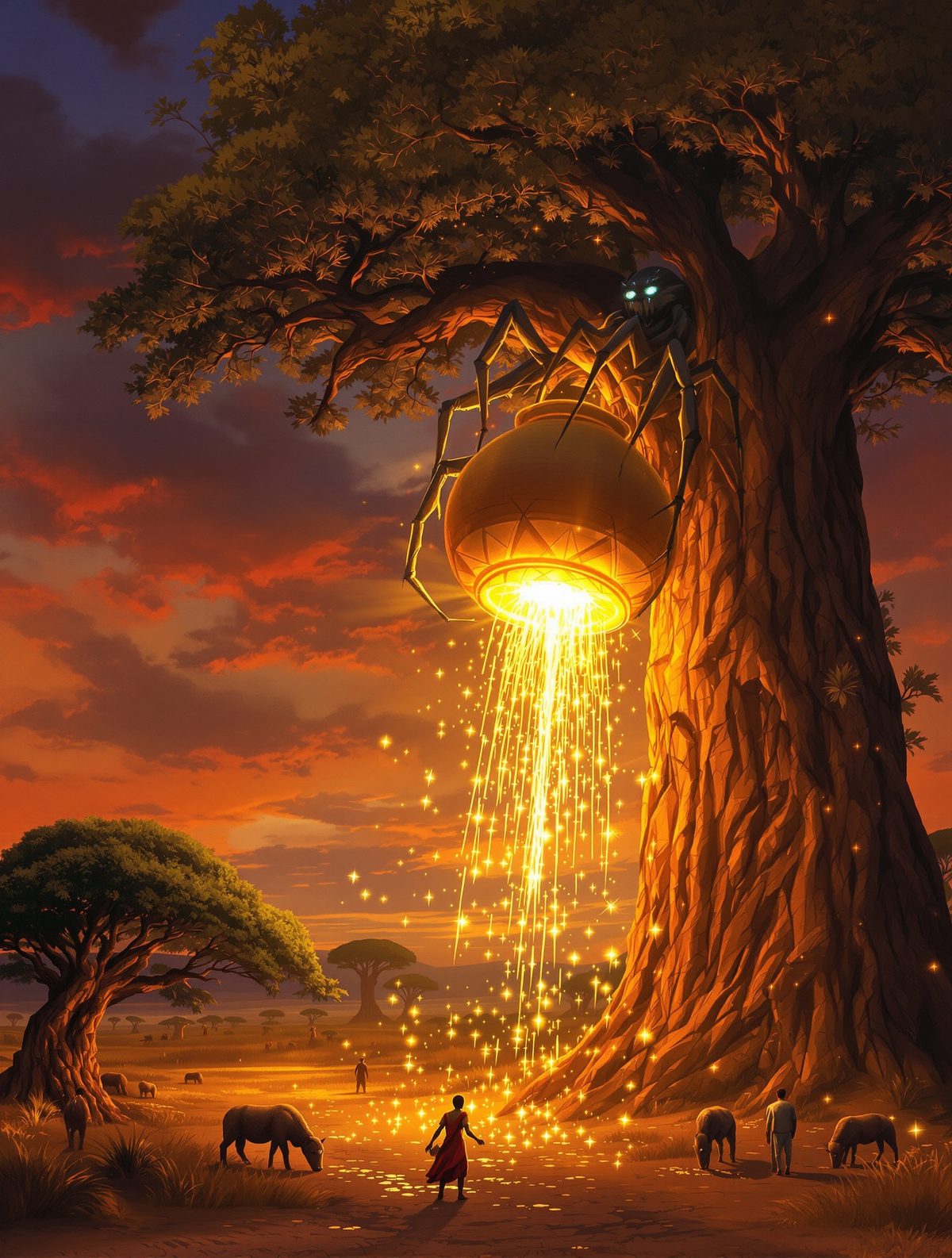
Picture this: somewhere in the misty dawn of time, when the world was still young and malleable, all of human knowledge existed in one place—a single, enormous pot clutched in the eight legs of a cunning spider. For one brief, shining moment, Anansi the trickster held every secret of the universe, every piece of wisdom that had ever been or ever would be. Then he tripped.
That stumble, high in the branches of the tallest tree in creation, would scatter knowledge across the earth like seeds in the wind, ensuring that no single being would ever again possess all wisdom. It's a story that has echoed through West African cultures for over a thousand years, whispered around fires from Ghana to Nigeria, from Senegal to the Ivory Coast. But like most legends that survived the brutal interruption of the slave trade, this tale carries truths that our textbooks somehow forgot to mention.
The Spider Who Dared to Trick the Sky God
Long before European colonizers would attempt to catalog and "civilize" West African oral traditions, the Akan people of present-day Ghana had already perfected the art of embedding profound philosophical truths within seemingly simple stories. Anansi—whose name derives from the Akan word "kwaku anansi," meaning "spider"—wasn't just any arachnid. He was a shape-shifting trickster who could appear as spider, man, or something in between, depending on what his schemes required.
The Akan storytellers, known as griots, understood something that modern educators often miss: wisdom transmitted through story sticks in ways that dry recitation never can. Archaeological evidence suggests these Anansi tales were already ancient when the great trading empires of Ghana and Mali rose to prominence between 800 and 1200 CE. Portuguese explorers in the 15th century noted the prevalence of spider imagery in West African art and textiles, though they largely dismissed the associated stories as "primitive superstition."
But Anansi was anything but primitive. In the cosmic hierarchy of Akan mythology, he occupied a unique position—small enough to be overlooked by the mighty, clever enough to outwit gods, and just foolish enough to make catastrophic mistakes that somehow benefited all humanity. He was the ultimate underdog, armed with nothing but his wits against forces infinitely more powerful than himself.
The Great Deception of Nyame
Nyame, the sky god of the Akan pantheon, possessed something that Anansi coveted above all else: perfect, complete wisdom. Not just knowledge of farming techniques or hunting strategies, but the deep understanding of how the universe truly worked. This wasn't mere information—it was the kind of wisdom that could predict the future, heal any disease, solve any problem, and answer any question that had ever puzzled humanity.
Here's where the story gets particularly fascinating from an anthropological perspective. Unlike many mythological traditions where knowledge belongs exclusively to the gods, Akan cosmology suggested that wisdom could be transferred—but only through cleverness, never through force or supplication. This reflects a deeply democratic view of intelligence that would later influence everything from traditional Akan political structures to modern concepts of education in post-colonial Ghana.
Anansi's method was characteristically devious. Rather than simply asking for wisdom (which would have been refused) or attempting to steal it (which would have been impossible), he convinced Nyame that humans were becoming too clever for their own good. "Look how they've learned to make fire," Anansi argued. "Soon they'll think they're equal to the gods themselves. Perhaps it would be safer to gather all wisdom in one place, where it can be properly... supervised."
The brilliance of this reverse psychology wasn't lost on traditional storytellers. They understood that the most effective way to acquire something is often to convince the possessor that giving it away serves their own interests. Nyame, persuaded by Anansi's apparent concern for cosmic order, agreed to collect all the world's wisdom into a single, massive clay pot.
The Weight of All Knowledge
What the oral traditions describe next would make any modern information theorist's head spin. Imagine every scientific principle, every mathematical theorem, every piece of practical knowledge, every philosophical insight, and every creative inspiration that humanity would ever need—all compressed into one container. The pot, according to various versions of the story, was so large that Anansi could barely wrap all eight legs around it, yet somehow it contained infinite space within its clay walls.
This paradox wasn't accidental. West African storytelling traditions often employed such impossibilities to signal deeper meanings. The pot represented something that many cultures struggle to understand even today: the relationship between the container and the contained, the finite and the infinite, the individual and the collective.
But here's a detail that most casual retellings miss—Anansi didn't immediately try to hide the wisdom. According to the most complete versions preserved by Ghanaian griots, he first attempted to use it. For a brief period, the spider possessed godlike knowledge. He could predict weather patterns, locate hidden water sources, understand the languages of all animals, and see the connections between all things.
Yet instead of using this wisdom to help others, Anansi's first instinct was to hoard it. This character flaw reflects a sophisticated understanding of human nature that predates similar insights in Western psychology by centuries. The Akan storytellers intuited what researchers would later confirm: that knowledge without the wisdom to share it appropriately becomes a burden rather than a gift.
The Climb That Changed Everything
Paranoid that humans might somehow reclaim their wisdom, Anansi decided to hide the pot in the one place no human could reach—the crown of the tallest tree in the world. Various regional traditions identify this tree differently; some say it was a massive baobab whose trunk was wide as a lake, others claim it was a towering mahogany that pierced the clouds themselves. What all versions agree on is that this tree was impossibly tall, its upper branches hidden in mist, its roots extending deep into the earth's molten core.
The image of Anansi beginning his climb is one of the most vivid in all of West African mythology. Picture the tiny spider, dwarfed by the enormous clay pot, struggling to carry a burden far too heavy for his size. He had tied the pot to his belly with strong silk threads, but the weight kept pulling him backward, making each step precarious.
Anthropologists have noted that this part of the story contains remarkable parallels to myths from cultures that had no historical contact with West Africa. The World Tree appears in Norse mythology as Yggdrasil, in Mayan cosmology as the Ceiba, and in various Siberian shamanic traditions. Yet the Akan version has a unique twist—the tree isn't just a cosmic axis, it's specifically a hiding place, suggesting a culture that understood knowledge as something that could be both elevated and isolated.
As Anansi climbed higher, the wind grew stronger. The pot caught the air like a sail, threatening to tear him from the bark. Several times he nearly fell, saved only by his ability to shoot out anchor lines of silk. The imagery here is deliberately reminiscent of a sailor fighting a storm—no accident, given that many Akan communities were familiar with coastal navigation and understood the power of wind and weather.
The Accident That Blessed Humanity
What happened next depends on which version of the story you hear. Some say Anansi's silk snapped under the strain. Others claim he was startled by a bird and lost his grip. The most psychologically sophisticated versions suggest that, in a moment of doubt about what he was doing, Anansi hesitated—and that moment of moral uncertainty caused his physical fumble.
Regardless of the cause, the result was catastrophic and wonderful in equal measure. The pot slipped from Anansi's grasp and plummeted toward the earth below. As it fell, it struck branches, rocks, and finally the ground itself, shattering into countless fragments. The wisdom inside exploded outward like a burst of light, scattering in all directions across the world.
Here's where the story becomes truly beautiful: the wisdom didn't distribute itself randomly. Instead, it settled in places and with people who could use it best. Farmers received knowledge of crops and seasons. Healers gained understanding of herbs and the human body. Musicians discovered rhythm and harmony. Mathematicians found numbers dancing in their minds. Children learned to ask the questions that adults had forgotten.
But—and this is crucial—no single person received all the wisdom. Everyone got some, no one got everything. The blacksmith understood iron but needed the farmer's knowledge of seasons. The storyteller possessed memory and words but required the musician's sense of rhythm. The healer knew bodies but depended on the hunter's understanding of the forest.
This forced interdependence wasn't a bug in the system—it was a feature. The Akan storytellers understood something that modern individualistic cultures often miss: true wisdom emerges not from isolated genius but from collaborative intelligence.
The Wisdom We Carry Today
When enslaved Africans were forcibly transported to the Caribbean and Americas between the 16th and 19th centuries, they carried these Anansi stories with them as cultural DNA. In Jamaica, Anansi became "Nancy"; in the American South, he transformed into Brer Rabbit. The details changed, but the core message persisted: wisdom belongs to everyone, and no single authority should control access to knowledge.
This wasn't just storytelling—it was resistance. In societies where enslaved people were forbidden to read, where their traditional knowledge systems were suppressed, and where they were told they were intellectually inferior, the Anansi stories carried a powerful counter-narrative. They whispered that wisdom was scattered everywhere, that intelligence came in many forms, and that even the smallest and most oppressed beings could outwit the mighty through cleverness and courage.
Today, as we grapple with questions about information access, artificial intelligence, and the democratization of knowledge, Anansi's accidental gift feels remarkably prescient. The internet has scattered information across the world much like that shattered pot scattered wisdom—creating both unprecedented opportunities and new challenges about how we share, verify, and use what we know.
The lesson embedded in this ancient West African story remains as relevant as ever: wisdom without sharing is merely hoarding, knowledge without community is just data, and perhaps the greatest truths emerge not from individual brilliance but from our willingness to piece together our scattered fragments of understanding. In the end, Anansi's clumsiness might have been the most intelligent thing he ever did.