Picture this: the last golden rays of sunlight fade behind the western horizon, and somewhere deep beneath the earth, an ancient battle for the very survival of existence is about to begin. While most of us simply flip on a light switch and go about our evening routines, the ancient Egyptians understood a terrifying truth that kept them awake at night—the sun's disappearance wasn't guaranteed to be temporary. Each sunset marked the beginning of a cosmic war between order and chaos, light and darkness, creation and absolute destruction.
In the shadowy realm of the Duat—Egypt's underworld—the great serpent Apophis coiled in patient, malevolent hunger, waiting for Ra's golden solar barge to enter his domain. This wasn't just mythology to the ancient Egyptians; it was the most fundamental reality of existence, more real than the pyramids they built or the Nile that sustained them.
The Solar Barge: Ra's Nightly Journey Through Hell
Every evening around 2500 BCE, as scribes in Memphis recorded the day's transactions and farmers along the Nile prepared for rest, the sun god Ra would begin his most perilous journey. His magnificent solar barge, called the Mesektet, would transform from the day vessel Mandjet that carried him across the heavens. This wasn't merely a change of boats—it was a complete metamorphosis for the approaching battle.
The Mesektet was no ordinary vessel. Ancient papyrus texts describe it as being constructed from pure light, its hull reinforced with the prayers of the living and the hopes of the dead. Ra himself would shed his daytime form as the falcon-headed deity and assume his nighttime appearance as Auf-Ra—literally "Ra of the Flesh"—a ram-headed god whose curved horns could pierce through the absolute darkness of the underworld.
But Ra didn't sail alone into this abyss. His crew included some of the most powerful deities in the Egyptian pantheon: Sia, the god of perception who could see through Apophis's deceptions; Hu, the god of divine utterance whose voice could command reality itself; and most crucially, Set—the god of chaos who, in a cosmic irony, became Ra's greatest defender against an even greater chaos.
Apophis: The Serpent That Could End Everything
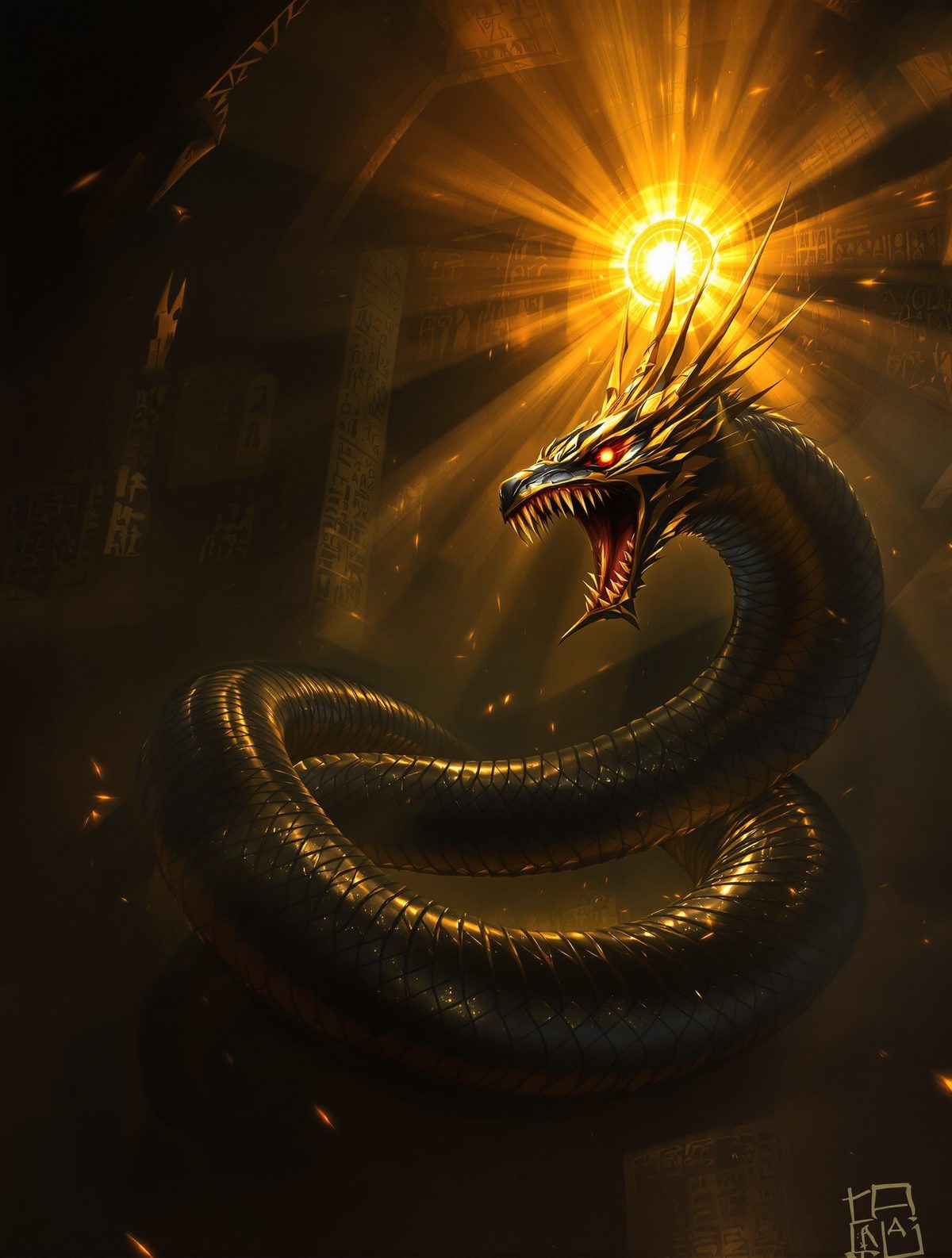
If Ra represented order, creation, and life itself, then Apophis—also known as Apep—embodied the complete opposite. This wasn't your garden-variety mythological monster. Ancient Egyptian texts describe Apophis as a serpent so vast that it could coil around the entire underworld, its body stretching for miles through the darkness. Some hieroglyphic accounts from the Temple of Edfu suggest the serpent measured over 50 cubits in length—roughly 75 feet of pure, world-ending malice.
But here's what most people don't realize: Apophis wasn't technically evil in the way we understand it today. The serpent represented isfet—the fundamental force of chaos that existed before creation and continuously threatened to return the universe to the primordial void from which it came. Apophis didn't hate Ra personally; it simply sought to undo existence itself, to return everything to the perfect, empty silence that existed before the first sunrise.
The serpent possessed abilities that would make modern horror writers weep with envy. It could hypnotize with its gaze, freeze the waters of the underworld with its breath, and most terrifyingly, it could swallow light itself. When Apophis opened its massive jaws, darkness didn't just fall—light actually flowed into its maw like water down a drain.
The Nightly Battle: Twelve Hours of Cosmic War
The ancient Egyptians divided Ra's underworld journey into twelve distinct hours, each presenting unique challenges and horrors. But it was during the seventh hour—the deepest, darkest point of night—that Apophis would make its move.
Picture the scene: Ra's solar barge, now dimmed to barely a flickering flame, navigates through waters black as obsidian. The air itself seems to thicken with malevolent intent. Suddenly, from the depths, Apophis rises. The serpent's emergence would cause the underworld to tremble, sending ripples of terror through both the realm of the dead and the world above.
The battle that followed wasn't a simple physical confrontation. According to the Book of the Dead and various pyramid texts, Apophis would attempt to swallow the solar barge whole, plunging the entire universe into eternal darkness. Ra's defenders would spring into action—Set wielding his massive spear, the deceased pharaohs lending their power, and the blessed dead chanting protective spells.
But here's the detail that will give you chills: there were nights when Apophis succeeded, at least partially. Solar eclipses weren't astronomical events to the Egyptians—they were moments when Apophis managed to swallow part of Ra during the day. The terror that gripped entire cities during eclipses stemmed from the very real fear that this time, Apophis might not let go.
The Magic That Kept the World Alive
The ancient Egyptians didn't simply hope Ra would survive each night—they actively participated in the battle. Temple priests would perform elaborate rituals every evening, essentially providing magical artillery support for the solar deity. At the Temple of Karnak, priests would burn wax figures of Apophis while reciting the Book of Overthrowing Apophis, a collection of some of the most vicious magical spells ever recorded.
These weren't symbolic gestures. The Egyptians believed that without their nightly magical support, Ra would inevitably fall to the chaos serpent. Every evening, as darkness fell across the Nile Valley, hundreds of priests in dozens of temples would begin their spiritual warfare. They would draw images of Apophis being stabbed, burned, and dismembered, each drawing charged with divine power and genuine desperation.
Common citizens participated too. Mothers would tell their children bedtime stories about Ra's journey, not to frighten them, but to add their voices to the cosmic chorus supporting the sun god. The very act of speaking Ra's name and recounting his victories provided magical strength for the nightly battle.
When Dawn Broke: Victory, But Never Final
Each sunrise brought overwhelming relief throughout ancient Egypt. Ra's emergence from the eastern horizon meant that once again, order had triumphed over chaos, existence had defeated void, and the world would continue for at least one more day. The solar barge would transform back into its daytime configuration, Ra would resume his falcon-headed form, and the cycle would begin anew.
But victory was never permanent. Apophis couldn't be truly destroyed because chaos, like energy, can neither be created nor destroyed—only contained. The serpent would retreat to the deepest waters of the underworld, nurse its wounds, and prepare for the next night's assault. This eternal struggle meant that vigilance could never cease, prayers could never stop, and the cosmic battle would continue until the end of time itself.
Archaeological evidence from worker's villages suggests that even common laborers would pause their evening meals to whisper quick prayers for Ra's protection. Graffiti found in tombs often includes hastily scratched images of spears piercing serpents—ordinary people adding their small contribution to the greatest battle ever fought.
Why This Ancient Terror Still Matters
In our age of electric lights and scientific understanding, it's easy to dismiss these ancient fears as primitive superstition. But consider this: the Egyptians understood something profound about the fragility of existence that we've largely forgotten. They recognized that the natural order we take for granted—the rising sun, the flowing river, the turning seasons—isn't guaranteed. It requires constant effort, vigilance, and yes, even faith to maintain.
Their nightly terror over Apophis devouring Ra reflects a deeper wisdom about entropy, chaos theory, and the second law of thermodynamics. Order naturally tends toward disorder; light naturally fades into darkness; civilization naturally collapses into barbarism—unless conscious effort opposes these forces.
Perhaps most remarkably, the ancient Egyptians believed that their daily actions, their moral choices, and their spiritual practices had cosmic consequences. In a world where we often feel powerless against global forces, the Egyptian model suggests that ordinary people—through their collective will, shared stories, and common purpose—can literally keep the light burning against the darkness.
Every morning when you see the sun rise, remember: somewhere in the realm of myth and meaning, the battle between Ra and Apophis continues. And maybe, just maybe, your recognition of that daily miracle adds one more voice to the eternal chorus keeping chaos at bay.