
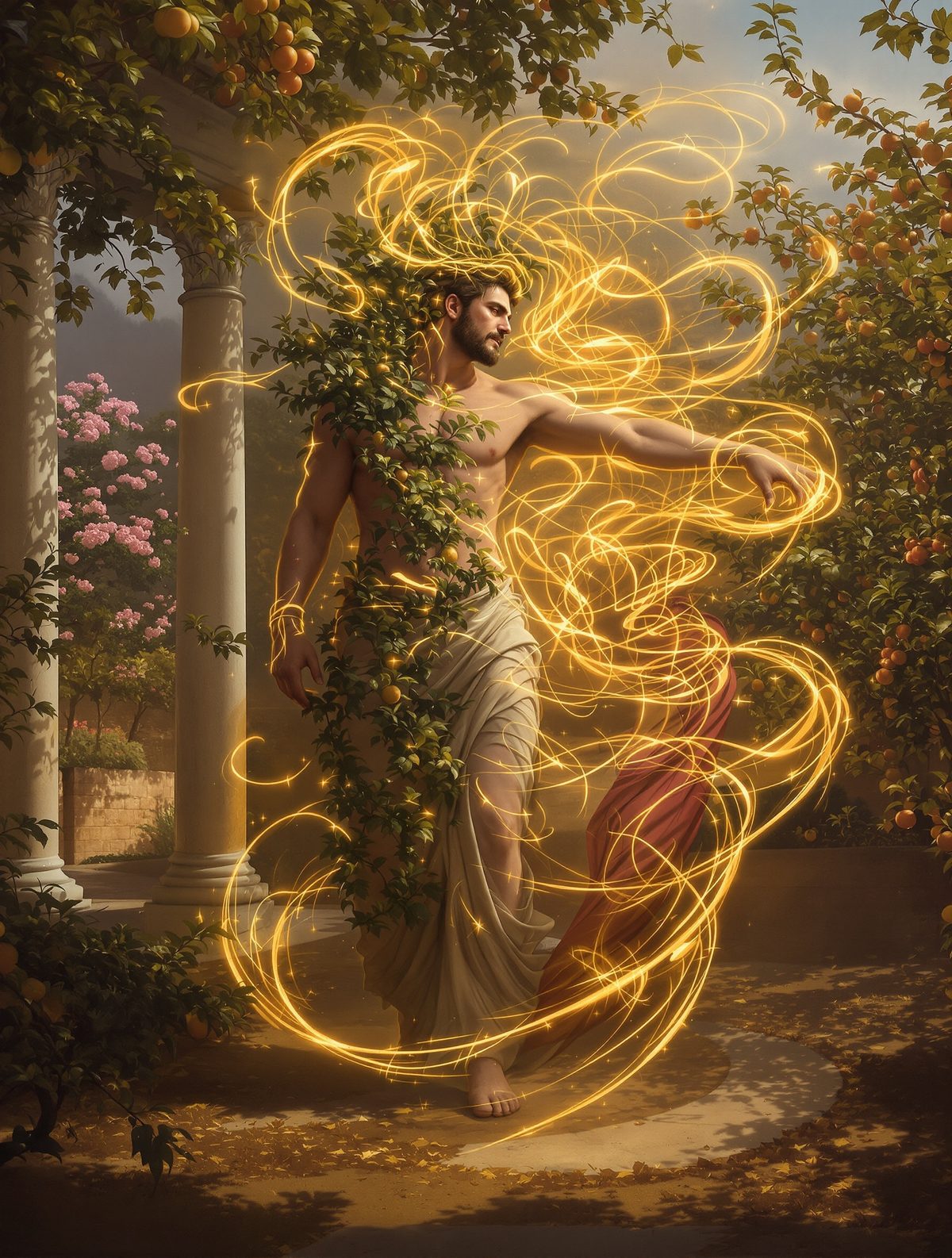
In the rolling hills outside ancient Rome, where golden wheat swayed in summer breezes and grapevines heavy with fruit climbed weathered stone walls, the most persistent love story in Roman mythology was unfolding. It wasn't the tale of star-crossed lovers or tragic heroes you might expect—instead, it was the story of a god who would literally become anyone and everyone to win the heart of the one woman who wanted nothing to do with love at all.
Picture this: a shapeshifting harvest deity so desperate for affection that he'd spend entire seasons disguised as different people, all to catch glimpses of a beautiful nymph who had sworn off romance entirely. This is the extraordinary tale of Vertumnus and Pomona—a story that reveals just how far obsession could drive even the gods, and why the Romans found this particular myth so captivating that it survived centuries of retelling.
The God of a Thousand Faces
Vertumnus wasn't your typical Roman deity. While Jupiter hurled thunderbolts and Mars commanded armies, Vertumnus possessed perhaps the most intimate power of all—he could become anyone. His name, derived from the Latin vertere meaning "to turn" or "to change," perfectly captured his essence. He was the god of seasons, of transformation, of the endless cycle that turned spring blossoms into autumn harvest.
But here's what most people don't realize: Vertumnus was likely an Etruscan god first, absorbed into Roman mythology around the 3rd century BCE as Rome expanded its influence across central Italy. The Romans were masterful at adopting and adapting the deities of conquered peoples, and Vertumnus fit perfectly into their agricultural pantheon. His primary temple stood on the Aventine Hill, where merchants and farmers would come to pray for favorable weather and bountiful crops.
What made Vertumnus truly unique among the gods was his restless nature. Unlike other deities who had fixed forms and predictable personalities, he was constantly changing—not just his appearance, but his entire being. Roman poets described him as appearing as a young man in spring, a mature farmer in summer, and a weathered harvester in autumn. This wasn't mere costume changes; Vertumnus actually became each form completely, experiencing the world through different eyes, different hearts, different desires.
The Untouchable Gardener of Rome
While Vertumnus wandered the countryside in his endless transformations, Pomona tended her sacred orchards with single-minded devotion. Her name comes from the Latin pomum, meaning fruit, and she was the only deity in the Roman pantheon specifically dedicated to fruit trees and orchards. Unlike the Greek pantheon with its numerous nature spirits, Rome had surprisingly few purely agricultural goddesses—making Pomona both rare and precious.
Roman writers, particularly Ovid in his Metamorphoses (written around 8 CE), painted Pomona as breathtakingly beautiful but completely uninterested in love or marriage. She had built high walls around her gardens—not just metaphorical barriers, but actual stone walls that kept out unwanted visitors. These weren't small plots, either. Archaeological evidence suggests that sacred orchards near Rome could span hundreds of acres, filled with apple, pear, and cherry trees that were considered gifts from the gods themselves.
What's fascinating is that Pomona represented a very Roman ideal: productive, organized, and self-sufficient. She didn't need rescue or protection. Her orchards flourished under her care, providing abundant fruit for both divine and mortal consumption. Roman women, particularly those of the upper classes, would have seen in Pomona a reflection of their own roles as managers of household resources and estates. She was competent, valuable, and entirely in control of her own destiny.
A Campaign of Hearts and Disguises
When Vertumnus first laid eyes on Pomona, tending her trees with gentle expertise, he fell instantly and completely in love. But this was no simple courtship—it became an elaborate campaign that would make even the most persistent modern suitor seem amateur by comparison.
Roman sources tell us that Vertumnus began his pursuit systematically, appearing in her orchards in different forms day after day. As a rugged farmer, he would praise her agricultural knowledge and offer to help with the harvest. As a young soldier fresh from campaign, he would regale her with stories of distant lands and promise to protect her precious trees. As a fisherman, he arrived with baskets of fresh catch from the Tiber, suggesting they could trade his fish for her fruit.
Each time, Pomona politely but firmly sent him away. She had work to do, trees to tend, walls to maintain. Love, she insisted, was a distraction she couldn't afford.
But here's where the story takes a darker turn that many modern retellings gloss over: Vertumnus's behavior was essentially stalking. He used his divine powers to bypass her clearly stated boundaries, appearing in her private spaces without permission, refusing to accept her rejection. The Romans of Ovid's time would have seen this differently—persistence in courtship was often viewed as romantic rather than troubling.
What made Vertumnus's campaign particularly elaborate was his attention to detail. When he appeared as a vine-dresser, his hands were stained with grape juice and his back bent from years of labor. As a harvester, he carried the calluses and sun-weathered skin of someone who had spent decades in the fields. He didn't just change his appearance—he embodied entire lifetimes of experience.
The Wisdom of the Ancient Woman
Finally, after months of rejection, Vertumnus tried his most ambitious disguise yet. He transformed himself into an elderly woman—bent with age, wise with experience, and completely non-threatening. This wasn't just any old woman; Roman sources suggest he became the very image of a respected matrona, the kind of older woman whose advice carried weight in Roman society.
Pomona, perhaps lonely after turning away so many suitors, welcomed this elderly visitor. They sat together among the apple trees, and the disguised Vertumnus began to weave a tale that would become one of the most psychologically sophisticated pieces of ancient storytelling.
The "old woman" praised Pomona's beauty and asked why such a lovely young nymph lived alone. When Pomona explained her dedication to her work and her disinterest in love, the elderly visitor nodded thoughtfully and began to tell a story—a cautionary tale about Anaxarete, a woman who spurned love so completely that the gods turned her to stone as punishment for her cruelty.
But here's the brilliant part: while telling this story, the disguised Vertumnus was also making his most honest appeal yet. Through the old woman's words, he spoke of the loneliness that comes with eternal solitude, the joy that could be found in partnership, and the natural harmony between the god of seasonal change and the goddess of fruitful abundance.
The Revelation and the Choice
As the story reached its climax, something shifted in the orchard. The afternoon light seemed to shimmer, and suddenly the old woman was gone. In her place stood Vertumnus in his true form—not as farmer or soldier or fisherman, but as himself: radiant, powerful, and completely vulnerable.
Roman poets describe this moment as one of perfect transformation—not just of Vertumnus's physical form, but of the entire situation. For the first time, Pomona was seeing not another disguised suitor, but the god who had loved her enough to become anyone she might want, anyone who might make her happy.
The revelation was both shocking and illuminating. Pomona realized that every kind farmer, every respectful soldier, every courteous fisherman had been the same persistent deity. But she also understood, perhaps for the first time, the depth of devotion that had driven such elaborate courtship.
In Ovid's telling, Pomona's heart finally opened—not to the disguises or the persistence, but to the authentic god who stood before her. The story ends with their union, described as a perfect match between the god of seasonal change and the goddess of fruitful harvest. Their combined powers would ensure Rome's agricultural prosperity for generations to come.
Why This Ancient Love Story Still Matters
The tale of Vertumnus and Pomona survived for over two thousand years because it grapples with questions that remain painfully relevant: How do we balance persistence with respect in matters of the heart? What happens when someone refuses to accept "no" as an answer? And perhaps most importantly, what does it mean to truly know someone when they're constantly changing who they appear to be?
In our age of social media personas and online dating profiles, Vertumnus's shape-shifting feels surprisingly contemporary. How many of us present different versions of ourselves to attract the people we desire? How often do we become who we think others want us to be, rather than revealing who we actually are?
The Romans saw in this myth a story about the necessity of change and adaptation in love—the willingness to grow and transform for another person. But modern readers might see something more troubling: a cautionary tale about the dangers of refusing to respect boundaries, and the complexity of consent when divine power is involved.
Perhaps that's why this ancient legend feels so urgent today. In a world where we're still learning to navigate the difference between romantic persistence and harassment, between transformation and deception, between love and obsession, Vertumnus and Pomona remind us that these questions are as old as civilization itself—and just as complicated as they've ever been.