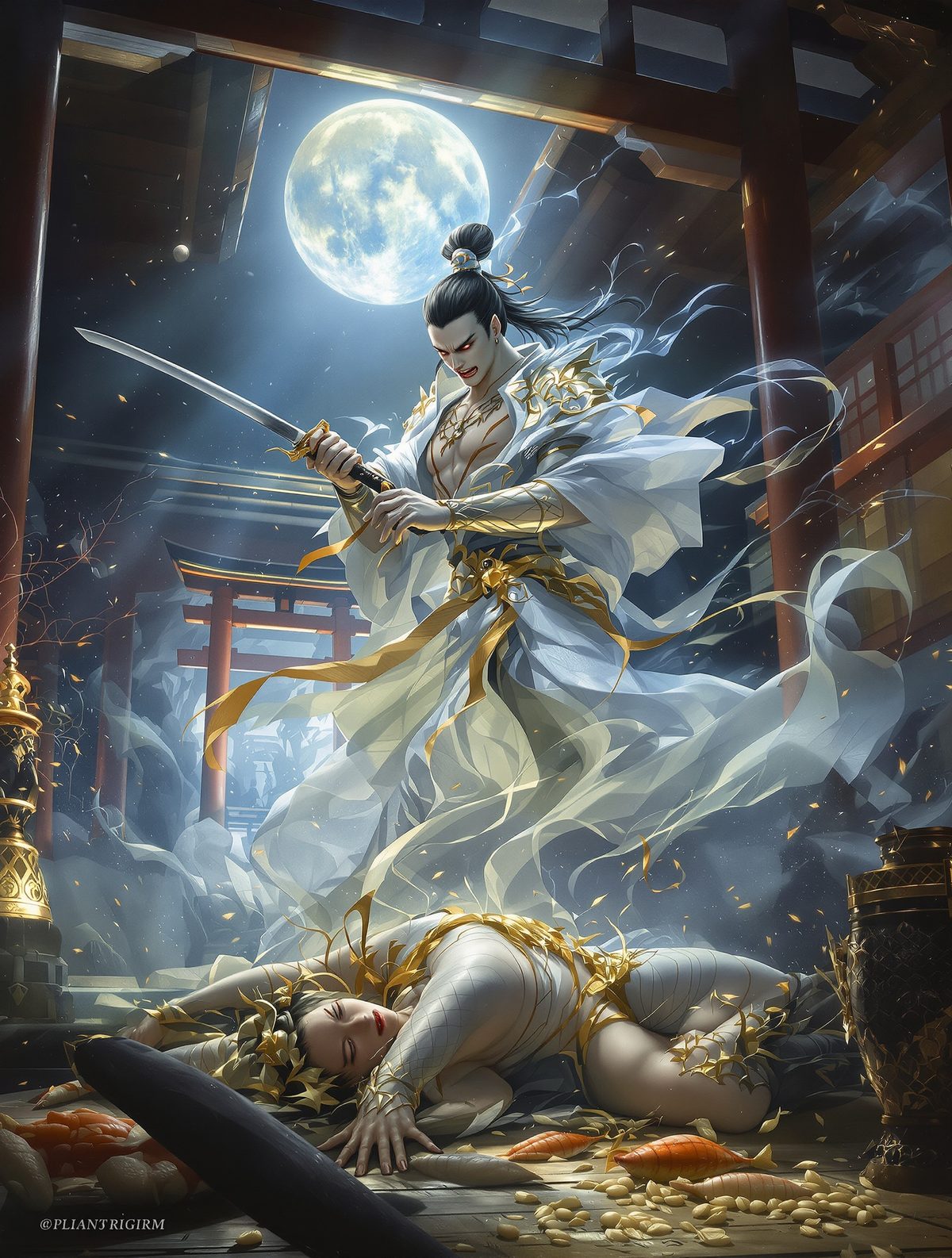
Picture this: You're invited to the most exclusive dinner party in the universe. Your host is a goddess, the food promises to be divine, and you're representing the very moon itself. What could possibly go wrong? Everything, as it turns out. In one horrifying moment of celestial etiquette gone catastrophically awry, a single act of disgust would tear apart the heavens themselves, separating the sun and moon for all eternity. This is the story of how divine manners—or the lack thereof—reshaped the cosmos.
The Divine Invitation That Changed Everything
In the primordial days of Japanese mythology, when the boundaries between earth and heaven were as thin as morning mist, three divine siblings ruled the cosmos with an uneasy harmony. Amaterasu, the radiant sun goddess, bathed the world in golden light. Her brother Susanoo commanded the storms and seas with tempestuous fury. And between them stood Tsukuyomi, the enigmatic moon god, whose silver light provided gentle guidance through the darkness.
The relationship between Amaterasu and Tsukuyomi was more than sibling affection—it was cosmic symbiosis. They shared the heavens in perfect balance, their celestial dance marking the passage of time itself. Day flowed into night, night yielded to day, and the world below thrived in their harmonious exchange. But this delicate equilibrium was about to be shattered by what should have been a simple social courtesy.
Uke Mochi, whose name literally translates to "food-holding goddess," extended an invitation that seemed innocuous enough. She was the divine embodiment of sustenance itself, responsible for ensuring that both gods and mortals never went hungry. Her invitation to Tsukuyomi wasn't unusual—gods frequently visited one another, sharing meals and reinforcing the bonds that kept the cosmic order intact. What was unusual was what happened when the moon god accepted her hospitality.
A Feast Fit for the Gods (Or So It Seemed)
Tsukuyomi descended from his lunar palace with all the dignity befitting his station. The moon god was known for his refined sensibilities and courtly manners—a sharp contrast to his storm-god brother's wild unpredictability. He arrived at Uke Mochi's realm expecting the kind of elegant feast that had become standard among the divine: ambrosia that sparkled like starlight, sake that flowed like liquid moonbeams, delicacies that transcended mortal understanding.
Uke Mochi welcomed her celestial guest with all the pomp and ceremony appropriate for one of such high rank. The stage was set for what should have been a pleasant evening of divine fellowship. The food goddess had prepared what she considered her finest hospitality—a demonstration of her unique powers that would showcase the very essence of sustenance itself.
But here's where the evening took a turn that no cosmic etiquette manual could have prepared them for. When the time came to serve the feast, Uke Mochi didn't simply present dishes that had been prepared in advance. Instead, she began to create the food in real-time, using methods that would have made even the most iron-stomached deity reach for the nearest celestial sick bag.
The Grotesque Performance That Ended Everything
What happened next depends on which ancient text you consult, but all versions agree on the fundamental horror of the scene. Uke Mochi turned toward the land and opened her mouth wide, vomiting forth perfect grains of rice that fell like precious pearls. She faced the ocean and from her mouth came fish of every variety, their scales still glistening with divine essence. When she turned toward the mountains, various game animals tumbled from her lips, each one perfect for the table.
But the goddess wasn't finished with her grotesque display of hospitality. Some accounts describe her producing additional delicacies from other bodily orifices—her nose birthing silkworms for the finest textiles, her hindquarters expelling soybeans and other legumes. What she saw as the ultimate expression of her divine nature, Tsukuyomi perceived as an abomination that defied every notion of proper behavior.
The moon god's refined sensibilities, honed by eons of celestial propriety, simply couldn't process what he was witnessing. This wasn't the elegant feast he had anticipated—it was a biological nightmare masquerading as divine hospitality. The food might have been perfect in quality, each grain of rice flawless and every fish pristine, but the method of production violated something fundamental in Tsukuyomi's nature.
In that moment of cosmic disgust, the moon god's hand moved to his sword with the fluid motion of celestial wrath. The blade, forged from concentrated moonlight and cooled in the depths of space, sang as it cleared its scabbard. With a single, decisive strike, Tsukuyomi ended Uke Mochi's grotesque performance—and her existence—forever.
The Sister's Fury and the Great Separation
When word of the murder reached Amaterasu, her reaction was swift and absolute. The sun goddess didn't pause to consider her brother's motivations or the circumstances that led to his violent outburst. All she knew was that Tsukuyomi had committed an unforgivable act of brutality against a fellow deity, and worse, he had done so over something as trivial as table manners.
"How dare you!" her voice thundered across the heavens, causing solar flares that could be seen from the farthest reaches of the cosmos. "Your actions are so vile that I can no longer bear to look upon your face!" The words carried the weight of divine law, binding and irreversible. In her rage, Amaterasu severed all ties with her brother, declaring that never again would they share the same sky.
This wasn't merely a family quarrel—it was a fundamental restructuring of reality itself. Where once the sun and moon had danced together across the heavens, sometimes sharing the sky in harmonious twilight, now they would be forever separated. Amaterasu would rule the day in solitary splendor, while Tsukuyomi was banished to reign over the night alone. The age of their cooperation was over, replaced by an eternal cosmic divorce that continues to this day.
The separation had immediate and far-reaching consequences. The gentle transitions between day and night became sharp, abrupt changes. The romantic notion of sun and moon sharing the sky became a rare occurrence, treasured for its very impossibility. Humanity lost the comfort of their divine rulers' harmony and gained instead the stark reality of celestial division.
The Unexpected Legacy of Divine Murder
But here's where the story takes an unexpected turn that most versions of this myth gloss over: Uke Mochi's death wasn't the end of her story. From her lifeless divine body sprouted all the foods that would sustain humanity for millennia to come. Rice grew from her head, millet from her forehead, red beans from her eyebrows, and soybeans from her nose. Her belly produced wheat, while her genitals gave birth to barley.
Amaterasu, despite her fury at Tsukuyomi, recognized the value of these gifts. She gathered the seeds and grains that had emerged from Uke Mochi's corpse and gave them to humanity, ensuring that mortals would never want for food. In a twisted sense, Tsukuyomi's act of violence had inadvertently provided the greatest gift the human race would ever receive—the foundation of agriculture itself.
The irony was lost on no one: the moon god's disgust at the goddess's methods of food production had ultimately made those very foods available to everyone. His act of cosmic rudeness had, through a chain of divine consequences, become the origin of human civilization's most fundamental necessity.
Why This Ancient Horror Story Still Matters
This isn't just another weird tale from humanity's mythological past—it's a surprisingly modern story about the consequences of our reactions to things that disgust us. Think about it: How often do we let our immediate emotional responses drive us to decisions that fundamentally alter our relationships and circumstances?
Tsukuyomi's violent overreaction to Uke Mochi's unconventional hospitality cost him his relationship with his sister and forever changed the cosmic order. His inability to look past the method to appreciate the intention—generous hospitality, however grotesquely expressed—speaks to a very human failing that transcends mythological boundaries.
In our modern world, we're constantly confronted with things that challenge our sensibilities, whether it's unfamiliar foods, different cultural practices, or simply ways of being that don't align with our expectations. The story of Tsukuyomi reminds us that our disgust, however justified it might feel in the moment, can lead to consequences far beyond what we intend.
The next time you find yourself reaching for your metaphorical sword in response to something that offends your sensibilities, remember the moon god who let his revulsion reshape the heavens. Sometimes the most profound wisdom comes from the most grotesque legends—the ones they definitely left out of the textbooks.