Picture this: the most powerful being in the universe receives a divine gift from one of the most temperamental sages in creation—and carelessly tosses it aside. What happens next will strip every god in heaven of their immortal strength and plunge the cosmos into chaos. This is the story of how a single discarded flower garland brought down the entire pantheon of Hindu gods, a tale that reveals the dangerous intersection of divine ego, sacred protocol, and cosmic consequences.
In the vast tapestry of Hindu mythology, few stories illustrate the precarious nature of divine power quite like the curse of Durvasa. It's a reminder that even gods must show respect for the sacred—and that sometimes, the smallest act of negligence can topple kingdoms.
The Wandering Sage with Fire in His Eyes
Durvasa wasn't just any ordinary sage—he was the very embodiment of divine wrath walking the earth in human form. According to the Bhagavata Purana, this formidable figure was born as a partial incarnation of Lord Shiva himself, inheriting all of the destroyer god's legendary temper but with the added volatility of mortal emotions. Durvasa's name literally means "one who is difficult to live with," and he lived up to this reputation with spectacular consistency.
What made Durvasa particularly dangerous wasn't just his quick temper—it was his immense spiritual power. Through millennia of intense penance and meditation, he had accumulated such tremendous tapasya (spiritual energy) that his curses were considered absolutely irrevocable. Even Lord Vishnu himself treated Durvasa with careful respect, knowing that one thoughtless word could unleash consequences that would ripple across all three worlds.
The sage was known to wander between the earthly realm and the celestial spheres, his matted hair flowing behind him, his eyes blazing with inner fire. Kings and commoners alike would prostrate themselves when they saw him approaching, for everyone knew the stories: Durvasa had once cursed King Ambarisha to be devoured by the Sudarshana Chakra, and had transformed dozens of others who failed to show proper reverence.
A Gift Blessed by Fortune Herself
On this particular day, Durvasa had been blessed with an extraordinary gift during his wanderings. He had encountered a group of celestial maidens who had just finished their worship of Goddess Lakshmi, the divine embodiment of prosperity, fortune, and spiritual wealth. The centerpiece of their ritual had been a magnificent garland—not just any ornamental chain of flowers, but a vaijayanti mala that had been personally blessed by Lakshmi herself.
This wasn't mere decoration. In Hindu tradition, such garlands were considered repositories of divine grace, imbued with the goddess's shakti (divine feminine energy). The flowers—likely including sacred lotus blossoms, marigolds, and jasmine—had been strung together while mantras were chanted, each bead and petal infused with spiritual significance. To receive such a garland was to receive a direct blessing from the goddess of abundance herself.
The celestial beings, recognizing Durvasa's spiritual stature despite his fearsome reputation, had reverently offered him this sacred ornament. As he accepted it, the garland seemed to glow with an inner radiance, its fragrance carrying the very essence of divine blessing. Here was a gift that could bring prosperity to entire kingdoms, protection from cosmic disasters, and the favor of the gods themselves.
Rather than keep this treasure, however, Durvasa decided to share the blessing. His destination: Amaravati, the glittering capital of Indraloka, where the king of gods held court in splendor that rivaled a thousand suns.
The King of Heaven's Fatal Misstep
Indra, seated upon his celestial throne Vimana, was at the height of his power when Durvasa arrived. The king of gods ruled over the Devas from his magnificent palace, its crystal walls reflecting the light of divine gems. Around him, the court buzzed with the activity of celestial musicians, dancing apsaras (heavenly nymphs), and the constant flow of nectar and ambrosia. This was a being who commanded the thunderbolt Vajra, who controlled the monsoons that fed the earth, and who had won his position through victory in countless cosmic battles.
When Durvasa approached with the sacred garland, protocol demanded that Indra should have received it with the utmost reverence. He should have stood, accepted it with both hands, and placed it respectfully around his own neck while offering prayers of gratitude. Instead, intoxicated by his own power and perhaps distracted by the pleasures of his court, Indra made a decision that would echo through eternity.
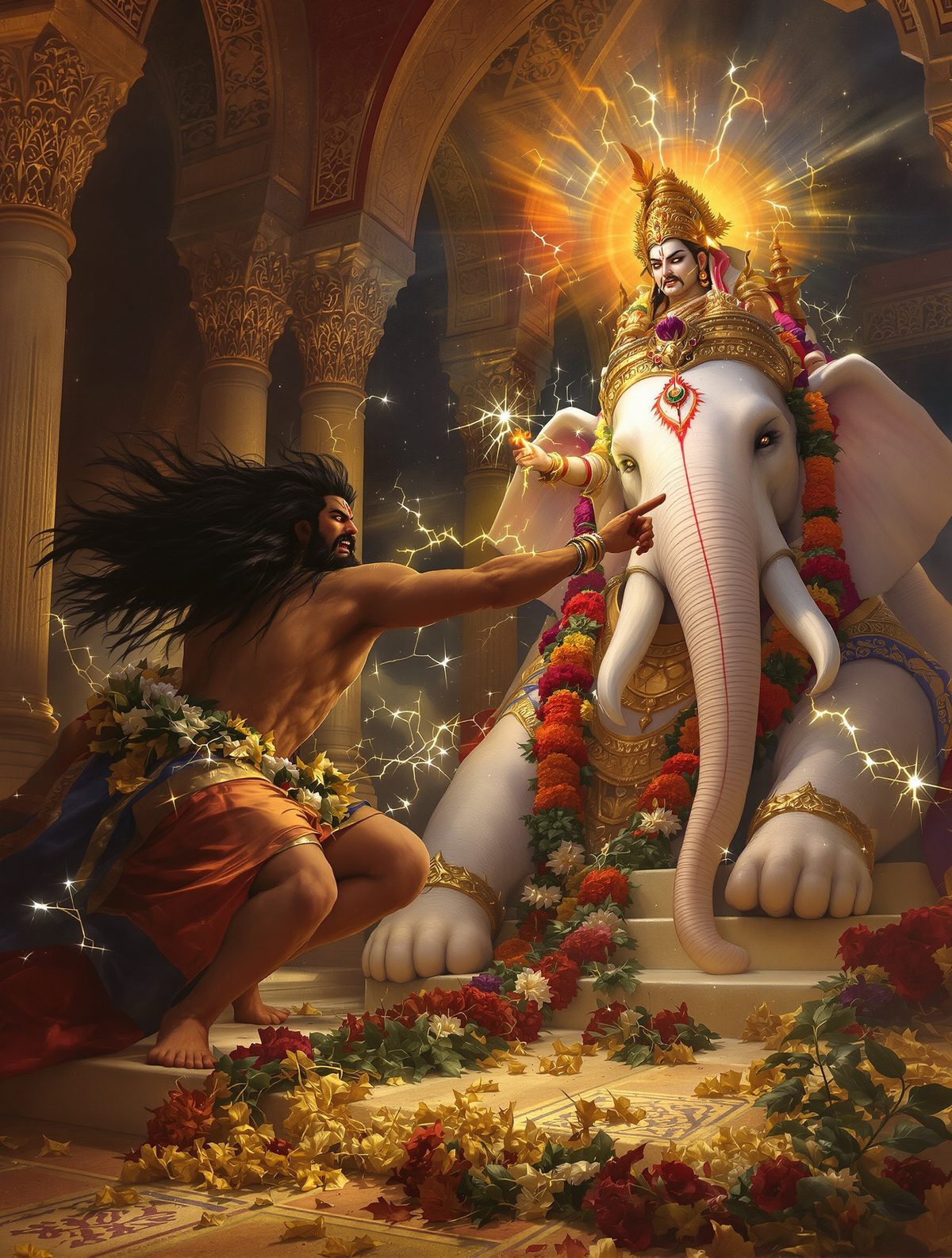
With casual disregard, he took the priceless garland—this repository of Lakshmi's own blessing—and carelessly draped it over the head of his mount, the white elephant Airavata. To Indra, it was perhaps a moment's thoughtlessness, a king's casual gesture toward a gift he didn't fully appreciate. But to Durvasa, watching his sacred offering being treated like mere decoration for a beast of burden, it was the ultimate insult.
What happened next sealed the doom of the gods. Airavata, either irritated by the unfamiliar weight and fragrance or simply acting on animal instinct, shook the garland from his massive head. The sacred flowers—each one a vessel of divine grace—scattered to the marble floor of the celestial court, where the elephant's mighty feet trampled them into fragments.
When Divine Fury Meets Cosmic Justice
The transformation in Durvasa was instantaneous and terrifying. His eyes blazed like supernovas, his voice thundered like the collapse of mountains, and the very air around him crackled with spiritual energy. This wasn't just anger—this was the righteous fury of the cosmos itself, channeled through a being who had spent eons accumulating the power to reshape reality with his words.
"Indra!" the sage's voice boomed through the crystal halls of Amaravati. "Your pride has blinded you to the sacred! You have shown contempt for the blessing of Lakshmi herself, treating her grace as mere ornament for your beast! So let it be—as you have cast aside her favor, so shall her favor be cast aside from you!"
The curse that followed wasn't just directed at Indra alone. With words that seemed to tear holes in the fabric of existence itself, Durvasa declared that all the Devas would lose their divine strength, their immortality, and their dominion over the cosmos. The tejas (divine radiance) that marked them as gods would fade, leaving them as vulnerable as mortals.
The effects were immediate and catastrophic. Across the three worlds, the cosmic order began to unravel. The sun lost its brilliance, the rains ceased to fall in their proper seasons, and the very foundations of heaven trembled. Most terrifyingly of all, the Asuras—the demons who were the eternal enemies of the gods—sensed the shift in cosmic power like sharks scenting blood in the water.
The Churning of Cosmic Consequences
What followed was nothing short of apocalyptic. The demon armies, led by the mighty Bali, swept across the celestial realms like a dark tide. The gods, stripped of their divine strength, found their weapons useless and their fortress-cities defenseless. One by one, the bastions of divine power fell: Amaravati itself was conquered, the sacred Mount Meru was occupied, and Indra was forced to flee his own kingdom like a common refugee.
The crisis forced the defeated gods to swallow their pride and seek help from the very source of all creation. In desperation, they approached Lord Vishnu, the Preserver, prostrating themselves before him in their humiliation. Vishnu's solution would become one of the most famous episodes in Hindu mythology: the Samudra Manthan, or churning of the cosmic ocean.
This massive undertaking required the gods to make an unprecedented alliance with their demon enemies, using the serpent Vasuki as a rope and Mount Mandara as a churning stick to extract the nectar of immortality from the primordial ocean. The churning would take a thousand years and produce both wonderful treasures and terrible poisons, ultimately restoring the cosmic balance—but at an enormous cost in divine pride and cosmic stability.
Yet here's a detail often overlooked in the grand narrative: the entire crisis could have been avoided if Indra had simply shown proper respect for a gift of flowers. The churning of the ocean, the alliance with demons, the temporary triumph of evil over good—all of it stemmed from one moment of divine thoughtlessness.
The Eternal Lesson of Sacred Reciprocity
This ancient tale resonates far beyond the realm of mythology because it speaks to fundamental truths about respect, gratitude, and the consequences of our choices. In our modern world, where we often treat gifts, relationships, and opportunities with casual disregard, Durvasa's curse serves as a powerful reminder that everything sacred—whether it's trust, love, friendship, or even our natural environment—requires conscious reverence to maintain its power.
The story also reveals a profound truth about leadership and power. Indra's downfall came not from external attack or internal rebellion, but from his own disconnect from the sacred foundations that legitimized his authority. How many leaders throughout history have lost everything not through grand failures, but through small acts of disrespect that revealed their fundamental unworthiness to lead?
Perhaps most importantly, the tale reminds us that in a universe governed by cosmic law rather than arbitrary power, even gods must answer for their actions. Durvasa's curse wasn't personal revenge—it was the universe itself responding to a violation of sacred order. In our interconnected world, where small acts of thoughtlessness can cascade into global consequences, this ancient wisdom has never been more relevant.
The next time you receive a gift—whether it's as simple as a flower or as complex as someone's trust—remember Indra's garland. Sometimes the most profound respect is found in the smallest gestures, and the most catastrophic consequences flow from the briefest moments of thoughtless pride.