In the gleaming halls of Asgard, where gods feast on mead and boar, a wolf pup played among the divine. Fenrir was no ordinary beast—son of the trickster god Loki and the giantess Angrboda, he possessed an intelligence that sparkled in his yellow eyes and a hunger that grew with each passing day. The gods watched with growing unease as this "pet" swelled from the size of a hound to that of a horse, his jaws snapping through iron chains like spider silk. They knew the prophecy: this wolf would one day devour Odin, the All-Father himself. But prophecies, as the Norse understood all too well, have a cruel way of fulfilling themselves precisely because we try to prevent them.
What followed was a tale of divine desperation, cunning deception, and ultimate sacrifice that would echo through the halls of Valhalla until Ragnarök itself—the story of how Tyr, the one-handed god of war, earned his epithet through the most heroic act in Norse mythology.
The Wolf Among Gods
Fenrir's presence in Asgard wasn't mere coincidence. The gods, in their complex relationship with fate, chose to keep their prophesied destroyer close. Only Tyr, the brave god of war and justice, dared approach the growing wolf to feed him. While other deities whispered nervously in corners, Tyr would stride confidently to Fenrir's side, meat in hand, looking directly into those predatory eyes without flinching.
This wasn't mere bravado. Archaeological evidence from the Viking Age reveals that Tyr was once far more prominent in the Germanic pantheon than surviving sources suggest. Tacitus, writing in 98 CE, identified him with Mars, calling him the chief war deity of the Germanic tribes. The Tuesday (Tyr's day) that we still observe each week bears his name, a linguistic fossil from when this one-handed god commanded more reverence than Thor himself.
But by the time the Prose Edda was recorded in 13th-century Iceland, Tyr had been largely overshadowed by Odin and Thor. The story of his sacrifice may explain why—sometimes the greatest heroes are remembered not for their victories, but for what they willingly lost.
Chains of Desperation
As Fenrir grew, so did the gods' anxiety. The wolf's strength had become legendary even among the divine. They forged Læding, a massive iron chain, and challenged Fenrir to test his might against it. The wolf, amused by the game, allowed them to bind him—then shattered the links with a casual stretch. Undaunted, the gods created Dromi, twice as strong as the first chain. Again, Fenrir broke free, pieces of metal raining down like deadly hail across Asgard's golden floors.
The failures weren't just embarrassing—they were terrifying. Each broken chain proved that conventional strength, even divine strength, couldn't contain this prophesied doom. The gods needed something beyond the physical realm, something that bent the very rules of reality.
In desperation, Odin sent a messenger to Svartalfheim, realm of the dark elves (or dwarfs), master craftsmen whose skills bordered on magic itself. These were the same artisans who had created Odin's spear Gungnir, Thor's hammer Mjolnir, and Sif's golden hair. But the commission they received this time was unlike any other: create bonds that could hold a force of nature, constrain destiny itself.
The Impossible Rope
The dark elves crafted Gleipnir, a rope that defied every expectation. Thinner than silk ribbon, softer than a whisper, it looked like something a child might use to tie back hair. But Gleipnir was woven from six impossible things: the sound of a cat's footfall, the beard of a woman, the roots of a mountain, the sinews of a bear, the breath of a fish, and the spittle of a bird.
This wasn't random mysticism—it was profound Norse philosophy made manifest. Each component was something that theoretically existed but practically didn't, representing the liminal spaces where reality bent. The Norse mind understood that to bind the impossible, you needed the impossible itself.
Modern scholars have noted the psychological sophistication of this concept. Gleipnir represents something stronger than physical force: the power of paradox, of things that exist in the spaces between certainty. It's a chain made of absences, gaps in reality that couldn't be broken because they weren't quite there to break.
The Price of Trust
When the gods returned to Fenrir with their deceptively delicate rope, the wolf's intelligence blazed forth. He had been fooled twice by games of strength, but this gossamer strand that the gods claimed could bind him? His predator's instincts screamed danger.
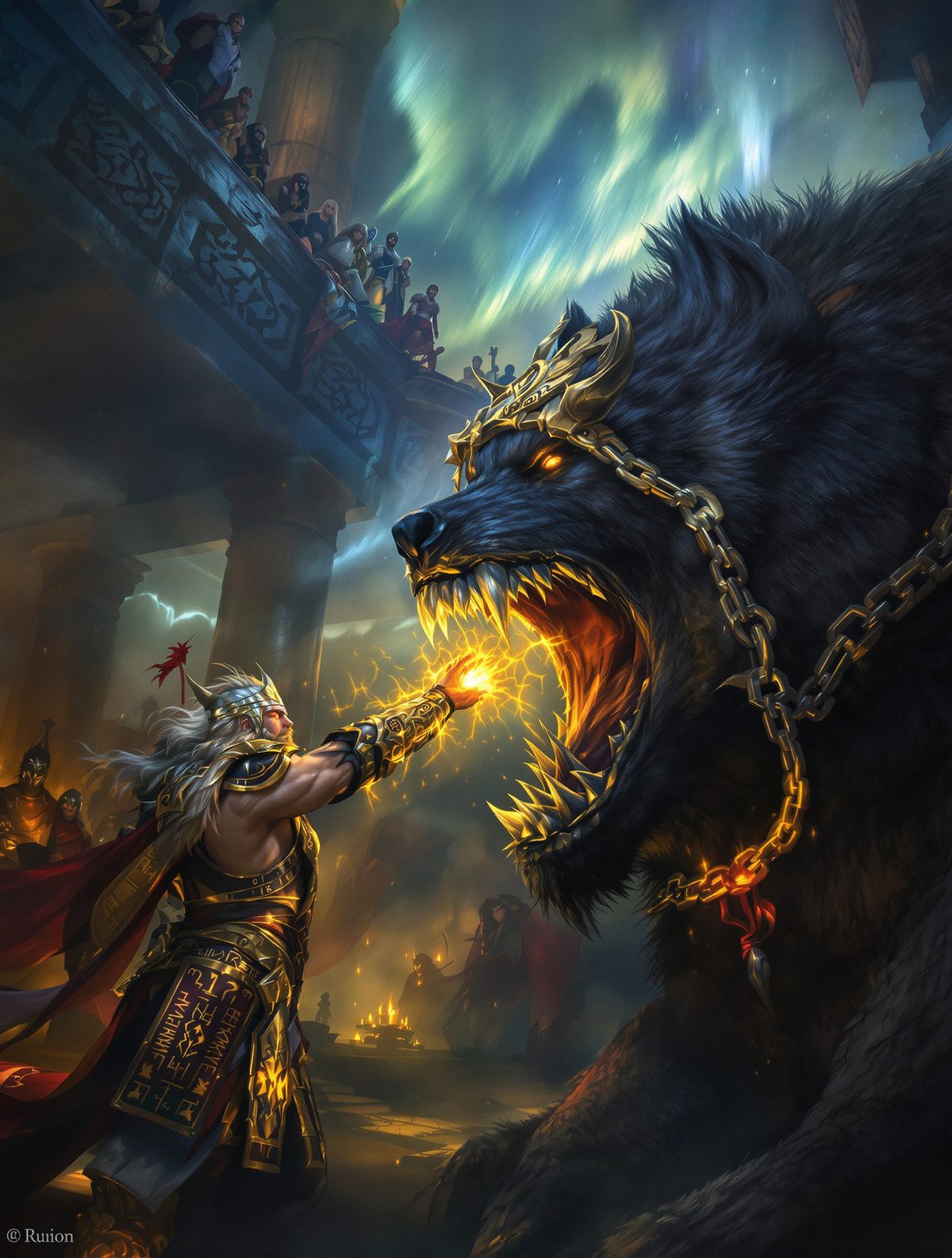
"If this rope is as harmless as it appears," Fenrir growled, his voice carrying the rumble of distant thunder, "then you should have no fear binding yourselves with it first. But if it's crafted with magic and treachery, then it will not touch my limbs—unless one of you places his hand in my mouth as pledge of good faith."
The silence that followed was deafening. Here was the heart of the matter laid bare: trust. The gods were asking Fenrir to trust them while planning his eternal imprisonment. The wolf, no fool, demanded collateral that matched the stakes. Not gold or weapons, but something irreplaceable—the hand of a god.
The divine council exchanged glances heavy with reluctance. Odin looked to his ravens. Thor gripped his hammer. Freyja studied her golden necklace. Balder, the beautiful, stepped half-forward then stopped. Each had reasons to refuse: their roles, their importance, their fear.
Only Tyr stepped forward without hesitation.
The Moment of Truth
What happened next has been preserved in remarkable detail across multiple sources—the Prose Edda, the Poetic Edda, and even references in earlier skaldic poetry. Tyr, god of war and justice, strode to Fenrir's side as he had done countless times before. But this time, as the other gods positioned Gleipnir around the wolf's massive limbs, Tyr placed his right hand directly between those legendary jaws.
The scene must have been breathtaking: the golden halls of Asgard framing this moment of ultimate trust and ultimate betrayal. Fenrir's warm breath on Tyr's palm. The other gods holding their collective breath. The deceptive softness of Gleipnir being drawn tight.
The moment Fenrir realized he couldn't break free, his jaws snapped shut with the force of fate itself. Tyr's hand was severed cleanly, blood spattering the floor of Asgard as the god of war stepped back, cradling his maimed arm without so much as a cry of pain.
The other gods laughed—all except Tyr. Their laughter wasn't joy but relief, hysteria, the nervous release of divine beings who had just witnessed something that would haunt them until the end of the world. They had saved themselves, but at a cost that would echo through eternity.
The Weight of Sacrifice
Tyr's sacrifice resonates across the centuries precisely because it embodies contradictions that feel achingly familiar. He was simultaneously hero and participant in betrayal, savior and destroyer of trust. In losing his hand, he gained something more complex than simple heroism—he became a figure who understood that sometimes doing right requires accepting terrible consequences.
Modern scholars note that Tyr's willing sacrifice stands in stark contrast to the often self-serving actions of other Norse gods. While Odin seeks wisdom for power and Thor battles for glory, Tyr acts purely for the protection of his community, knowing full well he'll be maimed and that his sacrifice enables a profound injustice.
This story wasn't just entertainment for Viking Age audiences—it was a meditation on leadership, sacrifice, and the terrible prices that sometimes must be paid. In a society where warfare was constant and leaders were expected to share their warriors' risks, Tyr's willingness to bear the cost of collective safety while others laughed would have carried profound moral weight.
Perhaps most remarkably, the Norse sources never present Tyr's sacrifice as purely noble. The gods' betrayal of Fenrir was a violation of sacred trust, and Tyr's participation makes him complicit. Yet without his sacrifice, the wolf would have remained free to fulfill the prophecy immediately. The story offers no easy answers, no clear moral path—only the reality that sometimes good people must do terrible things, and the gods themselves are flawed beings making impossible choices.
Today, in an age of complex global challenges that demand both individual sacrifice and collective action, Tyr's story reminds us that true heroism often comes not in moments of glory, but in quiet decisions to bear costs that others cannot or will not accept. The one-handed god teaches us that sometimes the price of holding back disaster is not just our comfort or convenience, but pieces of ourselves we can never reclaim.