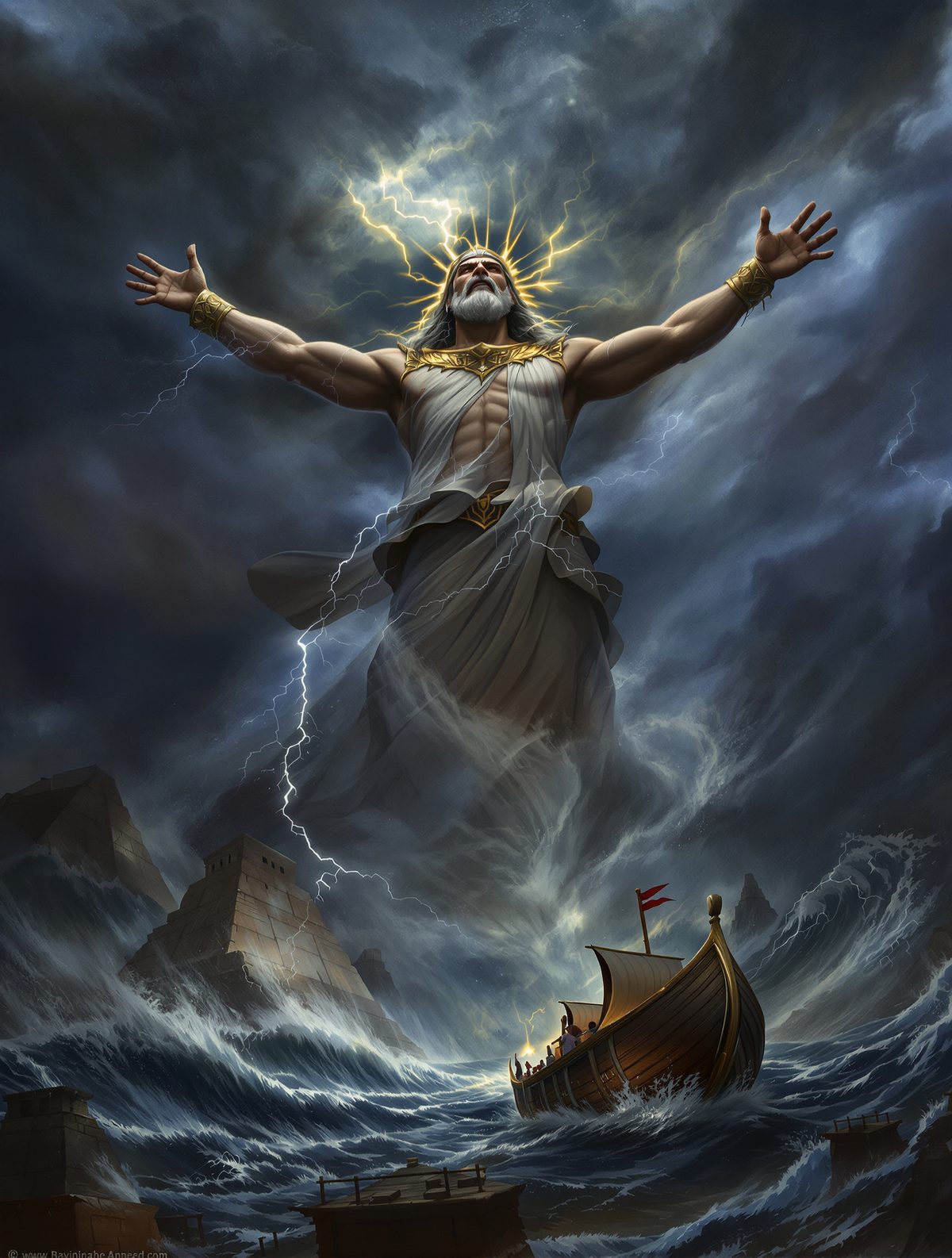
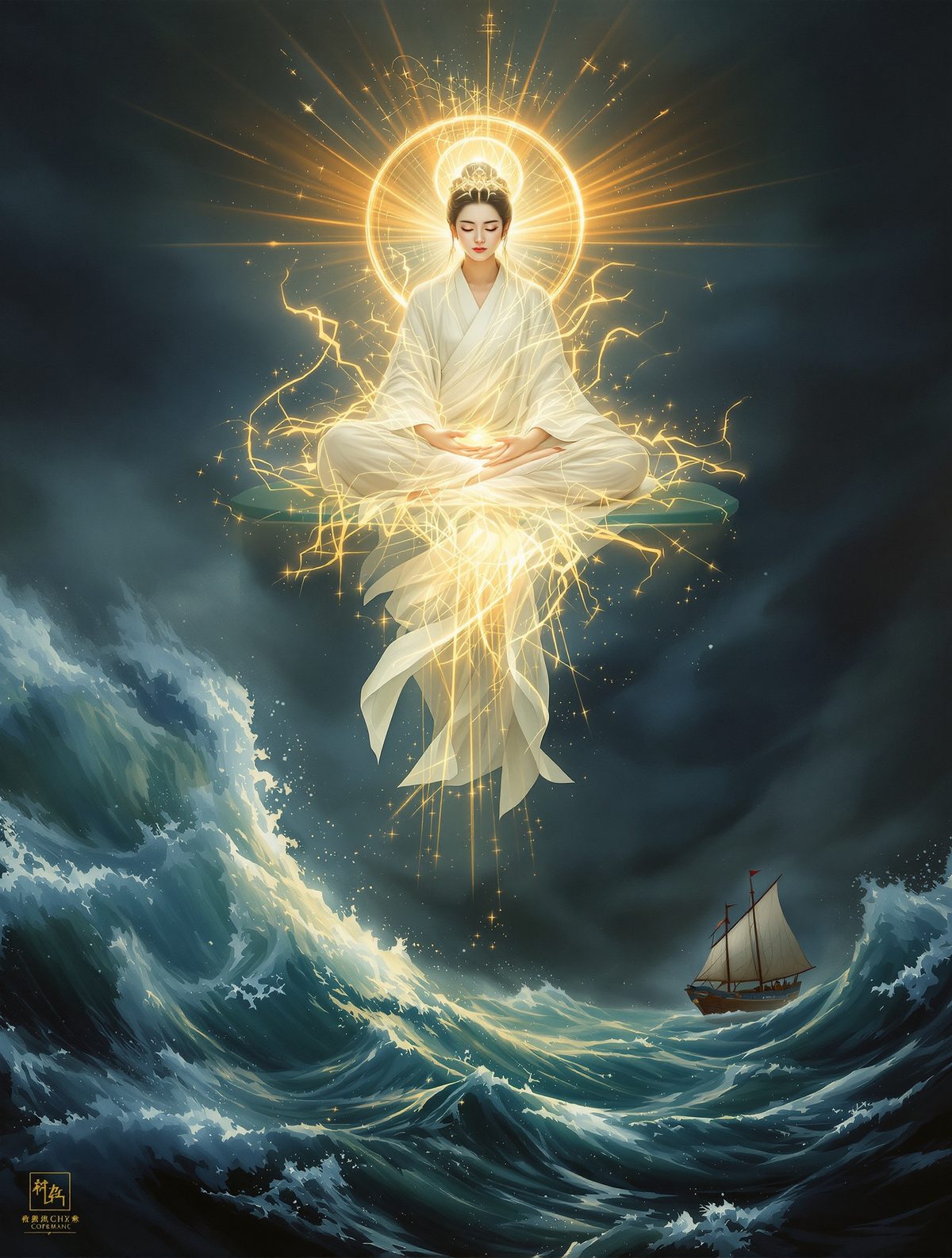
The storm howled across the Strait of Taiwan like a living thing, its winds screaming at 80 miles per hour as mountainous waves swallowed fishing boats whole. In a modest home on Meizhou Island, a sixteen-year-old girl sat in perfect stillness, her breathing so shallow she appeared dead. Her name was Lin Moniang, and at that very moment in 987 CE, her spirit was flying across the churning black waters, racing against time to save her drowning family.
This is not the story you'll find in most history books. Yet for over a thousand years, millions of people across Asia have worshipped this teenage girl as Mazu—the most powerful sea goddess in Chinese mythology. Her tale begins not with divine birth or celestial appointment, but with a moment of impossible choice that would echo through the centuries.
The Girl Who Spoke to Spirits
Lin Moniang was born on March 23, 960 CE, during the Song Dynasty, on tiny Meizhou Island off the coast of Fujian Province. Local records describe her as unnaturally quiet—so silent as an infant that her parents feared she was mute. They named her Moniang, meaning "silent girl," never imagining this strange child would become the voice that guided sailors home from the depths of the sea.
But Moniang's silence concealed extraordinary gifts. By age eight, she could predict weather patterns with uncanny accuracy, warning fishermen when typhoons approached days before they struck. Villagers whispered that she communicated with spirits, spending hours in meditation so deep that earthquakes couldn't wake her. Her family dismissed these stories—until the night her supernatural abilities saved their lives.
The Lin family were fishermen, like most residents of Meizhou Island. Moniang's father and four brothers made their living harvesting the treacherous waters of the Taiwan Strait, where sudden storms could transform calm seas into liquid mountains in minutes. On the evening of October 19, 987 CE, they sailed out expecting routine fishing. Instead, they sailed into legend.
The Night the Sea Turned Black
The typhoon struck without warning around midnight. Winds that had been gentle evening breezes suddenly exploded into a Category 4 monster, generating waves over 40 feet high. The Lin family's two fishing boats—fragile wooden vessels barely 20 feet long—found themselves separated in the chaos, their occupants fighting for survival as the sea tried to claim them.
Miles away on Meizhou Island, sixteen-year-old Moniang sat cross-legged in her room, deep in meditation. Her mother had grown accustomed to these nightly trances, but this one was different. The girl's body remained motionless for hours, yet her face contorted with effort, as if she were struggling against invisible forces. Tears streamed down her cheeks though her eyes remained closed.
What happened next challenges everything we understand about the boundaries between physical and spiritual reality. According to accounts recorded by Song Dynasty historians and preserved in the Tianfei Xiansheng Lu (Record of the Celestial Consort's Manifestations), Moniang's spirit left her body that night, manifesting as a brilliant red light that flew across the storm-tossed waters.
Flight Across the Storm-Torn Sea
Fishermen from neighboring villages later testified they witnessed something impossible during that terrible typhoon: a glowing figure moving through the storm, seemingly immune to the wind and waves. This luminous being—described as a young woman in flowing red robes—appeared simultaneously at two locations dozens of miles apart, guiding the Lin family's separated boats toward safety.
The spirit-form of Moniang worked through the night with supernatural strength. She pushed her father's boat away from jagged rocks that would have shattered it to splinters. When her second brother was swept overboard by a massive wave, witnesses claimed the red light dove into the churning water and lifted him back onto the deck. Most remarkably, she somehow guided both boats through the maze of reefs and shoals around Meizhou Island, leading them toward the protected harbor where they could ride out the storm.
But here's where the story takes its tragic turn—and reveals why interrupting a mystic's trance was considered one of the gravest taboos in ancient Chinese culture.
The Mother's Fatal Mistake
As dawn approached, Moniang's mother grew increasingly alarmed by her daughter's condition. The girl had been motionless for over six hours, her breathing so faint it was barely detectable. Her skin had turned cold and waxy, like a corpse. Fearing her daughter was dying, the terrified woman shook Moniang violently, calling her name until the girl's eyes snapped open.
The effect was instantaneous and devastating. Moniang's spirit, stretched across miles of ocean like an ethereal rope, snapped back into her body with such force that she screamed and collapsed. She had been guiding two boats to safety—but the sudden return left her spiritual energy scattered and depleted.
"I saved father and three of my brothers," she gasped to her mother, "but I could not bring back the fourth." Even as she spoke these words, she knew with supernatural certainty that her eldest brother had drowned in the final moments before her spirit's forced return.
When the surviving Lin family members reached shore that morning, they confirmed every detail of Moniang's impossible rescue—and the tragic loss of her eldest brother, whose body was found floating exactly where her vision had shown.
From Village Girl to Divine Protector
Word of Moniang's miraculous rescue spread like wildfire through the fishing communities of Fujian Province. Sailors began reporting sightings of a red light during storms—a benevolent presence that guided lost vessels to safety and rescued drowning fishermen. These weren't isolated incidents: Imperial records from the Song Dynasty document over 200 "miraculous rescues" attributed to Moniang's spirit between 987 and 1000 CE.
The girl herself lived only until age 28, dying in 987 CE (some sources say she ascended to heaven in a beam of light), but her death merely marked the beginning of her true power. Within decades, fishing families throughout coastal China were building shrines to honor "Mazu"—a title meaning "ancestral mother." By the Yuan Dynasty (1271-1368), she had received official recognition from the Imperial court, an unprecedented honor for a deity of humble origins.
Today, over 200 million people worldwide worship Mazu, making her arguably the most influential figure in maritime spirituality. There are more than 5,000 Mazu temples across 26 countries, with the largest—in Tianjin, China—attracting over 10 million pilgrims annually. Taiwan alone has over 800 Mazu temples, and her birthday celebration is the island's largest religious festival, drawing crowds that can exceed 2 million people.
The Light That Still Guides
In our age of GPS and satellite communication, it's tempting to dismiss Mazu's story as ancient superstition. Yet her legend persists for reasons that transcend technology. She represents something profoundly human: the willingness to risk everything—even one's life—to save others. In that meditation room over a thousand years ago, a teenage girl made a choice that defined not just her own destiny, but the spiritual lives of hundreds of millions of people.
Modern maritime workers—from Taiwanese fishing crews to Hong Kong ferry captains—still carry Mazu amulets and pray to her statue before dangerous voyages. During Typhoon Mangkhut in 2018, which killed over 100 people across Southeast Asia, survivors in multiple countries reported seeing mysterious red lights that guided them to safety. Coincidence? Perhaps. But for those who witnessed it, Moniang's spirit is still flying across storm-torn seas, still racing against time to bring the lost ones home.
The girl who became a goddess reminds us that legends aren't just old stories—they're blueprints for the kind of people we might choose to become. In a world that often feels as chaotic as those typhoon-lashed waters off Meizhou Island, we all need someone willing to send their light across the darkness to guide us home.