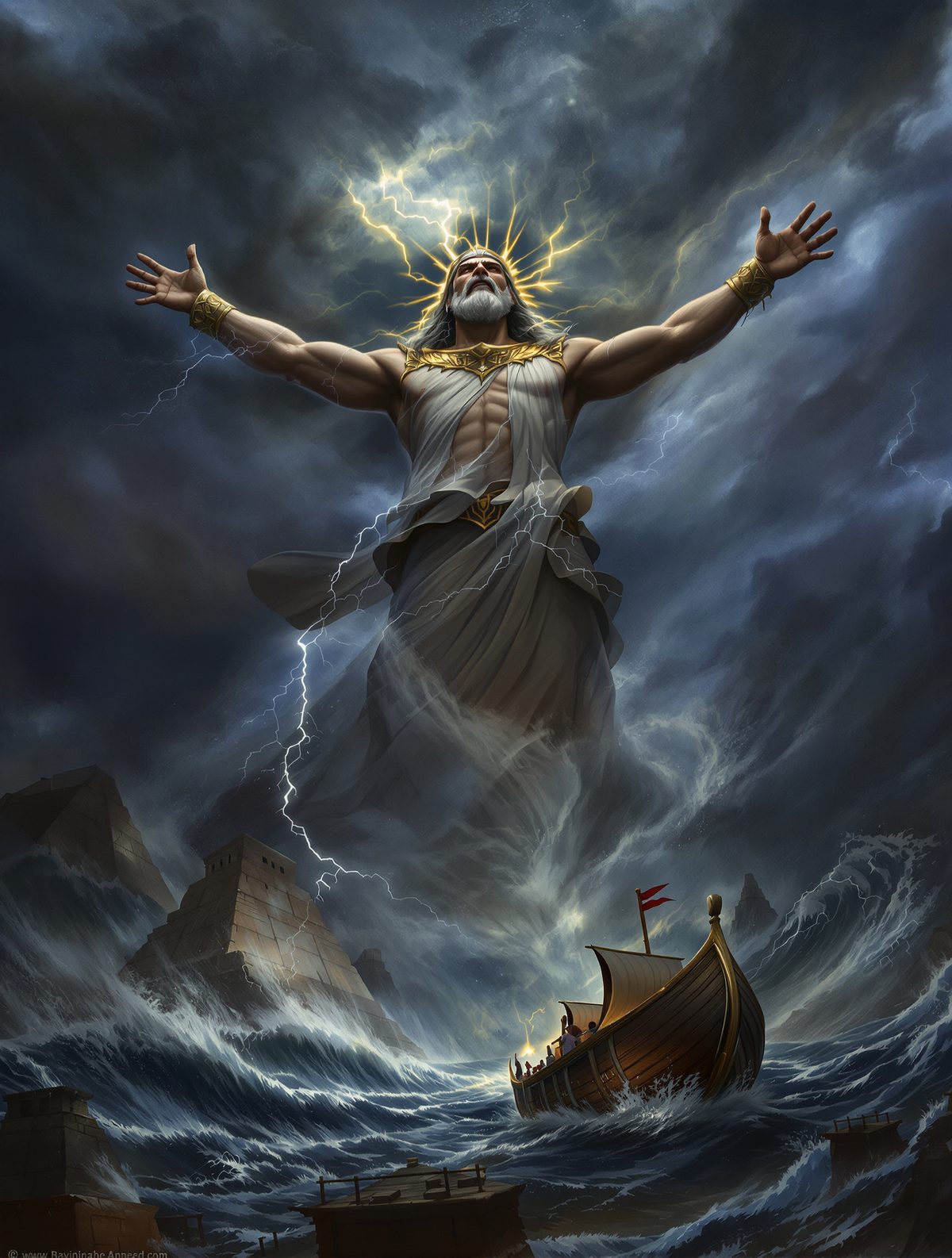
Picture this: you're a god trying to get some sleep after a long day of cosmic management, but downstairs, your noisy tenants won't stop partying. Their laughter echoes through the heavens, their arguments pierce the celestial silence, and their endless chatter has been going on for centuries. What would you do? If you're Enlil, the supreme storm god of ancient Mesopotamia, the answer is simple: drown them all.
This isn't just any flood story—it's the original template that would later inspire the biblical account of Noah's Ark. But the Mesopotamian version, recorded on cuneiform tablets over 4,000 years ago, contains twists and details that make it far stranger and more fascinating than the version most of us learned in Sunday school.
When Gods Lived Among Mortals
Around 2100 BCE, in the bustling city-states of Sumer and Akkad, scribes were already ancient history buffs. They recorded this tale as part of the Epic of Gilgamesh, but the flood story itself was far older—possibly dating back to actual catastrophic floods that swept through the Tigris and Euphrates river valleys around 2900 BCE. Archaeological evidence from sites like Ur and Shuruppak shows thick layers of sediment that could only have been deposited by massive floods, lending an eerie authenticity to the myth.
In this world, gods weren't distant, ethereal beings—they were your temperamental neighbors upstairs. Enlil, whose name literally means "Lord Wind," was the chief executive of the divine council. He controlled the storms, the harvests, and the fate of kings. But he had one very human weakness: he was a light sleeper.
The tablets describe how humanity had multiplied like rabbits across the fertile plains of Mesopotamia. Cities teemed with merchants hawking their wares, children playing in dusty streets, and priests chanting in towering ziggurats. The noise rose to heaven like incense—except Enlil found it about as pleasant as a smoke alarm going off at 3 AM.
The Divine Conspiracy
Here's where the story gets deliciously complex. Unlike later flood narratives where God simply tells Noah to build an ark, the Mesopotamian gods were bound by cosmic law. They couldn't just warn humans directly—that would be interference in the natural order. So Ea (also called Enki), the clever god of wisdom and water, had to get creative.
Ea had always been fond of humans—after all, he'd helped create them from clay and divine blood. He couldn't bear to see his favorite creations wiped out because of Enlil's insomnia. But how do you warn someone about divine genocide when you're forbidden from speaking directly to mortals?
The solution was brilliantly sneaky. Ea went to the reed hut of Utnapishtim, a pious man from the city of Shuruppak (modern-day Tell Fara in Iraq), and whispered not to him, but to his wall. Technically, he wasn't breaking any divine laws—he was just having a conversation with some reeds.
"Reed wall, reed wall! Brick wall, brick wall!" Ea called out. "Tear down your house and build a ship! Abandon possessions and seek life! Spurn property and save living things!"
The Riddle That Saved the World
Utnapishtim wasn't stupid—he knew exactly who was talking and why. But when his neighbors asked why he was suddenly building a massive boat in the desert, hundreds of miles from the nearest sea, he couldn't exactly say, "The gods are planning to kill you all." Instead, Ea had given him a clever riddle to tell them.
The riddle was a masterpiece of double meaning: "He who commands misfortune will rain down misfortune upon you." The neighbors heard this as a promise that their enemy (possibly a rival city's patron god) would shower them with arrows and defeat. What the riddle actually meant was that Enlil would shower them with water and death. They happily helped Utnapishtim build his ark, thinking they were preparing for military victory.
The specifications for this ancient ark were remarkably precise. The boat was to be a perfect cube—120 cubits on each side (about 180 feet), with seven decks divided into nine compartments each. Utnapishtim waterproofed it with bitumen and pitch, the same materials used in Mesopotamian shipbuilding. He loaded it with "the seed of all living things"—not just animals, but craftsmen, merchants, and skilled workers. This wasn't just about preserving species; it was about preserving civilization itself.
Seven Days of Cosmic Fury
When the flood came, it wasn't just rain—it was cosmic warfare. The tablet describes how "the Anunnaki lifted torches, setting the land ablaze with their flare." Adad, the storm god, thundered in the clouds while his companions Shullat and Hanish tore through the mountains. Even Ninurta, god of war, made the dikes overflow.
The description is terrifyingly vivid: "For one day the south wind blew, submerging the mountains, catching the people in a catastrophe like a battle. No one could see his fellow, they could not recognize each other in the torrent." The flood lasted seven days and seven nights—not the biblical forty—and was so intense that even the gods became frightened by what they had unleashed.
Here's a detail that didn't make it into later versions: the gods were hungry. Without humans to offer sacrifices, they had no food. The tablet poignantly describes how they "cowered like dogs, crouched by the outer wall" and "sat weeping" as they realized they might have made a terrible mistake.
The Feast That Changed Everything
When Utnapishtim's ark finally grounded on Mount Nimush (possibly in the Zagros Mountains), he released a dove, then a swallow, then a raven—the same sequence later adopted by the Noah story. But what happened next was uniquely Mesopotamian.
Utnapishtim built an altar and offered sacrifice. The smell of roasting meat rose to heaven, and the famished gods "gathered like flies over the offering." They were so grateful for food that they immediately regretted the flood. Enlil arrived late to the party and was furious to discover that humans had survived, but it was too late—the other gods had already decided that genocide by flood was off the table forever.
As compensation for his suffering, Utnapishtim and his wife were granted immortality and sent to live "at the mouth of the rivers"—possibly the Persian Gulf, where the Tigris and Euphrates meet. They became the ancient world's ultimate survivors, living witnesses to divine wrath and divine mercy.
Echoes Across Time
This 4,000-year-old story raises questions that feel surprisingly modern. What happens when those in power decide that ordinary people are just too inconvenient to tolerate? How do we navigate loyalty to different authorities when they conflict? And perhaps most importantly: sometimes survival depends not on strength or wealth, but on listening carefully to whispered warnings and reading between the lines of official statements.
The tale of Enlil's flood reminds us that the stories we think we know often have deeper, stranger roots. Long before Noah, there was Utnapishtim. Long before divine judgment, there was divine insomnia. And long before simple obedience saved the day, there was a clever god, a faithful human, and a riddle that saved the world. In our age of information overload and competing narratives, maybe we could all use a little more of Ea's wisdom—and Utnapishtim's ability to hear the truth whispered through the walls.