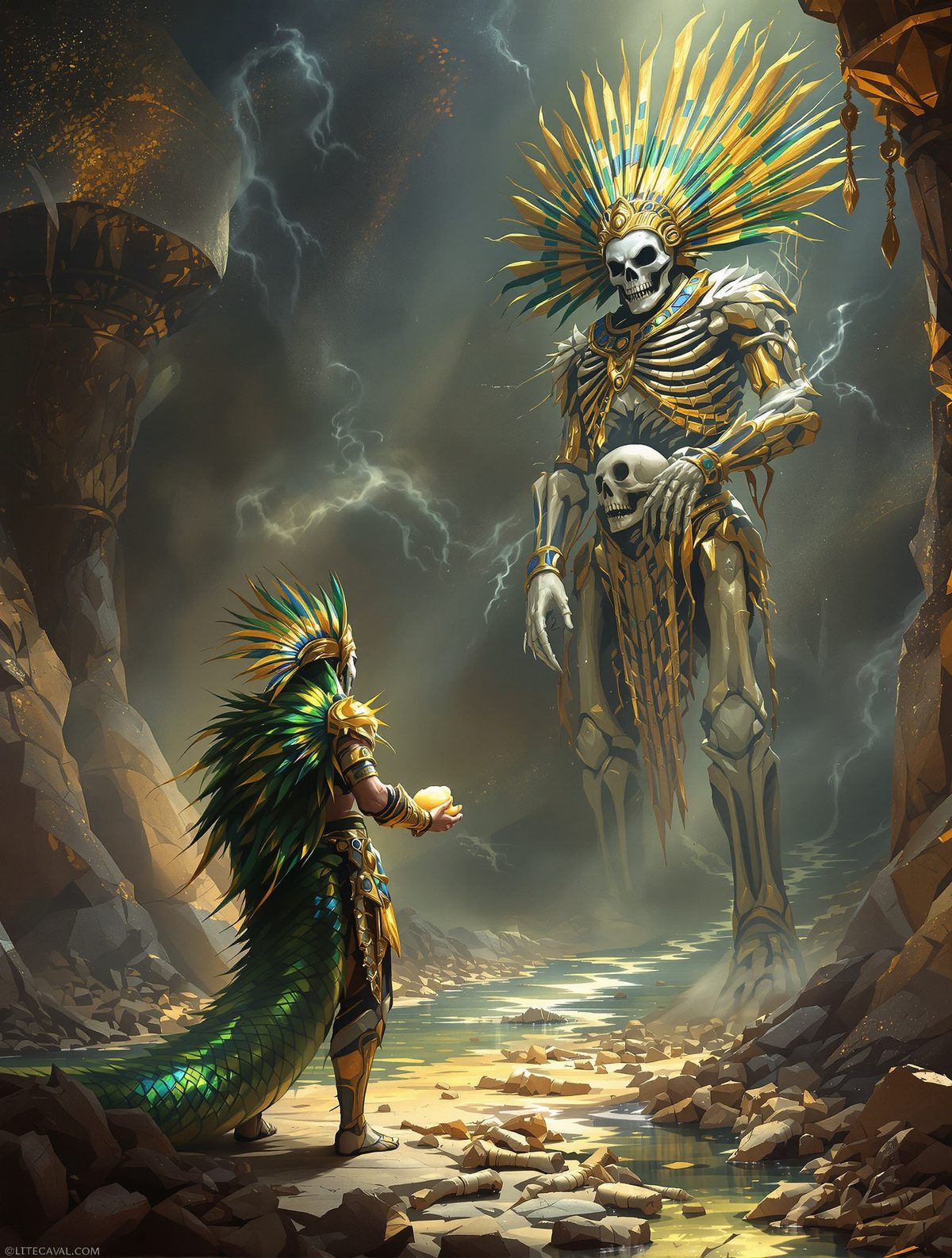
In the obsidian darkness of Mictlan, where no wind has blown for a thousand years, a feathered serpent god holds a conch shell to his lips. His breath fills the smooth, seamless surface—but no sound emerges. Across from him, Mictlantecuhtli, the Lord of Death, grins with a jaw of polished bone. The god of death has set an impossible task, and he knows it. What he doesn't know is that Quetzalcoatl didn't come this far to accept defeat. The future of humanity hangs in the balance of this divine game, and the Feathered Serpent is about to break all the rules.
When the Fifth Sun Went Dark
To understand the desperation that drove Quetzalcoatl into the realm of the dead, we must first grasp the catastrophe that preceded it. According to Aztec cosmology, recorded in the sacred Codex Chimalpopoca and other precious manuscripts that survived Spanish conquest, the world had already ended four times before. Each cosmic era, called a "Sun," met its destruction through the jealousy and warfare of the gods themselves.
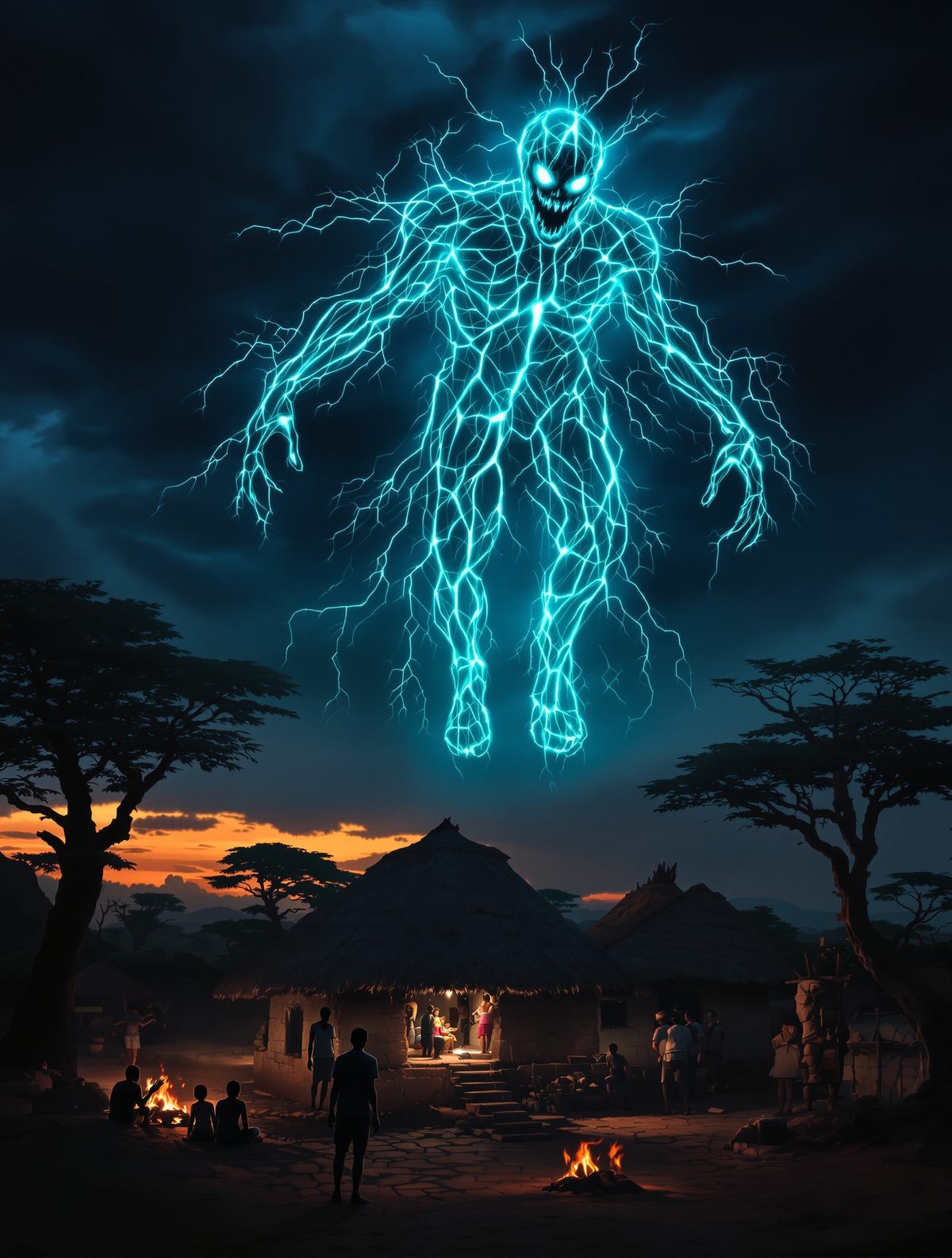
The Fourth Sun, known as Nahui-Atl or "Four-Water," ended when Tlaloc, the rain god, unleashed a deluge so terrible that humans transformed into fish to survive the endless floods. But the Fifth Sun—Nahui-Ollin or "Four-Movement"—met an even more devastating fate. Massive earthquakes tore the world apart, and savage jaguars descended from the sky to devour every last human being.
In the aftermath, silence. The gods looked upon a world scoured clean of humanity, and even they seemed stunned by the completeness of the destruction. Mountains of bleached bones lay scattered across the ravaged landscape, but even these remnants of mortality were beyond reach—they had been claimed by Mictlantecuhtli and taken down to his kingdom beneath the earth.
The Descent into the Bone Kingdom
Mictlan was no ordinary underworld. Unlike the Greek Hades or the Christian Hell, this was not primarily a place of punishment, but rather a complex realm where the dead underwent a four-year journey of trials before reaching their final rest. The Aztecs believed that most people—regardless of how they lived—would end up in Mictlan, traveling through nine levels of increasingly difficult challenges.
But Quetzalcoatl wasn't making this journey as a deceased soul. As one of the four sons of the dual god Ometeotl, he possessed the divine right to walk between worlds. Still, entering Mictlan alive was no small feat. The Feathered Serpent had to transform himself, shedding his brilliant plumes of green and gold for a form that could withstand the crushing weight of earth and stone above.
The palace of Mictlantecuhtli defied mortal comprehension. Constructed from the bones of every creature that had ever died, it rose from the deepest level of Mictlan like a monument to entropy itself. Femurs formed the pillars, skulls created mosaics across the walls, and rib cages arched overhead like the vaulting of some grotesque cathedral. Here, alongside his wife Mictlancihuatl, the Lord of Death held court over an empire of silence.
The Bargain with Death
When Quetzalcoatl appeared before the bone throne, Mictlantecuhtli showed no surprise. Gods, after all, have their own ways of knowing when momentous events are unfolding. "What brings the Feathered Serpent to my kingdom?" the death god asked, his voice like the grinding of millstones.
Quetzalcoatl's request was audacious beyond measure: he wanted the bones of the previous human race. Not just any bones, but the sacred remains from which new life could be fashioned. In Aztec belief, bones contained the essential life force needed for resurrection—they were literally the seeds of rebirth.
Here's where the story takes a fascinating turn that most retellings miss: Mictlantecuhtli actually agreed to the request. This wasn't the flat refusal you might expect from a god whose entire domain depended on keeping the dead firmly dead. Instead, he set a condition that he believed would make his agreement meaningless.
"You may have the bones," Mictlantecuhtli declared, "but first you must circle my kingdom four times while blowing this conch shell." He gestured, and one of his skeletal servants brought forth a conch of unusual beauty—pearl-white and perfectly smooth. "Make it sing, Feathered Serpent, and the bones of humanity are yours."
The trap was elegant in its impossibility. Conch shells produce their haunting call when air flows through specific openings. This conch had been crafted—or perhaps cursed—to be completely sealed. It was like asking someone to make music with a solid block of stone.
The Sound of Impossible Things
What happened next reveals something profound about Aztec views on divine wisdom and creative problem-solving. Lesser gods might have raged against the unfairness of the test or tried to bargain for different terms. Quetzalcoatl did something far more interesting: he cheated, but he cheated intelligently.
As he began his circuit of Mictlan, the Feathered Serpent called upon creatures that even the Lord of Death had not considered: worms. In the deepest places of the underworld, where decay itself decayed, these humble beings still carried out their work. Quetzalcoatl summoned them to bore holes through the conch shell, creating the openings necessary for sound.
But the worms worked slowly, and Mictlantecuhtli was growing suspicious. On the fourth and final circuit, with the conch still only partially hollowed, Quetzalcoatl made a desperate decision. He called upon the bees—creatures associated with both death (through their stings) and rebirth (through the honey that preserves and nourishes). The bees flew inside the conch and created a buzzing that emerged as a deep, resonant note.
The sound that echoed through Mictlan was unlike anything heard before or since—part conch call, part bee-song, part divine breath. It was the sound of life refusing to accept the permanence of death.
The Price of Resurrection
Mictlantecuhtli was bound by his word, but he was far from gracious in defeat. As Quetzalcoatl gathered the precious bones, the Lord of Death commanded his servants to dig a great pit in the god's path. Sure enough, startled by the sudden appearance of the trap, Quetzalcoatl stumbled and fell. The bones scattered and broke, with many pieces being devoured by quail that Mictlantecuhtli had summoned for just this purpose.
This final twist explains one of the most intriguing aspects of Aztec anthropology: they believed that the breaking of the bones was why humans came in different sizes. The fragments that Quetzalcoatl managed to save were of varying dimensions, and these determined whether the resulting humans would be tall or short, large or small. It's a creation myth that celebrates human diversity as a consequence of divine imperfection—a remarkably sophisticated theological concept.
But Quetzalcoatl's sacrifice wasn't complete. To bring life to the bone fragments, he performed one final act of creation: he bled upon them. Mixed with his divine blood, the bones transformed into the flesh and spirit of new humanity. This act of self-sacrifice established a cosmic debt that, according to Aztec theology, humans would spend their lives repaying through ritual bloodletting and, in extreme circumstances, human sacrifice.
The Echo of Ancient Wisdom
The story of Mictlan's test resonates far beyond its historical context because it grapples with questions that remain urgently relevant: What are we willing to sacrifice for the continuation of our species? How do we solve problems that seem impossible? And perhaps most importantly, what does it mean to cheat death itself?
In our modern world, where we face extinction-level threats from climate change, nuclear weapons, and ecological collapse, Quetzalcoatl's journey feels less like ancient mythology and more like a roadmap. The Feathered Serpent didn't save humanity through raw power or righteous anger, but through creativity, persistence, and the willingness to pay a personal price for collective survival.
The Aztecs understood something that we're only beginning to rediscover: that life and death exist in constant negotiation, and that resurrection—whether biological, cultural, or spiritual—always demands a sacrifice from those who would be its agents. In the deepest chambers of Mictlan, where a god once bled for the future of humanity, that lesson waits to be remembered by each new generation that must find its own way to make music from silence.