In the pre-dawn darkness atop the sacred mountain of Coatepec, an ancient goddess swept the temple floors with methodical precision. Coatlicue, the "Serpent Skirt," moved her broom across the stone in rhythmic strokes, her massive form adorned with a necklace of severed hands and hearts, her skirt writhing with living serpents. This was no ordinary housekeeping—this was a cosmic ritual performed by the earth mother herself. Then, as the first rays of sunlight pierced the horizon, something extraordinary happened. Feathers began to fall from the heavens like snow, each one glowing with divine light. When Coatlicue gathered these celestial plumes and tucked them against her body, she triggered a chain of events that would culminate in one of mythology's most brutal family conflicts—a pregnant goddess fighting for her life against her own murderous children.
The Mother of Gods in Her Terrifying Glory
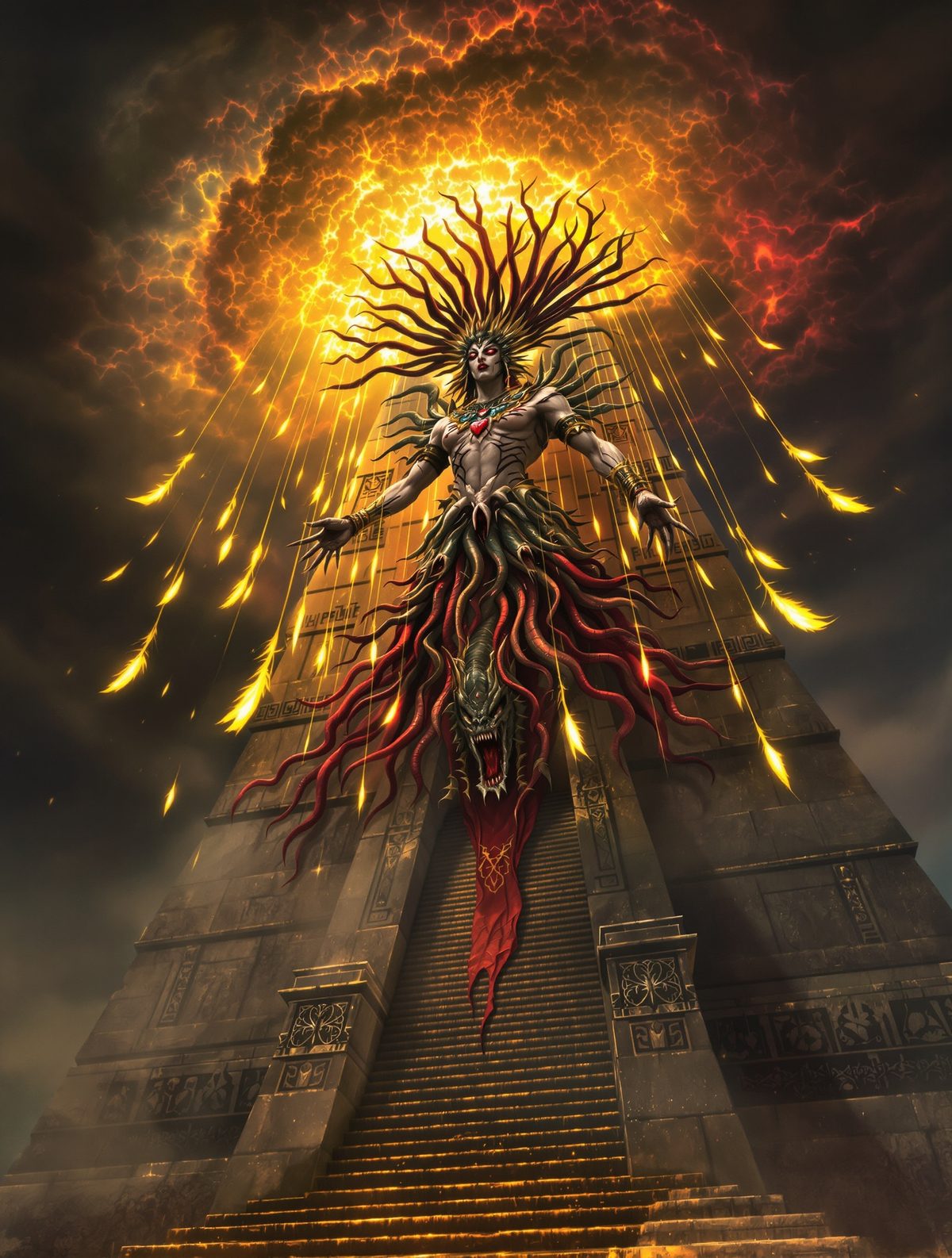
To understand the magnitude of what was about to unfold, you need to grasp who Coatlicue really was. This wasn't just another deity in the crowded Aztec pantheon—she was the primordial earth goddess, the mother who had already given birth to the moon, the stars, and four hundred mighty warriors known as the Centzon Huitznahua. The Aztecs didn't sanitize their deities for mass consumption. Coatlicue was depicted as simultaneously nurturing and nightmarish: her head was formed by two massive serpents facing each other, creating the illusion of a single face in profile. Blood flowed constantly from her neck where she had been decapitated, and her hands and feet ended in razor-sharp claws.
Archaeological evidence from the famous Coatlicue statue, discovered in 1790 in Mexico City's main square and now housed in the National Museum of Anthropology, shows her in all her terrifying maternal glory. Standing nearly nine feet tall and weighing over twelve tons, this basalt monument reveals the intricate details the Aztecs carved into their vision of the ultimate mother goddess. Her skirt, made of intertwined serpents, symbolized the earth itself—fertile yet dangerous, life-giving yet deadly.
But even goddesses, it seems, weren't immune to family drama of cosmic proportions.
The Feathers That Changed Everything
The morning that would forever alter the cosmic order began like any other in Coatlicue's routine. She had been sweeping the temple at Coatepec—literally "Snake Mountain"—when the mysterious feathers descended from the sky. Different versions of the myth describe these feathers in various ways: some say they were pure white and soft as clouds, others claim they shimmered with all the colors of the rainbow, and still others insist they were the brilliant blue-green of precious quetzal bird plumage.
What happened next reveals something fascinating about Aztec culture that many people don't realize: the concept of divine conception through sacred objects. When Coatlicue placed the feathers in her maxtlatl (the traditional loincloth-like garment worn by Aztec women), she wasn't just being practical—she was following a spiritual impulse that would result in immaculate conception. This wasn't uncommon in Mesoamerican mythology; the Maya hero twins were conceived when their mother held a skull to her palm, and various Aztec deities were born through similar miraculous means.
The moment those feathers touched her body, Coatlicue felt the familiar stirring of new life within her womb. But this pregnancy was different. The child growing inside her pulsed with unprecedented power, and cosmic forces began shifting in response to his presence.
When Children Plot Matricide
Word of their mother's pregnancy spread quickly among Coatlicue's existing children, and their reaction was swift and merciless. The four hundred Centzon Huitznahua, along with their sister Coyolxauhqui (the moon goddess), were outraged. In their view, this mysterious pregnancy brought shame upon their divine family. How could their ancient mother, already the parent of gods, become pregnant again under such strange circumstances?
Here's where the story takes a turn that reveals something crucial about Aztec society: the concept of family honor was so paramount that even gods would murder their own mother to preserve it. The Centzon Huitznahua weren't just angry—they were scandalized. In a culture where genealogy and legitimacy mattered enormously, even among deities, this unexplained pregnancy represented an intolerable disgrace.
Coyolxauhqui, whose name means "Golden Bells" (referring to the bells she wore on her cheeks), became the ringleader of the conspiracy. She convinced her four hundred brothers that their mother must die before she could give birth to this illegitimate child. The planning began in secret, with the moon goddess coordinating what was essentially a divine military campaign against their own mother.
But here's a detail that often gets overlooked: one brother refused to participate. Cuahuitlicac, whose conscience apparently outweighed his sense of family honor, secretly warned Coatlicue about the approaching army of her own children.
The War God's Violent Debut
As the four hundred warriors marched up Snake Mountain in full battle gear—feathered shields, obsidian-edged swords, and elaborate headdresses gleaming in the sunlight—Coatlicue faced an impossible situation. Heavily pregnant and alone atop the temple, she was about to be slaughtered by her own offspring. The image is both mythologically grand and deeply human: a mother betrayed by her children, facing death at their hands.
Then something unprecedented happened. The unborn child in her womb spoke to her, his voice somehow both reassuring and terrifying: "Do not be afraid, mother. I know what I must do."
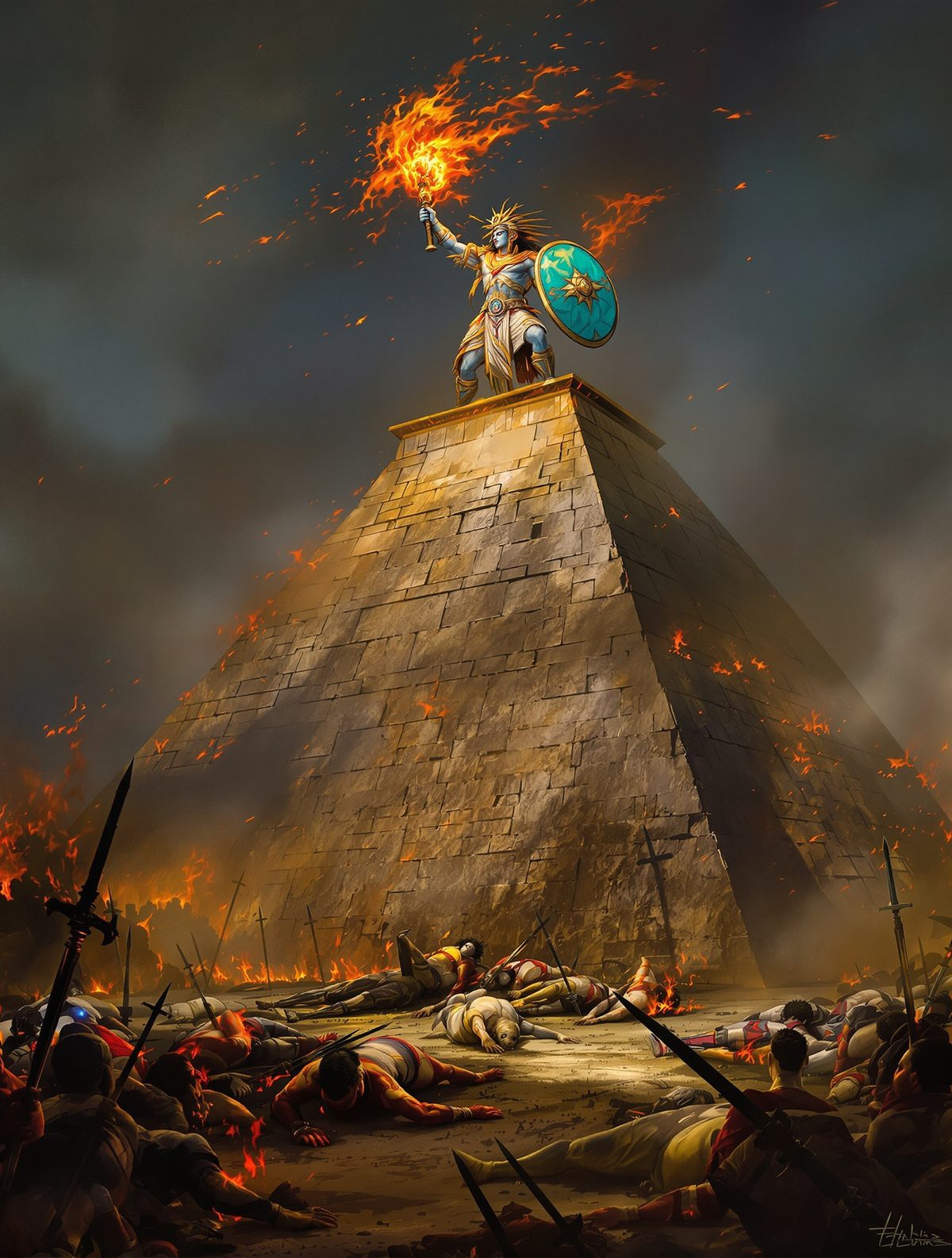
Just as the Centzon Huitznahua reached the summit and Coyolxauhqui raised her weapon to strike the killing blow, Coatlicue's child burst forth—not in the usual manner of birth, but as a fully grown, fully armed war god. This was Huitzilopochtli, "Hummingbird of the South," who would become the patron deity of the Aztec Empire and one of the most important gods in their pantheon.
What happened next was less birth and more battlefield massacre. Huitzilopochtli emerged wielding the Xiuhcoatl, a serpent of fire that served as both weapon and symbol of his power. Without hesitation, he attacked his own siblings. The battle was swift and brutal—Coyolxauhqui was decapitated and dismembered, her body parts flung across the sky to become the moon in its various phases. The four hundred brothers were scattered and became the stars of the southern sky, forever diminished and relegated to being overwhelmed by their brother's solar might each dawn.
The Cosmic Significance Hidden in Blood
This isn't just a violent family drama with mythological window dressing—it's a sophisticated creation myth that encoded the Aztecs' understanding of cosmic order. Every morning, when the sun (Huitzilopochtli) rises, it defeats the moon (Coyolxauhqui) and stars (the Centzon Huitznahua), reenacting this primordial battle. The myth explains not just the celestial mechanics visible to ancient astronomers, but also the eternal struggle between order and chaos, legitimate authority and rebellious challenge.
Archaeological discoveries at the Templo Mayor in Mexico City have revealed just how seriously the Aztecs took this story. At the base of Huitzilopochtli's pyramid, excavators found a massive circular stone depicting Coyolxauhqui's dismembered body—a permanent reminder of what happens to those who challenge divine authority. When enemies of the Aztec state were sacrificed atop this pyramid, their bodies were thrown down to land on this stone, symbolically reenacting the goddess's defeat.
The myth also reveals sophisticated thinking about gender roles and power. Coatlicue represents the ultimate maternal figure—creative, nurturing, but also terrible in her protective fury. She doesn't fight her own battles; instead, she creates the ultimate warrior to fight for her. This reflects Aztec beliefs about the complementary nature of feminine creative power and masculine destructive force.
Why This Ancient Story Still Matters
In our modern world, where family conflicts rarely involve literal dismemberment and cosmic reorganization, why should we care about Coatlicue's bloody birth story? Because buried within this ancient myth are universal themes that continue to resonate: the tension between tradition and change, the complex dynamics of family loyalty and betrayal, and the way societies use stories to make sense of natural phenomena they can't otherwise explain.
The Aztecs created a mythology that didn't shy away from the darker aspects of existence—their gods were flawed, violent, and recognizably human in their motivations, even while wielding cosmic power. Coatlicue's story reminds us that creation and destruction are often inseparable, that new life sometimes requires the violent overthrow of old orders, and that even among gods, family relationships can be the most dangerous relationships of all.
Perhaps most importantly, this myth demonstrates how ancient peoples used storytelling to process complex ideas about justice, legitimacy, and power. When we strip away the supernatural elements, we're left with a story about a mother who conceives under mysterious circumstances, faces family rejection, and ultimately gives birth to a son who violently restructures the world to protect her honor. It's a reminder that the questions that troubled ancient minds—about family, justice, and the proper order of things—are questions we're still grappling with today.