Imagine standing witness to the moment when the very foundations of the earth groaned in protest, when cosmic equilibrium hung by a thread, and when divine fury met divine tranquility in the most spectacular display of power the universe had ever seen. This is the story of how Ravana, the ten-headed demon king of Lanka, literally moved mountains—or rather, one sacred mountain—in an act of hubris that would echo through eternity.
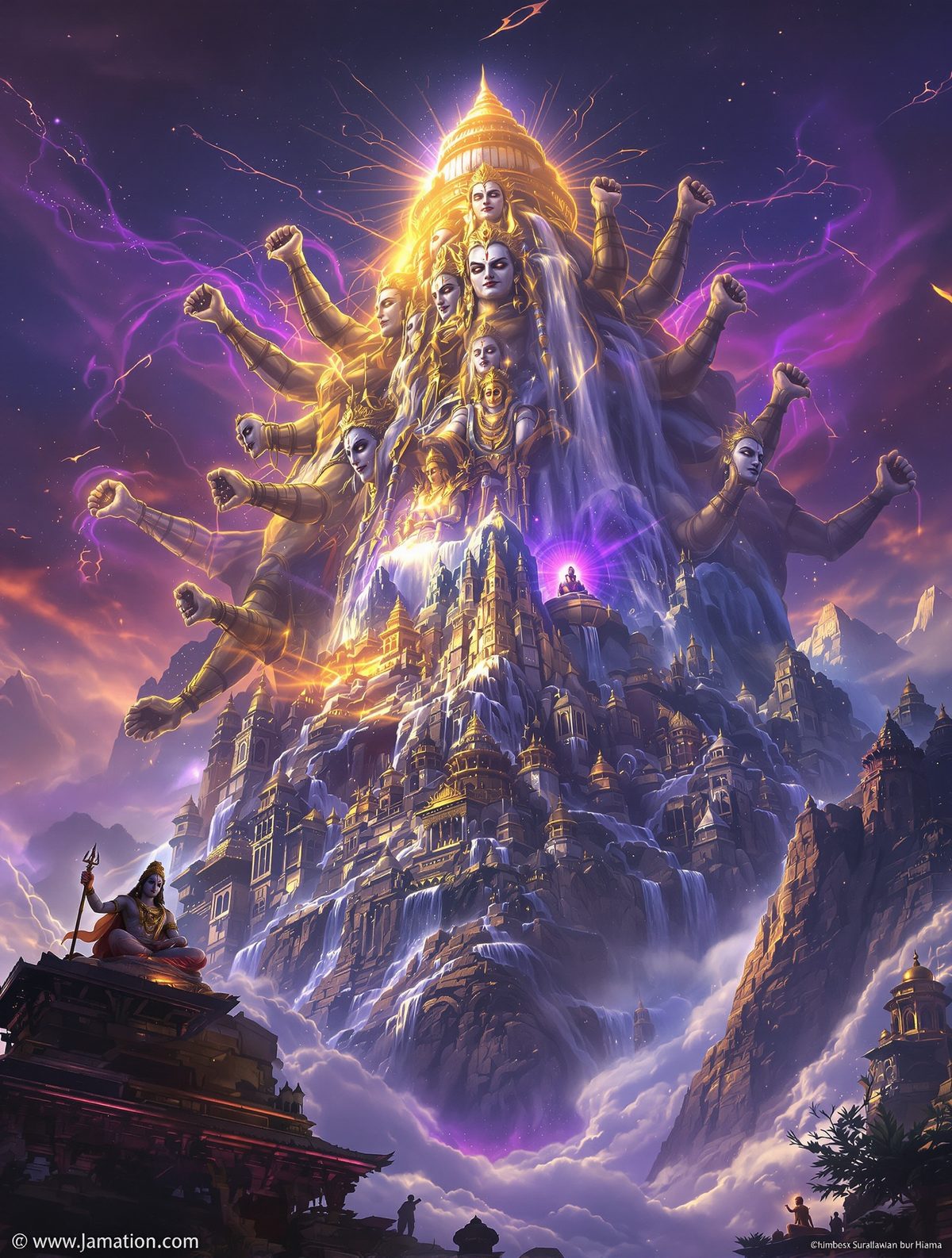
High above the Himalayas, where oxygen grows thin and mortals fear to tread, stood Mount Kailash—the 22,028-foot sacred peak that served as Lord Shiva's earthly throne. But on one fateful day, this immovable symbol of divine permanence would become little more than a plaything in the hands of mythology's most ambitious anti-hero.
The Chariot That Could Not Pass
Ravana's aerial chariot, the magnificent Pushpaka Vimana, had never encountered an obstacle it couldn't overcome. Stolen from his half-brother Kubera, the god of wealth, this wasn't just any flying vehicle—it was a technological marvel that could expand to accommodate vast armies or shrink to carry a single passenger. Ancient texts describe it as gleaming like the sun, capable of traveling at the speed of thought, and powered by the very essence of divine will.
But as Ravana soared through the clouds that day, returning from a conquest that had added yet another kingdom to his vast empire, the impossible happened. The Pushpaka Vimana simply stopped mid-flight, as if it had struck an invisible wall. The ten-headed king's multiple faces contorted in confusion and rage as he realized the truth: Mount Kailash, home of Lord Shiva, had created an impenetrable barrier around itself. No being, regardless of their power, could pass over the sacred peak without divine permission.
Here's what most people don't know: this wasn't actually Shiva's doing. According to the Shiva Purana, it was Nandi, Shiva's faithful bull, who had established the no-fly zone around Kailash. Acting as the ultimate cosmic security guard, Nandi had declared that none could disturb his master's deep meditation. But Ravana, in his characteristic arrogance, assumed this slight came directly from Shiva himself.
The King of Lanka's Twenty-Armed Fury
Ravana possessed twenty arms for a reason that goes back to one of mythology's most intense acts of devotion. Years earlier, seeking to impress Shiva, he had cut off his own ten heads as an offering. Pleased by this extreme sacrifice, Shiva not only restored the heads but granted Ravana ten additional arms, along with immunity from death by gods and demons—though notably, not from humans, a loophole that would prove fatally significant later.
Now, faced with what he perceived as a personal insult, Ravana made a decision that would literally shake the foundations of the universe. If he couldn't fly over Mount Kailash, he would simply move it out of his way. Dismissing his chariot, the demon king descended to the base of the sacred mountain, his twenty arms flexing with anticipation.
What happened next defied every law of physics known to ancient science. Ravana positioned his twenty arms strategically around the mountain's base—not just the visible parts, but extending his supernatural reach deep into the earth where Kailash's roots connected to the cosmic foundation. The Ramayana describes how his arms grew to impossible proportions, wrapping around underground rock formations that extended for miles in every direction.
When Mountains Become Toys
The moment Ravana began to lift, the entire cosmos took notice. According to the Skanda Purana, the lift registered on a universal scale—stars flickered, distant planets shifted in their orbits, and every divine being from Brahma to Vishnu felt the tremor. Mount Kailash, with its billions of tons of rock, ice, and accumulated spiritual energy from eons of worship, rose from its foundations like a child's building block.
But here's the detail that sends chills down the spine: Ravana wasn't straining. The ancient texts emphasize that he lifted the mountain playfully, almost casually, as if demonstrating that the home of the destroyer of the universe was merely an inconvenient pebble to be moved aside. His ten mouths laughed in unison, creating a sound so terrible that it caused avalanches across the entire Himalayan range.
The lifting of Kailash created unprecedented chaos. Rivers changed course mid-flow as their sources shifted. The Ganges, which originates from Shiva's hair and flows past Kailash, began flowing upward in complete defiance of gravity. Wildlife across the subcontinent felt the disturbance—elephants trumpeted in panic, tigers fled their territories, and birds fell from the sky, their navigation systems completely overwhelmed.
Shiva's Response: The Power of a Single Toe
Throughout this cosmic upheaval, Lord Shiva remained in deep meditation atop his mountain home, seemingly unaware that his entire residence was airborne. But appearances can be deceiving, especially when it comes to the Lord of Destruction. Shiva was not only aware—he was allowing Ravana to demonstrate the full extent of his power before delivering a lesson in cosmic humility.
Then came the moment that would be remembered across all worlds: without opening his eyes, without breaking his meditative pose, Shiva simply pressed down with his big toe. That single digit carried the weight of universal consciousness, the accumulated karma of every living being, and the fundamental force that holds reality together.
The effect was instantaneous and devastating. Mount Kailash didn't just settle back into place—it slammed down with such force that Ravana's twenty arms were trapped beneath its impossible weight. The demon king who had lifted mountains now found himself pinned like an insect, his supernatural strength rendered utterly useless against the casual pressure of divine will.
The Song That Shook Heaven
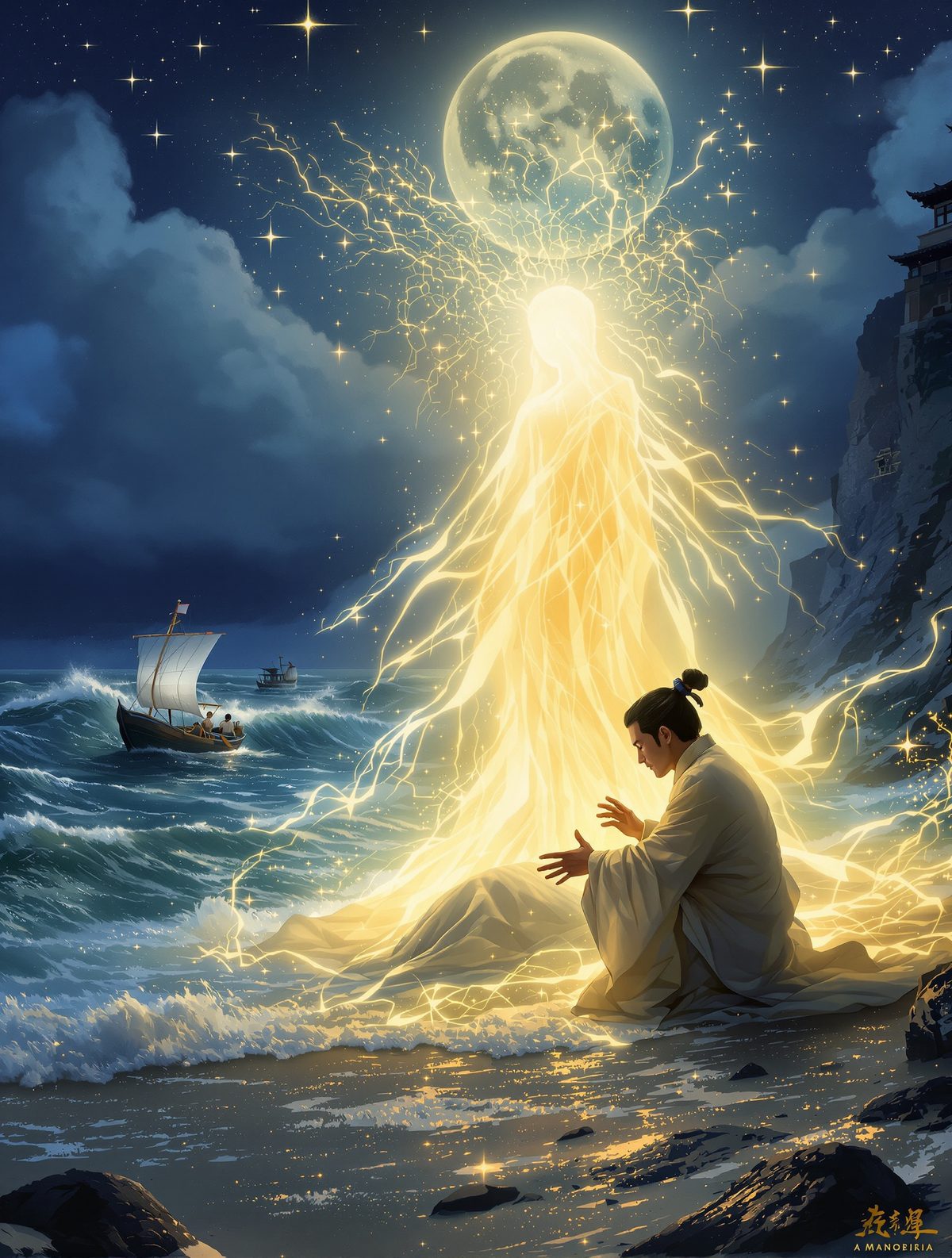
What followed next reveals perhaps the most fascinating aspect of Ravana's character—his transformation from cosmic villain to devoted artist. Trapped beneath Mount Kailash for what the texts suggest was several years, Ravana could have raged, threatened, or plotted revenge. Instead, he chose music.
Using his own tendons as strings, Ravana created the world's first veena and began composing what would become known as the Shiva Tandava Stotra—a hymn of praise so beautiful, so perfectly crafted, that it moved even the unmovable Lord Shiva to tears. The song's rhythm matched the cosmic dance of creation and destruction, its melody captured the essence of time itself, and its words painted pictures of Shiva's glory that had never been expressed before.
For a thousand years, according to some versions of the tale, this music echoed through the heavens. The other gods, initially terrified by Ravana's display of strength, now found themselves mesmerized by his artistic genius. This wasn't just a song—it was a sonic sculpture that reshaped the listener's understanding of the divine.
The Lesson That Echoes Through Time
Why does this ancient story continue to captivate us thousands of years later? Because it captures something profoundly human about the relationship between power and wisdom, between ambition and understanding. Ravana possessed strength that could literally move mountains, yet he discovered that true power doesn't come from what you can force into submission—it comes from what you can create, what you can inspire, and ultimately, what you can surrender.
In our modern world of technological marvels and unprecedented human capability, Ravana's tale serves as both warning and inspiration. We've learned to move mountains through engineering, to fly higher than any ancient chariot through aerospace technology, and to wield forces that would make the demon king envious. Yet the fundamental question remains: are we using our power to force our way through obstacles, or are we learning to create something beautiful enough to open doors that strength alone cannot budge?
The mountain still stands in Tibet, unchanged and unmoved, while Ravana's song continues to be sung in temples across India. Perhaps that's the most profound lesson of all—that what we build through force may crumble, but what we create through devotion, through art, through genuine understanding of our place in the cosmic order, becomes truly immortal.