
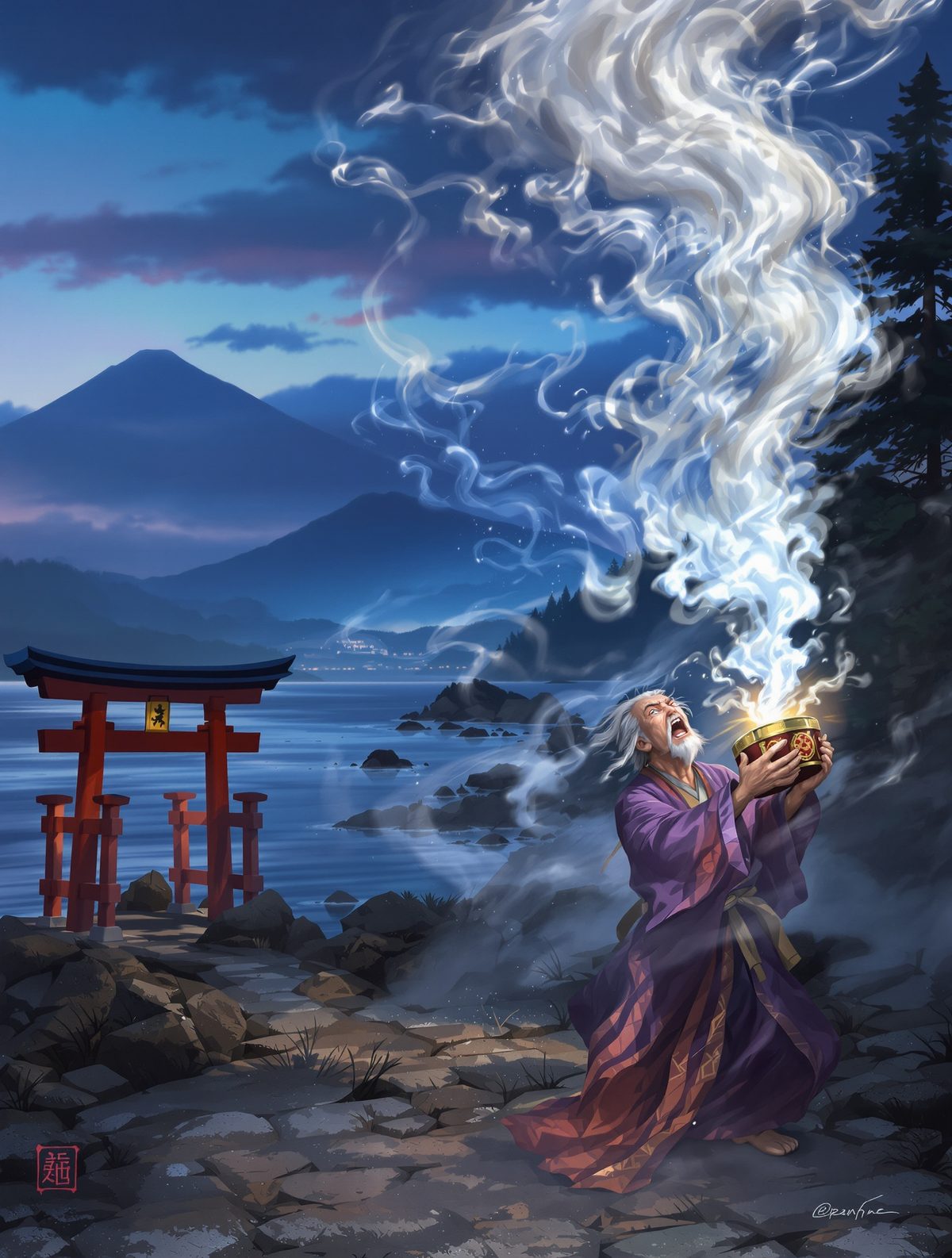
The white smoke curled upward like the soul of a dying man, and in that moment, Urashima Taro felt three centuries of stolen time crash down upon his mortal frame. His black hair bleached to snow in seconds. His strong fisherman's back bent like a reed in a typhoon. The skin on his hands, once smooth from years beneath the waves of Ryugu-jo, the Dragon Palace, wrinkled and spotted like ancient parchment. The mysterious tamatebako—the jeweled box his sea princess bride had pressed into his hands with trembling fingers and desperate warnings—lay empty at his feet, its terrible secret finally released.
But how had a simple fisherman from the coastal village of Miura come to possess such a cursed artifact? And why had Princess Otohime, daughter of the Dragon King himself, gifted him something that would destroy him? The answer lies in one of Japan's most haunting legends—a tale that has whispered across the islands for over 1,300 years, teaching generations about the terrible price of curiosity and the cruel mathematics of immortal love.
The Turtle and the Fisherman: An Act of Compassion
In the 8th century, along the rugged coastline of what is now Kanagawa Prefecture, lived a young fisherman named Urashima Taro. The Nihon Shoki (Chronicles of Japan), compiled in 720 CE, contains one of the earliest written versions of his story, though oral traditions suggest the tale is far older. Unlike the Disney-fied versions that would emerge centuries later, the original Urashima was no wide-eyed youth—he was a skilled fisherman who understood the sea's moods and respected its mysteries.
One autumn morning, as crimson maple leaves drifted across the harbor like scattered prayers, Urashima discovered a group of village children tormenting a large sea turtle on the beach. The ancient creature, its shell scarred by decades of ocean wandering, lay helpless as the children poked it with sticks and pelted it with stones. In medieval Japan, sea turtles were considered sacred messengers of the Dragon King, but these children saw only sport in the creature's suffering.
What happened next would change Urashima's fate forever. Rather than simply shooing the children away, he purchased the turtle from them—paying precious coins he could ill afford to lose. This detail, often glossed over in modern retellings, reveals something crucial about the original legend: true compassion requires sacrifice. Urashima didn't just save the turtle; he impoverished himself to do it.
As he carried the heavy creature to the water's edge, its ancient eyes seemed to hold an intelligence far beyond that of any ordinary animal. When the waves finally claimed it, the turtle turned back once, as if memorizing Urashima's face, before disappearing into the depths.
The Invitation from Another World
Three days later, as Urashima cast his nets in the pre-dawn darkness, the sea around his boat began to glow with an otherworldly phosphorescence. The turtle emerged from the luminous waters, but something had changed. Its voice, when it spoke, was clear and melodious as temple bells.
"Urashima-san," it said, using the honorific that acknowledged his kindness, "the Dragon King Ryujin wishes to thank you personally for saving my life. Will you come with me to Ryugu-jo, the palace beneath the waves?"
Here the legend reveals a fascinating aspect of ancient Japanese cosmology. Ryugu-jo wasn't merely an underwater city—it existed in a realm where time moved differently, where the laws that governed mortal life bent like light through water. The palace was said to be built from coral that sang lullabies and pearls that held captured moonlight. Its gardens bloomed with seasons that changed by room: spring's cherry blossoms in the east wing, summer's festivals in the south, autumn's maples in the west, and winter's contemplative snow in the north.
Urashima, perhaps moved by curiosity or maybe by the lonely life of a bachelor fisherman, agreed. As he climbed onto the turtle's shell, he felt the familiar weight of gravity release its hold. They descended through layers of blue that grew deeper and stranger, past schools of fish that swam in perfect geometric formations, past underwater mountains crowned with forests of kelp that swayed like dancers in an eternal wind.
Love in the Timeless Kingdom
Princess Otohime awaited him in a throne room carved from a single, massive pearl. Descriptions of her beauty in the ancient texts border on the supernatural: skin like polished jade, hair that moved as if underwater even in air, and eyes that held the depth of ocean trenches. But she was no passive fairy tale princess. As the Dragon King's daughter, she commanded the tides themselves and could speak to every creature that swam in the world's waters.
Their courtship unfolded across what Urashima perceived as three perfect days. They walked through impossible gardens where crystalline trees bore fruit that tasted like captured sunshine. They attended performances where whale songs provided the music and schools of tropical fish painted living murals in the water. They shared meals of ambrosia that satisfied not just hunger but every desire the heart could name.
But perhaps most remarkably, they talked. In an era when marriages were typically arranged and love was considered a pleasant bonus rather than a necessity, Urashima and Otohime chose each other. She was fascinated by his stories of the surface world—the way sunlight felt on human skin, how rain smelled, the sound of wind through bamboo forests. He was enchanted by her tales of the deep ocean's secrets—underwater volcanoes that birthed new islands, the migration routes of whales that spanned the globe, the ancient treaties between sea dragons and mountain spirits.
They married in a ceremony attended by every creature of the deep, where the wedding gifts included pearls the size of human heads and coral crowns that would have bankrupted surface kingdoms. For three days and nights, they lived in perfect happiness—a happiness so complete it seemed as if time itself had stopped to admire it.
The Return to a Changed World
But even paradise cannot forever silence the call of home. On what Urashima believed was their fourth morning together, homesickness struck him like a physical blow. He missed the smell of his fishing boat, the sound of seabirds, the simple pleasure of earth beneath his feet. When he confessed this to Otohime, her perfect composure cracked.
"You cannot leave," she whispered, and for the first time, her voice carried the vast loneliness of the deep ocean. "If you return to the surface world, we can never meet again. Time moves differently here. What seems like days to you..."
But Urashima, with the stubborn loyalty of a good man to his roots, insisted. Seeing his determination, Otohime made a choice that would haunt Japanese folklore for centuries. She gave him the tamatebako—a lacquered box inlaid with precious metals and sealed with golden cord.
"This contains our time together," she said, tears like liquid pearls streaming down her jade cheeks. "As long as it remains unopened, some part of you will always belong to this realm. But if you ever open it..." She couldn't finish the sentence. The gift was both a blessing and a curse, a thread connecting two worlds and a trap that would eventually destroy him.
The journey back to the surface felt different—rushed, as if the ocean itself was eager to expel him. When he finally reached familiar waters and saw his village in the distance, his heart should have soared. Instead, a creeping wrongness settled in his chest.
Three Hundred Years in Three Days
The village had changed. Where his modest home once stood, a shrine dedicated to a fisherman named Urashima Taro marked the spot. Confused and increasingly desperate, he approached an elderly man tending the shrine.
"Excuse me, grandfather," Urashima said, "but what happened to the man who lived here?"
The old man's eyes grew wide. "Urashima Taro? That's an ancient story, young man. My great-great-grandfather told it to me. A fisherman by that name disappeared into the sea three hundred years ago. Some say the Dragon King took him. Others believe he drowned. But why do you ask? You look remarkably like the paintings..."
Three hundred years. The words hit Urashima like a tsunami. His three days in paradise had been three centuries on Earth. Everyone he had ever known—his parents, his friends, the children who had tormented the turtle—all were long dead. He was a ghost walking through the ruins of his own life, carrying nothing but a mysterious box and the memory of an impossible love.
Standing alone on the beach where his story began, Urashima faced the cruel mathematics of immortal romance. Otohime had tried to warn him, but how do you explain to someone that love can exist outside of time? That happiness, when it's perfect, creates its own temporal prison?
The tamatebako felt heavier in his hands now, its golden cord seeming to pulse with hidden life. Otohime's final words echoed in his memory: This contains our time together. Perhaps, he thought in his desperation, opening it would return him to those three perfect days. Perhaps it would take him back to her.
The cord fell away like a sigh. The lid opened like a mouth. And the white smoke that poured out carried with it the weight of three centuries.
The Price of Forbidden Knowledge
As Urashima's body crumbled under the weight of stolen time, the true horror of his situation became clear. The box hadn't contained their time together—it had contained his time, the mortal years that should have passed while he lived as an immortal in Ryugu-jo. Otohime, in her desperate love, had tried to give him a choice: live as a man displaced in time but whole in body, or reclaim his temporal existence and pay the price all at once.
He had chosen knowledge over mystery, certainty over faith. In opening the box, he chose to understand rather than simply accept the gift of impossible love. It was a choice that revealed something fundamentally human—and fundamentally tragic—about our nature.
The legend of Urashima Taro has survived for over thirteen centuries because it speaks to fears that transcend culture and era. In our age of social media and constant connection, we understand better than ever how time can slip away unnoticed. We know the vertigo of realizing that years have passed in what felt like moments, that the world has changed while we were looking elsewhere. We understand the terrible mathematics of regret, the way a single choice can echo across decades.
But perhaps the most enduring aspect of Urashima's story is not its warning about curiosity or the passage of time—it's its meditation on love that exists beyond the boundaries of mortality. In giving Urashima the tamatebako, Otohime offered him the rarest gift imaginable: the choice to hold onto perfect love or return to imperfect life. That he chose knowledge over mystery, understanding over acceptance, makes him not foolish but heartbreakingly human. In the end, Urashima Taro's tragedy is not that he opened the box—it's that he lived in a universe where such a choice had to be made at all.