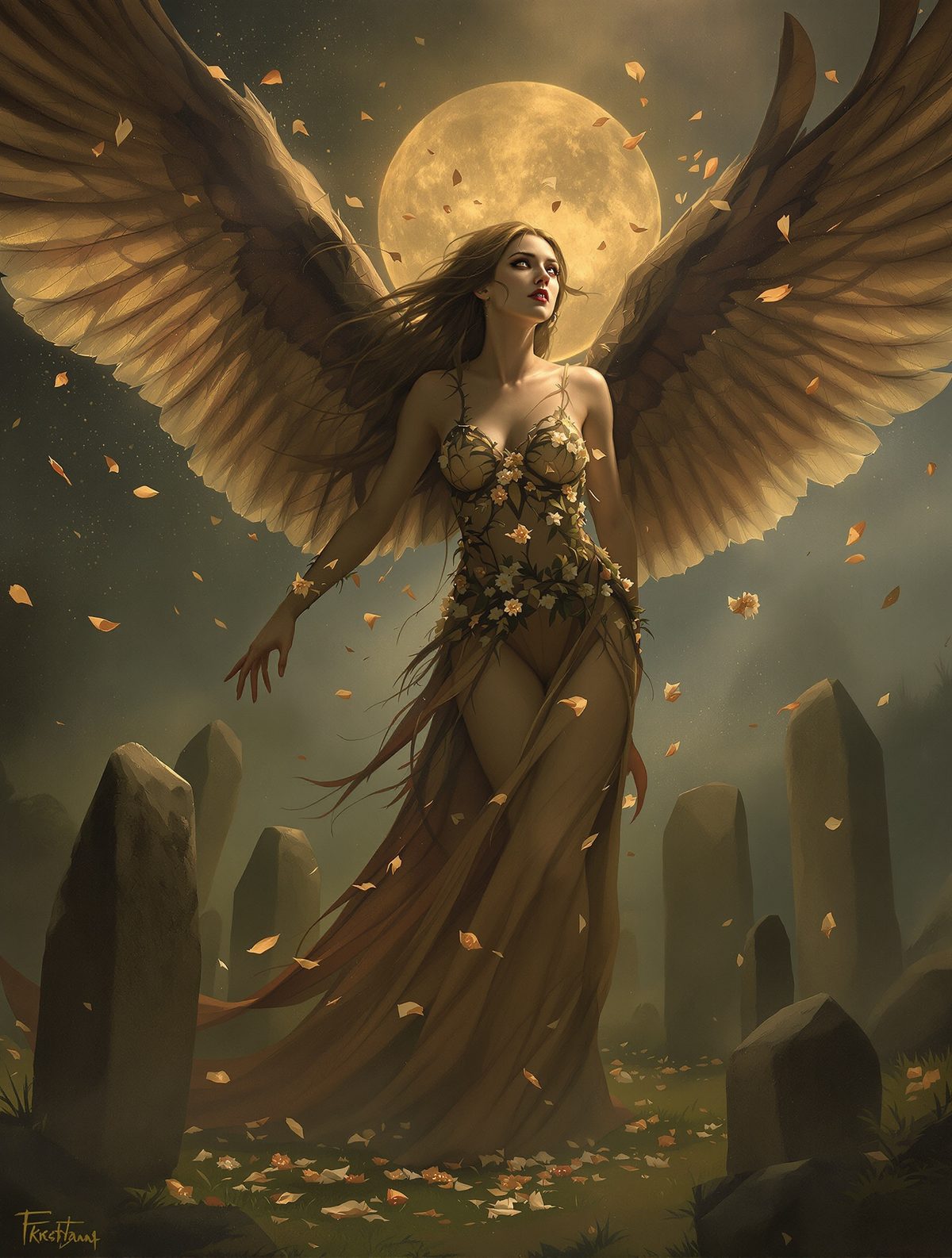
In the shadowed halls of Welsh mythology, where gods walked among mortals and magic flowed like mountain streams, a woman made of flowers committed the ultimate betrayal. Her name was Blodeuwedd—literally "flower face" in Old Welsh—and her story stands as one of the most haunting tales of love, betrayal, and divine retribution ever woven into Celtic legend. Created by the gods themselves to be the perfect wife, she would instead orchestrate the murder of her husband and pay a price that echoed through eternity.
But this wasn't just another tale of an unfaithful wife. Blodeuwedd's story reveals something far more disturbing about the nature of free will, forced marriage, and what happens when even the gods try to play matchmaker with disastrous results.
The Curse That Started It All
To understand Blodeuwedd's betrayal, we must first understand the impossible situation that created her. The tale begins with Lleu Llaw Gyffes, whose very name means "Bright One with the Skillful Hand"—a young man blessed with divine heritage but cursed by his own mother's rage. Arianrhod, his mother, had been humiliated during a magical test of virginity at the court of Math fab Mathonwy, the king of Gwynedd in northern Wales.
In her fury and shame, Arianrhod placed three devastating curses upon her newborn son: he would receive no name except from her, he would bear no arms except those she gave him, and most cruelly of all, he would never have a wife "of the race that is now on this earth." It was the ultimate rejection—a mother condemning her son to a life without love or companionship.
Through cunning and magic, Lleu's uncle Gwydion—one of the most powerful magicians in Welsh mythology—had already helped the boy overcome the first two curses. But the third seemed insurmountable. How do you find a wife for someone cursed never to marry a mortal woman?
The Bride Born from Blossoms
Gwydion's solution was as beautiful as it was unnatural. Together with his uncle Math fab Mathonwy, a king whose magical powers were legendary even among the gods, they decided to create a woman from scratch. But not from clay or bone—from the very essence of beauty itself.
On a spring morning thick with pollen and promise, the two sorcerers gathered their materials: oak flowers for strength and endurance, broom blossoms for their golden beauty, and meadowsweet for its intoxicating fragrance. These weren't random choices. In Celtic tradition, oak represented masculine power and kingship, broom symbolized fertility and new beginnings, while meadowsweet was sacred to love and marriage.
What happened next was perhaps the most extraordinary act of creation in all of Celtic mythology. Using their combined magical powers, Math and Gwydion wove the flowers together with spells of binding and songs of becoming. The petals swirled and coalesced, taking shape not just as flesh and bone, but as a woman of such breathtaking beauty that she seemed to carry the very essence of spring within her.
They named her Blodeuwedd, and by all accounts, their creation was perfect. She possessed not just physical beauty, but intelligence, grace, and every quality that should have made her the ideal wife. Yet here lay the first hint of the tragedy to come—she had been created to fulfill someone else's destiny, not to choose her own.
Love Blooms Where It Wasn't Planted
For a time, it seemed the magical marriage might actually work. Lleu and Blodeuwedd were given lands in Ardudwy, a region of rugged beauty in what is now northwestern Wales, where mountain meets sea. Their court became known for its splendor, and by all external measures, they appeared to be the perfect couple.
But perfection, as any student of mythology knows, is often the prelude to catastrophe.
The turning point came when Lleu departed on a journey to visit Math's court, leaving his flower-bride alone to manage their lands. It was during this absence that fate, in the form of Gronw Pebr, came hunting in their territory. Gronw was the lord of Penllyn, a region southeast of Lleu's lands, and he was everything that Lleu, for all his divine heritage, was not—purely mortal, passionate, and perhaps most importantly, a man who had chosen to pursue Blodeuwedd rather than having her created for him.
The attraction was immediate and mutual. Here's what makes Blodeuwedd's story so compelling: she wasn't simply a faithless wife, but a created being experiencing desire and choice for the first time. Imagine being brought into existence solely to serve another's needs, then suddenly discovering your own wants and desires—desires that ran completely counter to your intended purpose.
Their affair began that very night, and by the time Lleu returned, Blodeuwedd had already made her choice. She would not simply leave her husband—she would eliminate him entirely.
The Perfect Murder Plot
What makes Blodeuwedd's betrayal particularly chilling is the calculated patience with which she executed it. Like many figures in Welsh mythology, Lleu possessed certain protections that made him nearly impossible to kill. Blodeuwedd needed to discover exactly what those protections were.
Playing the role of loving, concerned wife, she began questioning Lleu about his vulnerabilities. Under the guise of wanting to protect him, she extracted the specific and bizarre conditions under which he could be harmed. Like Achilles' heel or Samson's hair, Lleu's weakness was oddly specific: he could only be killed by a spear forged for a year during sacred hours, while he stood with one foot on a bath and the other on a goat, and only at twilight.
It sounds almost comically impossible, but Blodeuwedd was nothing if not thorough. She convinced Lleu to demonstrate this "impossible" position, ostensibly so she could better protect him by knowing what to avoid. Trusting his created bride completely, Lleu obliged.
As he balanced precariously with one foot on the edge of a wooden bath and the other on a goat's back, twilight painting the Welsh countryside in shades of gold and purple, Gronw emerged from hiding. The spear he hurled had been crafted over the course of a full year, worked on only during the hours of Sunday mass when the Christian God's attention was elsewhere—a detail that hints at how these ancient Celtic tales adapted to the new religion spreading across Wales.
The spear struck true, and Lleu's anguished cry split the evening air. But being of divine heritage, he didn't simply die—instead, he transformed into an eagle and flew away, wounded and betrayed.
Divine Justice Has Wings
Blodeuwedd and Gronw's triumph was short-lived. Gwydion, the powerful magician who had helped create Lleu in the first place, wasn't about to let his nephew's murder go unpunished. Using his skills in tracking and magic, he followed the eagle's trail through the Welsh countryside, eventually finding the magnificent bird perched in an oak tree, slowly dying from its wound.
Through careful coaxing and powerful healing magic, Gwydion restored Lleu to human form and nursed him back to health. The reunion between uncle and nephew was tender, but their plans for revenge were anything but.
When they confronted the guilty lovers, Gronw met his end in a scene of poetic justice—killed by a spear thrown by the very man he had tried to murder, the weapon passing clean through a stone he had hoped would protect him. That stone, according to Welsh tradition, still stands near Llyn Morwynion in Gwynedd, pierced through with a hole that locals call "Gronw's Stone."
But for Blodeuwedd, death would have been mercy. Instead, Gwydion pronounced a punishment that was far more cruel and infinitely more permanent. "You will never show your face in daylight again for fear of all birds," he declared. "There will be enmity between you and all birds. You will not lose your name but will always be called Blodeuwedd."
With those words, he transformed her into an owl—a creature forever associated with darkness, solitude, and the very flowers from which she had been created, but now only able to see them in the pale light of moon and stars.
The Eternal Question of Choice
Blodeuwedd's transformation into an owl wasn't just punishment—it was a kind of dark enlightenment. As an owl, she gained the very thing that had been denied to her as a created bride: true independence. Owls answer to no one, hunt alone, and make their own choices about when and where to appear.
But perhaps the most haunting aspect of her story is how it speaks to us today. In our modern world of arranged relationships, societal expectations, and the pressure to fulfill roles others have defined for us, Blodeuwedd's rebellion resonates with surprising power. She was literally created to be the perfect wife, yet she chose passion over duty, desire over obligation.
Was she a villain who committed the ultimate betrayal, or a victim of gods who tried to create a sentient being without free will? The Welsh storytellers, wise in the ways of human nature, left that question deliberately unanswered. Even today, when you hear an owl's call echoing through the Welsh countryside, you're hearing the voice of a woman who chose her own destiny—and paid the ultimate price for that choice.
In the end, Blodeuwedd's story reminds us that the most dangerous thing you can give any created being is consciousness—because consciousness inevitably leads to choice, and choice, as the gods learned too late, can never truly be controlled.