Imagine weeping so hard that your tears carve valleys through mountains. Picture crying with such divine sorrow that your grief literally reshapes the landscape for millennia to come. In the mist-shrouded peaks of the Andes, long before the Inca built their empire of gold, such a tragedy unfolded. A creator god named Viracocha emerged from the sacred waters of Lake Titicaca to breathe life into stone—only to watch his children fail him so completely that he destroyed them all, then wandered the earth alone, his tears of regret cutting through solid rock like water through sand.
This isn't just another creation myth relegated to dusty anthropology textbooks. This is the foundational legend that shaped how millions of people understood their world, their mountains, and their place in the cosmos. And unlike the gentle, forgiving creator gods of many traditions, Viracocha's story is one of divine disappointment, cosmic loneliness, and the terrible weight of absolute power.
From Sacred Waters, A God Emerges
Lake Titicaca stretches across the Altiplano at a breathtaking 12,507 feet above sea level, making it the highest navigable lake in the world. But to the pre-Incan peoples of the Andes—the Tiwanaku, who flourished from roughly 300 to 1000 CE—this wasn't just a lake. It was the navel of the world, the place where creation itself began.
According to the legend preserved by the Inca and recorded by Spanish chroniclers like Pedro Sarmiento de Gamboa in 1572, Viracocha rose from these sacred waters into a world trapped in eternal darkness. The god himself was a figure of contradictions—sometimes described as bearded (unusual for indigenous Andean peoples), sometimes as a shapeshifter who could appear as a beggar or noble lord. His very name meant "sea foam" or "fat of the lake," connecting him eternally to the waters that birthed him.
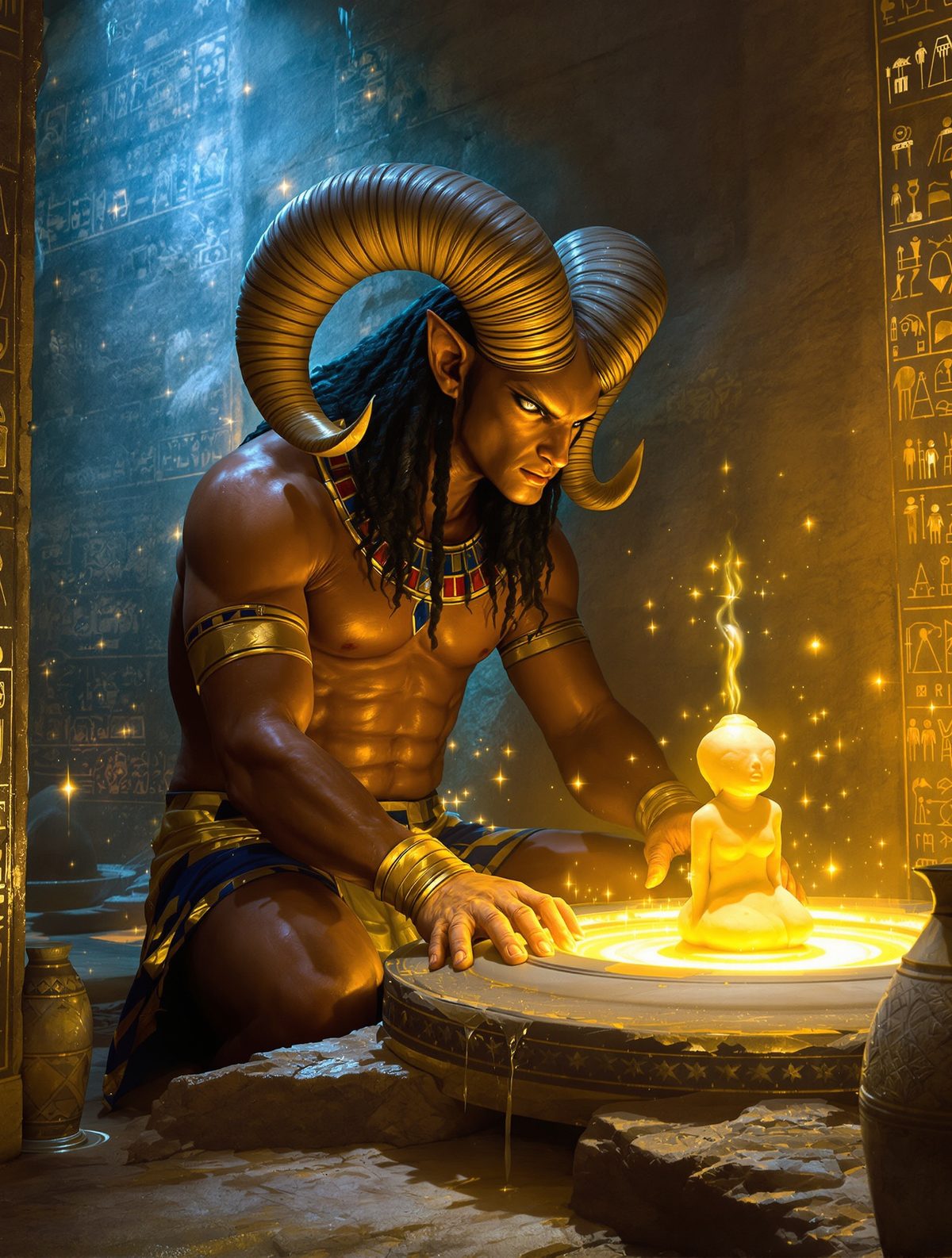
But here's what the textbooks rarely mention: Viracocha didn't create from nothing. The Andean worldview saw creation as transformation—the god took existing stone and breathed life into it. This wasn't the European concept of creatio ex nihilo. This was sculpture on a divine scale, with the entire world as his workshop.
The First Attempt: Giants Walking Among Mortals
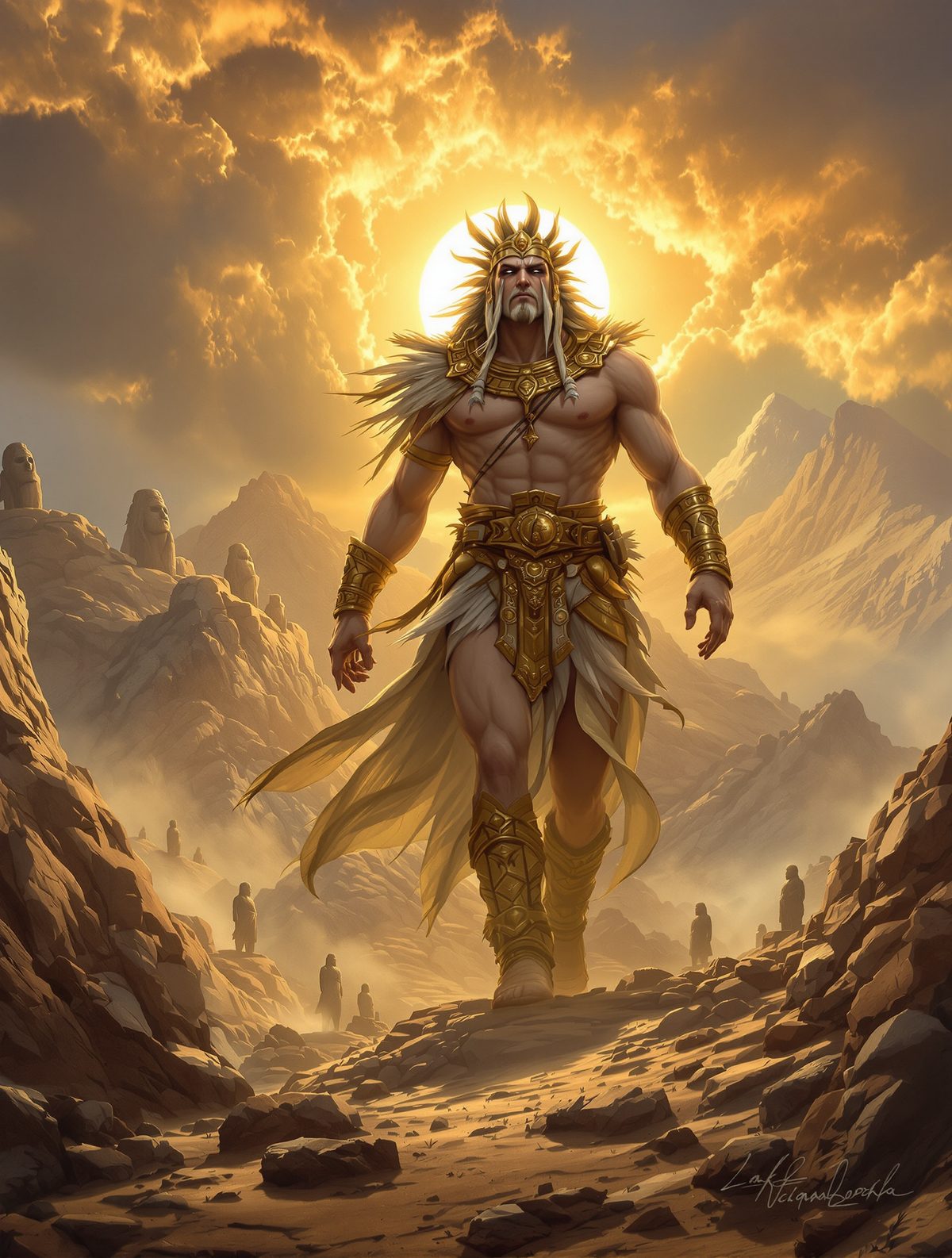
Viracocha's first creation was ambitious—perhaps too ambitious. He carved enormous beings from the living rock, giants who towered over the landscape. These first humans weren't the modest, reverent creatures the god had envisioned. Spanish chronicler Juan de Betanzos, writing in 1557, recorded that these giants were "very large in stature" and that some of their bones were still being discovered in his time, causing wonder among both indigenous peoples and conquistadors.
Archaeological evidence suggests this wasn't pure fantasy. The Tiwanaku civilization, centered around Lake Titicaca, created massive stone sculptures called "chachapumas"—some standing over 20 feet tall and weighing several tons. These monolithic figures, with their blocky features and imposing presence, may have inspired or reflected the legend of Viracocha's giants.
But size wasn't the problem. The giants had been given intelligence, strength, and dominion over the earth. What they lacked was humility. According to the chronicler Inca Garcilaso de la Vega, writing in 1609, these first humans "lived in darkness" both literally and spiritually. They failed to acknowledge their creator, showed no gratitude for their existence, and worst of all—they refused to worship the god who had given them life.
In Andean cosmology, reciprocity—ayni—was the fundamental principle governing all relationships, including those between humans and gods. The giants had broken the cosmic contract before they'd even learned to honor it.
Divine Fury: When Gods Play Medusa
What happened next reveals something profound about Andean concepts of divine justice. Viracocha didn't send floods or fire or plagues. Instead, he turned his disobedient children back into what they had always been: stone.
The transformation was instant and absolute. Spanish chronicler Pedro Cieza de León, writing in 1553, described vast fields of stone figures scattered across the Altiplano, each one a former giant frozen mid-action. Some appeared to be walking, others gesturing, still others seemed to be fleeing. The indigenous peoples he encountered told him these weren't natural rock formations—they were Viracocha's first children, preserved forever in their moment of divine punishment.
Modern visitors to Tiwanaku can still see what may have inspired these legends. The site is littered with massive stone heads and partially carved monoliths, some appearing almost human, others abstract. The famous "Bennett Monolith," discovered in 1932, stands over 24 feet tall and weighs approximately 20 tons. Its carved features seem almost alive, as if frozen in time.
But here's the detail that makes this myth truly haunting: Viracocha didn't petrify his children in anger. According to several versions of the legend, he wept as he did it. The god who had lovingly carved each giant from living rock was forced to return them to stone, not in hatred, but in profound disappointment.
Stone Tears Carve the World
What follows is perhaps the most beautiful and tragic part of the entire creation cycle. Viracocha, now alone in his perfectly ordered but lifeless world, began to walk. And as he walked, he wept.
But these weren't ordinary tears. When gods weep, the very earth responds. According to Andean legend, Viracocha's tears were so heavy with divine sorrow that they cut through solid rock like rivers through soft earth. Every valley in the Andes—from the Sacred Valley of the Incas to the dramatic gorges around Machu Picchu—was carved by the lonely god's grief.
This image would have resonated deeply with Andean peoples who lived intimately with their landscape. The Andes aren't gently rolling hills—they're a maze of sharp peaks, deep valleys, and dramatic gorges that seem almost supernatural in their formation. Modern geology tells us these valleys were carved by glacial action over millions of years, but the indigenous explanation is far more emotionally satisfying: they're the physical manifestation of a creator's regret.
As Viracocha wandered, his tears didn't just carve valleys—they created the waterways that would bring life to future civilizations. The Urubamba River, which flows past Machu Picchu, was said to follow the path of the god's wandering. Lake Titicaca itself was supposedly formed from his tears of both joy and sorrow—joy at the beauty of creation, sorrow at its imperfection.
The Second Attempt: Humanity Reborn
Eventually, Viracocha's grief transformed into determination. The god decided to try again, but this time with more wisdom and perhaps lower expectations. Standing in different locations across the Altiplano, he began creating new humans—smaller, more humble, and designed with built-in reverence for their creator.
This second creation was more methodical. At Tiwanaku, he created the ancestors of the Aymara people. At other sacred sites across the Andes, he crafted different ethnic groups, each with their own languages, customs, and territories. Unlike his first attempt at one perfect race of giants, Viracocha now embraced diversity.
But perhaps most importantly, he embedded in these new humans an instinctive understanding of ayni—reciprocity. They would know to give thanks, to make offerings, to acknowledge the source of their existence. The failure of his first children had taught the creator god a crucial lesson about the relationship between power and worship, creation and gratitude.
After completing his second creation, Viracocha continued walking westward across the Andes, teaching and guiding his new children. When he reached the Pacific Ocean near present-day Manta, Ecuador, he walked across the waves and disappeared, promising to return someday. The Inca later identified him with the constellation we call Orion, eternally watching over his children from the southern sky.
Why Stone Tears Still Matter
In our age of climate change and environmental destruction, Viracocha's story carries unexpected relevance. Here is a creator god whose tears literally reshape the landscape—whose emotional response to creation's failure becomes a permanent part of the world's geography. Every valley in the Andes serves as a reminder that even divine beings must live with the consequences of their choices.
The legend also offers a profound meditation on the relationship between creators and their creations. Viracocha's first humans weren't destroyed for being evil—they were destroyed for being ungrateful. In a world where we often take our creators (whether divine, parental, or natural) for granted, the image of stone giants frozen in their moment of indifference serves as a powerful warning.
Perhaps most importantly, Viracocha's tears remind us that landscapes aren't just geological accidents—they're repositories of meaning, emotion, and memory. When indigenous activists today fight to protect sacred sites in the Andes, they're not just preserving archaeological artifacts. They're defending a worldview in which every mountain, valley, and stream carries the emotional weight of creation itself.
The next time you see a photograph of Machu Picchu's dramatic valley or read about the mysterious stone heads of Tiwanaku, remember: you're looking at more than ancient architecture or natural beauty. You're witnessing the physical manifestation of a god's regret, carved in stone and water, preserved in indigenous memory, and powerful enough to reshape not just mountains, but entire civilizations' understanding of what it means to be human.