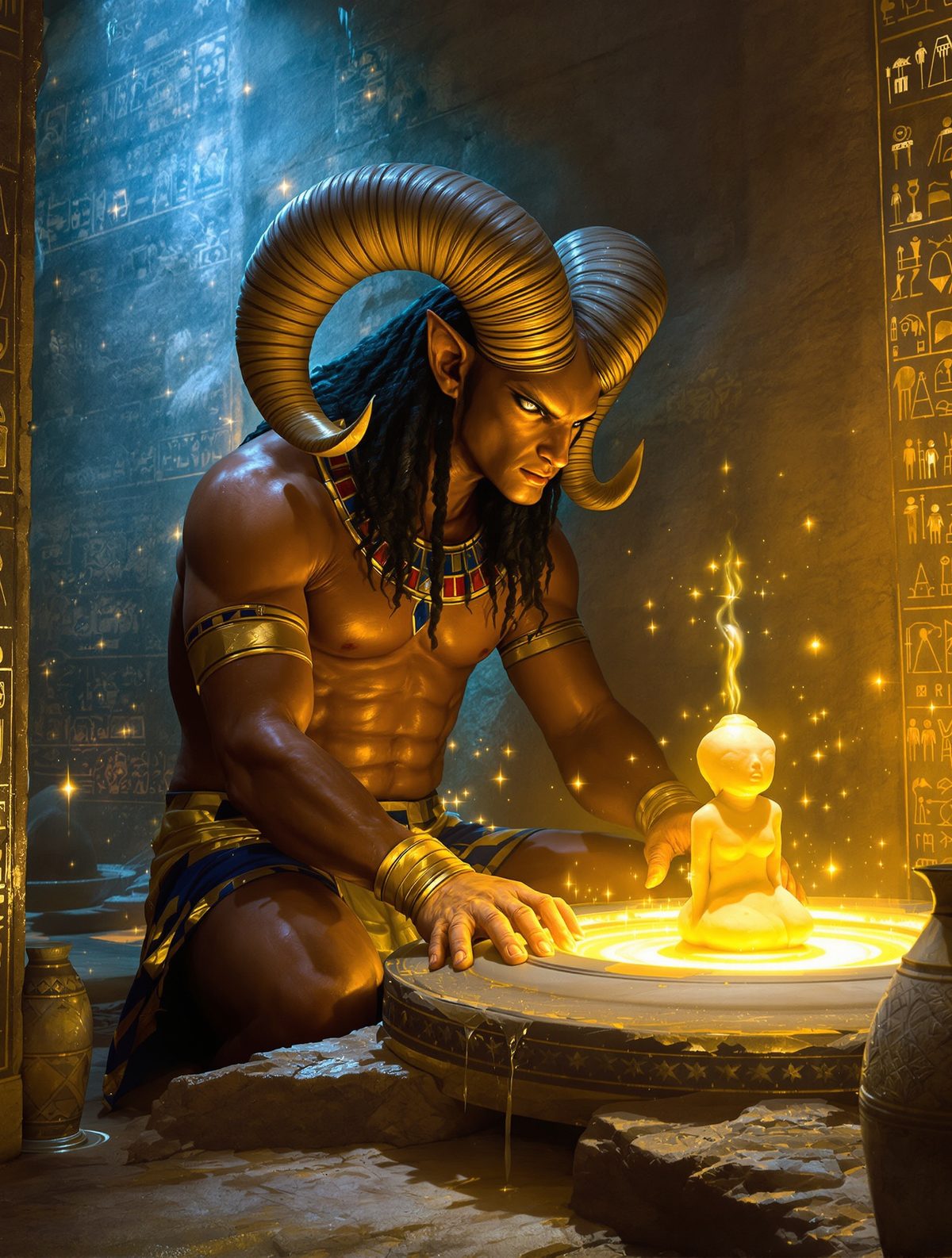

Deep beneath the mountains of what is now the Democratic Republic of Congo, where the earth splits open into caverns darker than moonless nights, a young hero once stood at the threshold between life and death. Mwindo—the miracle child born walking, talking, and laughing—gripped his magical flywhisk cokabulendo and gazed into the abyss. Above him, his people were dying. Below him waited Death himself, ready to play the ultimate game of chance with humanity's survival hanging in the balance.
This is no ordinary fairy tale. This is the Mwindo Epic, one of Africa's most complex and sophisticated mythological narratives, preserved for over a millennium by the Nyanga people of the eastern Congo Basin. Unlike the simplified myths that found their way into colonial-era books, Mwindo's journey to the underworld reveals a hero who must literally outwit Death to save his civilization—and the trials he faces there are unlike anything in Western mythology.
The Miracle Child Who Defied Destiny
To understand why Mwindo descended into hell, we must first understand what made him extraordinary. Born to Chief Shemwindo after a pregnancy that lasted seven years, Mwindo emerged from his mother's womb not as a helpless infant, but as a fully-formed child who could speak, walk, and command magic. In his tiny fist, he clutched the cokabulendo—a flywhisk imbued with supernatural power that would become his most trusted weapon.
But Mwindo's birth defied his father's decree that only daughters should be born in his kingdom. Shemwindo, fearing the prophecies that spoke of a son who would surpass him, immediately tried to kill the child. What followed was an epic conflict that saw Mwindo journey through multiple realms, gathering allies among spirits, animals, and ancestral powers. The Nyanga oral tradition preserves these stories in remarkable detail—some versions of the complete Mwindo Epic take over twelve hours to recite and contain more than 12,000 lines of poetry and prose.
Yet it was only after Mwindo had defeated his father and restored peace to the upper world that his greatest challenge began. The spirits who had helped him demanded payment, and that payment would require a journey no living person had ever survived.
The Summons from Below
The trouble began, as it often does in Nyanga tradition, with excess. Mwindo, drunk on his own power and success, began to hunt recklessly. He killed not just for food or ceremony, but for sport—slaughtering animals sacred to the forest spirits and disrupting the delicate balance between the world of the living and the realm of the ancestors.
Lightning, the chief of sky spirits who had aided Mwindo in his battles against his father, grew furious. In a scene that must have terrified ancient audiences around countless fires, Lightning appeared to the hero in a blaze of electrical fury. The message was simple but devastating: Mwindo had violated the cosmic order, and now he would face judgment in the land of Nyamwindo—the underworld ruled by Death himself.
What makes this moment particularly fascinating is how it reflects actual Nyanga beliefs about ecological balance. Archaeological evidence from the Congo Basin shows that the Nyanga people developed sophisticated conservation practices, including seasonal hunting restrictions and sacred forest preserves, centuries before European contact. Mwindo's transgression wasn't just spiritual—it was environmental, making him perhaps the world's first mythological eco-criminal.
Descent into the Realm of Shadows
The entrance to Nyamwindo lay deep within the earth, accessible only through caves that modern geologists have identified as part of the extensive limestone cave systems of the Albertine Rift. But for Mwindo, the journey downward was both physical and metaphysical—a descent through layers of reality that became increasingly hostile to living flesh.
Accompanied by his loyal companion Nkuba (Lightning's messenger), Mwindo discovered that his usual powers were severely limited in the underworld. His cokabulendo, which could level mountains and command armies in the world above, barely glowed in the realm of the dead. The spirits who had once rushed to aid him were absent or actively hostile. Most terrifying of all, the very air of Nyamwindo was antithetical to life—every breath was a struggle, every step forward an act of defiance against the natural order.
The Nyanga epic describes this realm in vivid detail: rivers that flowed upward, trees that grew with their roots in the air, and a sun that gave off darkness instead of light. Modern anthropologists recognize these inversions as sophisticated symbolic representations of death as the opposite of life—but for ancient audiences, these descriptions created a genuine sense of cosmic vertigo.
The Trials of Death
Death, known in the epic as Nyamwindo, was not the skeletal figure of European imagination, but a powerful chief who ruled the underworld with the same authority that earthly kings commanded their domains. When Mwindo finally stood before this ultimate sovereign, he found not a monster, but a being of terrible intelligence who understood exactly how to test a hero's worth.
The trials that followed were not mere physical challenges, but tests of wisdom, endurance, and moral character. Death's first challenge seemed simple: Mwindo must successfully plant and harvest crops in soil that had never known life. But this was no ordinary agricultural task—the seeds were the souls of the unborn, and failure would mean not just Mwindo's destruction, but the end of future generations among his people.
Using his flywhisk and his deep knowledge of plant spirits learned from his earlier adventures, Mwindo somehow coaxed growth from the barren underworld soil. But Death was not finished. The second trial required the hero to hunt and kill creatures that were already dead—beings of shadow and memory that could only be harmed by weapons forged from pure intention.
The final trial was the most diabolical: Mwindo had to choose between saving his own life and ensuring the prosperity of his people. Death presented him with two paths home—one that would return him safely to the surface but leave his kingdom cursed with eternal famine, and another that would restore abundance to his land but trap him forever in the underworld.
The Price of Victory
What happened next reveals the sophisticated moral philosophy underlying Nyanga mythology. Unlike many mythological heroes who triumph through strength or cunning alone, Mwindo's victory came through sacrifice and wisdom. He chose the path that would save his people, accepting what seemed like eternal imprisonment in the realm of death.
But Death, impressed by this act of selfless leadership, revealed the trial's true purpose. Mwindo had proven that he understood the fundamental responsibility of power—that true kings must be willing to sacrifice themselves for their subjects. This wisdom, Death declared, was more valuable than any magical weapon or supernatural ally.
Death released Mwindo, but not unchanged. The hero returned to the surface world with his cokabulendo transformed. No longer just a weapon of war, it had become a tool of cultivation and protection—a symbol of power tempered by wisdom and responsibility.
Echoes in the Modern World
The Mwindo Epic's journey to the underworld offers more than just thrilling adventure—it provides a template for understanding leadership, environmental responsibility, and the relationship between power and wisdom that resonates powerfully today. In an era when world leaders make decisions that affect entire ecosystems and future generations, Mwindo's trials in the underworld serve as a reminder that true leadership requires the willingness to descend into difficult places and make hard choices for the greater good.
Perhaps most remarkably, this African epic predates by centuries many of the themes that Western philosophy would later claim as innovations—the idea that power must be earned through moral trial, that environmental destruction carries spiritual consequences, and that the greatest leaders are those willing to sacrifice personal gain for collective benefit. When Mwindo emerged from the underworld, he brought with him not just his own salvation, but a new understanding of what it means to be truly heroic in a world where every action echoes through the interconnected web of life and death.