
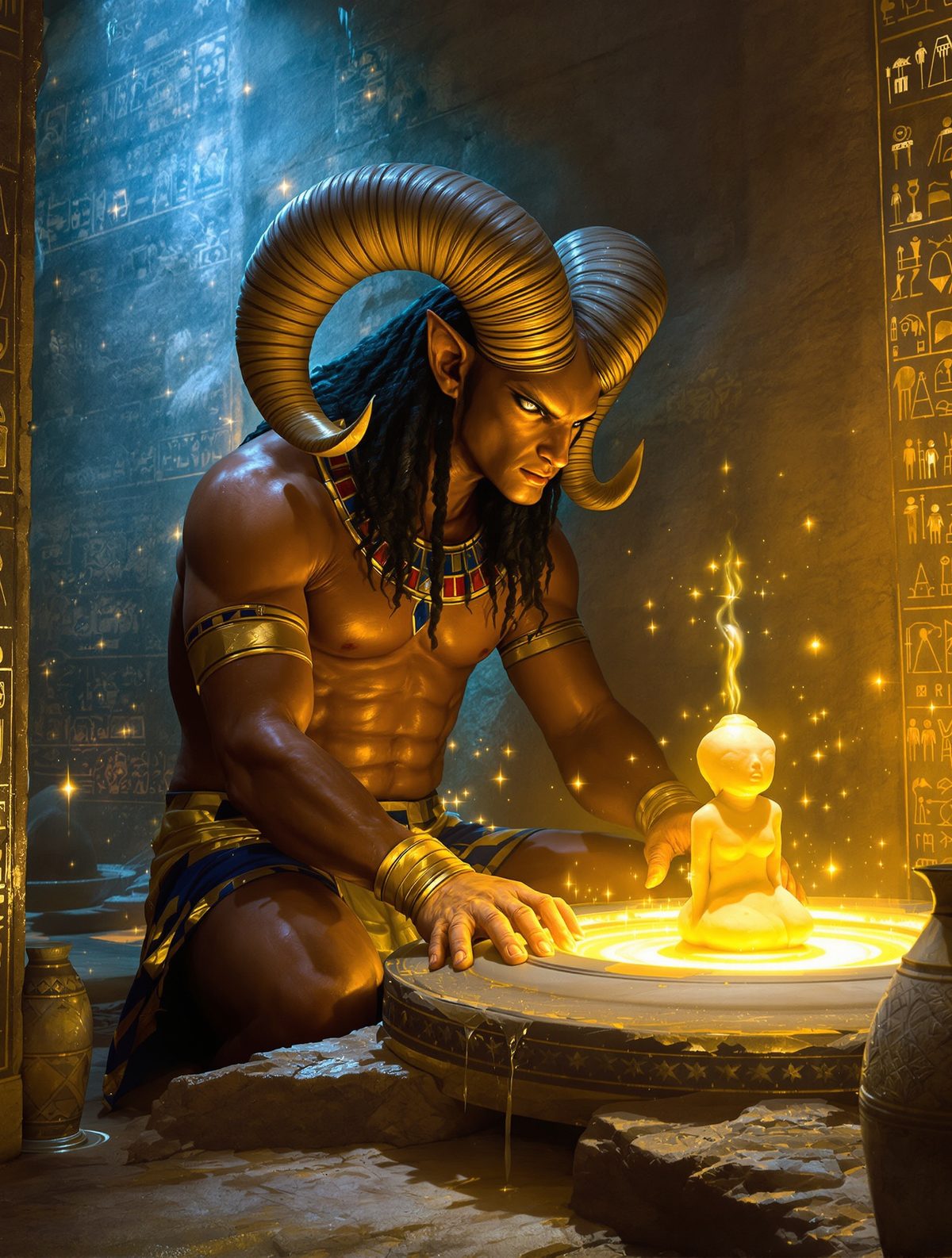
In the shadowed depths beneath Elephantine Island, where the Nile's first cataract thunders over granite boulders older than civilization itself, an ancient Egyptian priest places trembling hands upon a clay figure. The year is 2,400 BCE, and this isn't just any sculpture—it's a human soul being born. Above him, carved into living rock, the ram-headed god Khnum leans over his eternal potter's wheel, hands wet with the clay of creation. But here's what your history textbook never told you: this wasn't just mythology to the ancient Egyptians. This was the literal, scientific explanation for how every human being came to exist.
The Divine Potter's Workshop at the Edge of the World
Elephantine Island wasn't chosen randomly as Khnum's sacred seat. Located at Egypt's southern border, where the Nile explodes through a maze of granite islands in a thunderous display that ancient Egyptians called the First Cataract, this was literally the edge of their known world. Here, they believed, the Nile itself was born from the primordial waters of Nun—and here, in chambers carved deep into the island's bedrock, Khnum maintained his workshop of souls.
Archaeological evidence from the Temple of Khnum, continuously rebuilt over 3,000 years, reveals something extraordinary: actual pottery wheels found in sacred contexts, covered in hieroglyphic prayers asking Khnum to "shape the child in the womb." These weren't symbolic artifacts—they were working tools used in rituals where priests literally recreated Khnum's cosmic pottery session for every pregnancy in the region.
The ram god's workshop was imagined as existing simultaneously in the earthly temple and in the celestial realm. Ancient texts describe shelves lined with clay vessels, each containing a human Ka waiting to be born. But Khnum's pottery wasn't like any earthly craft—he worked with divine clay, mixed from the silt of the primordial flood and the tears of Ra, the sun god.
More Than Flesh: The Revolutionary Concept of Soul-Crafting
What made Khnum unique among creator deities worldwide was his role as a soul-sculptor. While other gods in various mythologies created human bodies, Khnum specifically crafted the Ka—ancient Egypt's concept of the eternal soul that would outlast physical death and journey through the afterlife. This wasn't just spiritual metaphor; it was advanced psychology wrapped in religious imagery.
The ancient Egyptian concept of the Ka was remarkably sophisticated. Unlike our modern notion of a single soul, Egyptians believed humans possessed multiple spiritual components: the Ka (life force), Ba (personality), Akh (glorified spirit), and others. Khnum's particular domain was the Ka, which modern scholars recognize as remarkably similar to what we might call genetic predisposition combined with core personality traits.
Papyrus texts from the Middle Kingdom (2055-1650 BCE) describe Khnum's process in startling detail. He would first shape the physical form, carefully molding features that would determine not just appearance but capabilities—strong hands for a craftsman, keen eyes for a scribe, broad shoulders for a warrior. Then came the crucial moment: breathing the Ka into the clay. This spiritual essence determined everything from intelligence and artistic ability to moral character and destiny.
The Pharaoh's Divine Assembly Line
Perhaps the most fascinating aspect of Khnum's mythology involves royal births. Wall carvings in the temples of Deir el-Bahari and Luxor show Khnum crafting not just the pharaoh-to-be, but also creating an identical Ka-figure on his wheel. This divine twin would serve as the ruler's spiritual double, guaranteeing their legitimacy to rule.
When Queen Hatshepsut faced challenges to her unprecedented reign as female pharaoh around 1479 BCE, she commissioned elaborate temple reliefs showing Khnum crafting her with distinctly royal attributes. The scenes show the ram god telling Amun-Ra: "I will shape her better than all gods, I will give her all life and satisfaction, all stability and all joy of heart." This wasn't just propaganda—it was a sophisticated argument about the divine source of leadership qualities.
The most remarkable example comes from the reign of Amenhotep III (1391-1353 BCE), whose architects created a series of hidden chambers beneath his mortuary temple where priests performed elaborate "re-creation" ceremonies. Using miniature potter's wheels and clay mixed with gold dust, they would symbolically recreate the pharaoh's divine crafting every year on his birthday, literally renewing his divine mandate to rule.
The Medical Mysteries of Divine Pottery
Ancient Egyptian medical papyri reveal that doctors invoked Khnum when treating what we would now recognize as developmental disorders, mental illness, and birth defects. The Edwin Smith Papyrus, dating to 1600 BCE, contains a prayer asking Khnum to "reshape the damaged clay" when treating head injuries that affected personality or cognitive function.
Even more intriguing are references to "Khnum's mistakes"—children born with physical or intellectual disabilities were sometimes explained as cases where the ram god had been distracted or had used inferior clay. However, rather than leading to abandonment, this often meant such children were considered sacred, touched by the god's direct attention in unusual ways.
Tomb inscriptions from Saqqara describe a remarkable 18th Dynasty physician named Khnum-hotep who developed treatments based explicitly on the pottery metaphor. He treated mental conditions by having patients work with clay while reciting hymns to Khnum, essentially creating what modern therapists would recognize as a sophisticated form of art therapy combined with cognitive behavioral techniques.
The Secret Rituals of Everyday Creation
While pharaohs received elaborate divine crafting ceremonies, ordinary Egyptians had their own connections to Khnum's workshop. Pregnancy rituals throughout Egypt involved expectant mothers visiting local Khnum shrines, where they would shape small clay figures representing their hoped-for children while priests chanted prayers asking the god to "form the child with care."
Archaeological excavations at Deir el-Medina, the village of royal tomb builders, uncovered hundreds of these small clay figures in household shrines. Chemical analysis revealed they were made from Nile clay mixed with ingredients like crushed eggshells (for strength), powdered gold (for divine favor), and aromatic resins (to please the god's senses).
The most touching discoveries are the small broken pottery wheels found in children's graves. Parents would bury young children with miniature versions of Khnum's divine tool, perhaps hoping the god would complete his work in the afterlife, crafting their child into a perfected form for eternity.
The Ram God's Eternal Legacy
As you scroll through social media today, watching parents post ultrasound images and debate nature versus nurture in their children's development, you're engaging with questions that would have been perfectly familiar to a priest of Khnum 4,000 years ago. The ancient Egyptians understood something profound: the mystery of human consciousness, personality, and individual difference demands explanation that goes beyond mere biology.
Khnum's potter's wheel represents humanity's oldest documented attempt to explain the emergence of individual consciousness—why each person is unique, why we possess the particular talents and limitations we do, and what determines the ineffable spark that makes us us. Modern neuroscience and genetics have given us new vocabulary for these questions, but we're still essentially asking what Khnum's priests asked: What invisible hand shapes the soul?
In an age of genetic engineering and artificial intelligence, when we're closer than ever to literally crafting consciousness, perhaps it's time to remember the ram god sitting at his eternal wheel, carefully shaping each soul with divine intention. After all, every human breakthrough begins with someone's hands in the clay, molding something that has never existed before into something that will change the world.