In the final moments of Ragnarök, as flames consumed the Nine Worlds and gods lay dying on the blood-soaked battlefield of Vigrid, silence itself took revenge. The monstrous wolf Fenrir had just devoured Odin, the All-Father, swallowing the king of the gods whole in his terrible jaws. Victory seemed assured for the forces of chaos. But then, stepping through the carnage with deliberate, measured steps, came a god who had never spoken a word—Vidar the Silent. What followed would be the most savage act of divine retribution ever recorded in Norse mythology, a moment so brutal that even the death-loving Vikings whispered about it in hushed tones.
The God Who Never Spoke
Among the pantheon of Norse deities known for their boastful speeches and cunning words—Odin with his riddles, Loki with his silver tongue, Thor with his thunderous declarations—Vidar stood as an anomaly. Called Víðarr in Old Norse, meaning "wide ruler," he was Odin's son, born to the giantess Grid in the wild forests beyond Asgard. But unlike his half-brother Thor or his father, Vidar chose silence as his power.
The medieval Icelandic scholar Snorri Sturluson, writing in his Prose Edda around 1220 CE, described Vidar as the god with the thick shoe, dwelling in a hall called Vidi, where grass and bushes grew knee-deep. This wasn't mere poetic imagery—every detail would prove crucial when the end times arrived. Vidar spent centuries preparing for a single moment, crafting the weapon that would avenge his father's death: a boot made from scraps of leather that had been discarded throughout the ages.
Here's a fact that would astound even medieval Vikings: Vidar's famous boot was forged not by divine magic, but by human waste. Every time a cobbler trimmed excess leather from a shoe's toe or heel, that scrap mystically became part of Vidar's weapon. This meant that every act of craftsmanship, every moment of human industry across Midgard, was unknowingly contributing to the gods' ultimate revenge. The silent god was literally weaponizing human creativity against the forces of destruction.
The Wolf That Swallowed Gods
To understand Vidar's revenge, we must first grasp the magnitude of what Fenrir represented. This wasn't merely a large wolf—Fenrir was chaos incarnate, a creature whose very existence threatened the cosmic order. Born of Loki and the giantess Angrboda, Fenrir had grown so massive in Asgard that only the war-god Tyr dared feed him, and even then with trembling hands.
The gods had tried to bind Fenrir with increasingly powerful chains. First came Leyding, forged from iron and broken like twigs. Then Dromi, twice as strong, which Fenrir snapped with a casual shake. Finally, the dwarves crafted Gleipnir, a silken cord made from six impossible things: the sound of a cat's footfall, the beard of a woman, the roots of a mountain, the sinews of a bear, the breath of a fish, and the spittle of a bird. This binding held—but at the cost of Tyr's right hand, bitten off when Fenrir realized he'd been tricked.
The Völuspá, that ancient prophetic poem composed sometime between 960-1000 CE, describes Fenrir's final moment of triumph in chilling detail. When Ragnarök came, the wolf broke free from his mystical bonds and made straight for Odin. The All-Father, wielder of the spear Gungnir and master of battle-magic, fought valiantly. But prophecy is inexorable. Fenrir's jaws, wide enough to stretch from earth to sky when opened, closed around the king of the gods.
The Silent Approach
Picture the scene: the battlefield of Vigrid, a plain 120 leagues wide in every direction, littered with the corpses of gods and giants. The air thick with smoke from the world-serpent Jörmungandr's poison breath. The clash of weapons had fallen silent. Fenrir stood triumphant over Odin's body, blood dripping from his cosmic jaws. For a moment that lasted an eternity, it seemed that chaos had won.
Then Vidar appeared.
Unlike his bombastic relatives, Vidar didn't charge into battle with war-cries or boasts. He walked—purposefully, silently, inexorably. The thick boot that he had been perfecting for centuries was laced tight. His hands, strengthened by eons of patient preparation, hung ready at his sides. The god who had never wasted a word was about to let his actions speak with devastating eloquence.
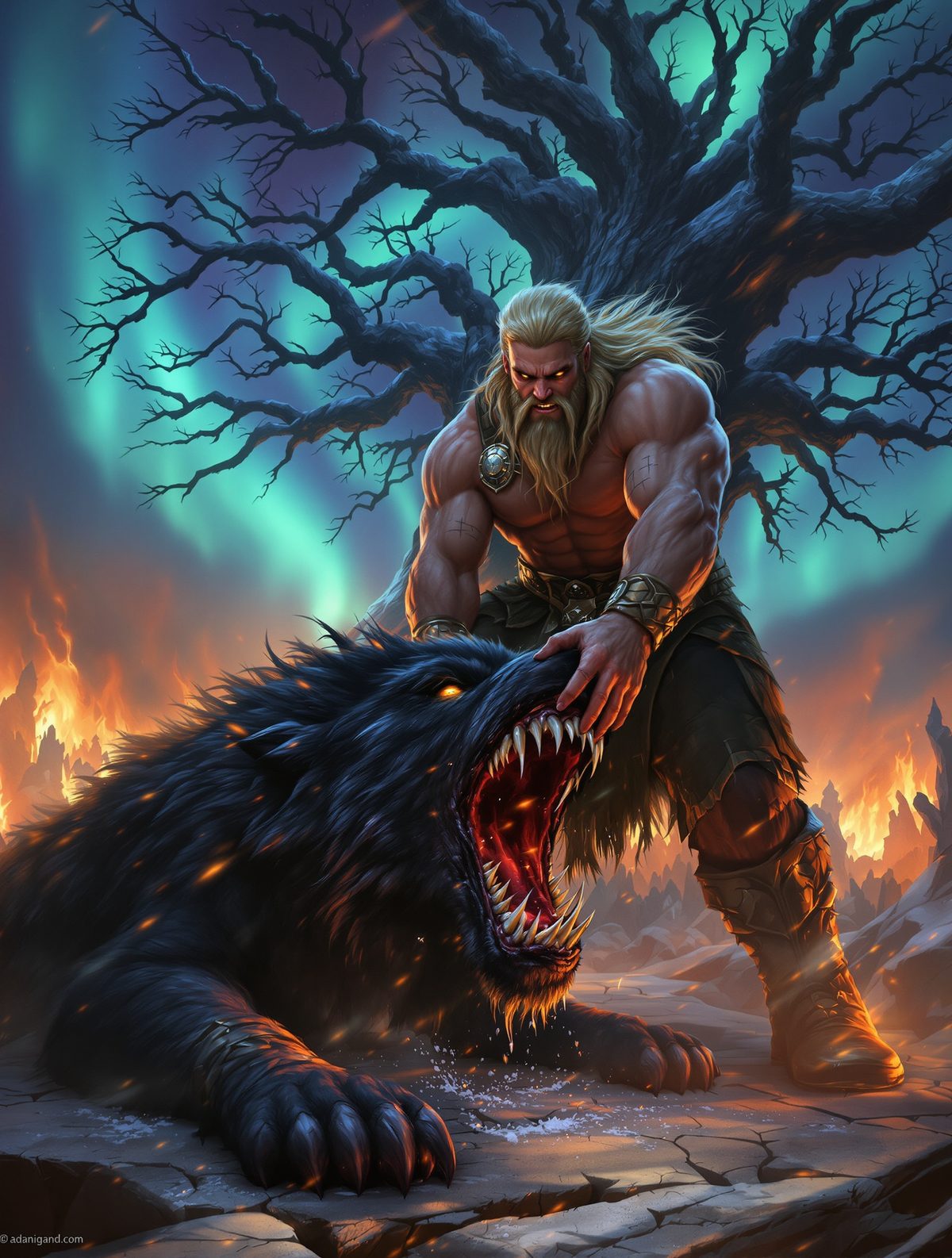
This is where the Norse sources become almost uncomfortable in their graphic detail. The Grímnismál, one of the poems in the Poetic Edda dating to the 10th century, describes what happened next with clinical precision. Vidar approached the wolf and placed his thick-soled boot against Fenrir's lower jaw, pressing it down against the earth with supernatural force.
The Most Brutal Act in Norse Mythology
What followed next challenges our modern sensibilities about divine behavior. Vidar reached up with both hands and grasped Fenrir's upper jaw. Then, in a display of strength that dwarfed even Thor's mighty deeds, he began to pull. The wolf who had devoured the king of the gods, who had broken chains forged by dwarven magic, who embodied the very principle of cosmic destruction—this ultimate predator became prey to silent, methodical vengeance.
Vidar tore Fenrir's jaw apart. Not quickly, not mercifully, but with the deliberate precision of someone who had waited centuries for this moment. The thick boot—woven from every scrap of discarded leather in human history—provided the leverage. The hands—strengthened by eternal patience—provided the force. The wolf's death scream echoed across the burning Nine Worlds as his jaw was ripped from his skull.
Medieval audiences found this scene both terrifying and deeply satisfying. Unlike the mutual destruction that claimed Thor and Jörmungandr, or the fiery death that consumed Freyr, Vidar's victory was absolute and personal. This wasn't cosmic balance—this was a son avenging his father with calculated brutality that made berserker rage look like a child's tantrum.
Here's what makes this revenge even more chilling: Vidar never said a word throughout the entire ordeal. No battle-cry, no declaration of vengeance, no final words to his fallen father. The god who had chosen silence as his domain remained true to his nature even in his moment of ultimate triumph. His actions alone spoke of justice, patience, and the terrible power of focused intention.
The Survivor's Legacy
Vidar's revenge carried significance beyond personal satisfaction. In Norse cosmology, he was one of the few gods destined to survive Ragnarök and rebuild the world afterward. His defeat of Fenrir wasn't just vengeance—it was the first act of cosmic restoration. By destroying the wolf who had killed Odin, Vidar eliminated one of the primary agents of chaos, making renewal possible.
The symbolism runs deeper than medieval audiences might have consciously recognized. Vidar's weapon—constructed from human craftsmanship—represented the idea that mortal industry could contribute to divine victory. Every cobbler who trimmed leather, every craftsman who perfected his work, was unconsciously participating in the gods' ultimate triumph over chaos. This wasn't just mythology; it was a profound statement about the value of human creativity and careful work.
Archaeological evidence from the Viking Age reveals that Vidar held special significance for craftsmen and those who worked with their hands. Amulets bearing his symbol—often a thick boot or a silent figure—have been found in workshops and smithies across Scandinavia, suggesting that medieval artisans identified strongly with the silent god's patient approach to his craft.
Why Silent Revenge Still Matters
In our age of instant communication and social media outrage, Vidar's story offers a startling counterpoint. Here was a deity who achieved ultimate victory not through clever words or thunderous proclamations, but through patient preparation and decisive action. He spent centuries perfecting his craft, waiting for the right moment, then struck with overwhelming force and absolute precision.
The lesson transcends mythology: sometimes the most powerful response to injustice isn't immediate retaliation or angry words, but careful preparation followed by devastating effectiveness. Vidar's silence wasn't weakness—it was concentrated power, waiting for the perfect moment to strike. In a world where everyone seems to have an opinion that must be immediately shared, the god who never spoke reminds us that actions, carefully planned and perfectly executed, can speak louder than any words.
Perhaps that's why this brutal tale of divine revenge continues to fascinate us. In Vidar's silent approach to Fenrir's corpse, in his methodical destruction of chaos itself, we see not just mythological justice, but a timeless truth: sometimes the most profound victories come not from those who speak the loudest, but from those who work the longest and strike the hardest when the moment finally arrives.