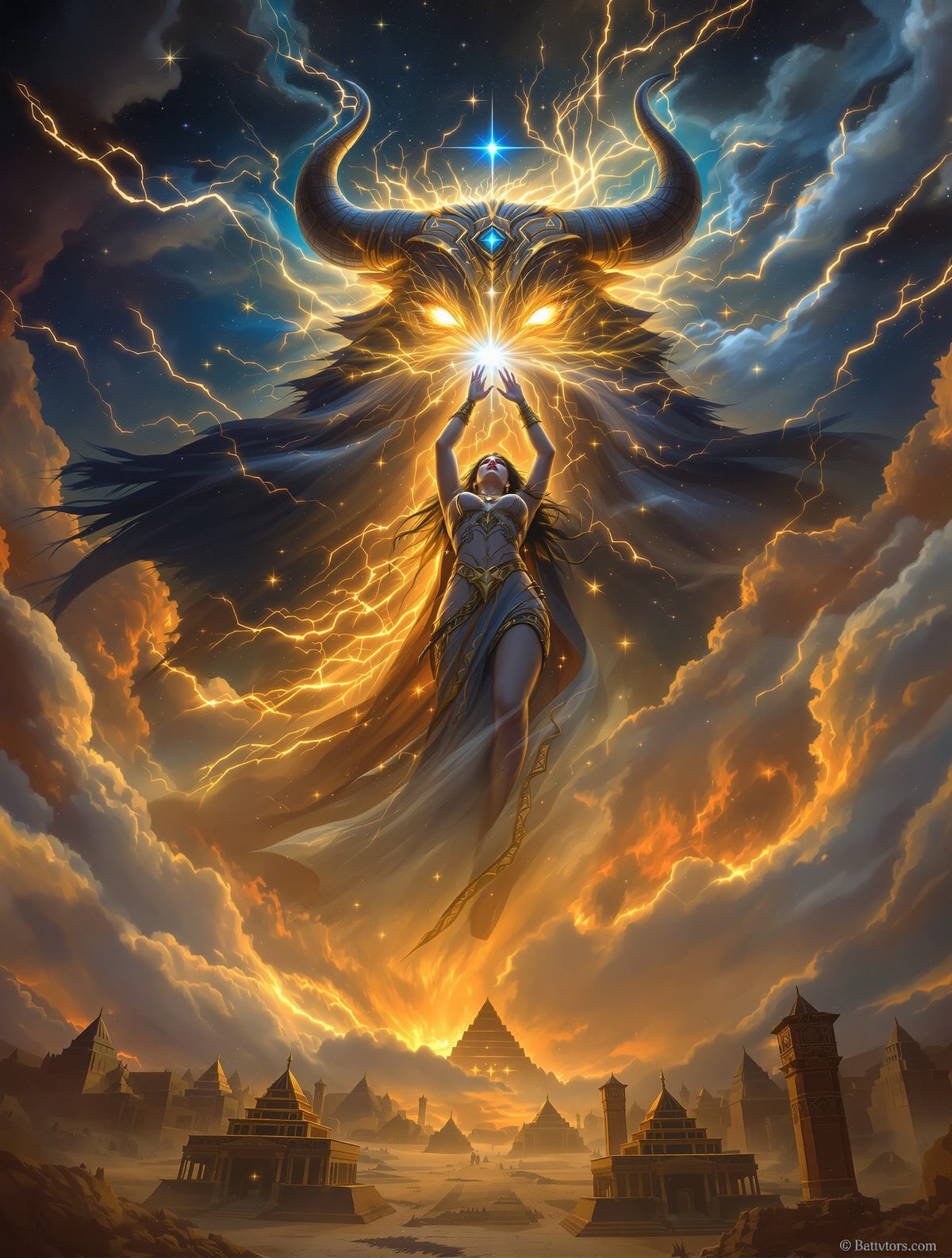
In the ancient city of Uruk, around 2100 BCE, clay tablets were being pressed with cuneiform symbols that would preserve one of humanity's most chilling tales of sibling rivalry. But this wasn't just any family feud—this was a deadly game of deception between two goddesses, where the stakes were nothing less than life, death, and the balance of the cosmos itself.
Picture this: messengers in tattered robes appear at the gates of heaven, bearing news of a sudden death in the underworld. They request the presence of Inanna, the radiant Queen of Heaven and Earth, at a funeral feast. It seems like a reasonable request—after all, what self-respecting deity would refuse to pay respects to the dead? But these weren't ordinary messengers, and this was no ordinary invitation. It was the opening move in the most elaborate trap ever conceived, orchestrated by Ereshkigal, the Queen of the Dead herself.
The Sister Left in Shadows
To understand why Ereshkigal would orchestrate such an elaborate deception, we need to step back into the divine family dynamics of ancient Mesopotamia. While her sister Inanna basked in the worship of millions—goddess of love, beauty, fertility, and war—Ereshkigal ruled over the kur, the dark underworld beneath the earth. The tablets tell us she had been "given the underworld for her domain," but they're curiously silent about whether this was her choice.
Archaeological evidence from sites like Nippur and Babylon reveals that Ereshkigal's cult was far smaller than her sister's. While Inanna had magnificent temples like the one at Uruk with its towering ziggurat reaching toward the heavens, Ereshkigal's worship was conducted in underground chambers and cave sanctuaries. The contrast couldn't have been starker—one sister celebrated in golden sunlight, the other honored in perpetual darkness.
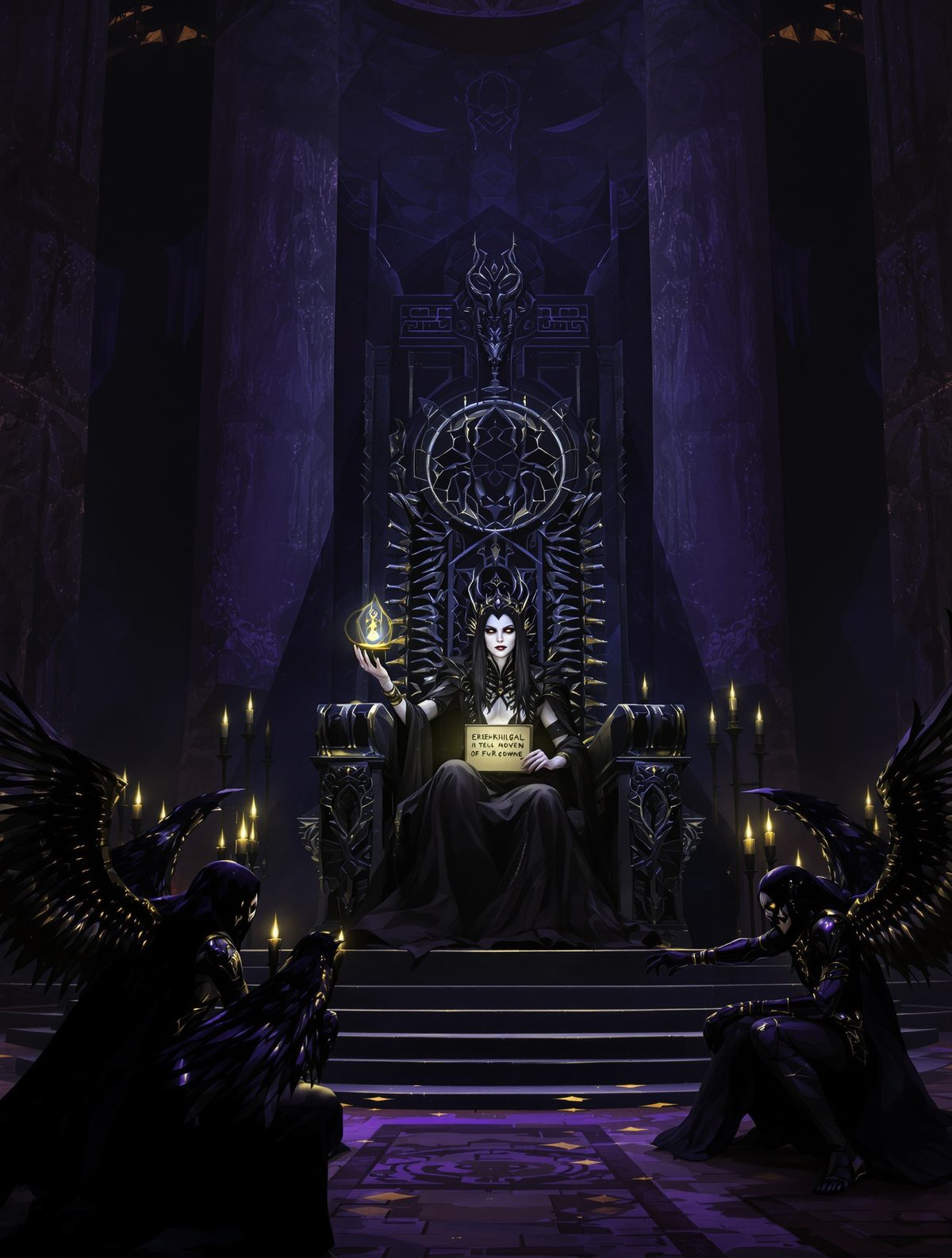
But here's what the textbooks rarely mention: Ereshkigal wasn't just some gloomy death goddess. She was arguably the most powerful deity in the Mesopotamian pantheon. Every living thing—mortal, hero, and god alike—would eventually come under her dominion. Even mighty Gilgamesh himself would one day kneel before her throne. Yet she remained largely invisible to the world above, her power acknowledged but rarely celebrated.
The Perfect Bait: Understanding Ancient Funeral Customs
Ereshkigal's invitation was masterfully crafted because it exploited something sacred in Mesopotamian culture: the absolute obligation to honor the dead. Archaeological discoveries at the Royal Cemetery of Ur have shown us just how seriously ancient Mesopotamians took their funeral rites. When Queen Puabi died around 2450 BCE, she was buried with 52 attendants who willingly followed her into death.
The "funeral feast" mentioned in the invitation would have been instantly recognizable to Inanna. These kispu ceremonies were elaborate affairs where food and drink were offered to the deceased, ensuring their comfort in the afterlife. Refusing such an invitation wasn't just rude—it was sacrilege that could anger the dead and bring catastrophic consequences upon the living world.
But here's the brilliant part of Ereshkigal's trap: there was no actual funeral. Cuneiform experts who have analyzed the various versions of this myth found in libraries from Nineveh to Babylon note that the supposed deceased is never named, never described, never mourned. It was a phantom death, designed specifically to lure Inanna into the underworld where different rules applied—Ereshkigal's rules.
The Descent: Seven Gates, Seven Garments
When Inanna received the invitation, she did exactly what Ereshkigal predicted—she couldn't refuse. But the Queen of Heaven wasn't naive. She instructed her loyal minister Ninshubur to raise an alarm if she didn't return within three days, and she armed herself with the me—divine powers that governed civilization itself.
The journey to the underworld took her through seven gates, each manned by Ereshkigal's gatekeeper, Neti. At each gate, Inanna was told she must remove one of her divine garments or ornaments. "It is the way of the underworld," Neti explained. By the time she reached Ereshkigal's throne room, she stood naked and powerless—stripped of her crown, her lapis lazuli necklace, her breastplate, her gold ring, her measuring rod and line, and even her royal robe.
This detail reveals something fascinating about ancient Mesopotamian beliefs: power was understood to be literally worn. Recent analysis of royal graves has found that Mesopotamian rulers were buried with elaborate regalia not just for show, but because these objects were believed to contain actual supernatural authority. By forcing Inanna to disrobe, Ereshkigal was systematically stripping away her sister's divine powers.
The Trap Springs: Death's Judgment
When the naked Inanna finally stood before her sister's throne, there was no funeral feast waiting—only the seven Anunnaki, judges of the underworld, who immediately pronounced the death sentence upon her. Ereshkigal herself delivered the killing blow with "the look of death," and Inanna's corpse was hung on a hook like a piece of meat.
The imagery here is deliberately shocking. This wasn't an honorable death in battle or a peaceful passing—this was butchery. Ereshkigal had reduced her radiant sister, beloved by millions, to carrion. For three days and three nights, the Queen of Heaven hung lifeless in the realm of the dead while the world above began to wither. Without Inanna's life-giving power, no animals mated, no crops grew, no children were conceived.
But perhaps the most chilling detail comes from later versions of the myth found in Ashurbanipal's library: Ereshkigal showed no emotion whatsoever as she watched her sister die. No anger, no satisfaction, no regret. The Queen of the Dead had simply done what death does—claimed another victim, even if that victim happened to be family.
The Price of Resurrection
Of course, the story doesn't end with Inanna's death. Thanks to Ninshubur's intervention and the wisdom of Enki, god of fresh water and cleverness, Inanna was eventually resurrected. But Ereshkigal demanded a substitute—someone had to take Inanna's place in the underworld. When Inanna discovered that her husband Dumuzi had been living it up in her absence instead of mourning her, she condemned him to spend half the year in the underworld, with his sister Geshtinanna taking the other half.
This resolution reveals the deeper purpose behind Ereshkigal's trap. It wasn't really about killing Inanna—it was about establishing balance. The queen of the underworld had forced the cosmos to acknowledge that life and death are partners, not enemies, and that even the most powerful must eventually bow to mortality's rules.
The Eternal Relevance of Deadly Deception
Today, when we read about Ereshkigal's fatal invitation, we might recognize something uncomfortably familiar. Here was someone whose essential work—managing death, judging souls, maintaining cosmic order—was largely invisible and unappreciated. She lived in the shadow of her more glamorous sister, whose domain was all light and life and celebration.
But perhaps Ereshkigal's story isn't really about jealousy or revenge. Maybe it's about the dangerous consequences of ignoring the darker necessities of existence. In a world that increasingly wants to avoid thinking about death, aging, and endings, Ereshkigal's trap reminds us that death will have its due—one way or another. Her invitation might have been false, but the funeral it promised was always going to be real. The only question was whose.
The ancient Mesopotamians understood something we often forget: you can't have a complete cosmos with only light and life and growth. Someone has to tend the shadows, judge the dead, and remind the living that all stories end. Ereshkigal's greatest trick wasn't luring her sister into the underworld—it was making sure that lesson could never be forgotten.