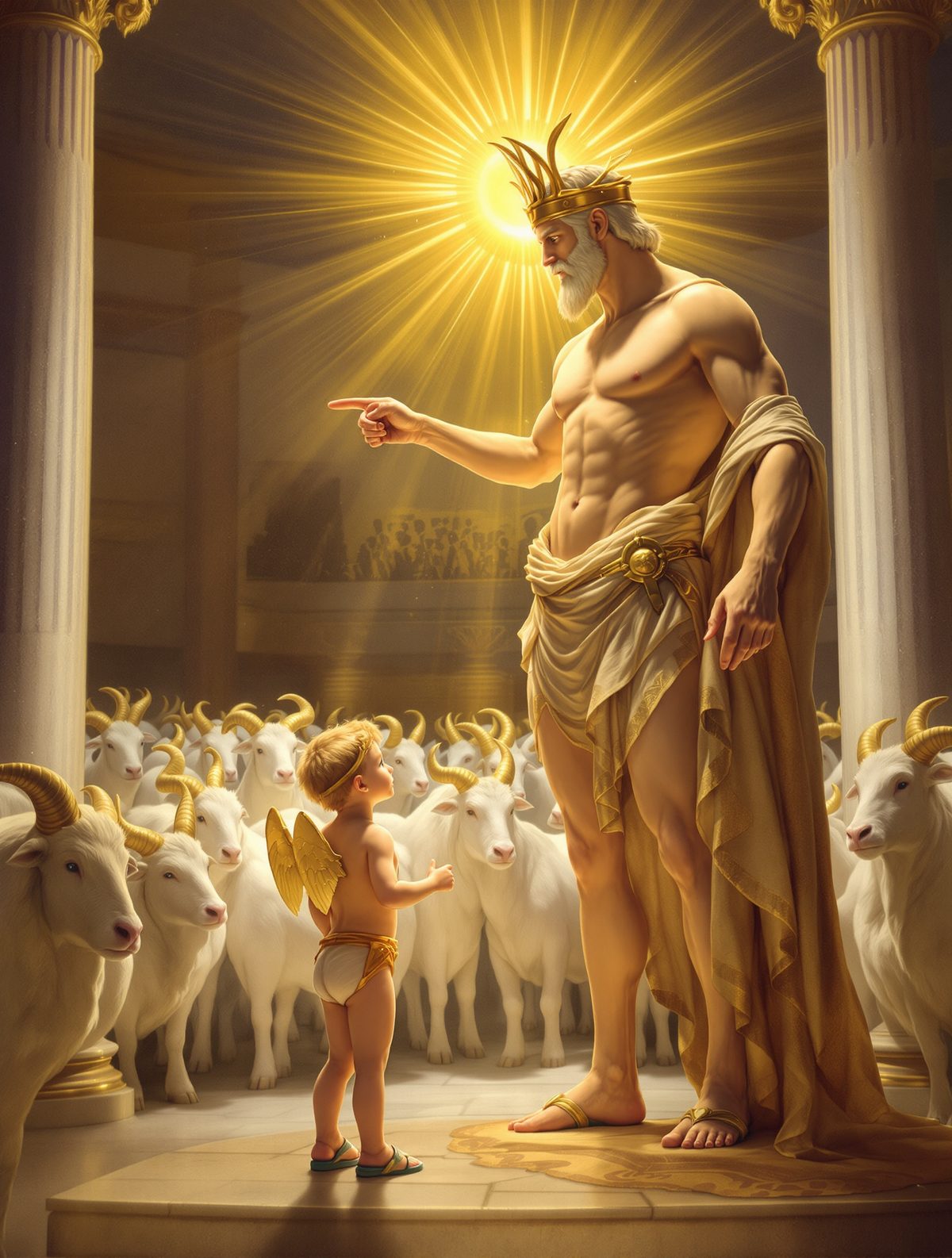
Picture this: the most powerful king in ancient India marches toward a humble hermitage with 100,000 soldiers, their bronze weapons gleaming in the sun, war elephants trumpeting, the very ground trembling beneath their feet. Their target? One old man and his cow. What happens next defies everything we think we know about warfare, divine intervention, and the true source of power in the ancient world.
This isn't just another tale from Hindu mythology—it's a story that shaped the spiritual landscape of an entire civilization, introducing concepts about divine justice, the futility of earthly power, and the incredible forces that lie dormant in the natural world, waiting to be awakened by those who truly understand them.
The Sage Who Owned Heaven's Greatest Treasure
In the golden age of the Treta Yuga, when gods still walked among mortals and the boundaries between the possible and impossible were far more fluid, there lived a sage named Vasishtha. But calling him simply a "sage" is like calling the Himalayas "some hills." Vasishtha was one of the Saptarishis—the seven great seers who were literally born from the mind of Brahma himself. He was the royal guru to the legendary Solar Dynasty, spiritual advisor to kings like Harishchandra and Dilipa, and keeper of wisdom so profound that his very name became synonymous with divine knowledge.
Yet among all his extraordinary possessions—his mastery over cosmic forces, his ability to travel between dimensions, his scriptures that could reshape reality—one stood out above all others: Kamadhenu, the wish-fulfilling cow of the gods.
This wasn't just any magical creature. According to the ancient texts, Kamadhenu emerged during the Samudra Manthan, the cosmic churning of the ocean that produced fourteen divine treasures, including the nectar of immortality itself. While the gods fought over amrita and powerful weapons, wise Vasishtha recognized the true prize. Kamadhenu could grant any wish, provide unlimited abundance, and—as events would soon prove—defend herself and her master with powers that made armies seem like children playing with sticks.
What made this cow so extraordinary? The Puranas describe her as having the body of a zebu cow but bearing within her essence all the gods themselves. Her four legs represented the four Vedas, her horns held the trinity of Brahma, Vishnu, and Shiva, and her udders contained the healing waters of the sacred Ganges. When she walked, flowers bloomed in her footsteps. When she mooed, the sound harmonized with the cosmic Om.
The King Who Wanted Everything
Enter Vishvamitra—a name that still resonates through Indian history as the epitome of royal ambition and spiritual transformation. But in our story, he hasn't yet become the great sage he's remembered as. He's still a Kshatriya, a warrior-king whose empire stretches across vast territories, whose armies number in the hundreds of thousands, and whose pride burns as bright as the sacrificial fires in his royal court.
The meeting between these two titans of ancient India began innocuously enough. King Vishvamitra, while hunting in the forest, stumbled upon Vasishtha's hermitage. What he found there challenged everything he thought he knew about wealth and power. The simple sage, living in a modest ashram, hosted the king's entire retinue—thousands of soldiers, hundreds of horses, dozens of elephants—with a feast so sumptuous and abundant that even the royal kitchens couldn't have matched it.
How was this possible? The answer stood peacefully in the hermitage courtyard: Kamadhenu, gently chewing grass, seemingly oblivious to the miracle she was performing. At Vasishtha's gentle request, she had manifested mountains of rice, rivers of ghee, forests of fruits, and delicacies that existed nowhere else in the mortal world. She had fed an army with less effort than a royal chef expending to prepare a single meal.
Vishvamitra's eyes burned with desire. Here was power beyond anything in his treasury. With Kamadhenu, he could feed infinite armies, create unlimited wealth, and extend his empire to the very edges of the known world. He made his offer: name any price. Gold, jewels, entire kingdoms—everything was negotiable.
Everything except the cow herself.
When Divine Meets Worldly
Vasishtha's refusal wasn't born of greed or spite—it came from a deeper understanding that Vishvamitra couldn't yet grasp. "O King," the sage explained, "Kamadhenu is not mine to give. She is the source of my students' nourishment, the foundation of dharmic rituals, and the divine mother who sustains not just my hermitage but the cosmic order itself. She belongs not to me, but to the universe."
For Vishvamitra, this response was incomprehensible. In his world, everything had a price, every desire could be fulfilled through force or negotiation, and kings took what they needed. He had never encountered something genuinely beyond his reach, and the experience ignited a rage that would reshape both men's destinies.
The king's solution was elegantly simple: if Vasishtha wouldn't give him the cow, he would take her. After all, what could one old hermit do against the mightiest military force in the land?
What followed was perhaps the most mismatched military campaign in all of mythology. Vishvamitra returned to his capital and assembled an army that the Valmiki Ramayana describes as numbering 100,000 soldiers, along with cavalry, war elephants, and chariot divisions. The Puranas paint an even grander picture—warriors stretching to the horizon, weapons that glinted like stars, war cries that echoed across multiple kingdoms.
Against this overwhelming display of earthly power stood one elderly sage, his handful of students, and a cow.
The Mouth That Birthed an Army
When Vishvamitra's forces surrounded the hermitage, the very air seemed to crackle with tension. The king himself rode at the front, resplendent in golden armor, his sword blessed by fire sacrifices, his confidence absolute. Behind him stretched the greatest military machine the ancient world had ever seen.
Vasishtha didn't reach for weapons or chant warrior mantras. Instead, he approached Kamadhenu with the same gentle manner he used for their daily interactions. The ancient texts record his words: "O Divine Mother, you see how worldly power seeks to claim what belongs to dharma. I will not raise my hand against these souls, for they know not what they do. But if you choose to protect yourself and the sacred order, I will not stop you."
What happened next defied every law of physics and warfare known to human civilization.
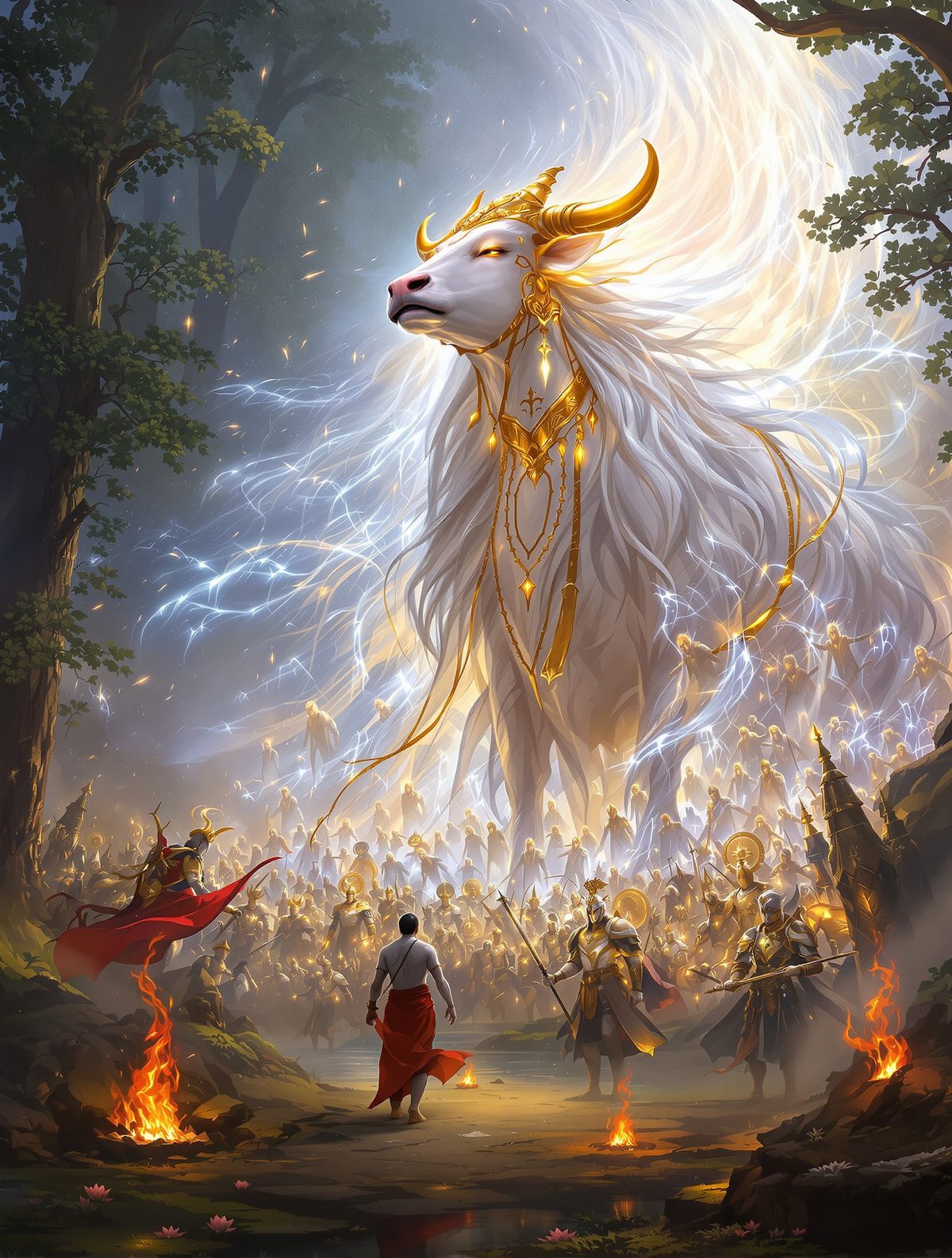
Kamadhenu opened her mouth, and an army poured out.
Not metaphorically. Not symbolically. The ancient chronicles describe with startling specificity how fully-armed warriors emerged from the divine cow's mouth like a flood of divine justice. First came the Pahlava soldiers—fierce warriors from the northwest territories, their curved swords singing through the air. Then the Shakas—nomadic fighters whose archery skills were legendary, their arrows finding marks with supernatural precision.
The Yavanas followed—foreign warriors whose fighting techniques were unknown to Indian armies, their exotic weapons and tactics sowing confusion in Vishvamitra's ranks. Kambojas emerged next—mountain fighters whose very war cries could scatter elephants, their battle-fury blessed by divine rage.
But the most terrifying sight was yet to come: the Barbaras, beings that existed somewhere between human and divine, their strength capable of crushing war chariots with bare hands, their courage untempered by fear of death because they were already beyond mortal concerns.
The Rout That Changed Everything
The battle—if it could even be called that—was over almost before it began. Vishvamitra's 100,000 soldiers found themselves facing an enemy that seemed to multiply endlessly, warriors who fought with divine weapons and supernatural skills, beings who reformed after taking mortal wounds and pressed their attack with implacable determination.
The Brahma Purana describes the scene in vivid detail: war elephants fled in terror, their mahouts unable to control them. Cavalry horses reared and bolted, throwing their riders. Infantry formations crumbled as soldiers faced opponents who seemed to materialize from thin air, strike with devastating effect, and vanish like smoke only to reappear elsewhere on the battlefield.
Most devastating of all was the psychological impact. These weren't human enemies driven by familiar motivations like territory or treasure. These were divine instruments of cosmic justice, and every soul on that battlefield understood at a primal level that they were fighting against the very order of the universe itself.
Within hours, Vishvamitra's mighty army was in full retreat. The king himself barely escaped with his life, saved only by the sage's inherent compassion. As the dust settled and silence returned to the forest, the divine soldiers simply walked back toward Kamadhenu and disappeared into her being as mysteriously as they had emerged.
The hermitage remained exactly as it had been—peaceful, modest, and undisturbed. Only the trampled earth and scattered weapons bore witness to one of the most extraordinary reversals of fortune in all of ancient literature.
The Transformation That Echoes Through Time
This crushing defeat became the catalyst for one of mythology's most profound character transformations. Vishvamitra, faced with the undeniable reality that worldly power meant nothing against spiritual authority, abandoned his throne and began the intensive spiritual practices that would eventually transform him from a Rajarishi (royal sage) to a Brahmarishi (divine sage), equal in stature to Vasishtha himself.
But the story's true power lies not in its spectacular battle scenes or miraculous events. It speaks to something deeper about the nature of power itself. In our modern world, we're still witnessing the same fundamental conflict between force and dharma, between those who believe might makes right and those who understand that true strength flows from alignment with cosmic principles.
Kamadhenu's divine army wasn't just a display of magical power—it was a demonstration that when we act in harmony with universal laws, resources and protection appear that we never could have imagined or engineered through human effort alone. The cow didn't create those warriors from nothing; she channeled forces that were always present, waiting for the right moment and the right cause to manifest.
Today, as we face our own battles between different forms of power—technological versus natural, economic versus spiritual, imperial versus sustainable—Vasishtha's divine cow reminds us that the universe itself has preferences. And sometimes, when pushed far enough, it pushes back.
The next time you hear about a seemingly powerless individual or principle standing against overwhelming odds, remember the sage who refused to sell his cow, and the mouth that birthed an army to prove that true power flows not from accumulation, but from alignment with something far greater than ourselves.