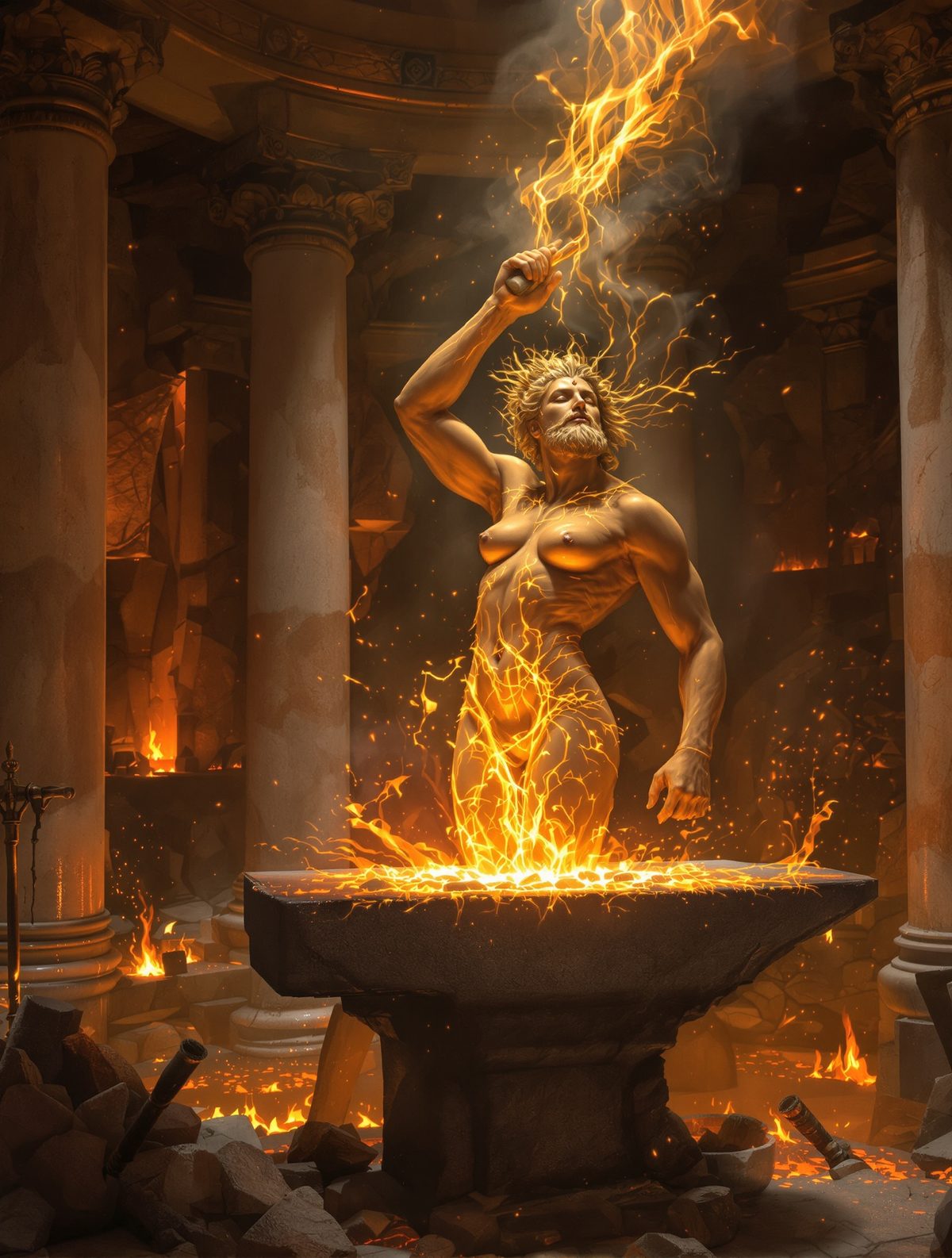
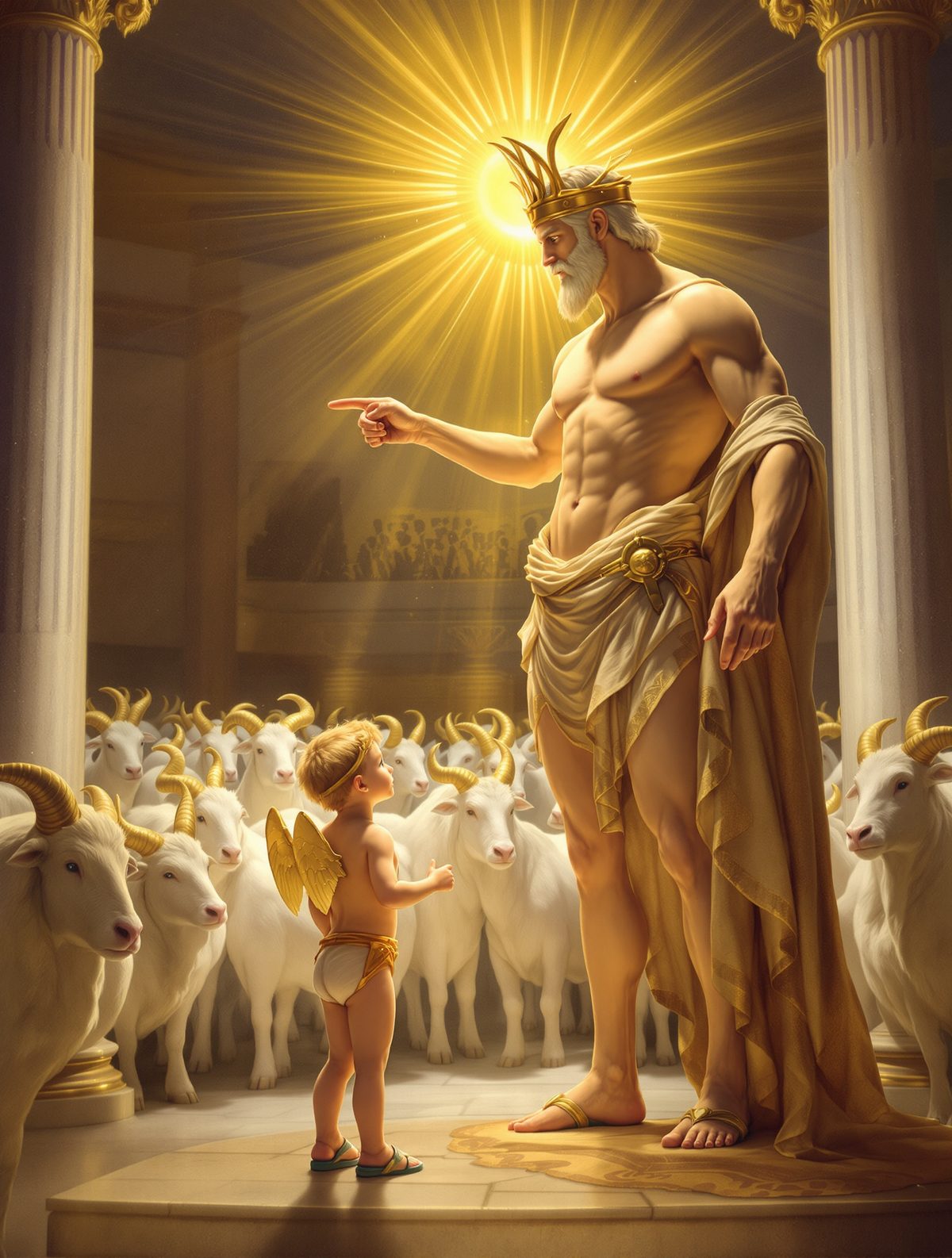
Picture this: a baby, barely hours old, crawling from his golden cradle in the dead of night. But this isn't just any infant—this is Mercury, son of Jupiter himself, and he's about to pull off the most audacious heist in divine history. His target? Apollo's prized cattle, sacred beasts that graze on ambrosia and drink from celestial streams. By dawn, the god of the sun will discover his entire herd has vanished without a trace, outsmarted by a child who can't even walk upright.
This isn't the stuff of children's fairy tales—this is Roman mythology at its most deliciously subversive, where even newborn gods can be master criminals, and the line between heroism and villainy blurs like morning mist.
The Birth of a Divine Trickster
Mercury's birth was anything but ordinary, even by divine standards. Born in a cave on Mount Cyllene to the nymph Maia, one of the seven Pleiades, Mercury emerged into the world with an intelligence that defied his newborn status. The Romans inherited this tale from their Greek predecessors, where Mercury was known as Hermes, but they embraced the story with particular relish—perhaps because it reflected their own cultural appreciation for cunning and strategic thinking.
According to Ovid's Metamorphoses and other classical sources, Mercury's divine nature manifested immediately. While mortal babies spend their first day sleeping and feeding, Mercury was already studying the world around him with calculating eyes. The cave where he was born, nestled in the peaks of Arcadia, would become ground zero for one of mythology's greatest practical jokes.
What makes this story particularly fascinating is its timing. In the Roman calendar, Mercury's birth was associated with the Ides of Maius (May 15th), a date when merchants would sprinkle their heads and their goods with water from his sacred well near the Porta Capena. The irony wasn't lost on the Romans—their patron god of trade and commerce began his career as a cattle rustler.
The Sacred Herd of Apollo
To understand the magnitude of Mercury's crime, we need to appreciate what he was stealing. Apollo's cattle weren't ordinary livestock—they were divine creatures, fifty immortal cows and bulls that grazed in the fertile valleys near Pieria in northern Greece. These animals were said to be snow-white with golden horns, and their milk could grant prophetic visions to those worthy enough to taste it.
The herd held profound religious significance. Apollo, as god of the sun, music, and prophecy, used these cattle in his daily duties. Ancient sources suggest the cattle represented the days of the month—their movement across the celestial pastures mirrored the sun's journey across the sky. Some scholars theorize that the fifty cattle represented a ancient Greek calendar system, making Mercury's theft not just criminal, but cosmologically disruptive.
The cattle were guarded by Apollo's faithful herdsman, but even divine oversight couldn't prepare him for what was coming. Roman writers particularly enjoyed this detail—that even the gods could be caught off guard by superior tactics and wit.
The Perfect Crime
As night fell on his birthday, Mercury put his plan into action with the precision of a seasoned criminal mastermind. But here's where the story gets truly ingenious: Mercury didn't just steal the cattle—he made them walk backwards.
This detail, preserved in Homeric Hymn IV and later Roman retellings, shows Mercury's tactical brilliance. By forcing the cattle to walk in reverse, their hoofprints pointed toward their original pasture, not their destination. Any tracker following the trail would head in completely the wrong direction. It's a level of strategic thinking that impressed even the most cunning Roman generals, who often invoked Mercury before their own deceptive military campaigns.
But Mercury's scheme went even deeper. He crafted primitive sandals for himself from bark and leaves, obscuring his own tracks. Then, according to some versions of the myth, he drove the cattle southward through the night, covering an impossible distance for a newborn—unless, of course, you happened to be born with divine powers of speed and endurance.
By dawn, Mercury had hidden the entire herd in a cave near Pylos, where he promptly sacrificed two of the bulls to the twelve Olympian gods. The sacrifice served a dual purpose: it was both a religious offering and the ultimate evidence disposal. Roman audiences particularly appreciated this touch—their own legal system understood the importance of eliminating evidence.
Apollo's Rage and Mercury's Masterful Deception
When Apollo discovered his missing cattle, his divine rage shook the very foundations of Olympus. The sun god's fury was so intense that, according to some accounts, the sun nearly failed to rise that day, casting the world into an eerie twilight. Apollo immediately set out to track the thief, but Mercury's backward-cattle trick worked perfectly—the god of prophecy found himself following false leads.
Eventually, Apollo's divine senses led him to Mount Cyllene and Mercury's cave. What happened next became the stuff of legend. Apollo burst into the cave, demanding his cattle back, only to find an infant lying peacefully in his cradle, wrapped in swaddling clothes, looking for all the world like any other newborn.
Mercury's performance was Oscar-worthy. When accused of cattle theft, the baby god looked up with innocent eyes and delivered one of mythology's most memorable lines: "What are cattle? I'm just a baby, born yesterday. I sleep and drink milk—that's all I know how to do." Roman writers loved this scene because it showcased the kind of bold-faced audacity they admired in their own leaders and generals.
The confrontation escalated when Apollo, not fooled by the innocent act, dragged Mercury before Jupiter for divine judgment. This is where the story takes its most delightful turn.
Divine Justice and Jupiter's Laughter
Standing before the throne of Jupiter, king of the gods, Mercury faced the ultimate court. Apollo presented his case with righteous indignation, while Mercury maintained his innocent baby act with unwavering commitment. But Jupiter wasn't born yesterday—unlike his defendant—and he saw right through the charade.
Here's the twist that makes this myth so enduringly popular: instead of punishing Mercury, Jupiter burst into laughter. The king of the gods was so impressed by his son's audacity and cleverness that he couldn't bring himself to be angry. Roman audiences found this particularly resonant—their culture celebrated virtus (courage) and ingenium (cleverness), even when applied to questionable ends.
Jupiter's verdict was characteristically wise: Mercury had to return the cattle to Apollo, but he would also be granted divine dominion over merchants, travelers, and—appropriately—thieves. The punishment became a promotion, establishing Mercury as one of the most important gods in the Roman pantheon.
But the story doesn't end there. As a peace offering, Mercury presented Apollo with the lyre—the first musical instrument, which Mercury had invented earlier that same day by stringing a tortoise shell. Apollo was so enchanted by the music that he gladly traded his remaining anger for the instrument, and the two gods became close allies.
The Legacy of Divine Mischief
Why does this ancient tale of divine cattle rustling still captivate us today? Perhaps because it speaks to something fundamentally human—the idea that intelligence and audacity can triumph over brute force and authority. Mercury's theft wasn't motivated by malice but by an irrepressible urge to test boundaries and see what he could get away with.
In our modern world of corporate whistleblowers, ethical hackers, and disruptive entrepreneurs, Mercury's spirit lives on. The god who began his career by stealing cattle and lying with a straight face became the patron of commerce, communication, and innovation. The Romans understood something we're still learning: that the qualities that make someone a successful rule-breaker are often the same ones that make them a successful leader.
Every time someone finds a creative solution to an impossible problem, or turns a mistake into an opportunity, they're channeling a little bit of that newborn god who looked at Apollo's seemingly untouchable cattle and thought, "I bet I can steal those." In a world that often rewards conformity, Mercury's first day reminds us that sometimes the most remarkable achievements begin with someone audacious enough to attempt the impossible—even if they can barely walk.