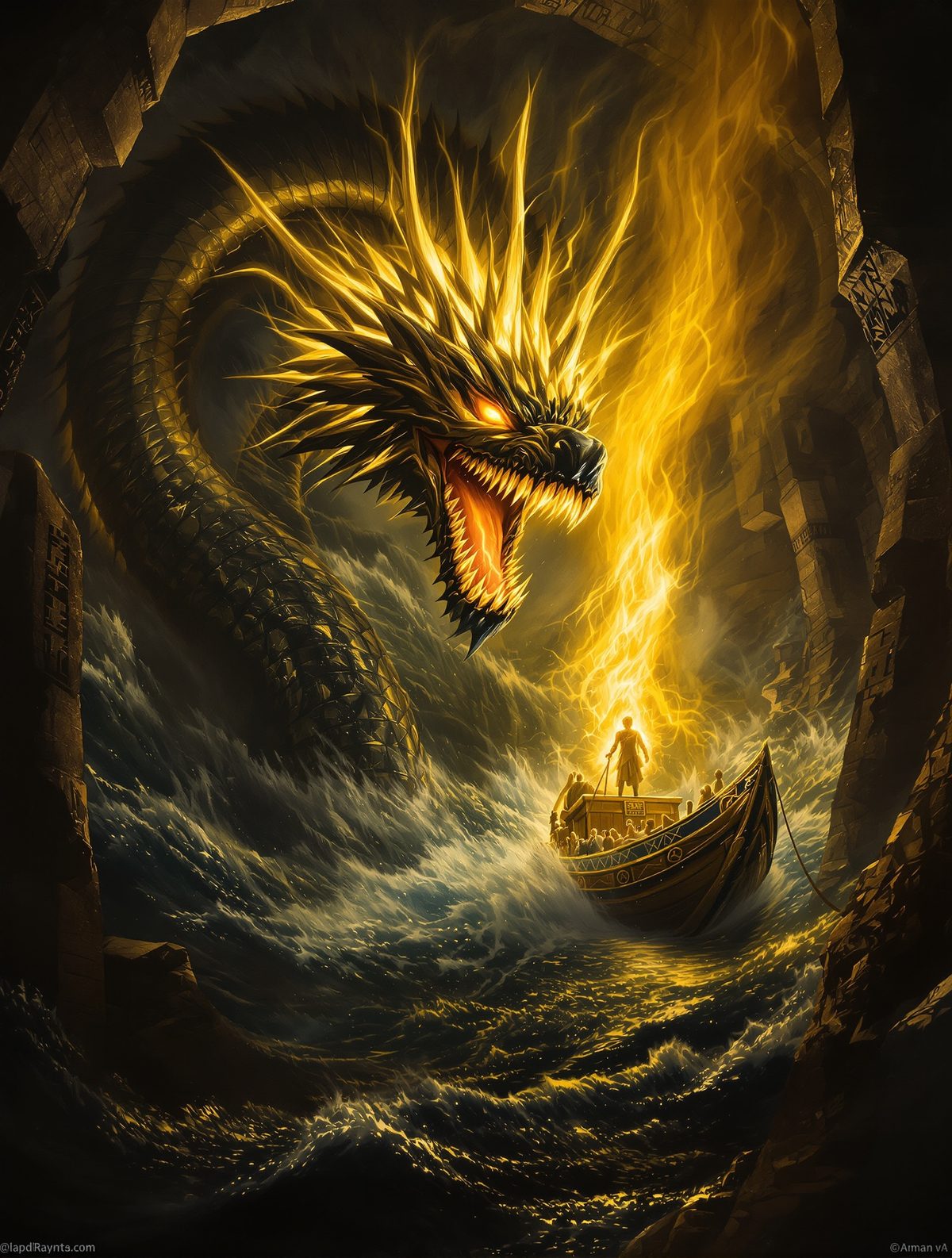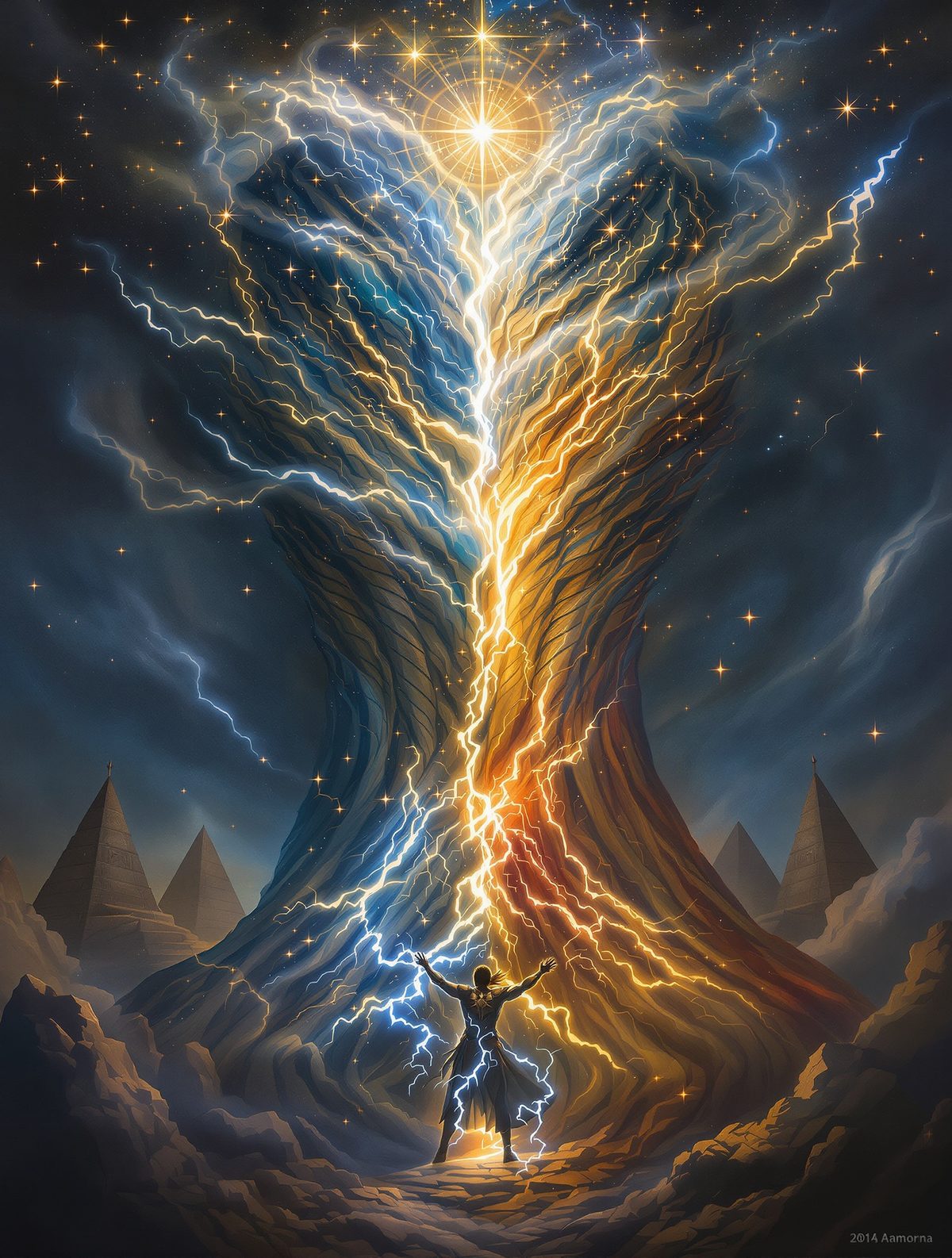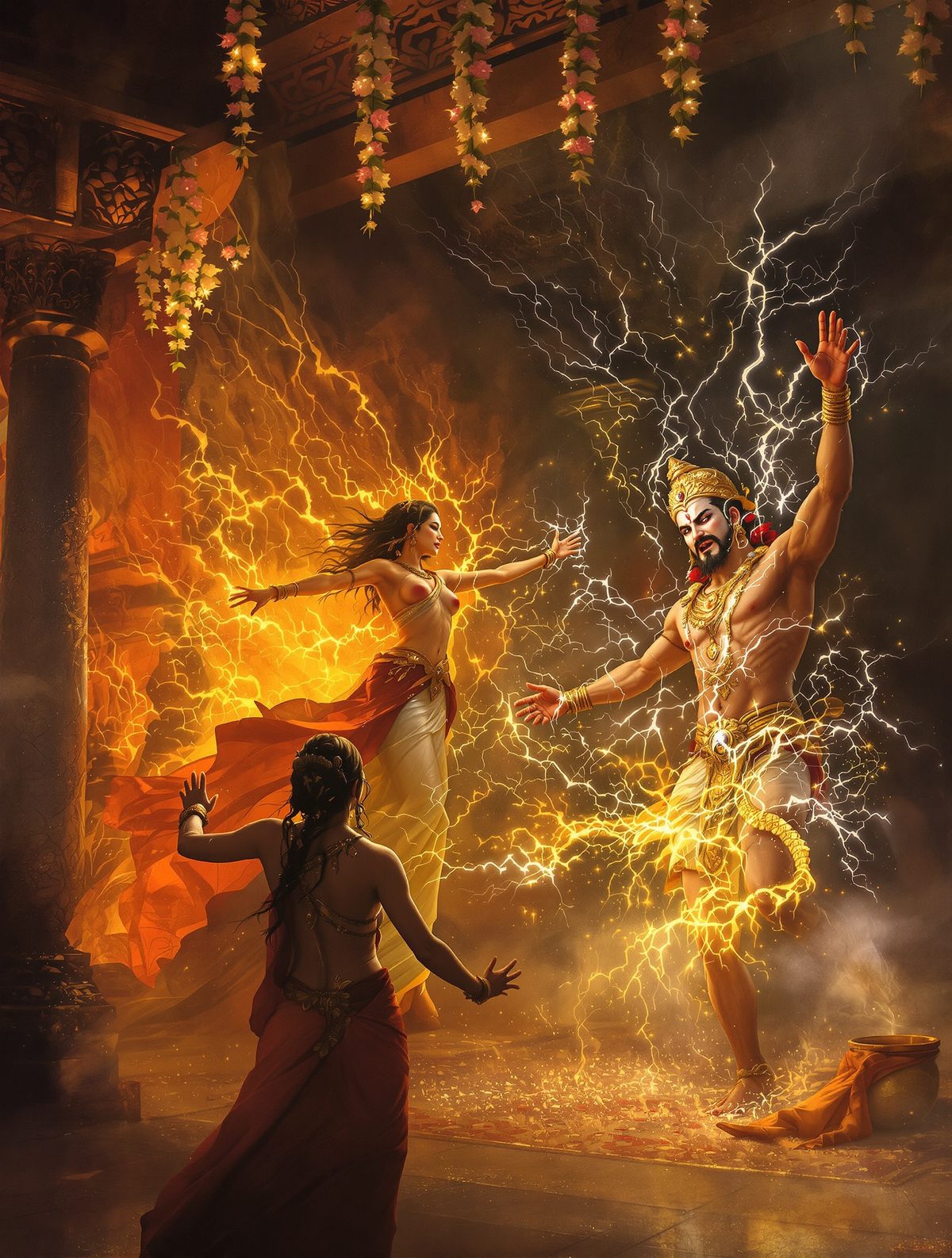
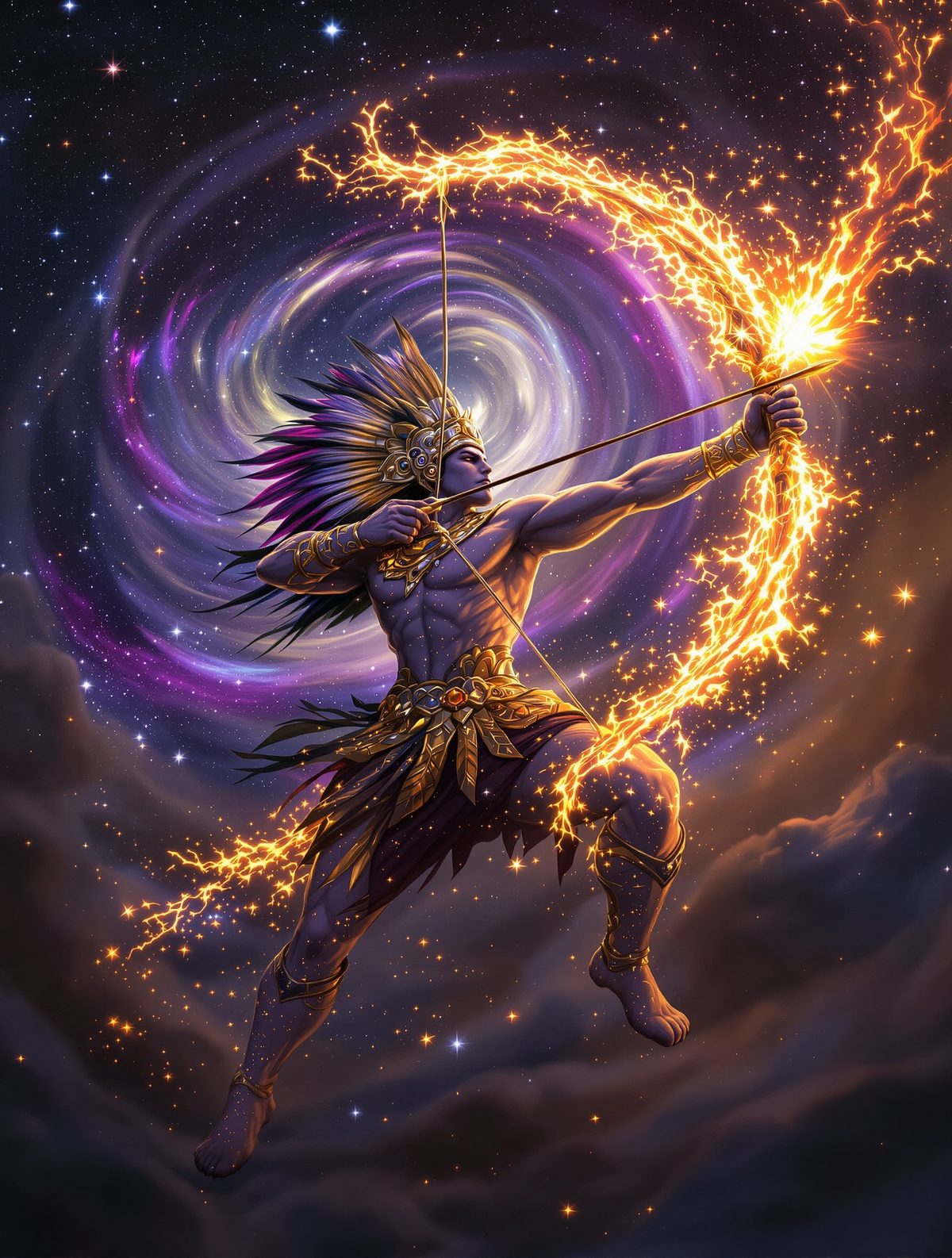
Picture this: a world plunged in perpetual darkness, where the only light comes from distant, cold stars scattered across an infinite black canvas. Somewhere in the celestial hunting grounds above, a god draws back his cosmic bowstring. His target? The frozen earth below, where humanity huddles in caves, teeth chattering not just from cold, but from the primal fear of endless night. The god's name is Mixcoatl—the Cloud Serpent—and in his hands, he holds the power to change everything with a single shot.
This isn't just another creation myth gathering dust in academic journals. This is the Aztec legend of how fire came to humanity, and it reveals a sophisticated understanding of astronomy, divine intervention, and the delicate relationship between heaven and earth that most history textbooks barely mention.
The Hunter in the Stars
Long before the Spanish conquistadors set foot in the Valley of Mexico, the Aztec people gazed up at the night sky and saw stories written in starlight. Among the most revered celestial figures was Mixcoatl, whose name literally translates to "Cloud Serpent" in Nahuatl, the language of the Aztecs. But don't let the serpent imagery fool you—this was first and foremost a god of the hunt, war, and the Milky Way itself.
In Aztec cosmology, Mixcoatl wasn't just associated with the stars—he was the stars. Specifically, he embodied the constellation we know today as the Milky Way, which the Aztecs saw as a great cosmic hunter striding across the heavens with his bow perpetually drawn. Archaeological evidence from Teotihuacan, dating to around 200 CE, shows early depictions of this stellar archer, suggesting the legend predates the Aztec Empire by more than a thousand years.
But here's where it gets fascinating: Mixcoatl wasn't originally an Aztec deity at all. The Chichimec peoples—semi-nomadic tribes who roamed central Mexico between 1000-1300 CE—worshipped him as their patron god of hunting and survival. When these groups eventually settled and intermingled with other Mesoamerican cultures, Mixcoatl's legend evolved, growing more complex and cosmically significant.
The Cosmic Bowstring
According to the legend preserved in the Codex Chimalpopoca, a 16th-century manuscript that survived the Spanish book burnings, humanity's earliest days were spent in a world without fire. The sun existed, but it was weak and distant, barely providing enough light to distinguish day from night. More importantly, there was no way to create flame—no lightning strikes that caught and held, no volcanic eruptions that brought molten rock to the surface.
The story goes that Mixcoatl observed this suffering from his hunting grounds in the sky. As the god of hunters, he understood better than anyone that fire wasn't just about warmth—it was about survival itself. Fire meant cooked food, protection from predators, and the ability to work metal and clay. Without it, humanity would remain forever trapped in a primitive state.
What makes this myth particularly intriguing is its astronomical precision. The Aztecs believed that Mixcoatl's bow was formed by specific star patterns that modern astronomers have identified as parts of Sagittarius and Scorpius. When these constellations reached their zenith in the night sky—typically during the dry season from October to April—it was said that Mixcoatl was drawing back his bowstring, preparing for the shot that would change everything.
The Arrow of Starlight
The moment of divine intervention came, according to the legend, during a particularly harsh winter when human settlements across Mesoamerica faced extinction. Mixcoatl could wait no longer. Drawing his bow with the strength of cosmic winds, he notched a single arrow made not of wood and obsidian, but of condensed starlight itself—what the Aztecs called tetlahuitl, literally "fire-light."
The arrow's flight was described in terms that would make modern astrophysicists pause with interest. It traveled not in a straight line, but in what the codex describes as a "serpent's path through the void"—possibly one of the earliest recorded descriptions of an object following orbital mechanics. As it descended toward Earth, the arrow gathered speed and intensity, its stellar fire growing brighter until it blazed across the sky like a second sun.
Here's a detail that rarely makes it into retellings: the arrow didn't just bring fire—it brought all fire. According to Aztec belief, every flame that has ever existed, from the smallest cooking fire to the great ceremonial blazes atop temple pyramids, traces its lineage back to that single cosmic arrow. This concept, known as tletl nepantla (fire-connection), meant that lighting a fire was quite literally a sacred act of participating in divine creation.
Where Heaven Touched Earth
The arrow struck earth at a location the Aztecs called Tollan—not the historical city of Tula, but a mythical "Place of Reeds" that existed somewhere between the physical and spiritual worlds. Some scholars believe this location was inspired by actual volcanic activity in central Mexico, particularly around the Popocatépetl and Iztaccíhuatl volcanoes, where indigenous peoples would have witnessed lava flows and understood the earth's capacity to produce fire.
What happened next reads like something from a cosmic disaster movie. The arrow's impact created a massive crater that immediately filled with divine fire. But this wasn't destructive—instead of consuming everything around it, the fire began to spread in controlled waves, seeking out worthy recipients. According to the Anales de Cuauhtitlan, another surviving codex, the first humans to receive fire were those who had maintained their devotion to the gods despite the dark times. The fire came to them as small, manageable flames that they could tend and share.
Intriguingly, archaeological evidence supports the idea that fire-making technology spread rapidly across Mesoamerica around 3,500 years ago. Sophisticated fire-starting tools, including fire-bow sets and tinder fungus cultivation, appear almost simultaneously across vast distances—a pattern that would have seemed miraculous to ancient peoples and perfectly consistent with a divine gift spreading outward from a single point of origin.
The God Who Became a King
But Mixcoatl's story doesn't end with his cosmic archery. In a twist that blends mythology with actual history, this stellar god was said to have descended to earth in human form during the 10th century CE. Historical records from this period describe a Chichimec leader named Ce Acatl Topiltzin Mixcoatl who conquered much of central Mexico and established several important settlements.
This human Mixcoatl was reportedly the father of Ce Acatl Topiltzin Quetzalcoatl—the legendary priest-king who would later be conflated with the feathered serpent god himself. The implications are staggering: according to Aztec genealogies, the god who brought fire to humanity later walked among mortals and founded a royal dynasty that influenced Mesoamerican politics for centuries.
Spanish chronicler Fernando de Alva Cortés Ixtlilxóchitl, writing in the early 1600s, recorded detailed genealogies showing how various noble houses traced their ancestry back to this divine-human Mixcoatl. Whether this represents actual historical memory or mythological legitimization of political power remains hotly debated among scholars.
The Enduring Flame
Today, as we grapple with questions about humanity's relationship with technology, energy, and our place in the cosmos, the legend of Mixcoatl's star-arrow offers surprising relevance. This isn't just a quaint story about how ancient people explained natural phenomena—it's a sophisticated meditation on the responsibility that comes with transformative power.
The Aztecs understood that fire was both creative and destructive, that the same force that cooked food and forged tools could also burn cities and consume forests. By framing fire as a divine gift that required ongoing relationship with the cosmic order, they embedded environmental responsibility into their most fundamental creation story. Every flame lit was both a celebration and a reminder of humanity's debt to the larger universe.
Perhaps most remarkably, modern astronomy has revealed that the metaphor of stellar fire wasn't metaphorical at all. The heavy elements that make combustion possible—carbon, oxygen, iron—were literally forged in the hearts of dying stars and scattered across space when those stars exploded. In a very real sense, every fire is starlight, and Mixcoatl's cosmic arrow continues to fly through space, carrying the building blocks of flame from one world to another.
The next time you strike a match or light a candle, remember the Cloud Serpent drawing back his bowstring in the star-filled hunting grounds above. Some gifts from the gods, it turns out, never stop giving.