Picture this: somewhere beneath your feet right now, in the absolute darkness of the underworld, a serpent the size of a mountain coils in restless anticipation. Its eyes burn like crimson stars, its breath could poison entire kingdoms, and its jaws yawn wide enough to swallow the sun itself. This is Apep—and every single dawn depends on his failure.
While most of us take sunrise for granted, the ancient Egyptians knew better. They understood that each new day was actually a hard-won victory in humanity's most crucial battle: the nightly war between the sun god Ra and the primordial serpent of chaos. For over 3,000 years, this cosmic struggle captivated one of history's greatest civilizations, influencing everything from royal burial practices to the daily prayers of common farmers along the Nile.
The Golden Barge Descends into Darkness
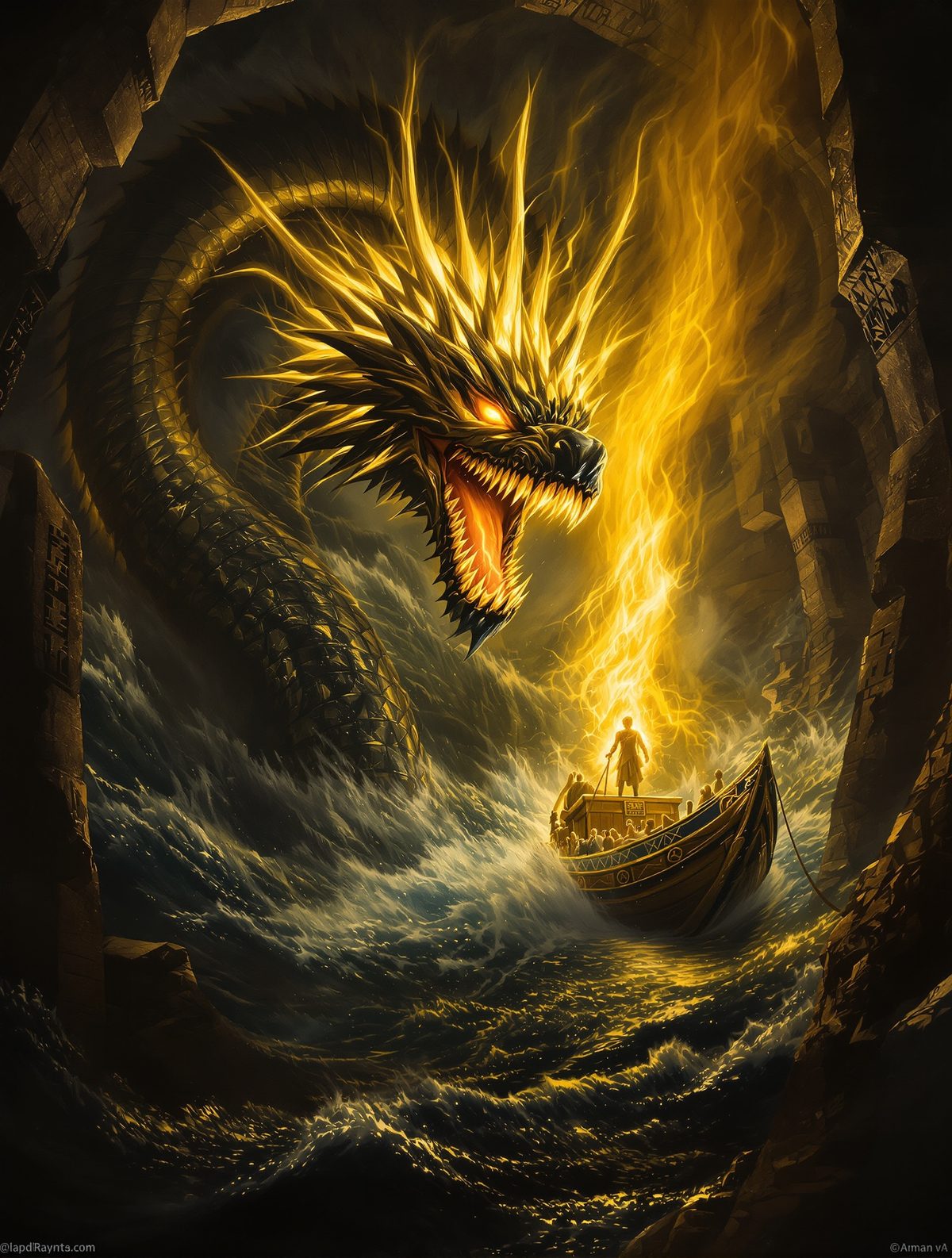
As the last light fades from the western horizon, Ra begins his most perilous journey. The sun god, depicted as a falcon-headed deity crowned with a solar disk, boards his magnificent golden barge called the Mesektet—literally "the boat of millions of years." This isn't just any vessel; it's a cosmic ship that carries the very essence of light, life, and order through the treacherous waters of the Duat, Egypt's underworld.
The ancient papyrus texts describe this barge in breathtaking detail: constructed from imperishable gold and precious stones, it glows with its own inner fire, cutting through the primordial darkness like a beacon. Twelve hours of night stretch ahead—twelve gates that Ra must pass through, each more dangerous than the last. But it's in the seventh hour, in the deepest part of the underworld, that the real terror awaits.
What makes this myth particularly fascinating is how seriously the Egyptians took it. This wasn't merely a bedtime story—it was cosmic reality. Priests in temples across Egypt performed nightly rituals to help Ra in his struggle, and pharaohs were buried with copies of the Amduat (literally "That Which Is in the Underworld"), detailed guidebooks mapping every twist and turn of this supernatural journey.
Apophis: The Serpent That Devours Light
In the bowels of the Duat, where even darkness fears to tread, Apep waits with infinite patience. Also known as Apophis to the Greeks, this wasn't just another mythological monster—he was the physical embodiment of chaos, entropy, and everything that sought to unmake creation itself. Ancient texts describe him as a serpent so massive that his coils could encircle mountains, his length stretching beyond comprehension.
But here's what most people don't know about Apep: he wasn't evil in the way we typically understand the concept. The Egyptians saw him as a necessary force—chaos wasn't inherently malicious, but rather the primordial state from which order had to be constantly carved and maintained. Apep represented the universe's natural tendency toward entropy, the cosmic background radiation of disorder that predated creation.
The serpent's methods were as terrifying as they were varied. Sometimes he would attempt to hypnotize Ra with his gaze, causing the sun barge to slow and nearly stop. Other times he would drink the primordial waters of the underworld, creating whirlpools that threatened to capsize the divine vessel. But his most feared tactic was simple and direct: he would rear up from the depths and attempt to swallow Ra whole, barge and all.
The Nightly Battle for Dawn
What unfolds next reads like the ultimate cosmic thriller. As Ra's barge approaches the seventh hour of night, the water begins to churn. The very air grows thick with malevolent energy. Then, with a sound like thunder splitting the earth, Apep rises from the depths, his massive head breaking the surface of the underworld's river.
But Ra doesn't face this threat alone. His barge carries a divine crew that would make any superhero team jealous. There's Set, the god of storms and violence, standing at the prow with a massive spear. Despite being Ra's sometime enemy in other myths, Set takes his role as the sun god's protector during this journey with deadly seriousness. The cat goddess Mafdet prowls the deck, her claws sharp enough to cut through chaos itself. The mysterious Mehen, depicted as a protective serpent, coils around Ra's cabin like living armor.
The battle itself varies from telling to telling, but certain elements remain constant. Set hurls spears of lightning into Apep's massive form. The serpent's roars shake the foundations of reality. Sometimes the barge is indeed swallowed, and Ra must cut his way out from the inside using sacred knives. Other times, the combined efforts of the divine crew manage to wound Apep so severely that he retreats to the depths to lick his wounds—but never dies, for chaos cannot be permanently destroyed.
The Priests Who Fought Darkness
What makes this myth extraordinary is how it bridged the gap between cosmic drama and daily life. In temples throughout Egypt, priests performed elaborate rituals designed to aid Ra in his struggle. The most detailed of these ceremonies took place in the Temple of Karnak, where every night priests would create wax models of Apep, inscribe them with curses, and then burn, dismember, and bury them while reciting protective spells.
These weren't symbolic gestures—the Egyptians believed they were performing actual cosmic maintenance. Papyrus texts like the Book of Overthrowing Apep provide step-by-step instructions for these rituals, complete with specific incantations and the exact materials required. One particularly striking passage instructs priests to "make a model of the serpent... and you shall put it in the fire every day at the hour when Ra enters his setting in the western mountain of Manu."
Even more fascinating, these rituals intensified during solar eclipses, which the Egyptians understood as moments when Apep was temporarily winning the battle. Archaeological evidence from the New Kingdom (1550-1077 BCE) shows that during eclipses, entire communities would gather at temples to perform protective rites, shouting and making noise to help scare away the cosmic serpent.
When the Serpent Wins: Eclipses and Cosmic Terror
But what happened when Apep actually succeeded, even temporarily? Solar eclipses terrified the ancient Egyptians precisely because they represented moments when the serpent's jaws closed around Ra's solar disk. These events weren't just astronomical curiosities—they were existential crises that required immediate divine intervention.
A remarkable papyrus from the reign of Taharqa (690-664 BCE) describes the royal response to a total solar eclipse: "The serpent of chaos has swallowed the god, and all the land is in darkness at midday. Let every priest perform the rites of protection, let every soldier beat his shield, let every woman wail the songs of power, that the light might return to the world."
The Egyptians developed sophisticated mathematical models to predict eclipses—not out of scientific curiosity, but out of desperate necessity. They needed to know when Apep would strike so they could marshal their magical defenses in advance. These calculations, preserved on astronomical papyri, show a level of mathematical sophistication that wouldn't be matched in Europe for another thousand years.
The Eternal Dawn: Why Apep's Story Still Matters
In our modern world of electric lights and 24-hour convenience stores, it's easy to forget how genuinely terrifying darkness once was. But the myth of Apep and Ra touches something deeper than ancient fears of the night—it speaks to humanity's ongoing struggle against entropy, chaos, and the forces that seek to unmake our carefully constructed order.
Every scientist working to prevent climate change, every teacher fighting ignorance, every person choosing hope over despair is, in their own way, standing with Set on the prow of Ra's barge, spear in hand, facing down the chaos serpent. The Egyptians understood that civilization isn't humanity's natural state—it's an ongoing act of creation that must be renewed daily, just like the sunrise.
Perhaps that's why this 4,000-year-old myth still resonates today. In a world where it often feels like chaos is winning, where the news cycle brings fresh catastrophes each dawn, we need the reminder that the battle for light and order is eternal—and that somehow, against all odds, the sun keeps rising. The serpent coils in the depths, patient and eternal, but so far, every morning proves that the forces of creation remain just a little bit stronger than the pull of the primordial dark.