The Mediterranean sun beat down mercilessly as the Tyrrhenian pirates spotted their prize: a lone youth standing on the rocky shore of Naxos, his purple cloak fluttering in the sea breeze. To their greedy eyes, everything about him screamed wealth—from his golden sandals to the way he carried himself with aristocratic ease. They had no idea they were looking at a god.
What happened next became one of the most terrifying transformation myths in Greek literature, immortalized in the Homeric Hymn to Dionysus around the 7th century BCE. But this wasn't just another divine revenge story. It was a cosmic lesson about hubris, divine justice, and the thin line between civilization and the wild chaos that Dionysus represented.
The Perfect Mark: A God Disguised
The young man they seized appeared to be around twenty years old, with dark, flowing hair and an almost feminine beauty that marked him as nobility. In ancient Greece, such well-dressed young men were often traveling aristocrats carrying substantial ransoms—exactly the kind of prize that could set a pirate crew up for life.
The Tyrrhenian pirates were no mere coastal raiders. Archaeological evidence suggests they were likely from Etruria (modern-day Tuscany), part of sophisticated maritime networks that controlled much of the western Mediterranean during the 8th-6th centuries BCE. These weren't desperate men—they were professional criminals operating what amounted to an ancient organized crime syndicate.
But Dionysus, the god of wine, madness, and divine ecstasy, had chosen this particular disguise for a reason. As the youngest of the Olympian gods and son of Zeus, he was still establishing his divine authority across the Greek world. Every encounter like this was both a test of mortal respect and an opportunity to demonstrate his terrible power.
The pirates bound him with ropes and dragged him aboard their black-hulled ship, already calculating the ransom they'd demand. What they couldn't see—what no mortal could see unless the god willed it—was the divine fire burning behind those deceptively gentle eyes.
The First Signs: When Nature Rebels
As the ship pulled away from shore, the sailors noticed something odd. Their prisoner's bonds kept falling away, no matter how tightly they tied them. The ropes seemed to loosen of their own accord, slipping from his wrists like water.
Then came the wine.
It started as a trickle across the deck—rich, red, and impossibly fragrant. Within moments, it became a torrent, flowing from nowhere and everywhere at once. The Homeric Hymn describes it as "sweet and fragrant," but for the increasingly panicked crew, its supernatural origin made it more terrifying than any storm.
What modern readers might not realize is how deeply wine was connected to divine power in ancient Greek culture. Wine wasn't just alcohol—it was a sacred substance that could bring mortals closer to the gods or drive them to madness. Archaeological finds from Dionysiac cult sites across the Mediterranean reveal elaborate wine-serving vessels decorated with scenes of divine transformation, suggesting that stories like this weren't mere entertainment but religious experiences.
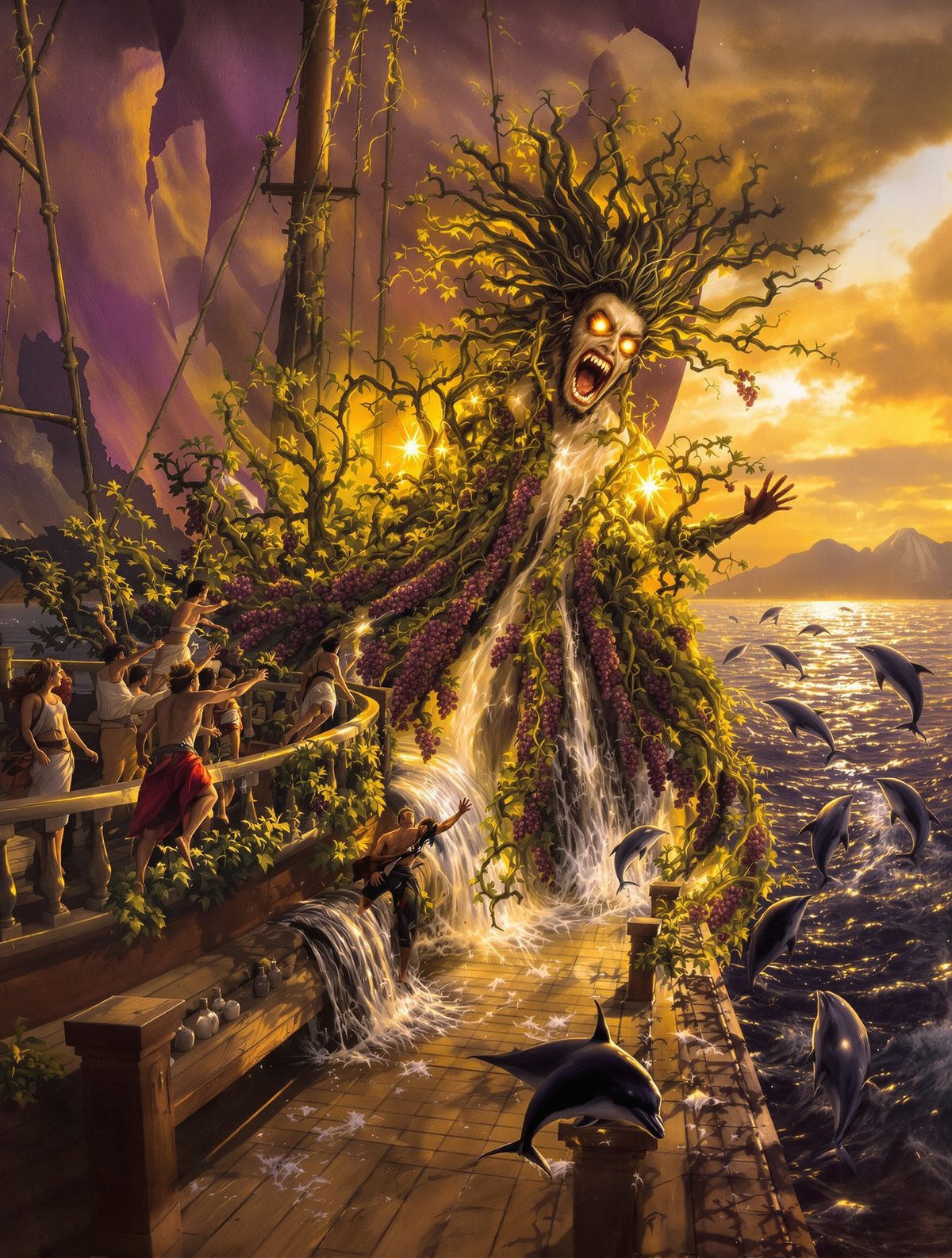
Next came the vines. Thick, green tendrils erupted from the ship's wooden planks, growing with impossible speed. They wrapped around the mast, coiled through the rigging, and began to sprout heavy clusters of grapes. The ship itself was being transformed into a floating vineyard, a vessel of Dionysiac power that no longer belonged to the mortal realm.
Divine Revelation: The God Shows His True Face
As terror gripped the crew, their captive finally revealed himself. The beautiful youth began to change, his form growing larger and more terrible. A crown of ivy materialized on his head, and wild beasts—lions and bears—suddenly materialized on the deck, their eyes glowing with divine fire.
But perhaps most terrifying of all was the sound that filled the air: the music of flutes and drums, the wild, intoxicating rhythm that accompanied Dionysiac festivals. This wasn't celebration music—it was the sound of divine madness, the audio signature of a god who could drive mortals insane with ecstasy or terror.
Ancient Greek vase paintings from the 6th century BCE frequently depict this moment, showing a figure wreathed in vines while terrified sailors leap from a ship surrounded by dolphins. These weren't just artistic interpretations—they were religious images that reminded viewers of divine power and the consequences of disrespecting the gods.
The helmsman, either wiser or more terrified than his companions, immediately recognized what they faced. He fell to his knees and begged his crew to release their prisoner, crying out that they had captured one of the immortal gods. But it was already too late for apologies.
The Transformation: From Pirates to Dolphins
What happened next defied every natural law. As divine madness seized the crew, they began to change. Their skin turned gray and slick, their limbs fused together, and their faces elongated into familiar bottle-nosed shapes. One by one, the Tyrrhenian pirates threw themselves over the side—not as men, but as dolphins.
This transformation wasn't arbitrary cruelty. In Greek thought, dolphins held special significance as intelligent, benevolent sea creatures who rescued drowning sailors and guided ships to safety. By turning the pirates into dolphins, Dionysus wasn't just punishing them—he was forcing them to spend eternity helping the very people they had once victimized.
Archaeological evidence from ancient Delos reveals dolphin mosaics in Dionysiac shrines, suggesting that this transformation story was central to the god's maritime worship. Sailors would make offerings to Dionysus not just for safe passage, but for protection from pirates—knowing that the god himself had dealt with the problem before.
Only the helmsman was spared, saved by his quick recognition of divine power and his attempts to protect the god. Dionysus blessed him with prosperity and favorable winds, rewarding the wisdom to know when mortals were outmatched.
The Deeper Meaning: Why Pirates Became Sea Guardians
Modern scholars have identified fascinating parallels between this myth and real historical events. During the 7th-6th centuries BCE, when this story was likely composed, Greek colonization was spreading across the Mediterranean. Pirates posed a genuine threat to trade and religious pilgrimage, often targeting priests and sacred vessels traveling between temples.
The transformation of pirates into dolphins served multiple symbolic functions. Dolphins were associated with Apollo, Dionysus's brother, and were considered psychopomps—creatures who guided souls between worlds. By becoming dolphins, the pirates were forced to serve the divine order they had violated, spending eternity as protectors rather than predators.
But there's an even deeper layer. Dionysus represented the power of transformation itself—the ability of wine to turn celebration into chaos, of religious ecstasy to blur the line between human and divine. The pirates' metamorphosis reflected the god's fundamental nature: everything in his presence could be transformed, for better or worse.
Recent archaeological discoveries at Dionysiac sites have revealed that dolphin imagery was often paired with grape vines in religious art, suggesting that ancient worshippers understood this connection between transformation and divine justice.
Echoes Across the Centuries: Why This Story Still Matters
The tale of Dionysus and the pirates resonates today because it explores timeless themes about power, justice, and transformation. In an age where modern "pirates"—from corporate raiders to cyber criminals—operate with apparent impunity, the idea of cosmic justice still appeals to our sense of moral order.
But perhaps more importantly, the story reminds us that transformation can be both punishment and redemption. The pirates didn't simply die for their crimes—they were given new purpose, forced to become protectors of the very seas they had terrorized. In our own time, when we struggle with questions of criminal justice and rehabilitation, this ancient myth offers a different model: not just punishment, but transformation into something better.
The next time you see dolphins playing in a ship's wake, remember the Greek sailors who believed they were watching reformed pirates, forever bound to guide travelers safely home. Some transformations, the ancients understood, are both justice and mercy—a lesson that might just be worth remembering in our own turbulent age.