Under the burning sun of ancient Egypt, amid the shifting sands of time, a tale unfolded that would transcend centuries: the story of Thoth restoring Horus's eye. Deep within the myths of Egypt, where gods mingled with mortals and the divine walked amongst the dust, a war raged — a war not of armies but of the heavens themselves. In this mythical struggle for power between Horus and Set, the result straddled not just victory or defeat, but a path to cosmic harmony.
The Battle of Gods Under the Egyptian Sun
In a realm ruled by gods of infinite power and unmatched wisdom, a new generation sought to lay claim to the throne of Egypt. Horus, the falcon-headed god, was the rightful heir. Yet, Horus's destiny was marred by familial betrayal. Set, god of chaos and the unpredictable tempest, was Horus's uncle, and his ambitions soared skyward as the gusty desert winds. Their conflict was seismic, a celestial struggle that resounded through the heavens, and the battleground was the very essence of Egypt itself.
Histories and mythologies from 3000 BCE detail a titanic struggle, where Set, in a violent clash, tore out his nephew's eye — the emblematic eye of sight and perception. He cast it across the earth, a gesture not of triumph but a statement: the chaos he represented could scatter even the mightiest forces.
The Wisdom of Thoth: Gathering the Shattered
This is where Thoth, the enigmatic god of wisdom, enters. Depicted often with the head of an ibis or baboon, Thoth was more than a mere healer; he was a scribe of the gods, an arbitrator, and above all, the upholder of Ma'at — the universal order. As Horus mourned the loss of his eye, it was Thoth who acted to balance celestial scales.
Thoth journeyed across the expanse of Egypt, a symphony of symbols and signs swirling around him. He was the healer, the weaver of words and wisdom. His task was no lesser than gathering the scattered shards of divine sight, a feat that transcended mere physicality and delved into the realm of the spiritual. Thoth’s wisdom and magical prowess are often associated with the lunar cycles, perhaps a symbolic healing narrative that mirrors the waxing and waning of the moon.
The Eye of Horus: A Symbol Renewed
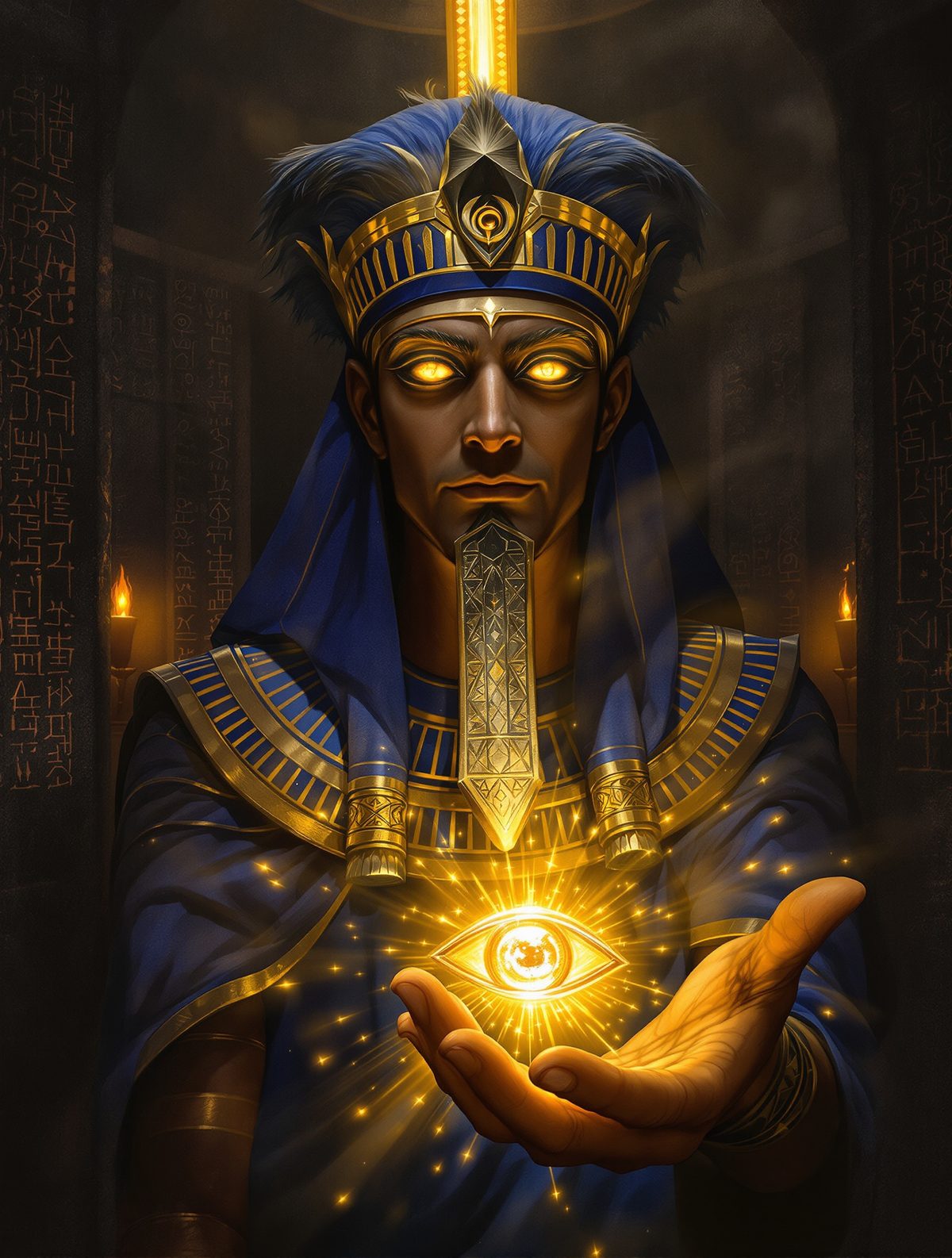
After Thoth restored Horus's eye, it was no longer just an organ. It transformed, metamorphosing into the Wedjat — the eye that sees everything. Rich in its multi-layered symbolism, the Wedjat was imbued with qualities of protection, royal power, and good health. It adorned the walls of tombs, the crests of pharaohs, and served as amulets worn by common folk and nobility alike.
Intriguingly, the eye itself, in mathematical terms, was divided into fractions, with each part representing a different sense — sight, smell, thought, hearing, taste, and touch. This detailed structure not only speaks to the intricate nature of ancient Egyptian beliefs but also suggests a level of mathematical sophistication and symbolism that is a marvel even by modern standards. It was Thoth’s divine wisdom that reshaped the broken into an icon of unity and completeness.
The Echoes of a Restoration Through Time
The restoration of Horus's eye had repercussions that rippled across Egyptian mythology. The eye became a beacon of justice and the moral backbone of leadership. What began as a familial vendetta transcended into a mythos that illustrated the necessity of wisdom in overcoming chaos. The tale exemplified that even in the face of devastating loss and disarray, a single act of wisdom and balance could lead to profound healing and restoration.
Thoth's contribution was not merely pragmatic but philosophical. In stitching together the pieces of Horus's shattered eye, he restored more than the physical form. He reinstated the balance of order over anarchy, the divine right over unruly usurpation. In its new form, the eye perpetually reminded both mortals and gods of a truth profound: to see is to understand, and to understand is to govern with wisdom.
Why Thoth's Healing Touch Matters Today
As we peel back the layers of these ancient tales, a truth remains relevant: the narratives of old are reflections of timeless human struggles. In Thoth's act of restoring Horus's eye, we uncover a lesson of collective resilience and the boundless power of wisdom. Today, when nations and individuals face chaos and fragmentation, this legend offers a compelling reminder. It speaks to the human spirit's capacity to gather broken shards and create a cohesive future that mirrors not just survival, but thriving harmony and insight.
The story of Thoth, Horus, and Set is more than just mythology; it is an allegory deeply embedded in the human psyche. To read it is to embark on a journey through the sands of time, discovering echoes of wisdom that continue to guide the essence of humanity's pursuit of balance and enlightenment.