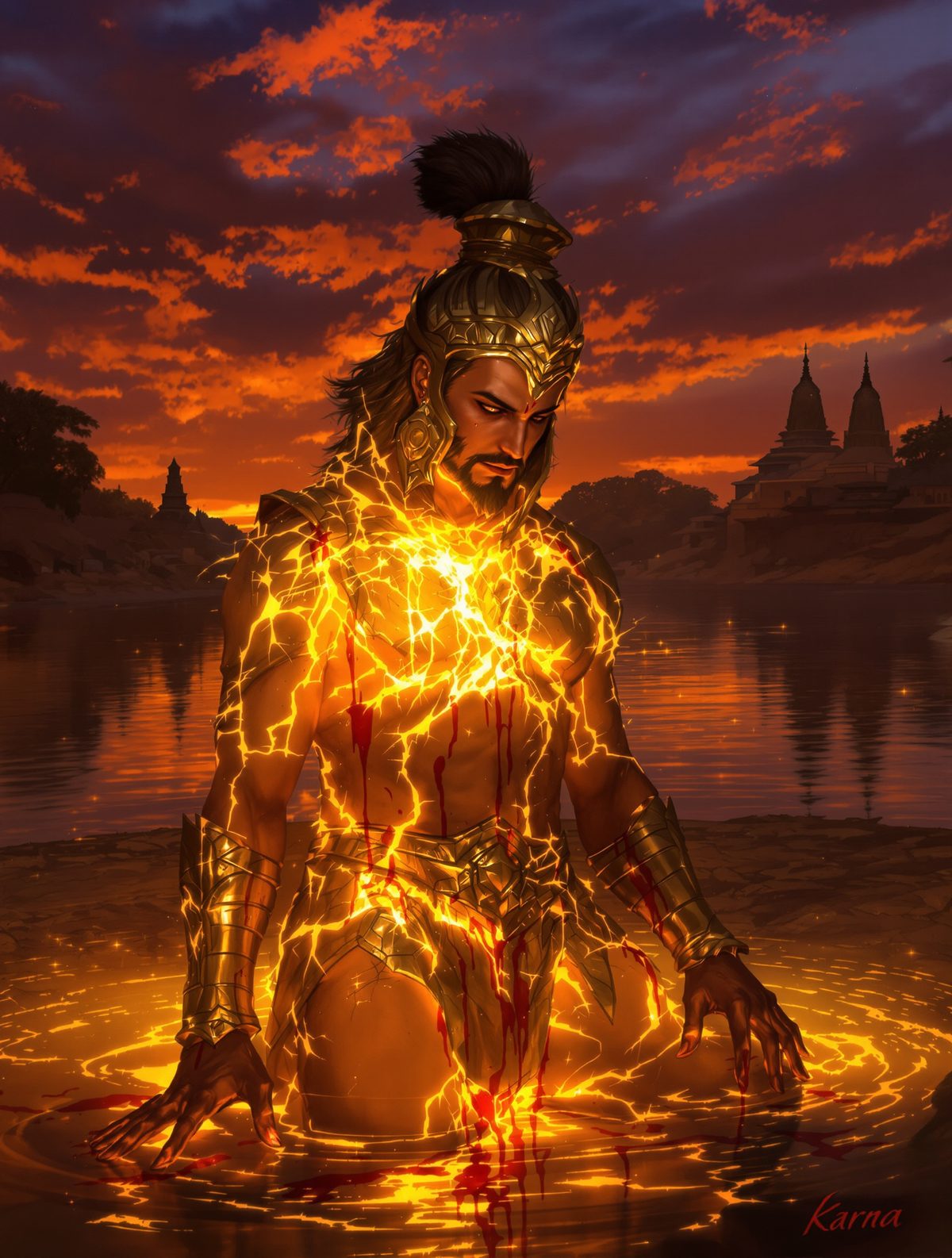
In the grand theater of the Mahabharata, where devas danced with destiny and mortals writhed in the throes of dharma, walks a figure carved from legends. His name: Karna. Known as the tragic hero, his saga is one of honor unfaltering in the face of fate’s cruelty. But among all his tales, one shining moment captures the essence of his valor—a moment that chills the blood and warms the heart. It is the story of how Karna gave away his divine armor, his kavacha, along with a piece of his very soul.
The Birth of the Unbreakable Warrior
Karna's origins are steeped in celestial mystery. Born to the virgin princess Kunti, before her marriage, through the boon of sage Durvasa, Karna was the son of Surya, the sun god. The universe conspired to clothe this newborn with a set of golden armor and earrings, the kavacha-kundala, fused to his skin—a gift from his divine father. This armor rendered him nearly invulnerable, a glimmering shield against the chaos of the world. As a child set upon destiny's uncertain path, Karna burgeoned into a beacon of strength and nobility, with the golden sun eternally at his side.
His life, however, was not without its hardships. Separated from his birth mother and raised by a charioteer, Karna was barred from the privileges of his true birthright. Yet he stood steadfast, establishing himself as a peerless archer and warrior. But in an ironic twist of fate, it was this same armor—his very skin—that became the subject of divine intrigue and immortal chronicles.
The Deceiver Descends
Flash forward to the epic’s grand stage. It was the eve of the Kurukshetra War—a war that threatened the cosmos with its destructive might. The gods, ever vigilant and strategic, recognized Karna’s invincibility as a formidable hindrance to the Pandavas, whom many believed were the rightful heirs to the throne. Indra, the king of the gods and the father of Arjuna, Karna’s arch-rival, devised a plan to rid Karna of his divine protection.
Cloaked in the guise of a weary beggar, Indra descended to the earthly realm. His request was simple yet piercing—to seek alms from the generous king of Anga. It was known far and wide that Karna's generosity knew no bounds. But here lay the god’s cunning stratagem: He sought to ask for something no spirit, divine or mortal, had a right to expect.
The Supreme Sacrifice
One morning, as rays of dawn pierced the indigo sky, Indra stood before Karna’s palace. The warrior, having recognized the divine aura even beneath layers of deception, greeted him with genuine warmth. Despite the imminent war, Karna’s benevolence eclipsed the clouds of suspicion. When the beggar finally voiced his unimaginable demand—to take from him the armor and earrings fused to his flesh—Karna’s gaze never wavered. Without a flicker of hesitation, he agreed, understanding the price laid before him.
With a steady hand, Karna unsheathed a knife. Veins of sunlight danced upon the blade as he began the harrowing process of excising the golden armor from his skin. Historians and poets have long pondered this moment, trying to capture its gravity—Karna, smiling through the anguish, transformed pain into poetry. The flesh tore, and the divine remnants of his celestial heritage lay at the god’s feet. Witnesses say the earth itself wept at such unparalleled fortitude.
The God’s Redemption
Impressed by Karna’s unwavering devotion to his principles, Indra’s heart softened. In a rare act of divine reciprocity, he blessed Karna with a weapon, the Vaijayanti, known as the Vasavi Shakti—an irresistible dart of deity. However, this too came with a tragic caveat—it could be used only once. In the chessboard of life and death, it was a piece more symbolic than practical.
Little do most know that Indra’s request harbored deeper reasoning. Beyond the strategic advantage to the Pandavas, it was the god’s test—a measure of the mortal soul’s capacity to transcend its own fears. Karna passed not just with his hands but with his heart, embodying the very essence of sacrifice that defines heroism across epochs and tales.
Legacy Tarnished in Gold
Why does a tale told on dusty parchments millennia ago still grasp the consciousness of a modern world? Perhaps because Karna’s story reminds us of an ideal larger than life’s tribulations. It is a mirror reflecting the continuing battle between destiny and honor, between celestial interference and human integrity. The act of giving away his most potent defense echoes as an anthem of generosity that transcends material bindings, daring us to reexamine our own lives in terms of the principles we hold dear, even to the extent of personal loss.
As Karna carved his legacy into our shared mythic psyche, so too do we find pieces of our own in his narrative, a journey where each of us faces our own Indra, our own test. And through it all, Karna’s unwavering smile challenges us—a testament to the indomitable spirit that cannot be broken, only admired and learned from.