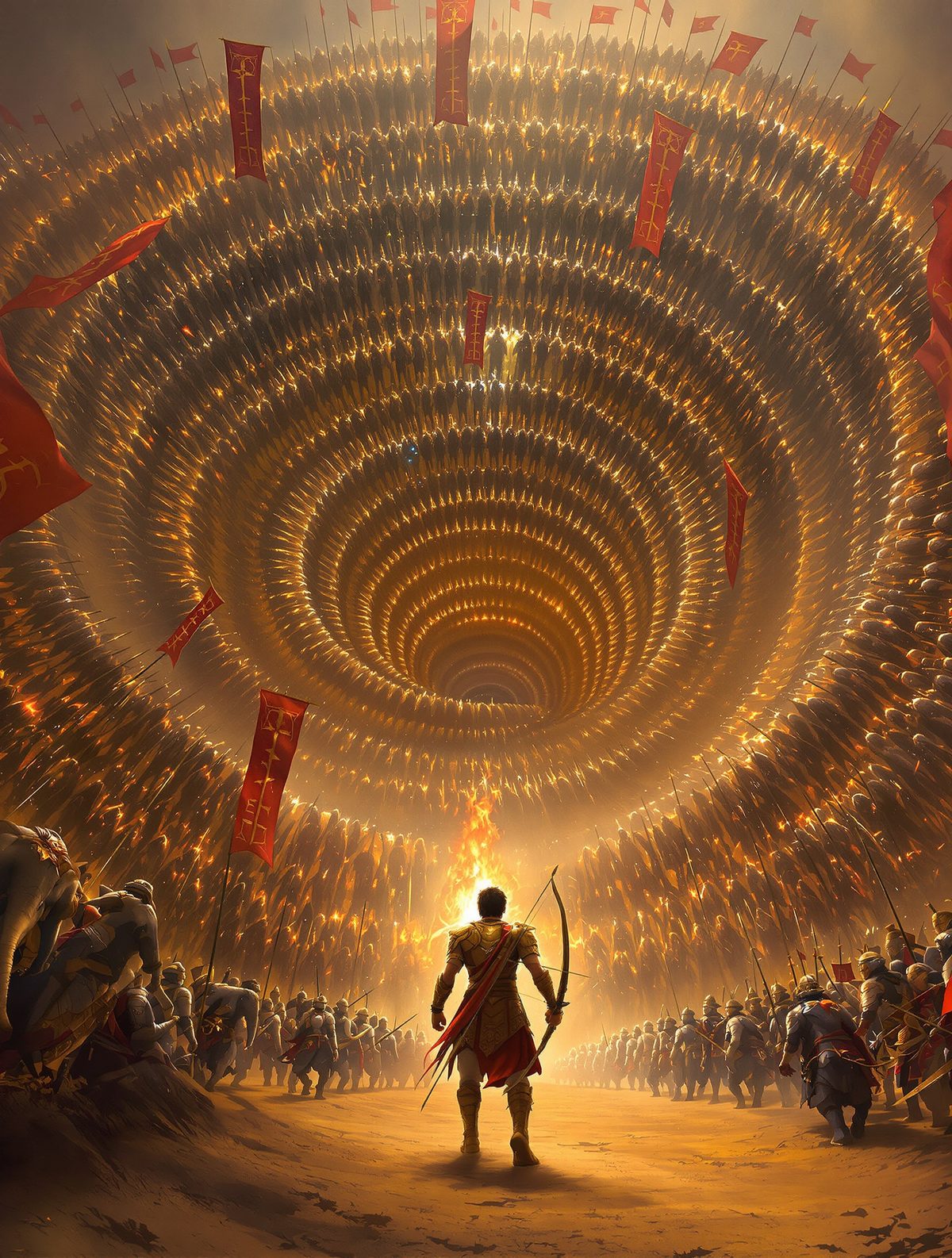
In the heart of a fierce battle on the dusty plains of Kurukshetra, a teenage warrior faced an intricate challenge that would echo through history. Abhimanyu, the valiant son of Arjuna, charged into one of the most formidable military formations—the Chakravyuha. Yet, despite his bravery, he was destined never to return. How is it that a young warrior, trained by the best, could find himself ensnared in such a deadly spiral? This is the story of Abhimanyu's tragic entry into legend.
The Unfinished Whisper of a Secret
Long before Abhimanyu set his feet on the battlefield, his fate was unwittingly sealed by a conversation in the womb over sixteen years earlier. Legend has it that his father, Arjuna, recited the intricacies of warfare to his expectant wife, Subhadra. As Arjuna delved into the nuances of the Chakravyuha formation—one of the deadliest and most impenetrable battle formations known in Indian warfare—little did he realize that an unborn Abhimanyu was avidly listening.
The Chakravyuha, or the "Wheel Formation," was a spiral-like structure designed to trap and isolate the enemy. The ability to enter was a profound skill on its own, and Arjuna described this technique in great detail. But just as he began explaining how to exit the formation successfully, Subhadra fell asleep, leaving Abhimanyu with only half the wisdom he needed—a fatal gap in his knowledge.
The Lure of Kurukshetra
The sixteenth day of the epic war dawned like any other—a brutal, surreal, and bloody affair. The powerful Kaurava generals had devised a plan to keep Arjuna, a formidable archer of extraordinary skill, away from the core battlefield. They knew that if Arjuna could not breach their plans, the field would be ripe for an attack on the Pandavas.
With Arjuna drawn away by a strategic diversion involving the Samsaptakas, the Kauravas initiated the Chakravyuha, confident that no one in the Pandava army knew how to penetrate it. However, dismissive of their enemy's potential, they did not count on Abhimanyu's courage. He bravely volunteered to enter the formation, armed with the partial knowledge he had gleaned as a fetus.
The Lone Warrior's Charge
The Kurukshetra battlefield was a maelstrom of sound and fury—thundering chariots, clashing swords, and the visceral cries of war. Abhimanyu steered his chariot into the formidable spiral, his heart pounding with a mix of fear and resolve. It was a testament to his warrior spirit and his lineage that he could break into the Chakravyuha with apparent ease, wreathing through the layers of enemy soldiers like wind through trees.
He was aptly supported by the Pandava warriors: Bhima, Yudhishthira, Nakula, Sahadeva, and others battled to follow his lead, but they were held back by strategic counter-attacks. Each time they attempted to close ranks behind him, the Kauravas, using their superior numbers, blocked their advance, isolating Abhimanyu deeper within the deadly spiral.
A Sacrifice Enfolded by Treachery
The Kaurava generals, astonished by the young lad's prowess, realized that conventional warfare wasn't enough. Unity broke into a pact of treachery as they abandoned the warrior's code, attacking him en masse, a grotesque violation of fair combat. Duryodhana, Drona, Karna, Shakuni, and Dushasana—names that resonate with varying tones of reverence and wrath in India—joined together in a final, vicious assault.
Abhimanyu fought valiantly, his bow relentless and his spirit indomitable. Yet, the young warrior was surrounded, outnumbered, and weaponless after his bow string was broken. The end came as he was struck down not by a single, honourable foe, but by a collective infamy—forever enshrining his heroism and the disgrace of his attackers in the annals of the epic.
The Ripple Through Time
Abhimanyu's fall on the battlefield was more than just the death of a hero; it was a pivotal moment in the Mahabharata. His death galvanized the Pandavas, fueling their resolve to ultimately prevail. This violent tipping point in the epic swings both ways—highlighting the ancient Indian dilemmas of dharma, duty, and the haunting cost of war.
From a modern perspective, Abhimanyu's story resonates as a narrative about the perils of incomplete knowledge. The education and understanding of any subject, particularly one so fraught with potential consequences as warfare, demand comprehension, humility, and preparation. As in the case of Abhimanyu, bravery and talent alone may not suffice without a complete understanding of the path forward and back.
Abhimanyu's tragic tale is one of courage and sacrifice that has been preserved for millennia, a stark reminder of both the human cost of war and the enduring fight for justice. His legacy, carried through the ages, challenges today's readers to contemplate the balance of knowledge and courage—a timeless lesson echoed beyond the pages of ancient texts.