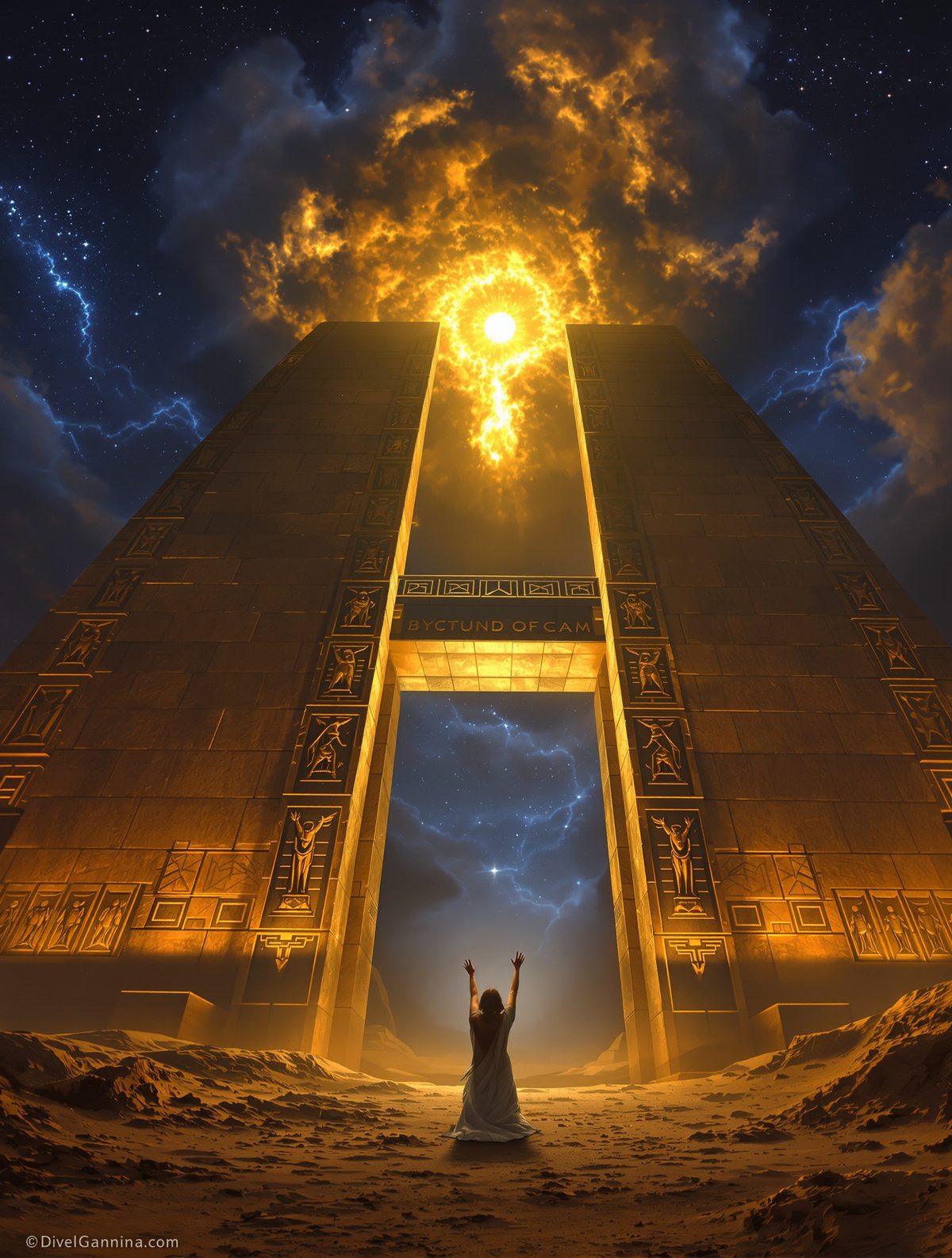
In the shadowy realms below the earth, echoing with secrets untold, a haunting scene unfolded. The goddess Inanna, radiant and revered, hung lifeless on a hook in the underworld, her radiance extinguished in the darkness. For three long days and nights, the goddess's brilliance was withheld from the world above. But as each moment passed, waiting in hushed desperation was not the way of Ninshubar, her devoted servant. Armed with but a single command, Ninshubar was the living heartbeat pleading through the silence—a servant who dared to shake the very heavens with her cries.
The Descent into Darkness
The tale begins over five thousand years ago, in the cradle of civilization—ancient Mesopotamia. Here, nestled between the Tigris and Euphrates rivers, the epic of Inanna unfolded, a labyrinthine saga of love, power, and sacrifice. Inanna, the goddess of love, beauty, and war, sought to descend into the underworld, Ereshkigal's domain, challenging the boundaries that none dared to cross. She left behind explicit instructions with Ninshubar, her herald and confidante: if I do not return, execute the plan.
But why would a goddess descend into the underworld? This audacious journey was not born of whimsy. Some say Inanna sought to expand her power, while others whisper of familial obligations propelling her downward. To witness her sister, Ereshkigal, who ruled the shadowy depths, was a journey fraught with peril and hubris.
The Desperate Vigil
Ninshubar, loyal yet powerless, stood in the earthly realm, eyes upon the path her mistress trod. She waited for a signal, a whisper of return. But the silence was relentless. Armed with perseverance and a heartfulness echoing Inanna's grandeur, she took to her task. Ninshubar donned mourning garb, scattered ashes upon her brow, and unleashed a lamentation so poignant that the heavens trembled. Her voice rose to the divine, begging for intervention with the raw power of human emotion.
Strategically, she approached three mighty deities, as instructed—Enlil, god of air and father of the cosmos; Nanna, the moon god; and Enki, god of wisdom and freshwater. However, true to the intricate weave of divine politics, Enlil and Nanna turned her away, reasoning Inanna's presence in the underworld was rightful. But Enki, touched by Ninshubar’s desperation and loyal ardor, pledged his aid.
Enki’s Ingenious Creation
Enki, known for his craft and cunning, devised a plan to retrieve the radiant goddess from the jaws of death. From the dirt beneath his fingernails, he crafted kurgarra and galatur, two creatures imbued with mystical life forces. These creations carried no allegiance to the underworld yet possessed the essence to traverse its oppressive gloom. Enki instructed them with one simple mission: infiltrate the underworld, console Ereshkigal, and when the opportunity arose, demand Inanna’s release.
This remarkable infusion of life was a brilliant example of divine ingenuity. Enki, unlike other deities, viewed tradition not as a tether but as a challenge to innovation. His creations were minuscule facsimiles of humanity, gifted with immense charm, which they wielded skillfully to manipulate an unyielding queen consumed by grief.
The Artistry of Negotiation
The underworld was a place of exacting laws, its gates guarded by indomitable spirits. Yet, Ninshubar’s pleas amplified by Enki’s genius opened a path—a crack in the underworld's armor. The kurgarra and galatur found Ereshkigal in laborious throes, reflecting the earth’s dark lament. They mirrored her cries, offered sympathy, and thus, disarmed her in her most vulnerable state. It was a stroke of divine tact; Ereshkigal succumbed to their empathy and, in a rare moment of kindness, offered them a boon. They demanded Inanna's inert form, and with celestial negotiation—as complex as any treaty—Inanna was returned to the land of the living.
This tale reveals the power of devotion, wisdom, and empathy. Who would have thought that beings fashioned from dirt could reverse the inevitability of death? It is a narrative twist that enhances the lore of Mesopotamian mythology with poetic justice.
The Legacy of Ninshubar
And so, Ninshubar—a servant, a herald, a mourner—etched herself into history, elevating a story of loss into one of triumph. Without her ceaseless devotion and strategic perseverance, Inanna might have remained but a memory, trapped in the underworld’s clutches. Instead, her cries were instrumental in the goddess's resurrection. The myths remind us that even the smallest actor, driven by loyalty and love, can tip the scales of fate.
Ninshubar is remembered not just as a loyal servant but as a beacon of relentless faith and undying commitment. Her story underscores that courage is not the absence of fear but the presence of duty—she acted without pause, sound in the knowledge that her actions supported a greater cosmic arc.
Why This Matters Today
In the modern world, where noise often drowns out signal, Ninshubar’s tale reverberates as a powerful allegory. It speaks to the transformative power of courage, commitment, and compassion. An earnest plea, when voiced with genuine intent, can shatter the echo chamber of indifference. As we navigate our own ever-complex narratives, perhaps we are all tasked to be, in some capacity, the Ninshubar of our times—relentless, purposeful, and unyielding in our quests for justice, love, and truth.