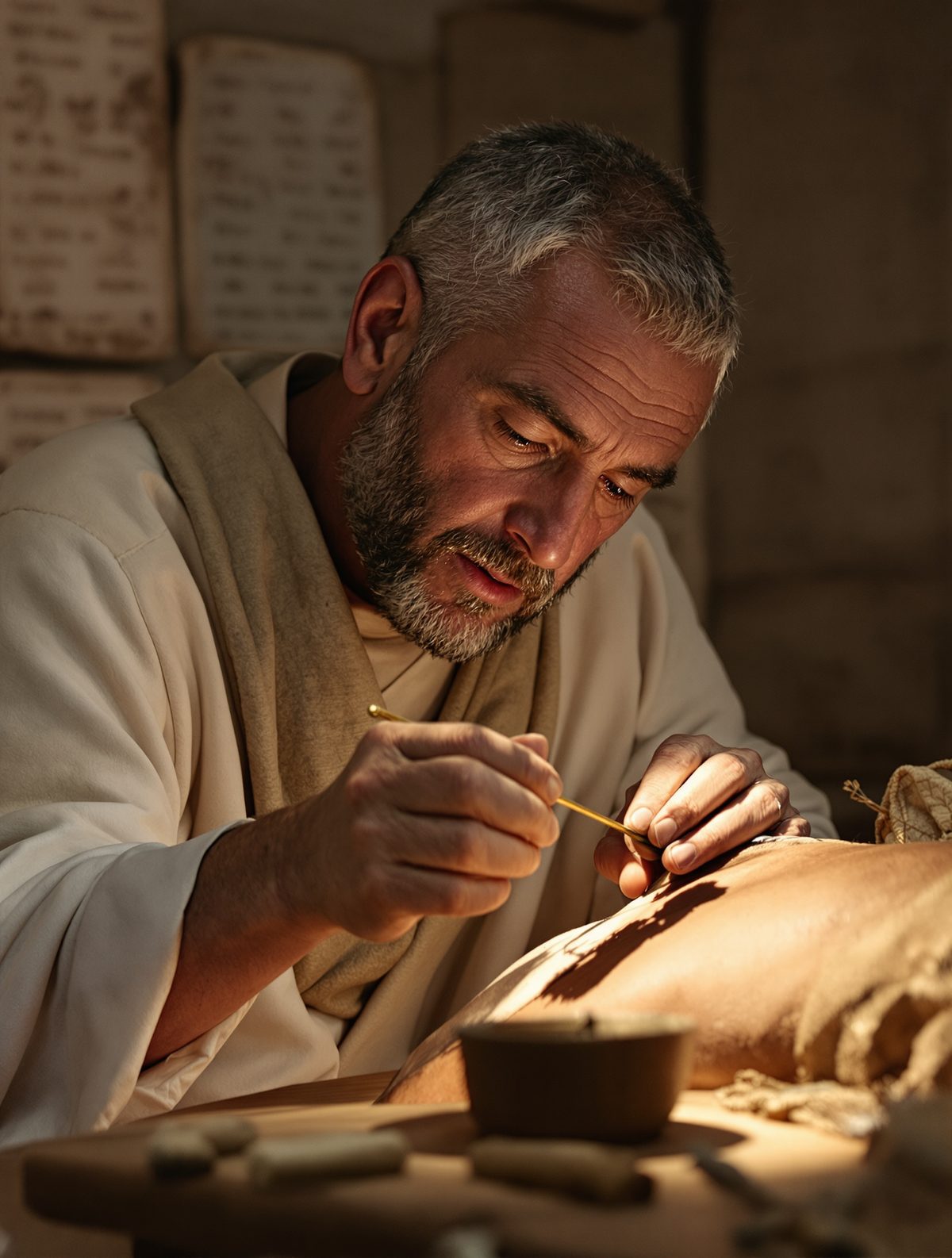
The bronze needle trembled in Ur-Lugal's weathered hands as he leaned over the nobleman's face in the flickering lamplight of ancient Ur. Outside the mud-brick walls, the Euphrates River carried merchant boats toward distant lands, but inside this small chamber, time seemed suspended. The year was approximately 2800 BC, and what was about to happen had never been attempted in the entire history of humanity.
Lord Enlil-bani had been blind in his left eye for three summers, a milky white cloud having gradually stolen his sight. In Sumerian society, such afflictions were often seen as divine punishment, but Ur-Lugal—a humble barber who spent his days trimming beards and pulling teeth—saw something else entirely. He saw a problem that might have a solution.
The Barber Who Dared to Dream Beyond Razors
In ancient Mesopotamia, barbers occupied a unique position in society. They weren't just grooming specialists—they were the closest thing to medical practitioners that most people ever encountered. With their steady hands and sharp instruments, they performed everything from tooth extractions to minor surgeries, wound treatments to ritualistic scarification.
Ur-Lugal operated his modest shop near the ziggurat of Nanna, the moon god, in the bustling city of Ur. Archaeological evidence suggests that Sumerian barbers used an impressive array of tools: bronze razors sharpened to surgical precision, copper tweezers, bone needles, and various herbal preparations. But what set Ur-Lugal apart wasn't his equipment—it was his extraordinary powers of observation.
For months, he had watched customers struggle with eye ailments. He noticed that some had hard, white growths over their pupils, while others had a softer, more translucent cloudiness. Through careful observation—a practice that would later become the cornerstone of scientific medicine—he theorized that these might be different conditions requiring different treatments.
When Lord Enlil-bani arrived at his shop that fateful morning, desperate and willing to try anything, Ur-Lugal made a decision that would echo through medical history.
The Surgery That Shouldn't Have Worked
What Ur-Lugal attempted that day was what modern medicine calls cataract surgery—the removal or displacement of the eye's clouded natural lens. Using a bronze needle no thicker than a blade of grass, he carefully punctured the eye at the edge of the cornea, a technique remarkably similar to what ophthalmologists call "couching."
The procedure itself was harrowing. With no anesthesia beyond perhaps some fermented barley wine, Lord Enlil-bani had to remain perfectly still while Ur-Lugal worked. The barber's plan was elegantly simple: push the clouded lens away from the center of the eye, allowing light to reach the retina once again.
But here's where Ur-Lugal's genius truly shone. Rather than simply attempting the procedure dry, he had prepared a mixture of honey and ground cedar resin—substances we now know have natural antibacterial properties. The Sumerians had discovered honey's medicinal qualities centuries earlier, though they couldn't have known about the bacteria they were fighting.
For what felt like an eternity, Ur-Lugal worked with microscopic precision, gently manipulating the clouded lens while trying to avoid the delicate structures surrounding it. One wrong move could have caused permanent blindness, infection, or even death.
The Moment That Changed Everything
When Ur-Lugal finally withdrew his needle and stepped back, both men held their breath. Lord Enlil-bani blinked several times, his eye watering from the trauma. Then, slowly, his expression changed from pain to wonder to absolute amazement.
"By the beard of Gilgamesh," he reportedly whispered, "I can see the individual bricks in the wall."
The surgery had worked. For the first time in three years, Lord Enlil-bani could see clearly from his left eye. The clouded lens had been successfully displaced, and although his vision wasn't perfect—the eye's natural focusing mechanism had been altered—he could distinguish shapes, faces, and details that had been lost to him.
Word of the miracle spread through Ur faster than flood waters through the marshlands. Within days, people were traveling from neighboring city-states to witness the man who could give sight to the blind. In a society where physical disabilities often meant social death, Ur-Lugal had literally restored a nobleman's place in the world.
From Barber Shop to Royal Court
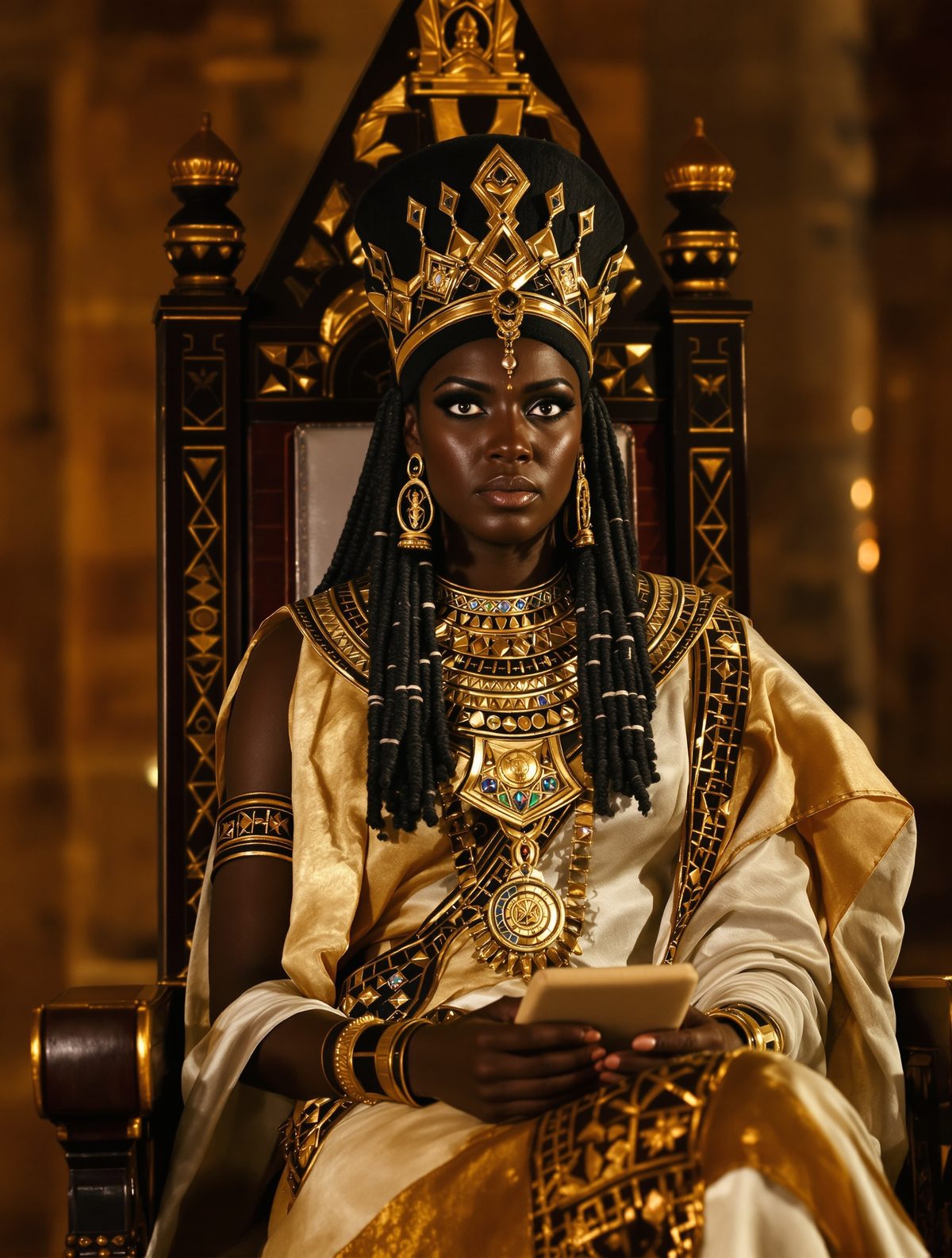
The transformation in Ur-Lugal's fortunes was as dramatic as his patient's restored sight. King Mesannepada, ruler of Ur and one of the most powerful monarchs in early Sumerian history, summoned the barber to court. What had begun as a desperate experiment in a humble shop near the ziggurat was about to become a royal appointment.
But the king didn't just want Ur-Lugal's services—he wanted to understand his methods. In what may have been history's first medical consultation, Ur-Lugal explained his observations about different types of eye conditions, his theories about treatment, and his careful preparation techniques.
The appointment as royal physician came with incredible privileges: a house within the palace complex, access to the finest materials and instruments, and most importantly, the protection and patronage to continue his experimental work. Ur-Lugal went from charging copper pieces for beard trims to receiving gold and silver for medical consultations.
Perhaps most remarkably, cuneiform tablets from this period suggest that Ur-Lugal began teaching his techniques to other practitioners, establishing what may have been the world's first informal medical school. These early physician-students would spread throughout Mesopotamia, carrying with them the knowledge that blindness wasn't always permanent, that careful observation could lead to breakthrough treatments.
The Ripple Effects of One Bold Moment
Ur-Lugal's successful surgery didn't just restore one man's sight—it fundamentally changed how ancient peoples thought about medicine and disability. Before this moment, most ailments were attributed entirely to divine displeasure or supernatural forces. While spiritual explanations remained important, Ur-Lugal's success proved that human skill and understanding could sometimes provide solutions where prayers and offerings had failed.
Archaeological evidence suggests that eye surgery became increasingly sophisticated in Mesopotamian civilizations over the following centuries. Bronze surgical instruments discovered in excavations show remarkable refinement, with some needles so precisely crafted they rival modern surgical tools in their sharpness and durability.
The techniques Ur-Lugal pioneered spread throughout the ancient world. Similar procedures appeared in ancient Egypt, India, and eventually Greece, where physicians like Hippocrates would build upon these early foundations to create more systematic medical practices.
What's truly astonishing is how closely Ur-Lugal's intuitive approach paralleled modern surgical principles: careful patient selection, sterile technique (the honey mixture), precise instrumentation, and detailed post-operative care. He had stumbled upon—or perhaps reasoned his way toward—practices that wouldn't be fully understood scientifically for another four millennia.
Why This Ancient Surgery Still Matters Today
Every year, modern ophthalmologists perform over 20 million cataract surgeries worldwide, making it one of the most common and successful medical procedures on Earth. When a surgeon today uses an ultrasonic probe to break up a clouded lens, or inserts an artificial lens to restore perfect vision, they're following a path first walked by a Sumerian barber with steady hands and an innovative mind.
But Ur-Lugal's legacy extends far beyond ophthalmology. His story represents the very birth of evidence-based medicine—the revolutionary idea that careful observation, logical thinking, and skilled technique could triumph over seemingly impossible medical challenges. In an age when most people accepted physical limitations as inevitable, he dared to ask, "What if this could be fixed?"
Perhaps most importantly, Ur-Lugal's journey from humble barber to royal physician reminds us that breakthrough innovations often come from unexpected places. The person who changes the world might not be the one with the highest status or the most formal education—sometimes, it's simply the one willing to look at an old problem with fresh eyes, armed with nothing more than curiosity, courage, and a very steady hand.