
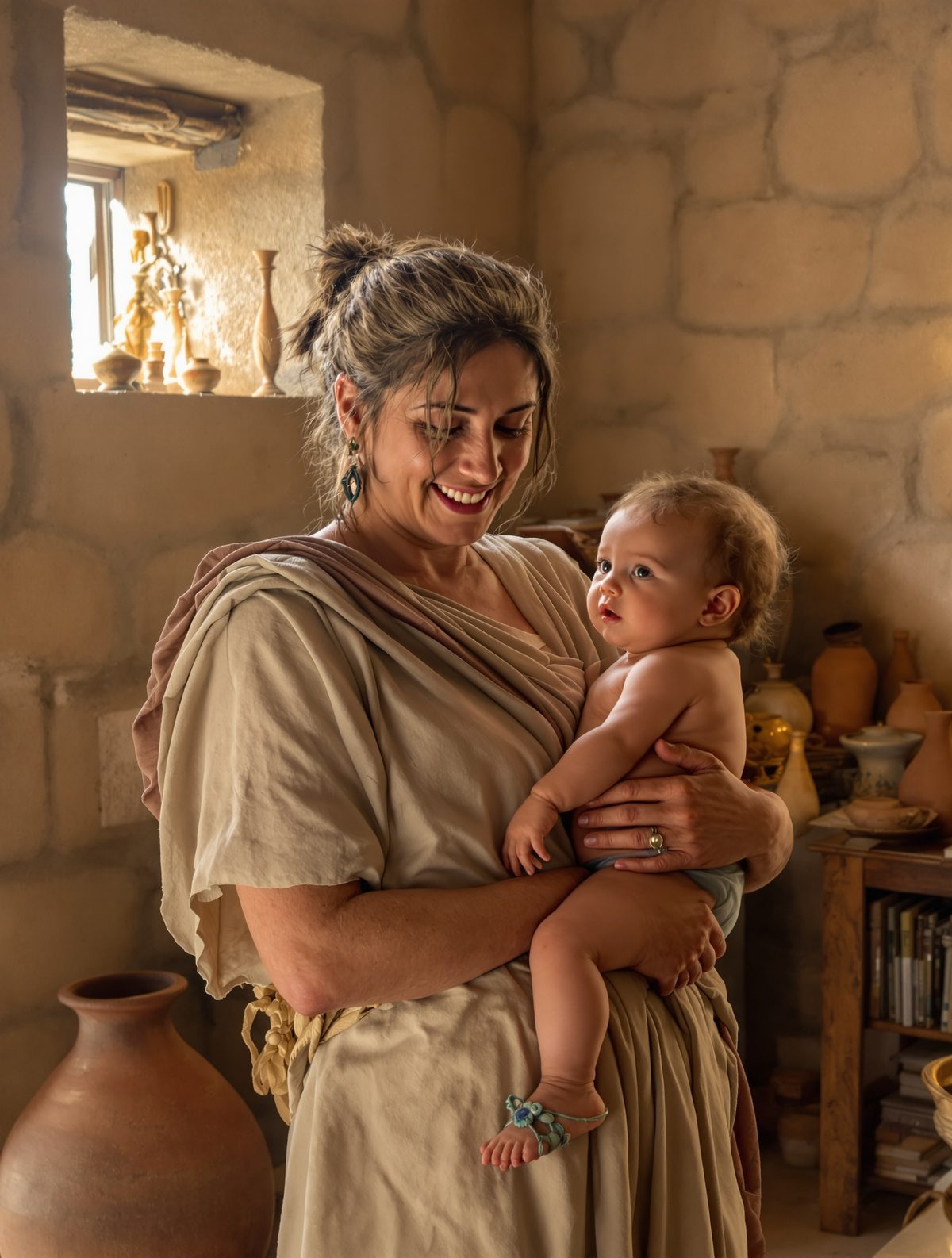
In the shadowed corridors of the imperial palaces on Rome's Palatine Hill, where marble statues of gods gazed down with cold eyes and the scent of incense mingled with whispered conspiracies, one woman held the future of the world's greatest empire in her arms. Not once, but three times. Her name was Antonia, and though history barely remembers her, she nursed, raised, and shaped three infants who would grow up to command legions, build monuments, and rule over sixty million souls. Each would become emperor. Each would change the course of Roman history. And each owed their very survival to a slave woman whose story has been lost to time.
What makes Antonia's tale even more remarkable is that she wasn't just changing diapers and singing lullabies—she was literally keeping the imperial bloodline alive. In an age when infant mortality claimed one in three Roman children, and palace intrigue made imperial babies particularly vulnerable targets, this forgotten woman became the thread that held the Julio-Claudian dynasty together.
The Sickly Prince Who Would Become a Monster
It was sometime around 15 AD when Antonia first encountered her destiny in the form of a desperately ill three-year-old boy. Gaius Julius Caesar Augustus Germanicus—who would later earn the nickname Caligula, meaning "little boots," from the miniature soldier's sandals he wore around military camps—was dying.
The child had accompanied his parents, the beloved general Germanicus and Agrippina the Elder, on campaign along the Rhine frontier. But the harsh Germanic winters and constant travel had taken their toll on the boy's fragile constitution. When the family returned to Rome, young Gaius was wracked with fever and wasting away before their eyes. The imperial physicians, with their bloodletting and exotic potions, had failed. It was then that someone—history doesn't record who—suggested bringing in Antonia.
Wet nurses in ancient Rome were far more than mere feeding assistants. They were considered to have an almost mystical connection to the children they nursed, believed to pass along not just nourishment but character traits through their milk. The Romans took this so seriously that they carefully screened wet nurses for moral character, physical health, and even astrological compatibility.
Antonia worked what the imperial family surely saw as a miracle. Through some combination of devoted care, superior nutrition, and perhaps simple maternal warmth that the formal imperial household lacked, she brought the dying child back from the brink. The future emperor who would declare war on Neptune and make his horse a consul owed his very existence to this slave woman's tender ministrations.
But Antonia's influence on Caligula went far beyond saving his life. Roman wet nurses typically stayed with their charges for years, essentially becoming second mothers. She would have been the one to comfort him through nightmares, teach him his first words, and provide the emotional foundation that would—for better or worse—shape his personality. Given Caligula's later notorious instability, one can't help but wonder what traumas from his early childhood might have been soothed by Antonia's presence, and what demons might have emerged without her stabilizing influence.
The Stammering Scholar's Unlikely Protector
If saving Caligula was remarkable, Antonia's next charge presented an even greater challenge. Born in 10 BC with what appeared to be cerebral palsy or another neurological condition, Tiberius Claudius Caesar Augustus Germanicus seemed destined for obscurity at best, elimination at worst. The future Emperor Claudius stammered, drooled, walked with a limp, and had an uncontrollable head twitch that made him the embarrassment of the imperial family.
In a culture that prized physical perfection and saw disability as a potential mark of divine disfavor, Claudius was hidden away from public view. His own mother, Antonia the Younger (confusingly sharing a name with our wet nurse, though being an entirely different person of much higher status), reportedly called him "a monster of a man, not finished but merely begun by Nature."
But our Antonia—the slave, not the aristocrat—saw something different in the awkward, stumbling child. While the imperial family focused on his disabilities, she nurtured the brilliant mind trapped within that uncooperative body. Roman wet nurses were often responsible for their charges' early education, and it may well have been Antonia who first recognized and cultivated Claudius's exceptional intelligence.
The results were extraordinary. Claudius would grow up to become one of Rome's most scholarly emperors, a prolific author who wrote histories of the Etruscans and Carthaginians, expanded the empire to include Britain, and proved that the stammering, twitching boy everyone had written off possessed one of the sharpest minds of his generation. When he unexpectedly became emperor in 41 AD after Caligula's assassination, those who had dismissed him discovered they had underestimated him entirely.
How much of Claudius's intellectual development can be attributed to Antonia's early influence? Roman sources suggest she was one of the few people in the imperial household who treated him with genuine affection and respect during his vulnerable childhood years.
The Final Emperor: Beauty Hiding Future Horror
Antonia's third and final imperial charge arrived in 37 AD, the same year that her first ward, Caligula, became emperor. Lucius Domitius Ahenobarbus—later known to history as Nero—was born into a family tree so twisted with political marriages, murders, and betrayals that it read like a Greek tragedy.
Unlike the sickly Caligula or disabled Claudius, Nero was a beautiful, healthy child with golden curls and bright eyes. Roman historians describe him as charming and precocious, showing early promise in music and poetry that delighted the cultured Roman elite. But beneath this appealing exterior lurked genetic and environmental time bombs that would eventually explode into tyranny, matricide, and madness.
Nero's father, Gnaeus Domitius Ahenobarbus, was reportedly a violent man who once gouged out a knight's eye in the Forum and deliberately ran over a child with his chariot on the Appian Way. When congratulated on Nero's birth, he supposedly replied that any child born to him and Agrippina the Younger would be "detestable and a public disaster." His mother, that same Agrippina, was ruthlessly ambitious and would later poison her husband Emperor Claudius to secure Nero's path to the throne.
Into this toxic family dynamic stepped Antonia, once again providing what may have been the only source of unconditional love and stability in an imperial child's early years. For a woman who had already raised two future emperors, caring for a third must have felt both familiar and ominous. Did she recognize the warning signs? Could she sense the darkness that would eventually consume the golden-haired boy who giggled in her arms?
The Invisible Hand That Shaped an Empire
What makes Antonia's story so fascinating—and frustrating—is how completely it has been erased from the historical record. We know the names of countless Roman generals, senators, and courtiers whose impact on history was arguably far less significant than hers. We have detailed accounts of gladiatorial games, military campaigns, and political intrigues. But the woman who quite literally kept the imperial dynasty alive remains a phantom, mentioned only in passing references that require careful detective work to piece together.
This erasure reflects the brutal realities of Roman slavery and gender dynamics. Slaves, no matter how crucial their roles, were considered property rather than people worthy of historical commemoration. Women, even free women, rarely earned detailed biographical treatment unless they were connected to powerful men or committed spectacular crimes. A slave woman, no matter how influential, was doubly invisible to ancient historians.
Yet Antonia's influence rippled through decades of Roman history. When Caligula declared himself a god and terrorized the Senate, some of his capacity for survival in those early, vulnerable years came from her care. When Claudius conquered Britain and built aqueducts that supplied Rome with fresh water for centuries, the intellectual foundation for those achievements may have been laid during quiet hours with a slave woman who saw potential where others saw only disability. When Nero burned Christians as torches and allegedly played his lyre while Rome burned, the man capable of such horrors had once been soothed to sleep by Antonia's lullabies.
The Price of Invisible Labor
Perhaps the most sobering aspect of Antonia's story is how it illuminates the countless women whose labor—emotional, physical, and intellectual—has been essential to history while remaining unrecognized. In boardrooms and classrooms, behind famous men and powerful families, the pattern continues. How many pivotal moments in history have turned on the care, wisdom, and dedication of people whose names we will never know?
Antonia didn't just feed and clean three future emperors—she provided the emotional scaffolding that allowed them to survive childhood and develop into the complex, flawed, occasionally brilliant men who would rule the ancient world's greatest empire. Her story reminds us that history is shaped not just by the famous figures we study in textbooks, but by the invisible army of caregivers, supporters, and nurturers who make those famous lives possible.
In our modern world, as we finally begin to recognize the value of care work and emotional labor, Antonia's forgotten legacy takes on new relevance. The next time you read about Julius Caesar or Augustus, remember that behind every powerful person—then and now—stands someone whose love, sacrifice, and dedication made that power possible. They may not have their names carved in marble or their deeds celebrated in epic poems, but they are the true foundation upon which civilizations rise and fall.
Somewhere in the afterlife, perhaps Antonia looks down on the history books that remember her charges as monsters and madmen, heroes and villains, and smiles with the quiet satisfaction of someone who knew them when they were just children who needed comfort in the dark.